Bitcoin Current Cycle Breaks Pattern As LTH-To-STH Supply Transfer Fails To Materialize

bitcoinist发布于2026-03-16更新于2026-03-16

文章摘要

Bitcoin's current market cycle is breaking historical patterns as the typical large-scale supply transfer from Long-Term Holders (LTHs) to Short-Term Holders (STHs) has not materialized. Despite the price rebounding above $73,000, on-chain data shows LTHs still control about 79% of the supply, unlike previous cycles where their dominance decreased significantly during bull markets. Analyst Darkfost notes that supply shifts occurred in six waves, with sufficient liquidity allowing LTHs to find counterparties without drastic selling pressure. Additionally, increased speculation and institutional inflows via ETFs and Digital Asset Treasuries are reshaping market dynamics, indicating stronger long-term confidence and a structural shift in Bitcoin’s holder composition.

The cryptocurrency market is turning bullish again, and Bitcoin has experienced a bounce, triggering optimism among investors. While Bitcoin’s price is holding firm above the $73,000 mark, its market dynamics are undergoing a major shift that could shape the flagship asset’s direction in the short term.

A Key Change In Bitcoin’s Market Structure?

Bitcoin’s price is showing bullish strength once again, recovering above the $73,000 level during the weekend. However, on-chain market data reveals that the way supply is shifting between long-term BTC holders (LTHs) and short-term BTC holders (STHs) throughout the current cycle is clearly changing.

Darkfost, in a post on X, highlighted that this transfer of supply between the two groups has not occurred in the ongoing cycle the same way it did in previous cycles. As prices rise, long-term investors have historically transferred their holdings to more recent market players during significant bull market periods.

This trend suggests a major reset in the initial market structure of Bitcoin, where supply is equally controlled by short-term and long-term holders. Moving on, the expert stated that the first key thing to remember in the current cycle is that long-term holders still hold the majority of the BTC supply.
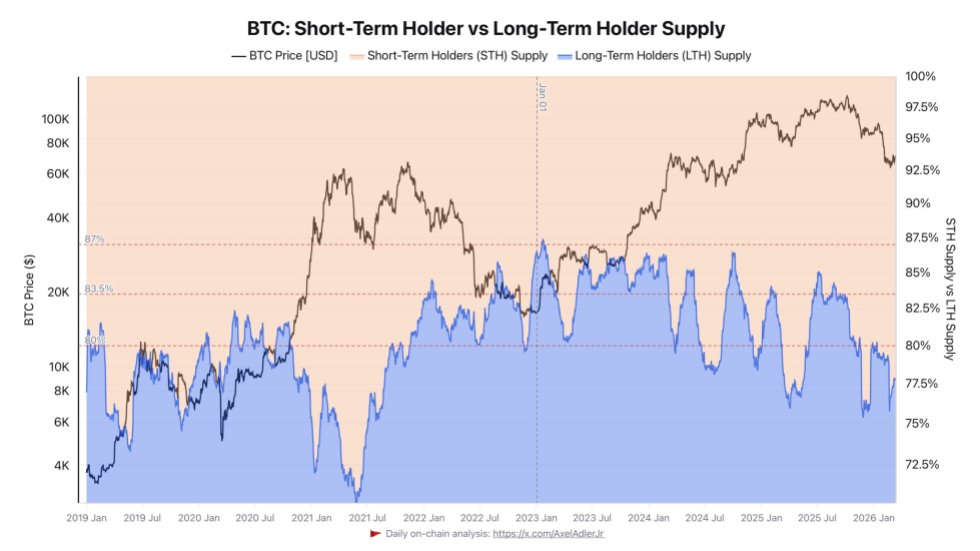
A shift in supply transfer between Bitcoin STHs and LTHs | Source: Chart from Darkfost on X

Rather than witnessing a rapid decline in LTH-held supply as Bitcoin nears the conclusion of its cycle, this time the process took a different turn. As of Sunday, these key investors represent roughly 79% of the total BTC supply.

The development is similar to that of the 2021 cycle, where the share of supply held by long-term holders fell from 82% to 70% in a space of 6 months. A major trigger is the insufficient liquidity from short-term holders to absorb the selling pressure from long-term investors.

The Movement Of BTC In 6 Separate Waves

During the current cycle, Darkfost reports that this transfer occurred in 6 waves. Meanwhile, STHs were observed swooping in to absorb the supply at every stage. These investors eventually turned into LTHs over time. After examining the coin movement within the 6 waves, Darkfost has underscored two major observations.

One is that liquidity appears to have been substantial during this cycle, and this allowed LTHs to steadily discover counterparties while Bitcoin’s price action extends. Secondly, speculation seems to have been stronger than before, with some short-term holders offloading their stash shortly after holding their BTC for more than 6 months in order to quickly realize profits.

Another key development observed in the market is the arrival of new participants via the Exchange-Traded Funds (ETFs) and Digital Asset Treasuries (DATs). Such a trend points to renewed capital and demand for the flagship asset from institutional investors who are confident about its long-term prospects. According to Darkfost, all of these factors are adding to a changing market structure for Bitcoin.

At the time of trading, Bitcoin’s price was trading at $73,815, following a more than 3% bounce over the last 24 hours. Its trading volume has followed suit, spiking by over 77% within the past day.

BTC trading at $73,807 on the 1D chart | Source: BTCUSDT on Tradingview.com

热门币种推荐

相关问答

QWhat is the main difference in Bitcoin's supply transfer pattern between long-term holders (LTHs) and short-term holders (STHs) in the current cycle compared to previous cycles?

AIn the current cycle, the transfer of supply from long-term holders to short-term holders has not occurred in the same way as in previous cycles. Long-term holders still hold the majority of the supply (roughly 79%), and the process has been more gradual, occurring in 6 distinct waves, rather than a rapid decline in LTH-held supply.

QWhat percentage of the total Bitcoin supply do long-term holders (LTHs) currently control, according to the article?

AAs of the time of the article, long-term holders (LTHs) represent roughly 79% of the total Bitcoin supply.

QWhat are the two major observations made by Darkfost after examining the coin movement within the 6 waves of supply transfer?

AThe two major observations are: 1) Liquidity has been substantial, allowing LTHs to steadily find counterparties as Bitcoin's price extends. 2) Speculation has been stronger, with some STHs selling their BTC shortly after holding for more than 6 months to realize profits quickly.

QWhat new participants are cited as a key development contributing to Bitcoin's changing market structure?

AThe arrival of new participants via Exchange-Traded Funds (ETFs) and Digital Asset Treasuries (DATs) is a key development, pointing to renewed capital and demand from institutional investors confident in Bitcoin's long-term prospects.

QWhat was Bitcoin's price and 24-hour performance at the time the article was written?

AAt the time of writing, Bitcoin's price was $73,815, following a more than 3% bounce over the last 24 hours.

你可能也喜欢

通过掷骰子离线保管比特币密钥:并非人人愿意为之

文章探讨了通过投掷骰子生成比特币钱包种子短语的安全方法及其现实挑战。核心观点如下: **1. 骰子提供物理熵源** 骰子结果由众多微小变量决定,理论上虽可预测,但实践中无法被攻击者复制或计算,从而提供高质量的随机性。每个六面骰子投掷约产生2.585比特熵,50次投掷即可满足典型12词助记词(128比特熵)的安全需求。 **2. Coldcard漏洞事件凸显手工熵源的价值** 近期Coldcard硬件钱包因固件漏洞导致其内部随机数生成器存在缺陷,致使约1128枚比特币被盗。但那些**完全**通过足量骰子投掷生成种子短语的用户未受此漏洞影响,因为他们的主密钥未使用有缺陷的生成器。 **3. 重要警示:手工种子并非万能保护** 安全研究员指出,即使用户使用骰子生成了安全的种子,若他们使用了Coldcard的其他功能(如生成纸钱包、克隆密钥、共享签名密钥、密码等),这些**衍生密钥**仍可能调用有漏洞的随机数生成器,从而存在风险。安全种子不保证设备生成的所有秘密都安全。 **4. 手工生成熵源的现实局限性** 尽管数学上可靠,但该方法对大多数用户并不友好: * **过程繁琐易错**:需投掷50-99次,精确记录,任何输入错误都会导致钱包完全不同。 * **引入新风险**:用户可能在记录、转换过程中泄露信息,或使用有偏的骰子/投掷方式。 * **用户体验差**:难以想象大规模推广需要用户手动投掷近百次骰子。安全措施需适应现实生活场景和普通用户的知识水平。 **5. 给用户的建议** 受影响的Coldcard用户应: * 更新固件至最新版。 * 检查是否使用过有漏洞的功能生成了次级密钥或密码,如有则需立即更换。 * 考虑采用多签方案,使用不同厂商的设备分散风险。 **结论**:手工投掷骰子生成熵源是技术娴熟用户的一个有效安全选项,但其过程复杂、容易出错,不适合作为主流用户的默认方法。长远目标是依赖安全、透明且无需专业知识的硬件/软件随机数生成方案。

cryptonews.ru1小时前

通过掷骰子离线保管比特币密钥:并非人人愿意为之

cryptonews.ru1小时前

交易

现货

热门文章

加密市场宏观研报:《GENIUS Act》法案取得重大进展,BTC突破历史新高,后市全新展望

2025年5月22日,比特币价格正式突破11万美元大关,创下历史新高。在政策面、宏观经济、资金面与投资者结构共同作用下,一场结构性牛市浪潮正在展开。而此轮上涨背后的核心驱动,是美国《GENIUS稳定币法案》的实质性进展以及多项利好的叠加。本文将从政策端突破、宏观环境转向、链上与ETF资金结构、交易行为演化,以及重点受益赛道五大维度,全面解析此轮BTC再创新高的深层逻辑,并前瞻下半年市场的潜在趋势。

1.8k人学过发布于 2025.05.22更新于 2025.05.22

加密市场宏观研报:《GENIUS Act》法案取得重大进展,BTC突破历史新高,后市全新展望

相关讨论

欢迎来到HTX社区。在这里,您可以了解最新的平台发展动态并获得专业的市场意见。以下是用户对BTC(BTC)币价的意见。

活动图片