Original | Odaily Planet Daily (@OdailyChina)
Author | DingDang (@XiaMiPP)
Amidst the current intense market volatility and the rapid creation and subsequent abandonment of Chinese Memes, if there's one narrative still worth our sustained attention, privacy is undoubtedly among them.
From the surge of Zcash in 2025 to Monero breaking its 8-year high in 2026. The performance of privacy-related assets is no longer just a brief emotional resurgence but is being repositioned within the long-term proposition of crypto infrastructure.
In their recently published article "Privacy trends for 2026" at the beginning of the year, a16z re-examined the role of privacy in the next stage of crypto technology evolution from multiple perspectives including decentralized communication, data access control, and security engineering methodologies(Recommended reading "Zcash is Just the Beginning, How a16z Redefines the Privacy Narrative for 2026?").
In this context, privacy is no longer just a tool for "resisting regulation" but a fundamental infrastructural capability supporting the sustainable operation of crypto systems. This issue of Odaily Planet Daily systematically reviews multiple privacy-related assets; let's take a look at which projects are truly gaining market favor recently?
Monero(#15): The Return of Privacy Fundamentalism After 8 Years
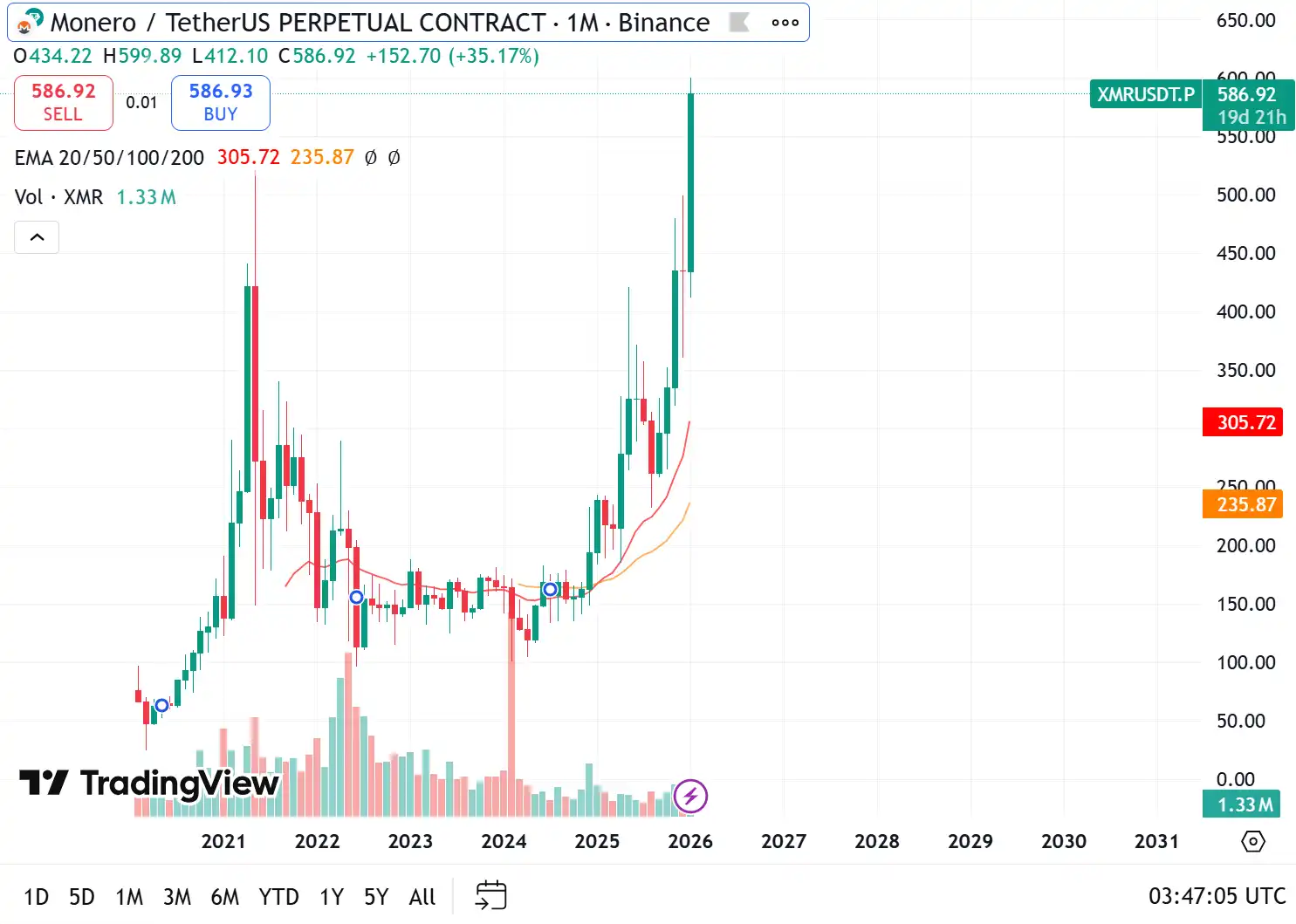
On January 13th, Monero (XMR) price broke through $650. Its rise since the beginning of 2024 has exceeded 500%. But more symbolic than the increase is that this is XMR's first effective breakthrough of the historical high from the 2017 bull cycle, after a gap of 8 years.
In the cryptocurrency world, Monero is perhaps one of the most thorough and tenacious existences regarding privacy attributes. From its birth in 2014 to the present, it has consistently adhered to "default privacy, mandatory privacy, untraceability" as its core design philosophy.
In specific implementation, Monero systematically erases on-chain analyzability through multi-layered cryptographic mechanisms. Ring Signatures are used to hide the identity of the transaction sender: the real input is mixed with multiple historical "decoy" outputs from the blockchain into a "ring", external observers can only determine that "someone in the ring is spending funds" but cannot determine who it is; Stealth Addresses automatically generate a one-time receiving address for each transaction, only the recipient can identify this income through the view key, thus severing the permanent association between the recipient and the public address; and Ring Confidential Transactions (RingCT) further hide the transaction amount, using Pedersen Commitments and Bulletproofs++ range proof technology to ensure the amount remains invisible while still allowing the network to verify that no coins are created out of thin air or double-spent.
After these mechanisms are stacked, the sender, receiver, and amount of all transactions are hidden by default, the entire chain has no traceable transparent records, thereby providing extremely high anonymity and fungibility, far exceeding that of coins with optional privacy.
But as the saying goes, "怀璧其罪" (To be innocent yet possess a treasure is itself a crime), this extreme design has also made Monero one of the least friendly existences from a regulatory perspective. Under continuous compliance pressure, by 2024, mainstream exchanges like Binance and OKX successively delisted all XMR spot trading pairs, retaining only contract trading.
Zcash(#28): A Severe Governance Shock
The biggest contributor to this round of privacy resurgence is Zcash. Related reading: Privacy Coin Revival: From Binance Delisting Candidate to a 13x Surge, ZEC's Lightning Rebirth.
However, on January 8th, Josh Swihart, CEO of the Zcash (ZEC) development team Electric Coin Company (ECC), posted an article stating that the majority of the Bootstrap board members (the non-profit organization behind ECC, which supports Zcash by managing ECC), particularly Zaki Manian, Christina Garman, Alan Fairless, and Michelle Lai (referred to as the ZCAM group), had significantly deviated from Zcash's mission. Under the ZCAM group's decision of constructive dismissal, the entire ECC team chose to resign. It should be added that since 2020, after the majority of shareholders chose to donate their shares, ECC had gradually transitioned to a non-profit structure, with Bootstrap taking over governance functions. After the news was announced, ZEC once fell below $362, a drop of over 40%.
Bootstrap subsequently issued a clarification statement, saying the dispute stemmed from legal restrictions encountered while seeking external investment, and discussions have now begun on "alternative structures for external investment and the privatization of Zashi", working with legal counsel to ensure all paths comply with US non-profit organization laws, without deviating from Zcash's long-term mission or harming the broader community's interests.
However, this statement did not immediately reverse market sentiment.
Nevertheless, the Zcash Foundation also posted, stating that Zcash has always been a decentralized open-source protocol, and no single contributor, team, or organization can control Zcash.
From its initial design, Zcash made "resilience" one of its core goals. Its codebase is completely open source, consensus rules are maintained by independent nodes globally, and ecosystem development is supported by diverse organizations and contributors. As a protocol guardian, the Zcash Foundation's mission includes: maintaining protocol security, funding independent research and engineering practices, promoting decentralized governance, and advocating for privacy as a fundamental human right.
Humanity(#215): Not a Privacy Coin, Reconstructing "Private Identity"
Unlike the aforementioned projects, Humanity Protocol (H) does not focus on "financial privacy" but attempts to reconstruct the balance between privacy and trust at the digital identity level.
Humanity uses palm print biometrics combined with zero-knowledge proofs to verify that a user is a real human without leaking any personal data, aiming to build a decentralized trust layer resistant to Sybil attacks. The project was launched in 2023, and the token H went live in June 2025.
In terms of application, Humanity has announced a partnership with Mastercard to combine its open financial connectivity with the Human ID identity system, enabling users to access real-world financial services like credit and loans without exposing their privacy.
In July 2025, Nasdaq-listed company Prenetics announced the inclusion of H tokens in its crypto asset treasury. The company had previously purchased 187 BTC for $20 million, being the first healthcare company to configure a Bitcoin treasury. Perhaps also because of this, coupled with actions on the funding side, the H token price once rose from $0.026 to $0.4, a maximum increase of 14 times, then fell back and experienced a full round of turnover, currently recovering to around $0.17.
Compared to other privacy projects, Humanity is still in an earlier stage. But the "private identity" direction it切入 provides another way to open up the privacy narrative.
Railgun(#331): DeFi's "Private Wallet Layer"
Railgun is a decentralized privacy protocol based on zero-knowledge proofs, operating on Ethereum and multiple EVM-compatible chains. Its core goal is not simple anonymous transfers but to provide DeFi users with composable private interaction capabilities.
Unlike mixers like Tornado Cash, Railgun is more like a "private wallet layer". Users can directly build private balances within the protocol and then interact privately with any EVM smart contract. The entire process is non-custodial, open-source, and requires no trust in a third party. It allows users to completely hide wallet addresses, transaction amounts, and strategy details when performing operations like trading, lending, providing liquidity, or mining, without sacrificing the decentralized nature of DeFi.
The project was launched in 2021. After Tornado Cash was sanctioned, Railgun introduced a "Proof of Innocence" mechanism in 2024 to reduce the risk of being misjudged as an illegal tool, while gradually expanding to Layer2 to reduce usage costs.
Ethereum co-founder Vitalik Buterin is an early supporter of Railgun and has used the protocol multiple times for donations to avoid on-chain tracing.
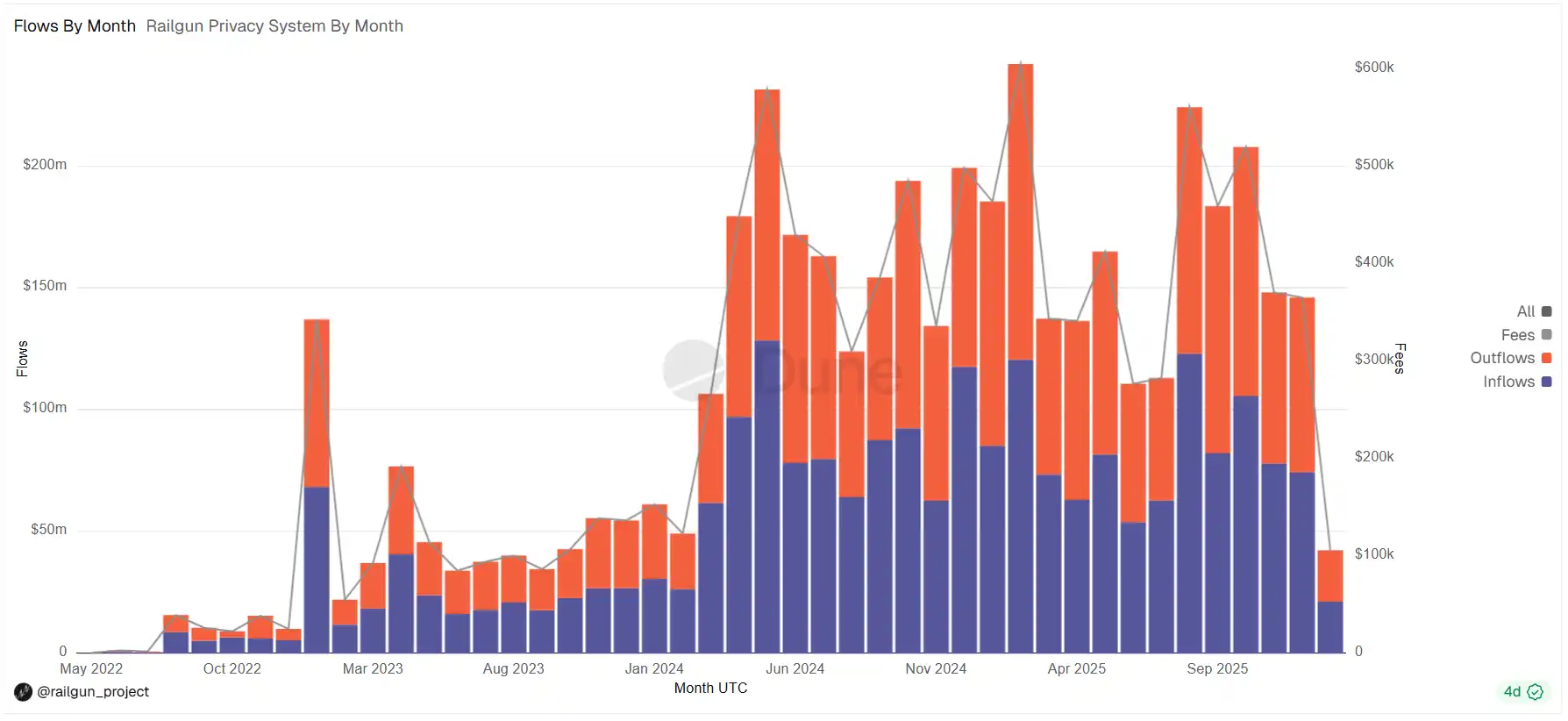
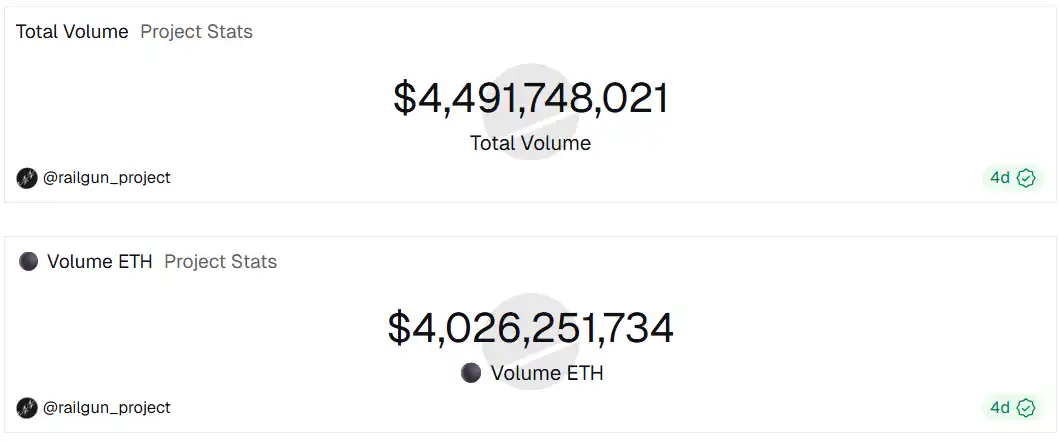
Dune data shows that since 2022, Railgun's fund usage has remained active, especially after Ethereum Gas costs significantly decreased in 2024, activity noticeably increased. To date, the cumulative transaction volume has reached $4.49 billion, of which ETH accounts for approximately $4.03 billion.
Pirate Chain(#488): Taking "Privacy" as the Only Prerequisite, Making No Compromises
Pirate Chain (ARRR) is a cryptocurrency project also focused on privacy protection, aiming to provide the most anonymous digital currency. The project started in 2018, inspired by Zcash's zk-SNARKs technology. However, unlike Zcash's optional privacy, Pirate Chain is 100% mandatory privacy, forming the world's largest organic anonymity set, preventing information leakage through network activity, and supporting fast verification without exposing data. The project has no ICO, no pre-mining, no developer taxes; development and maintenance rely mainly on community contributions. Its core developers have backgrounds spanning multiple ecosystems including Bitcoin, Zcash, Komodo, and Monero; talent is the project's core.
In terms of consensus mechanism, Pirate Chain uses Equihash PoW and introduces Delayed Proof of Work (dPoW) as an additional security layer. dPoW significantly increases the cost of launching a 51% attack by notarizing blocks on an external chain, which is also a common defense mechanism for small-scale PoW networks.
It is worth noting that after Komodo announced its acquisition by Gleec in December 2025, the market might be concerned about Pirate Chain's reliance on Komodo's infrastructure. In response, the project announced on January 7th, 2026, that dPoW has been successfully migrated from the original Komodo to Komodo Classic, the security mechanism has been seamlessly continued, and the network has achieved independent operation.
Tornado Cash(#769): Still Operating After Sanctions
Tornado Cash (TORN) is a mixing protocol running on Ethereum, using zk-SNARKs technology to break the direct link between on-chain transactions. Simply put, it uses a "pool mixing" method to make ETH or ERC-20 tokens lose traceability between deposit and withdrawal.
It was once one of the star projects on Ethereum. But in 2022, the US Treasury Department's OFAC directly listed Tornado Cash's smart contracts on the SDN sanctions list, the first time in history that immutable smart contracts were sanctioned. Subsequently, developer Alexey Pertsev was sentenced in the Netherlands, and Roman Storm and Roman Semenov faced trial in the US. Affected by this, Tornado Cash's governance token TORN was also successively delisted from mainstream exchanges.
A turning point occurred at the end of 2024. The Fifth Circuit Court of Appeals ruled that OFAC overstepped its authority—immutable smart contract code does not constitute "property" and cannot be sanctioned, thus overturning the sanctions decision against the contracts themselves.
But the legal disputes did not end there. In 2025, Storm was partially convicted on charges of "illegally operating a money transmission business", while the jury failed to reach a unanimous verdict on money laundering and sanctions-related charges; related cases may continue in 2026.
It is worth noting that since its launch in 2019, Tornado Cash has operated in the form of a DAO. The protocol is completely open source, the initial developers long ago lost control, and the contracts are immutable once deployed.
According to monitoring by crypto regulatory technology company Bitrace, in 2025, Tornado Cash addresses received a total inflow of 693,412 ETH, with a total value of approximately $2.5 billion; calculated in US dollars, the net inflow for the year was about $1.4 billion, mainly in ETH. This means that even after the sanctions turmoil, among native crypto users, the demand for private Ethereum transfers remains significant.
Dusk Network(#781): Putting Privacy Inside the System, Not Against It
If most of the aforementioned projects choose to keep their distance from regulation, then Dusk Network represents another route within the privacy track—attempting to coexist with compliance frameworks from the protocol level.
Dusk Network (DUSK) was founded in 2018. It is a Layer 1 blockchain protocol focused on privacy protection and compliance, founded by technical experts Jelle Pol and Emanuele Francioni, primarily targeting financial applications and real-world asset (RWA) tokenization. Its mainnet officially launched in early 2025, and its consensus mechanism uses a variant of Proof of Stake (PoS).
Dusk's technical core is not "hiding everything completely" but revolves around "auditable privacy". By combining zero-knowledge proofs (ZK) with homomorphic encryption (HE), Dusk allows transaction information to remain private by default, but enables auditing through selective disclosure under compliance or legal requirements.
Because of this, Dusk has positioned itself as compliant financial infrastructure from the start, explicitly supporting MiCA, MiFID II, and the EU DLT pilot regime. This design means it faces less pressure and has a larger survival space.
From a narrative perspective, Dusk stands on two main lines currently receiving high market attention: privacy + RWA. As traditional financial institutions begin to explore on-chain asset issuance and settlement, "regulator-friendly privacy" should gradually become a real demand.
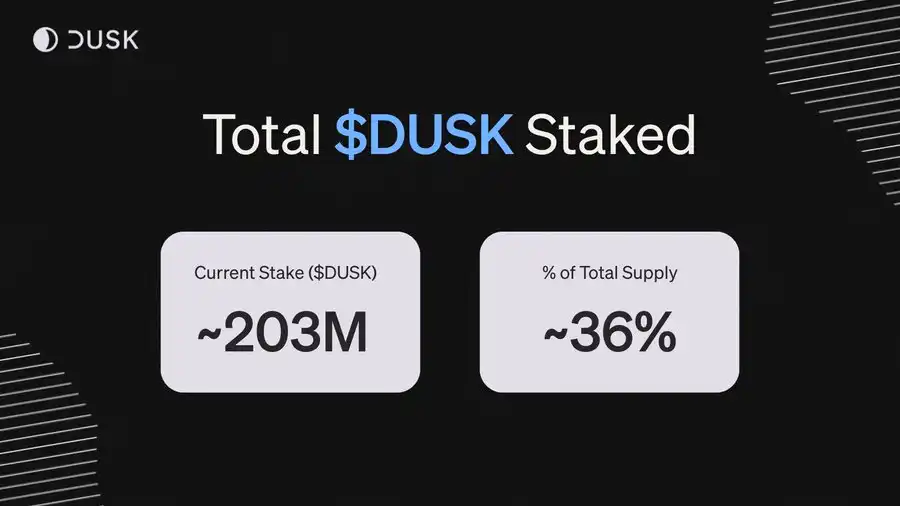
The latest data disclosed by the Dusk Foundation on December 29th shows that over 200 million DUSK is currently staked, accounting for 36% of the supply. This, to some extent, also reflects token holders' recognition of its long-term positioning.