
Quick Facts:
- ➡️ Aave has retired the Avara brand and shuttered the Family Wallet to refocus on its core lending protocol and Lens ecosystem.
- ➡️ The market trend is shifting away from generalist “super-apps” toward specialized platforms that solve specific industry pain points.
- ➡️ SUBBD Token is capitalizing on this shift by using AI and Web3 to disrupt the high-fee structures of the $85B creator economy.
- ➡️ Early data shows strong demand for SUBBD’s model, with over $4.5 million raised during its presale phase.
The ‘crypto super-app’ dream took a hit this week. Aave, one of decentralized finance’s largest lending protocols, announced a strategic retreat from its consumer-facing wallet ambitions.
Stani Kulechov, Aave’s founder, confirmed the organization is retiring the ‘Avara’ parent brand and shutting down the Family Wallet, a product acquired just last year to bridge the gap between DeFi and everyday users.
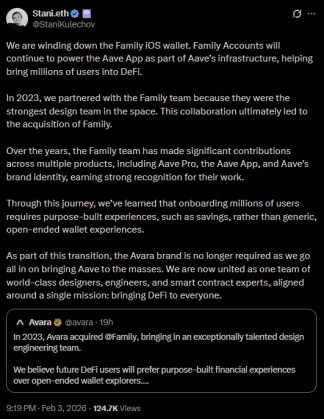
It’s a sharp pivot back to basics. For the past two years, the narrative was all about expansion—building social graphs (Lens Protocol), stablecoins (GHO), and wallets under one massive umbrella. But that era appears over.
The reversal suggests the market frankly no longer rewards broad, open-ended ecosystems that lack immediate stickiness. Instead, liquidity is flowing toward purpose-built protocols that solve specific, high-friction problems rather than general utility.
This restructuring comes as the broader crypto market hunts for the next major narrative beyond simple asset speculation. While infrastructure giants like Aave consolidate to defend their moats, capital is rotating into sectors offering tangible utility for non-crypto natives.
Specifically, the intersection of AI and the creator economy is seeing aggressive growth. It’s within this vacuum of consumer utility that projects like SUBBD Token ($SUBBD) are finding traction, using the exact kind of specialized focus that the ‘Family’ wallet missed.
Buy your $SUBBD here.
AI Tools Replace Generic Interfaces
The failure of the Family Wallet highlights a brutal truth in crypto: users don’t need another place to store private keys; they need a reason to use them.
While Aave retreats to infrastructure, SUBBD Token ($SUBBD) is capitalizing on the $85 billion content creation industry by attacking the inefficiencies of Web2 incumbents. The current landscape for creators is defined by exploitation, platforms routinely extract up to 70% of earnings in fees, while arbitrary bans restrict audience reach.
SUBBD addresses this not by building a generic wallet, but by deploying an EVM-compatible ecosystem designed specifically for creator sovereignty. By merging Web3 payments with proprietary AI models, the platform offers tools that were previously fragmented across a dozen subscriptions.
Features like the AI Personal Assistant allow creators to automate interactions, while AI Voice Cloning and AI Influencer Creation open new revenue streams that don’t require the creator to be physically present 24/7.
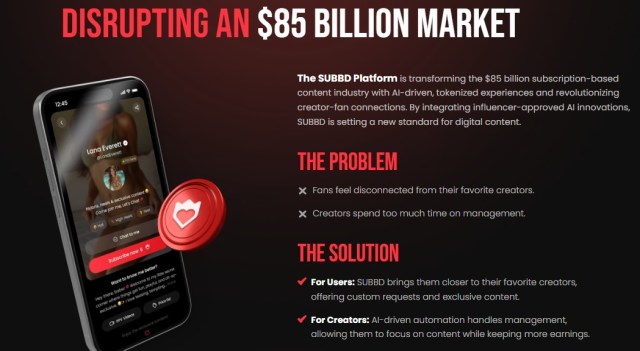
This utility-first approach differs fundamentally from the strategy Aave just abandoned. Where Avara attempted to capture users through a generalist interface, SUBBD captures them through essential service provision. The platform’s decentralized architecture ensures creators maintain ownership of their content and earnings, removing the middleman risk that plagues platforms like OnlyFans or Patreon.
For the market, this represents a shift from ‘crypto as a wallet’ to ‘crypto as a business backend.’
Check out the SUBBD ecosystem.
SUBBD Presale Draws Capital Seeking Utility
The market’s appetite for this specific utility is quantifiable. While legacy DeFi tokens struggle with governance restructuring, SUBBD Token has maintained steady inflows during its presale phase.
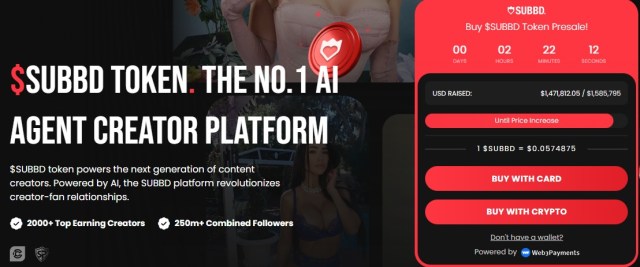
According to current data, the project has successfully raised $1.4M, signaling strong confidence from early adopters who view the convergence of AI and content monetization as the next logical step for retail crypto adoption.
Investors are currently entering at a price point of $0.05749, positioning themselves before the platform’s full public rollout. Beyond the speculative aspect, the protocol’s staking mechanics are designed to encourage long-term ecosystem stability.
The project offers a fixed 20% APY for the first year to participants who lock their tokens. This incentive structure does two things: it reduces circulating supply volatility during the critical early growth phase, and it aligns incentives between the platform’s developers and its community.
Smart money monitors these metrics closely because they suggest a departure from ‘vaporware.’ The token serves a dual purpose: governance rights over platform features, such as voting on AI creator curation, and utility within the ecosystem for tipping, subscriptions, and accessing token-gated content.
As Aave refocuses on the backend of DeFi, projects like SUBBD are building the front-end utility that actually drives mass adoption.
You can buy $SUBBD here.
The content provided in this article is for informational purposes only and does not constitute financial advice. Cryptocurrency investments carry inherent risks, including high volatility and potential loss of capital. Always conduct your own due diligence before investing.

Related Posts

Crypto Market Structure Bill Nears Key Moment As CFTC Chair Signals Progress Within Months

Dubai’s $280M Diamond Tokenization Sets RWA Precedent as Bitcoin Hyper Secures $31.2M

Bitcoin Dominance Shifts: Crypto Usage Spreads Beyond Bitcoin as $HYPER Keeps Gaining

Binance Crushes Competition With $155B Asset Surge; $HYPER Emerging as Bitcoin L2 Leader

Criptomoneda prometedora para invertir ante el cambio de sentimiento: el auge de la infraestructura Bitcoin








