$635M in, $405M out – How the Fed quietly shook the crypto market

ambcrypto发布于2026-03-25更新于2026-03-25

文章摘要

The crypto market slowed last week, with many attributing the decline to Middle East tensions. However, the primary driver was the U.S. Federal Reserve's cautious policy signals. According to CoinShares, digital asset investments saw $230 million in inflows—significantly lower than previous weeks. Notably, $635 million entered just before the Fed meeting, but $405 million exited shortly after, indicating investors are highly sensitive to interest rate expectations. Bitcoin led with $219 million in weekly inflows, though short-Bitcoin products also gained $6 million, reflecting mixed sentiment. Solana remained strong with $17 million inflows over seven weeks, while Ethereum saw $27.5 million in outflows. Chainlink and Hyperliquid attracted $9.1 million combined. Despite price declines—ETH and HYPE fell ~6.7%, BTC dropped ~4%, and SOL dipped only 2%—capital continued flowing in. User activity was highest for Chainlink, while Solana maintained steady social volume. The Altcoin Season Index read 47, below the 75 threshold for a confirmed altcoin season, but sustained inflows suggest a potential buildup toward a broader rally. Institutional behavior showed a "buy the dip" mindset rather than panic selling.

The crypto market slowed down last week. And, while many blamed global tensions in the Middle East, the real reason behind the same might have been the U.S. Federal Reserve.

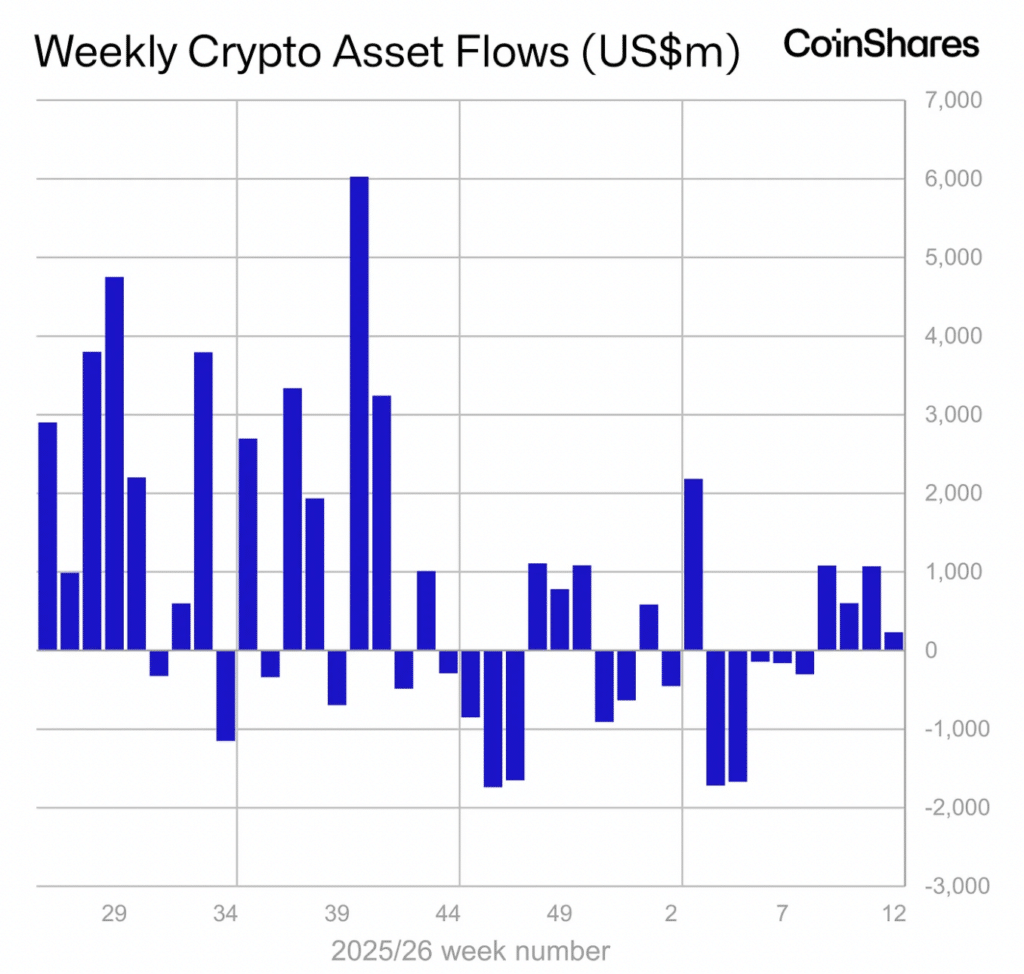
According to a report from CoinShares, digital asset investment products saw $230 million in inflows. However, this figure was much lower than the ones seen in previous weeks.
Source: CoinShares

Looking closer, most of the money came in before the Fed’s meeting, with $635 million added in just two days. After the Fed signaled a more cautious approach, about $405 million quickly left the market.

This suggested that investors may be reacting more to interest rate expectations than global conflicts, adjusting their positions based on future monetary policy.

While total inflows of $230 million hinted at a recovering market, the data showed that investor sentiment is still mixed.

Analysis of different coins and their performance over the past week

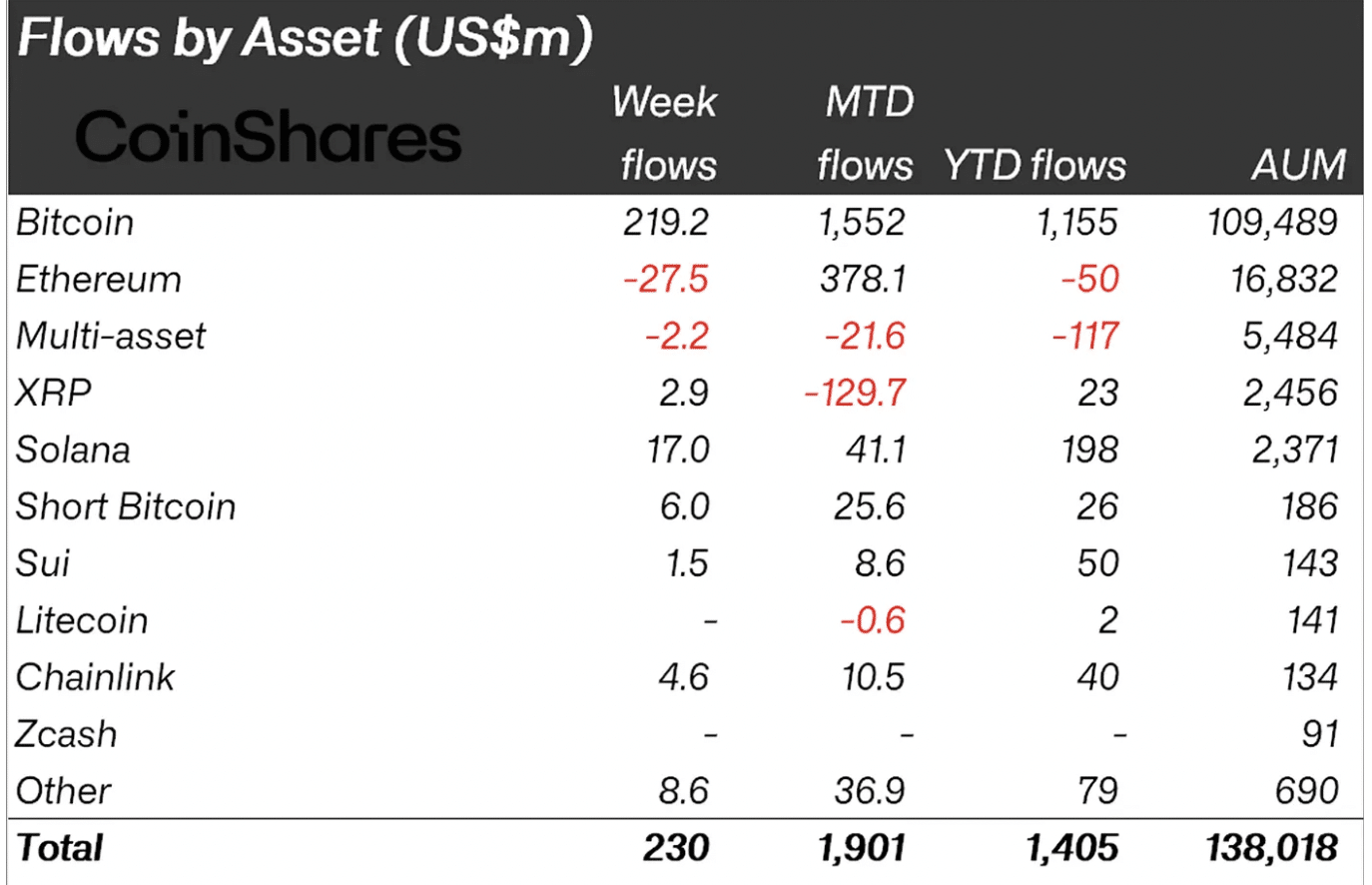
Bitcoin [BTC] is still leading the market, bringing in about $219 million in weekly inflows. However, the overall picture revealed that investors are unsure about what comes next.

Interestingly, short-Bitcoin products also saw $6 million in inflows, which means some investors are betting on a price drop while others are buying the dip.

At the same time, Chainlink [LINK] and Hyperliquid [HYPE] have been gaining attention, bringing in a combined $9.1 million.

Notably, Solana [SOL] has been strong, bringing in $17 million and extending its inflow streak to seven weeks. Ethereum [ETH], however, saw $27.5 million in outflows.
Source: CoinShares

Overall, this suggsted that the investors are being cautious after the recent signals from the FOMC.

Price action and more

These figures come on the back of most cryptocurrencies falling on the charts over the past week. ETH and HYPE were hit the hardest, both falling by around 6.69%.

LINK also dropped by about 5.21% over the past week. BTC performed a bit better, with a smaller decline of 3.97%. Meanwhile, SOL exhibited the most strength, slipping only 2.03% over the same period.

However, even though prices were falling, money was still flowing into the market.

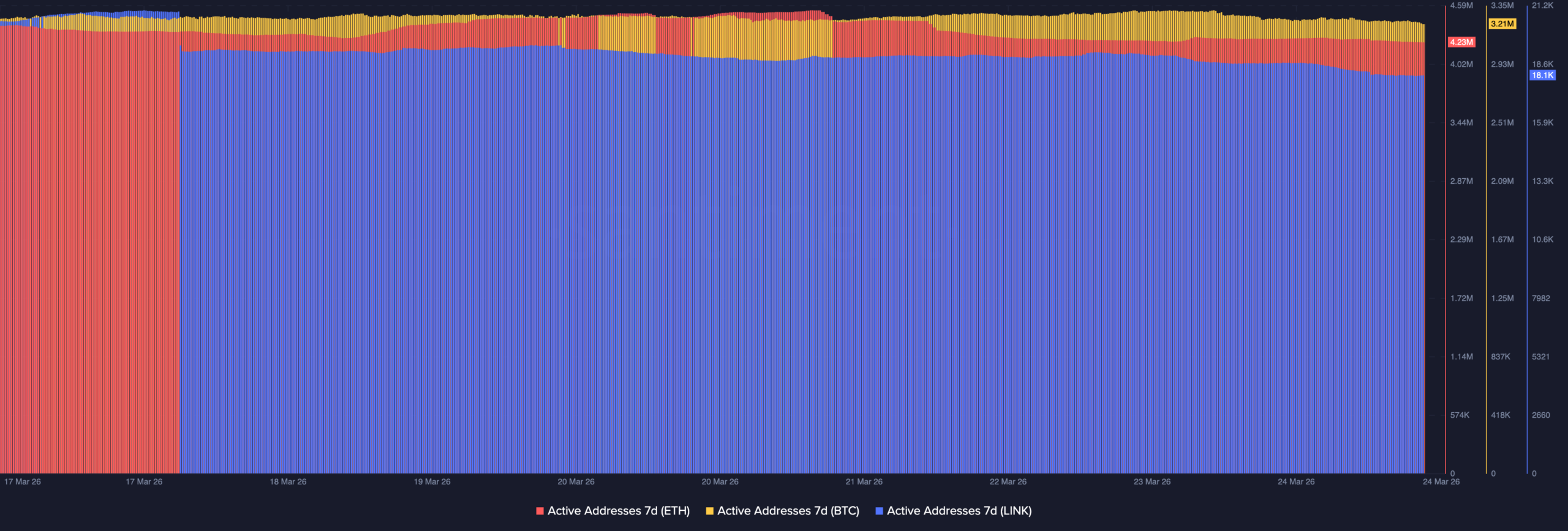
In fact, Santiment’s 7-day active addresses suggested that Chainlink was leading in terms of user activity. All while Ethereum and Bitcoin showed more moderate and stable usage patterns.
Source: Santiment

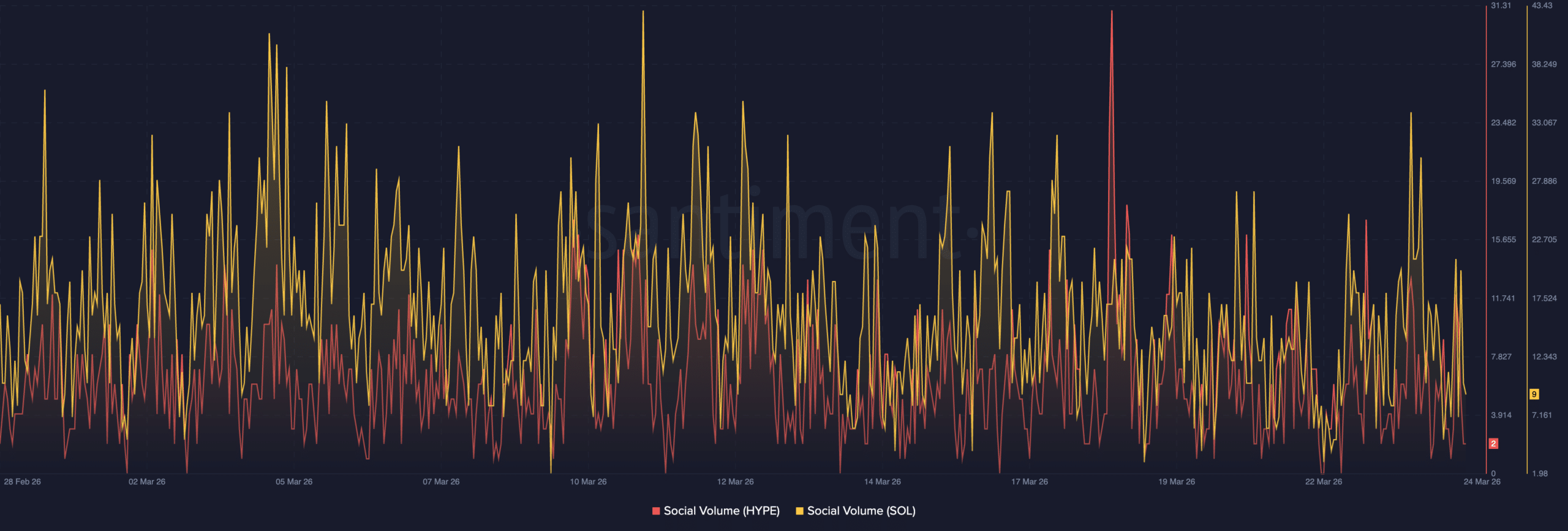
Additionally, the social volume data suggested that Solana has maintained a steady and strong presence in discussions over time.

On the contrary, while Hyperliquid has seen short bursts of attention, it has struggled to sustain any consistent momentum.
Source: Santiment

Is altcoin season around the corner?

All this has also pushed analysts to think that the altcoin season is imminent.

For its part though, the Altcoin Season Index, with a press time reading of 47, needs to reach 75 to confirm a full altcoin season.
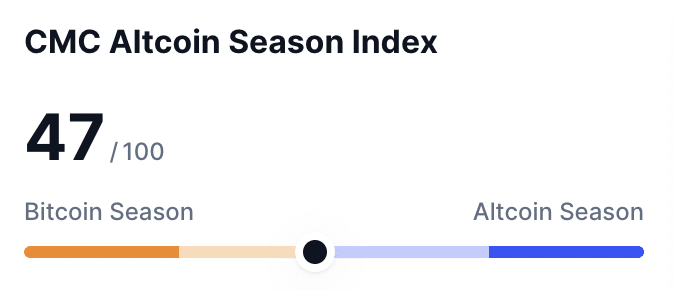
Source: CoinMarketCap

Hence, if inflows from regions like the U.S and Europe continue, this phase could be the final buildup before a broader altcoin rally begins.


Final Summary

  • Institutional behavior hinted at a “buy the dip” mindset, rather than panic selling.
  • Gap between price action and capital inflows alluded to hidden strength beneath short-term market weakness.


相关问答

QWhat was the main reason behind the crypto market slowdown last week, according to the article?

AThe main reason was the U.S. Federal Reserve's cautious approach, as investors reacted more to interest rate expectations than global conflicts.

QHow much money flowed into digital asset investment products before the Fed's meeting, and how much left after?

A$635 million flowed in before the Fed's meeting, and about $405 million left after the Fed signaled a more cautious approach.

QWhich cryptocurrency saw the largest weekly inflows, and how much was it?

ABitcoin [BTC) saw the largest weekly inflows, bringing in about $219 million.

QWhat does the Altcoin Season Index need to reach to confirm a full altcoin season?

AThe Altcoin Season Index needs to reach 75 to confirm a full altcoin season.

QWhat was the overall net inflow for digital asset investment products last week?

AThe overall net inflow for digital asset investment products last week was $230 million.

你可能也喜欢

韩国交易所“大战”监管机构,挑战执法、立法边界

韩国加密行业正与金融监管机构FIU(金融情报分析院)爆发正面冲突。过去FIU通过反洗钱法规对交易所严格处罚,但近期交易所开始通过法律诉讼和行业倡议系统性挑战其监管依据。 首尔行政法院在一审中撤销了FIU对Upbit运营公司Dunamu的部分营业停止处分,认为FIU对违规标准和处罚依据说明不足。法院强调,监管机构实施重罚必须证明交易所在明确规则下存在故意或重大过失。FIU已就此案提出上诉。同样,法院也暂停了FIU对Bithumb的六个月营业停止处分,以避免审理期间造成不可逆的损失。 在立法层面,韩国拟修订《特定金融信息法》,计划将1000万韩元以上加密资产转移一律纳入可疑交易报告范围。行业自律组织DAXA强烈反对,指出该“毒丸条款”可能违反法律保留原则,并将导致STR报告量暴增85倍,淹没真正的高风险信号,反而削弱反洗钱效率。 深层矛盾在于,韩国加密市场活跃但综合监管框架尚未成熟,目前主要依赖FIU的执法。交易所从被动接受转向通过司法和立法程序挑战监管,标志着韩国加密监管进入新阶段,监管规则本身的正当性将受到更严格审视。这场冲突短期内可能升级,但长期或有助于推动韩国建立更成熟、可持续的加密监管体系。

marsbit15分钟前

韩国交易所“大战”监管机构,挑战执法、立法边界

marsbit15分钟前

50倍存储后,孙宇晨永远在看下一个十年

孙宇晨以拍下巴菲特午餐、吃下天价香蕉等出位行为闻名,也面临SEC诉讼等争议,但其投资眼光常被忽略。早在2016年,他就建议年轻人投资比特币、英伟达、特斯拉等。以英伟达为例,若当时投资1万元,至2026年5月价值约240万元。 2025年底,他预言“存储是新的石油”,随后西部数据分拆的闪迪(SNDK)股价一年内大涨近50倍。当市场狂热追逐存储概念时,孙宇晨已将目光投向更具未来感的赛道:具身智能、无人机、空间计算和太空探索。 他认为,具身智能(如人形机器人)正从执行代码转向“看世界做事”,是AI在物理世界落地的关键。无人机已在军事、农业、物流等领域跑通商业闭环。空间计算(如苹果Vision Pro)旨在让AI理解物理空间,是机器人、自动驾驶等的基础。在太空领域,他本人于2025年乘坐蓝色起源飞船完成亚轨道飞行,并看好太空经济与区块链的结合。 他的投资逻辑是:押注确定性的赛道,两端布局,不赌单家公司。例如在机器人领域,既押注特斯拉(身体/制造),也押注英伟达(大脑/AI芯片);在无人机领域,看好其在军事应用中替代传统装备的趋势;在太空领域,关注即将IPO的SpaceX及其产业链。 孙宇晨将这些趋势串联起来,描绘出一幅“物理AI”改变现实世界运行方式的图景:从工厂机器人到自动驾驶,从无人机蜂群到星际探索。他认为,过去互联网改变了信息流动,而未来AI将重塑物理世界本身。

marsbit1小时前

50倍存储后,孙宇晨永远在看下一个十年

marsbit1小时前

史上最昂贵中期选举背后的亿万富翁们

彭博社分析指出,2026年美国中期选举已成为史上最昂贵的一选战,联邦政治委员会已募集超47亿美元,预计政治广告支出将达108亿美元。亿万富豪成为关键资金力量,其捐款不仅争夺国会控制权,也直接影响与自身利益密切相关的政策走向,如财富税、加密货币与人工智能监管等。 目前巨额资金多流向共和党阵营。顶级个人捐赠者包括:乔治·索罗斯(1.026亿美元)主要支持进步主义事业;埃隆·马斯克(8480万美元)大力支持特朗普阵营及共和党竞选委员会;Jeff Yass(8180万美元)是特朗普MAGA Inc.的最大金主之一,关注择校权等议题;OpenAI联合创始人Greg Brockman夫妇(5000万美元)支持特朗普及人工智能议题。 其他重要捐赠者有:Richard Uihlein(4530万美元)资助保守派议程;风投家Marc Andreessen(4470万美元)和Ben Horowitz(4440万美元)聚焦加密货币与人工智能政策;Miriam Adelson(4260万美元)长期支持特朗普及亲以色列政策;对冲基金大佬Paul Singer(3392万美元)转向支持特朗普对以强硬立场;建材巨头Diane Hendricks(2579万美元)亦是特朗普的坚定支持者。 匿名政治捐款的占比持续攀升。随着11月选举日临近,预计将有更多富豪加入顶级捐赠者行列。这场选举的结果将深刻影响美国未来两年的政策方向。

marsbit1小时前

史上最昂贵中期选举背后的亿万富翁们

marsbit1小时前

交易

现货
合约
活动图片




