Author: Zen, PANews
"Circle focuses on long-term development and believes the stock price will eventually provide the answer."
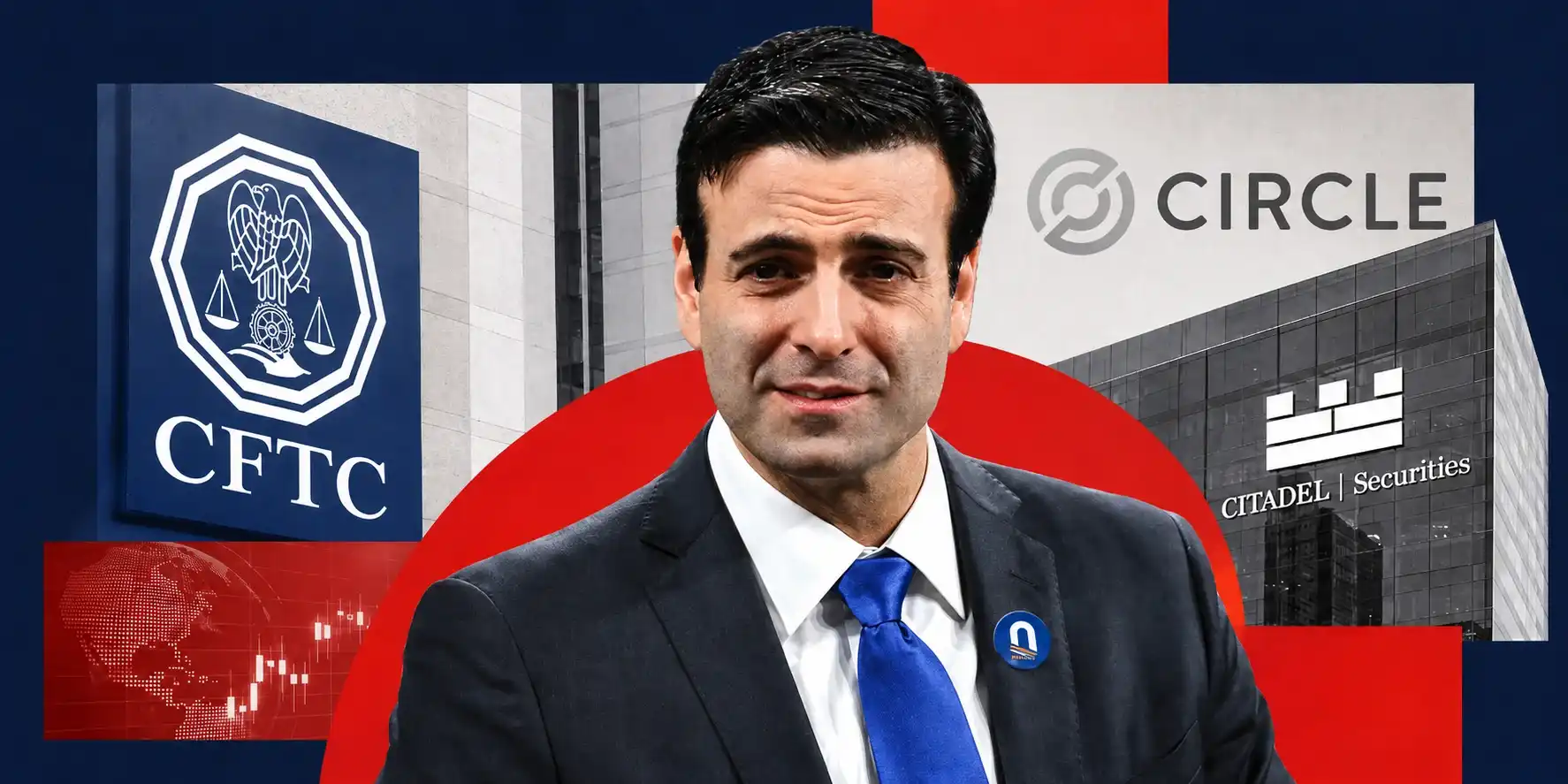
Facing the bleak reality of the stock price falling 70% from its peak and market value evaporating, former CFTC Chairman and Circle President Heath Tarbert, during an interview with FOX Business on July 14, was asked by the host what he would say to investors who bought Circle stock at its historical high. He calmly expressed the above viewpoint.
However, the reality is not favorable for Circle. Analysts from Mizuho Securities USA LLC recently downgraded Circle's rating from "Neutral" to "Underperform," giving it the lowest Wall Street target price of $50.
As the stock price continues to fall, it is indeed part of Tarbert's job as president to urge ordinary shareholders to choose long-termism and remain patient. Yet, it appears highly ironic when he was exposed for continuously selling CRCL shares since Circle's IPO completion, cashing out approximately $30 million in total, and never increasing his holdings. This stark contrast between public words and private actions stands out.
Frantically Cashing Out, Leaving the Verbal Long-Termism for the Market
The revolving door between government and business is a classic script for former US officials. As a former CFTC chairman friendly to cryptocurrencies, Heath Tarbert joined Circle in July 2023 as Chief Legal Officer and Head of Corporate Affairs. Tarbert's role was clearly to leverage his experience spanning the US Treasury, CFTC, White House, and Wall Street to help Circle communicate with regulators, accelerate business growth and its public listing, and promote USDC's integration into the traditional financial system.
Tarbert himself stated that he valued Circle's "regulation-first" development approach and hoped to promote the establishment of clear, consistent rules for digital assets. In early 2025, he was further promoted to become Circle's first President, overseeing legal, compliance, risk, public policy, communications, and international expansion.
Judging from his public statements, Tarbert has almost always been one of the most active promoters of Circle's "long-termism" narrative. He repeatedly emphasized that stablecoins should not be understood merely as crypto trading tools but as the next generation of payment, settlement, and internet finance infrastructure. Circle's current investments, he argued, cannot be measured simply by short-term profits or stock price fluctuations.
However, regarding his personal shareholding, he arranged something entirely different from his public stance even before Circle's listing. On June 4, 2025, the day before Circle's IPO pricing and official listing, Tarbert established a Rule 10b5-1 trading plan to sell up to 353,290 Circle shares within one year.
Consequently, in the 13 months following the IPO, he sold shares for 7 months, offloading over 360,000 shares in total and cashing out more than $30 million. Notably, on March 2, 2026, Tarbert sold 122,007 shares in a single transaction worth approximately $11.5 million, the largest of all his sales.
Rule 10b5-1 plans allow executives to preset the timing, quantity, or price conditions for future stock sales when they do not possess material non-public information, thus avoiding trading based on insider information. Most of Tarbert's sales were executed automatically by brokers through such plans, yielding profits of about $24.4 million.
Perhaps Tarbert felt his selling intensity was not strong enough. Before the first trading plan had even fully concluded, he established another Rule 10b5-1 plan on March 10, 2026, preparing to sell up to an additional 160,000 shares by the end of this year, including shares acquired through exercising options. Since Circle's IPO, Tarbert has never actively purchased company shares on the open market.
In reality, it is quite common for company executives to sell some equity to diversify personal assets. What has upset the community is that even after massively cashing out at relatively high stock prices, and while the price has fallen by about three-quarters, he continues to emphasize that the market should adhere to long-termism, yet he himself shows no intention to increase his holdings on the open market. This inevitably leads people to suspect that Tarbert actually just wants to cash in and leave, without ever having genuine confidence in Circle's long-term development.
Mastering the Revolving Door: Joined Citadel Securities 27 Days After Stepping Down as CFTC Chairman
Even before joining Circle's core management, Tarbert was very adept at leveraging his US political and commercial connections for personal gain.
He was trained early in law and finance, having worked at the White House, the Senate Banking Committee, and the Treasury Department. He also served as head of the banking regulatory practice at the international law firm Allen & Overy. During the Trump administration, Tarbert served as Assistant Secretary of the US Treasury for International Markets, participating in G7, G20, Financial Stability Board, and US-EU financial regulatory coordination, and once acting as Under Secretary of the Treasury for International Affairs.
In 2019, Trump nominated Tarbert as Chairman of the CFTC. Because he had both Republican administration experience and professional background in banking regulation, international finance, and law, his nomination faced no significant resistance. The Senate ultimately confirmed him as Chairman with 84 votes in favor and 9 against, with a term originally lasting until April 2024.
After the 2020 presidential election, Democrats regained the White House, and Tarbert stepped down on the day of Biden's inauguration. His public reason was to make way for the new president to choose a permanent Chairman, which is part of the normal power transition at US regulatory agencies after a change in administration.
However, Tarbert could have remained as a regular Commissioner until 2024 but chose to resign from all positions on March 5, 2021. Twenty-seven days later, Tarbert swiftly joined Citadel Securities, a top market maker directly impacted by financial regulatory policies, as its Chief Legal Officer.
This episode later shaped the basic public perception of him—exceptionally skilled at entering the regulatory system, accumulating institutional resources, and then converting those resources into compliance, lobbying, and policy influence capabilities for large financial firms.
From Citadel Securities to Circle: Controversy Begins with the "Revolving Door"
Beyond joining Citadel Securities as an executive less than a month after leaving a key regulatory position, the specific timing of his "urgent" entry into the company also raised external doubts.
In early 2021, large numbers of retail investors concentrated on buying stocks like GameStop that were heavily shorted by institutions, causing prices to soar dramatically and inflicting huge losses on some short funds. At the peak of this frenzy, Robinhood suddenly restricted users from buying GameStop, AMC, and other stocks while still allowing sales, causing related stock prices to plummet. Some investors later accused Robinhood of colluding with Citadel Securities to suppress stock prices, alleging the platform weakened retail buying pressure by disabling the "buy button" to bail out Wall Street short sellers.
In this controversy, Citadel Securities became a focal point of suspicion. On one hand, it was one of Robinhood's most important order execution partners and a source of payment for order flow; on the other hand, Ken Griffin, founder of Citadel Securities, had just injected capital into Melvin Capital, a hedge fund severely hit by the GameStop short squeeze. At that time, this leading market maker was facing intense scrutiny from Congress, regulators, and public opinion.
And precisely during this sensitive period, Tarbert, who had just left the CFTC, coincidentally took up the position of Chief Legal Officer at Citadel Securities, responsible for handling legal, compliance, and regulatory affairs. Tarbert possessed knowledge of how regulatory agencies operate, the policy-making process, and Washington connections—exactly what Citadel Securities needed most at that time: the ability to handle Congressional investigations and potential market structure reforms.
After joining Citadel Securities, Tarbert did not confine himself to traditional legal affairs. In 2023, during his tenure as Chief Legal Officer, Citadel Securities strongly opposed the SEC's proposed reforms for retail order auctions. The SEC wanted some retail orders to undergo open auctions before execution to increase competition among market makers. Citadel Securities submitted lengthy comments, arguing that the SEC's economic analysis contained serious errors and that the reform was an unproven "radical experiment" that could harm execution quality for retail investors.
Similar conflicts of interest appeared in the crypto market. In September 2022, Tarbert, as Chief Legal Officer of Citadel Securities, testified before the US Senate, supporting the Digital Commodities Consumer Protection Act and advocating for expanding the CFTC's regulatory authority over the crypto spot market. Meanwhile, Citadel Securities had already received an $11.5 billion investment from Sequoia Capital and crypto investment firm Paradigm and publicly stated plans to expand its business into crypto assets.
From a chronological perspective, a former CFTC Chairman, after joining a market maker preparing to enter the crypto market, publicly pushes for expanding the CFTC's power over that very market. This inevitably leads outsiders to question: Was he designing public rules as a regulator, or was he helping a potential new employer shape a more favorable market environment in advance?
In 2023, Tarbert left Citadel Securities and joined Circle instead. In late 2022, constrained by the regulatory environment, Circle's plan to go public via a SPAC fell through. Subsequently, Circle urgently needed a politically savvy executive to clear its listing obstacles and pursue a direct IPO. Two years later, Circle successfully completed its IPO, and Tarbert once again became one of the most important external representatives for a financial enterprise highly dependent on regulatory policy.
From the company's perspective, Tarbert is undoubtedly an extremely valuable executive. He understands how the regulatory system operates and excels at mobilizing policy, connections, and market resources, always helping the company cross critical thresholds related to compliance, financing, and market access when it most needs it.
Throughout Tarbert's career, a constant theme has been his precise judgment of policy cycles and market windows. What he truly excels at is converting the credibility and policy resources accumulated from his regulatory career, along with market opportunities, into his most valuable professional bargaining chips at different stages.
However, as he repeatedly switches identities between regulatory agencies and financial firms, cashing out at opportune moments, it is not him personally who bears the long-term risks, but rather the investors who believe in his public narrative.