Author: Stacy Muur
Compiled by: AIdidiaoJP, Foresight News
In the crypto space, allowing users to freely create prediction markets has long been an unresolved, major challenge. Over the years, almost all attempts have ended in failure.
@trylimitless (Limitless) has taken a unique path to address this challenge. Recently, they launched the UGM (User-Generated Market) feature, allowing any user to create their own crypto price prediction markets. This is a bold attempt to tackle a long-standing pain point in the prediction market space.
Let's explore previous attempts, the reasons for their failures, and how Limitless is making this model work.
A History of Permissionless Prediction Markets
The earliest permissionless prediction market was @AugurProject. Launched on Ethereum in 2018, its core concept was "anyone can create a market on any topic, priced by the crowd for truth."
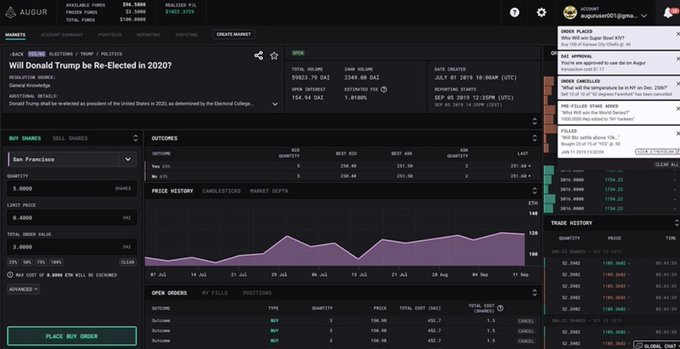
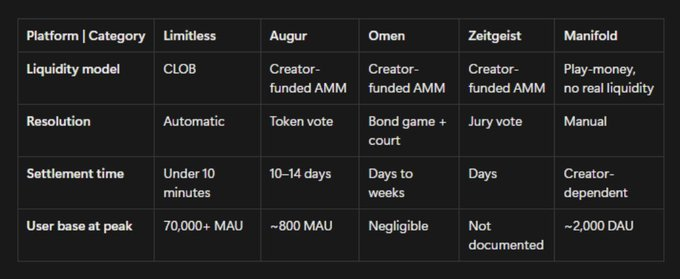
Perfect in theory, but desolate in practice. The project's token reached a peak market cap of over $170 million, yet its daily active users were only about 47, with fewer than 115 users per week.
The reasons for failure were brutal and mutually reinforcing:
- Liquidity was scattered across thousands of empty markets (because anyone could create a market).
- Market settlement took 10 to 14 days.
- User funds were locked until settlement.
- Users had to run their own Ethereum node before placing bets.
Augur was not an isolated case. @OmenEth on the Gnosis chain adopted a similar model and gradually faded. @ZeitgeistPM on Polkadot even added creator fees but still struggled to generate substantial trading volume. @ManifoldMarkets once built a real community using virtual currency, with daily active users peaking at several thousand, but later declined to below 900 after the hype subsided.
Different teams, different chains, yet all ending the same way.
A Recurring Pattern
This recurring pattern is hard to attribute to mere execution issues. Making creation free and easy doesn't create demand; it just floods the platform with more supply, all competing for the same small pool of attention.
This leads to fragmentation of prediction markets on two levels:
Thin Liquidity
Most markets created by users quickly become ghost towns. On early AMM (Automated Market Maker) platforms, creating a market also required providing initial liquidity with one's own capital, increasing the cost.
Poor Discoverability
When anyone can create a market, you quickly get a dozen slightly different versions of "Will the Fed cut rates in July?" markets, further fragmenting liquidity.
Imagine a user opening the app and seeing a list of half-dead markets, each with almost no liquidity. Who would want to stay?
It was this very problem that forced the industry's biggest player to pivot. In 2022, Polymarket shifted to a curated model, concentrating liquidity into a few deep markets, which proved effective. But it also abandoned its initial promise of open creation—the "harder version" of allowing anyone to easily launch a market remained unsolved.
The Settlement Challenge
Liquidity and discoverability are tricky enough, but if settlement isn't hardcoded, user trust collapses.
After a market ends, the platform needs to decide how to settle it. Objective events like "Will Bitcoin close above $100,000?" are easy to handle. But those requiring subjective interpretation, like whether a politician's statement constitutes endorsement of a specific policy, easily spark controversy.
Most platforms rely on token holder voting to resolve disputes. The intention is decentralized settlement, but in practice, voting power is often concentrated among the largest holders. And since they can also place bets like regular users, they have the potential to manipulate outcomes.
This erodes trust in the fairness of settlement, creating another path back to the liquidity problem.
How Limitless Responds
Any new attempt must overcome the three hurdles of thin liquidity, poor discoverability, and unreliable settlement. @trylimitless has made different choices in these areas.
Focusing on the newly launched UGM feature: any user can create a market in just a few steps:
- Select an asset.
- Set a price target (percentage change or specific dollar value).
- Set a duration (from 15 minutes to 1 day).
- Launch (requires holding LMTS tokens).
The longer the market duration, the higher the creation cost.
Anyone can trade these markets. Upon expiry, an oracle automatically pulls the asset price and settles the result instantly. These markets rely on real-time price feeds from @PythNetwork and @Chainlink, requiring no voting, no dispute panels, no committees.
Markets are limited to objective types, e.g., "Will SOL be above price X at a given time?". The smart contract can automatically settle the moment the market closes. It's not possible to create markets requiring human interpretation (like election results or disputed news events). Limitless deliberately restricts the scope to price markets because this is the only type that can be reliably settled within seconds every time, whereas other platforms often take hours or even days.
The cold-start problem tripped up most previous platforms. Limitless already has advantages here:
- Cumulative trading volume exceeding $3 billion.
- Trading volume in May and June exceeding $1.2 billion.
- Peak monthly active traders over 70,000.
There is already a fairly active trader base, completely different from Augur in 2018.
Another crucial difference: Limitless uses an order book model rather than the early AMM model. On platforms like Augur, creating a market required funding initial liquidity yourself. Limitless eliminates this step entirely; traders place their own buy and sell orders, and markets only need to attract them.
The most ingenious part is the creator economic mechanism. Creating a market costs 100 to 1000 LMTS tokens, which are non-refundable. In return, the creator receives 50% of all trading fees generated by that market.
On one side is a real cost, on the other a real reward. The cost effectively prevents market spam, as each market requires a real financial commitment. The reward means truly active markets can generate tangible fee income for creators.
The cost mechanism also adds utility to the LMTS token. Creating each market burns LMTS tokens from the open market, directly linking token utility to UGM activity. The more people create markets, the greater the demand for LMTS.
Summary and Outlook
The existing evidence clearly points in one direction: all previous attempts at permissionless prediction markets either got bogged down in settlement disputes, drowned in dead liquidity, or simply abandoned the open model for curation.
Limitless is the first solution designed to address all three failure modes simultaneously.
Settlement (the trickiest problem) is completely avoided by sticking to oracle-based price markets.
The cold-start problem is mitigated by an existing active user base.
The cost-and-reward structure for market creation balances incentives for both sides.
Most importantly, with these markets settling faster, we will quickly see if the design works at scale.
If it does, permissionless prediction markets finally have their first viable blueprint.
Disclosure: The author holds some $LMTS tokens and is a Limitless user.