Author: Winnie, CryptoPulse Labs
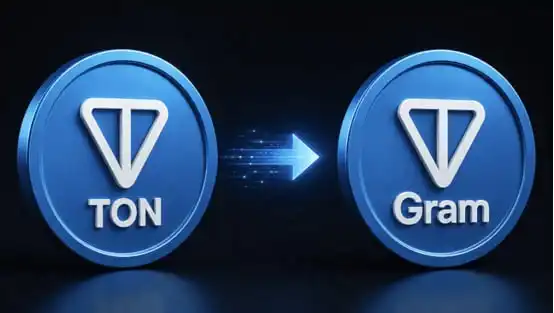
On June 9th, the results of the TON Vote community governance were announced. Over 81% of voters supported changing the native token name from Toncoin to Gram, and the token code will also change from TON to GRAM, with the changes scheduled to take effect officially on June 15th.
On the surface, this seems like just a brand upgrade, but for old players who experienced the Telegram token issuance saga, the name "Gram" carries the initial ideals and story of TON.
More importantly, against the backdrop of Telegram's monthly active users exceeding 1 billion, the TON ecosystem re-entering a growth cycle, and the rapid expansion of its on-chain payment and Mini App ecosystem, this renaming may be far more significant than just a logo change.
I. Behind TON's Brand Upgrade: Gram Officially Returns to the Crypto Market
Let's go back to 2018. At that time, Telegram founder Pavel Durov launched the TON (Telegram Open Network) plan, aiming to build a blockchain network covering hundreds of millions of users worldwide.
The project's whitepaper explicitly stated that the name of the network's native currency would be "Gram."
During the fervent ICO era, TON once set a fundraising record of $1.7 billion and was seen as one of the blockchain projects with the greatest potential for mass adoption.
However, in 2020, the U.S. SEC sued Telegram for allegedly conducting an unregistered securities offering. Ultimately, Telegram was forced to halt project development and refund investors.
Many thought TON was over, but the story didn't end there.
Subsequently, the open-source community took over the code and continued development. The project gradually evolved into today's The Open Network. To distinguish it from the original project, the community renamed the token to Toncoin, while keeping the token code as TON.
After several years of development, TON has re-emerged as a mainstream public chain. And now, with the token officially renamed to Gram, this name that had been dormant for years finally returns to the market's view.
An important step in the "Make TON Great Again" plan. Officials stated that this renaming is the fourth step in the "Make TON Great Again (MTGA)" seven-step strategy.
Based on public information, the TON team is driving a comprehensive brand overhaul. This upgrade mainly includes changing Toncoin to Gram, changing the TON code to GRAM, launching a new logo and visual system, synchronizing updates to wallets and ecosystem applications, and gradual adaptation by trading platforms.
It's noteworthy that only the token brand is changing; the blockchain network will maintain the name "The Open Network." In other words, the TON chain remains the TON chain, but the currency on the chain is once again called Gram.
This is similar to the Ethereum network keeping its name while ETH suddenly changes. Therefore, this is not a technical upgrade but a brand strategy adjustment.
In the crypto market, narrative is often more important than technology. For many veteran players, Gram represents TON's original dream. It is the story from 2018 that attempted to bring blockchain to hundreds of millions of global users; it is also a significant symbol of Telegram's challenge to the traditional financial system.
II. From Public Chain Competition to Brand Competition, TON is Seeking Differentiation
If we rewind two years, TON might not have had the conditions to rename, but the situation today is completely different.
Over the past year, Telegram has become one of the fastest-growing Web3 traffic portals globally. Especially after the explosion of hit applications like Notcoin and Hamster Kombat, a large number of users were exposed to on-chain assets for the first time.
The TON ecosystem's user base has rapidly expanded, with continuous growth in wallet numbers, on-chain active addresses, payment scenarios, and developer numbers.
For TON, it is no longer an experimental project; it has begun to become a large-scale ecosystem with a real user base. Against this backdrop, the timing for a brand upgrade has matured. Reviving "Gram" may be about strengthening the Telegram DNA.
In fact, "Toncoin" has always had a problem. Although it is highly aligned with the TON network name, it lacks a sufficiently distinct brand memory point.
Gram is different. This name is deeply tied to Telegram's history. Just mentioning Gram will remind veteran users of a series of keywords: Telegram, Pavel Durov, the $1.7 billion fundraising, the vision for global payments, Web3 super apps, etc. This brand equity is something Toncoin cannot provide.
For TON, re-adopting Gram is equivalent to reactivating brand value that has been dormant for years. This can help TON establish a more unique cognitive label in the fiercely competitive public chain market.
Currently, competition in the Layer1 track is intensifying. Besides Ethereum, new public chains like Solana, Sui, and Aptos are all vying for users and developers.
The technological gap is gradually narrowing, and what can truly create a difference is starting to become brand and traffic.
From this perspective, TON's biggest advantage is not TPS or gas fees, but the Telegram behind it. A global user base exceeding 1 billion is a moat difficult for other public chains to replicate. And the name Gram can further strengthen this association.
In the future, when users mention Gram, they will think not just of a token, but of the entire Telegram ecosystem. This is precisely the effect TON hopes to achieve.
III. From Token Upgrade to Ecosystem Expansion, Can Gram Open Up New Space?
Looking at historical experience, the crypto community often reacts positively to brand upgrades. Whether it's a project name change, token split, or visual upgrade, it can become a focus of short-term capital attention.
The reason is simple: a brand upgrade means a new story. And the market loves stories the most. Gram's return also possesses this attribute.
For a period of time in the future, "Gram's Revival" is likely to become a new communication theme for the TON ecosystem. For the trading market, this narrative has the potential to increase attention and capital inflows.
Of course, a name change alone cannot support prices long-term. What truly determines value remains ecosystem development. The Telegram payment system may be further improved
Compared to short-term price fluctuations, TON's future payment layout is more worthy of attention. From its inception, Gram was positioned as a digital payment currency. Its goal is not merely as an investment asset, but to become a medium of value exchange within the Telegram ecosystem.
Now, with the development of the Telegram Stars system, the expansion of the Mini App ecosystem, and the increase in on-chain payment scenarios, Gram's application space is gradually opening up.
If Telegram further integrates its payment system in the future, Gram may take on an even more central role, which is also one of the long-term logics the market is most concerned about.
Over the past few years, most public chains have been competing for developers. TON seems to have chosen a different path; it attempts to embed blockchain directly into the social platform users are already accustomed to using.
This model is somewhat similar to the development path of WeChat Pay. Users don't need to understand the underlying technology; they just need to complete payments, transfers, tipping, or game operations, with the blockchain hidden in the background.
If this model ultimately proves successful, TON could become the first Web3 network to truly achieve mass adoption by hundreds of millions of users. And Gram would be the core value carrier within this ecosystem.
Therefore, the significance of this renaming may far exceed market imagination. It is not just a brand return, but could be the beginning of TON redefining its own positioning.
Conclusion
For the market, Gram is not just a token name; it represents the dream Telegram once had of building a global digital economic network.
And now, against the backdrop of Telegram's traffic, on-chain payments, the Mini App ecosystem, and the continuous integration of AI applications, this dream may be getting a second chance.
In the coming years, what's truly worth watching may not be that TON changed its name. It is whether Gram can leverage Telegram's vast user network to grow into the crypto industry's first genuinely global internet currency.