Ethereum is facing one of its most uncomfortable periods in recent memory, with GSR Research’s Carlos Guzman arguing that leadership turnover, weak ETH performance and a sharpening debate over the Ethereum Foundation’s (EF) role have exposed a deeper strategic crisis for the network.
GSR Research Flags Ethereum’s Identity Crisis
In a note titled “Ethereum’s Identity Crisis,” Guzman framed the issue as more than a temporary morale problem. At least nine senior EF contributors have departed in 2026, according to the note, including five in May alone. The list includes protocol cluster leads Tim Beiko and Barnabé Monnot, veteran researchers Carl Beekhuizen and Julian Ma, and former co-executive director Tomasz Stańczak.
Several of the exits followed an internal mandate centered on CROPS, shorthand for censorship resistance, open source, privacy and security. The framework was intended to clarify the foundation’s priorities, but Guzman wrote that many in the community perceived it as deprioritizing growth and adoption at a moment when Ethereum is already under pressure from faster-moving rivals.
The personnel churn has amplified a broader debate over whether the EF should remain a narrow research and protocol institution or take a more active role in defending Ethereum’s market position. Dankrad Feist, formerly at the foundation, publicly called for a new $1 billion-plus organization economically aligned with Ethereum to fill what he sees as an institutional void. Bankless co-host and long-time ETH bull David Hoffman also said he had sold all of his ETH, citing frustration with leadership he views as insufficiently focused on growth.
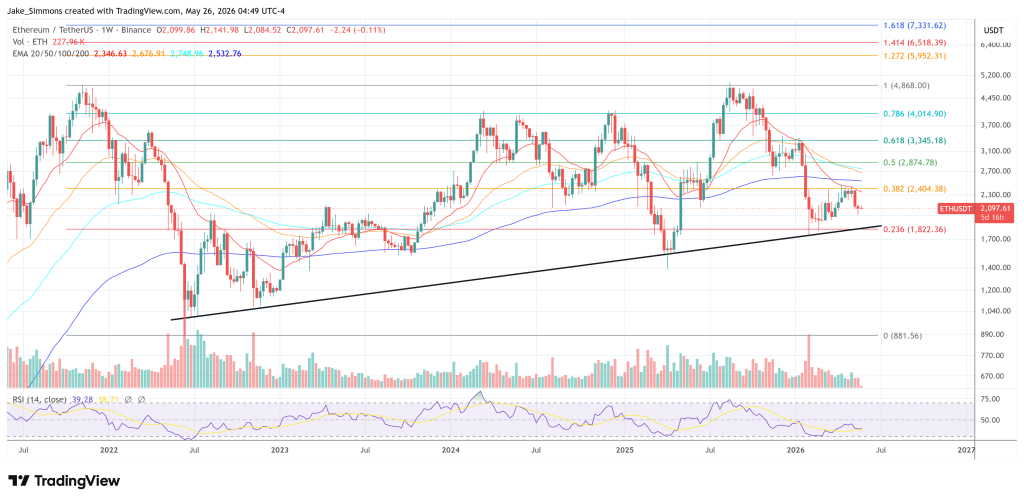
The market backdrop has made the internal debate harder to dismiss. Guzman noted that ETH is down roughly 30% year to date, while the ETH/BTC ratio fell to 0.027 in May, its lowest level since mid-2025. Network revenue has also weakened as Ethereum cedes ground to chains such as Solana, Tron and Hyperliquid. Revenue is not a complete measure of network health, particularly as blockchains deliberately reduce fees to attract users, but the trend has fed the perception that Ethereum’s economic gravity is weakening.
Vitalik Buterin responded with a lengthy post on X that sought to redefine the foundation’s role rather than expand it. Buterin described the EF as “a smaller ship” that should sell less ETH and focus narrowly on CROPS. He also argued that the foundation should be viewed as “one node, with a defined purpose,” not the center of Ethereum itself.
That framing is central to the tension Guzman identifies. Buterin’s argument is that moving talented people into roles outside the foundation may be necessary if the ecosystem is to attract outside capital and develop independent leadership. The foundation, in this view, should not become ETH’s growth department. It should preserve the properties that make Ethereum credible in the first place.
Buterin’s technical vision rests on three pillars that he said could make Ethereum “deeply impressive” in ways competitors cannot easily replicate. The first is provably bug-free software through AI-assisted formal verification, an approach that appeared unrealistic until recently but may now be moving closer to feasibility.
The second is what he called “available chain consensus,” a property Guzman described as unique among proof-of-stake chains because it combines traditional BFT-style safety under network asynchrony with Bitcoin-like safety under synchrony against attackers up to 49%. The third is intermediary minimization, reducing Ethereum’s reliance on centralized relayers and third-party infrastructure for transaction inclusion and privacy through proposals such as FOCIL and EIP-8141.
The core bet is credible neutrality. Guzman argued that this remains a more compelling advantage than Ethereum’s critics often acknowledge. The view that “blockspace is a commodity” misses an important point: users have repeatedly shown a willingness to pay more to transact on one chain rather than another when that chain offers superior assets, applications, liquidity and network effects.
But the note also underscored the limits of that argument. Credible neutrality may attract builders and institutions, but users still need affordable transactions, fast execution, privacy and a workable experience. On several of those fronts, Ethereum remains vulnerable to competitors that are optimizing for throughput, fees and user experience today while promising stronger neutrality tomorrow.
Guzman’s conclusion is not that Buterin’s vision is wrong. It is that Ethereum’s window to execute on it is not unlimited. The question now is whether a smaller, more narrowly focused EF can preserve Ethereum’s deepest differentiator while the rest of the ecosystem builds the growth machinery around it.
At press time, ETH traded at $2,097.