Iran’s Hidden Crypto Trails Exposed As Arkham Publishes Public Wallet Map

bitcoinist发布于2026-05-14更新于2026-05-14

文章摘要

Blockchain intelligence firm Arkham has published a public, searchable map of cryptocurrency wallets linked to Iran's central bank, Bank Markazi. The core of the map is two Tron-based wallets that were sanctioned by the U.S. Treasury on April 24, identified as property of the bank and tied to the IRGC-Qods Force and Hezbollah. Approximately $344 million in crypto was frozen in the action, with Tether complying to freeze the funds. Arkham's research aims to serve as a starting point for tracing transaction flows. Analysis reveals a complex, layered system where Iranian oil revenues move through brokers, intermediary wallets, and DeFi protocols to obscure their origin before reaching central bank-linked accounts. While the Tron network itself cannot monitor transactions, it points to a joint financial crime unit with Tether and TRM Labs to flag illicit activity. The exposed wallets are part of a larger trend. Estimates indicate Iran's total crypto transaction volume reached roughly $11.4 billion in 2024 and $10 billion in 2025. Furthermore, Iran is reportedly considering charging crypto tolls for ships in the Strait of Hormuz, signaling digital assets' expanding role beyond sanctions evasion.

Blockchain analytics firm Arkham has built a public, searchable map of crypto wallets it links to Iran’s central bank — a move that puts Tehran’s alleged digital holdings in plain sight of investigators and anyone else curious enough to look.

How Iran Moves Money Through Crypto

The map centers on two Tron-based wallets that were added to the US Treasury’s Specially Designated Nationals list on April 24. Treasury identified both addresses as property of Bank Markazi Jomhouri Islami Iran — the country’s central bank — citing ties to the Islamic Revolutionary Guard Corps-Qods Force and Hezbollah.

Around $344 million in crypto was frozen as part of the action, Treasury Secretary Scott Bessent said, describing the goal as cutting off Tehran’s ability to generate, move, and bring home funds.

Stablecoin issuer Tether confirmed it had frozen the funds at the request of US authorities, citing activity tied to unlawful conduct, without naming Iran directly in its public statement.
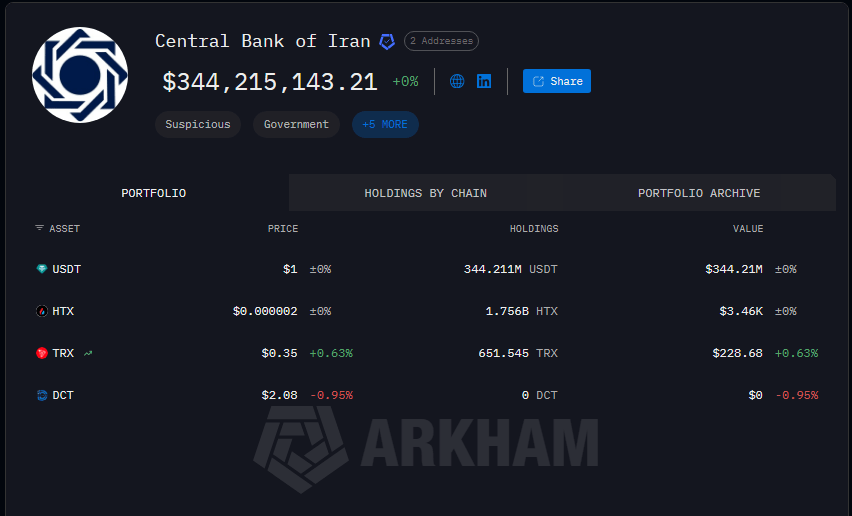
Arkham published its research on May 11, grouping the sanctioned addresses under a Central Bank of Iran entity page that it says can be used as a starting point to trace connected wallets and transaction flows.

The firm said the wallets hold TRC-20 tokens — a token standard that runs on the Tron network and includes USDT, the world’s largest stablecoin.

A Layered System Built To Hide

The money trail is not simple. According to Chainalysis, Iranian oil revenues passed through brokers, intermediary wallets, cross-chain bridges, and decentralized finance protocols before ending up in accounts linked to Iran’s central bank and IRGC-connected entities. The pipeline was built for concealment, layered step by step to obscure its origins.

A TRON spokesperson said the network itself cannot monitor or block individual transactions, but pointed to the T3 Financial Crime Unit — a joint effort between TRON, Tether, and TRM Labs launched in 2024 — as its main tool for flagging abuse.

BTCUSD trading at $80,564 on the 24-hour chart: TradingView

The unit works with law enforcement to freeze hundreds of millions in funds tied to sanctioned groups and terrorism financing, the spokesperson said. Tether declined to comment separately.

Iran’s Crypto Activity Runs Deep

The exposed wallets are just one piece of a much larger picture. Based on estimates from TRM Labs and Chainalysis, Iran’s total crypto transaction volume reached roughly $11.4 billion in 2024 and $10 billion in 2025.

Meanwhile, Iran is said to be looking into charging crypto-denominated tolls to ships passing through the Strait of Hormuz — a sign that digital assets are being considered as a revenue channel well beyond sanctions evasion.

Featured image from Bitcoin Policy Institute, chart from TradingView

相关问答

QWhat did the blockchain analytics firm Arkham do regarding Iran's crypto activity?

AArkham built a public, searchable map of crypto wallets it links to Iran's central bank, exposing Tehran's alleged digital holdings.

QWhat was the amount of crypto frozen by the US Treasury action related to Iran, and what were the cited reasons?

AAround $344 million in crypto was frozen. The US Treasury identified the wallets as property of Iran's central bank, citing ties to the Islamic Revolutionary Guard Corps-Qods Force and Hezbollah.

QHow does the article describe the complexity of Iran's money trail involving crypto?

AThe money trail is described as not simple; it involved a layered system built for concealment, passing through brokers, intermediary wallets, cross-chain bridges, and DeFi protocols to obscure origins before reaching accounts linked to Iran's central bank.

QAccording to estimates mentioned, what was Iran's estimated total crypto transaction volume in 2024 and 2025?

ABased on estimates from TRM Labs and Chainalysis, Iran's total crypto transaction volume reached roughly $11.4 billion in 2024 and $10 billion in 2025.

QWhat is one potential future use of digital assets by Iran mentioned in the article, beyond sanctions evasion?

AIran is said to be looking into charging crypto-denominated tolls to ships passing through the Strait of Hormuz, indicating digital assets are being considered as a broader revenue channel.

你可能也喜欢

KalqiX 将自托管打造成主流及传统交易者的大众市场功能

多年来,Web3行业一直以实现自我托管为市场标准、彻底摆脱中心化中介的愿景而运作。然而现实并非如此,Web3始终未能构建出既能保护自我托管、又无需用户做出过多妥协的系统。 正当许多专家对DeFi和Web3的未来表示怀疑时,Web3初创公司KalqiX推出了其突破性的中央限价订单簿(CLOB)去中心化交易所(DEX),旨在重振人们对链上系统的信心。 目前绝大多数交易活动仍集中在中心化交易所(CEX)。交易者通常需要在便利性与托管风险之间做出选择:要么接受托管风险以获得更优的用户体验、流动性和执行速度;要么为了无需信任的操作而忍受次优的交易体验。 KalqiX的使命正是将“鱼与熊掌兼得”的梦想变为链上现实:在保持用户资产自我托管的同时,提供可媲美CEX的执行质量和用户体验。其CLOB DEX采用了一种革命性的设计哲学:将订单处理和匹配过程放在链下进行,从而实现了CEX级别的速度和响应能力;而交易结算和验证则通过零知识证明在链上完成,确保了交易的有效性,且无需信任任何中心化中介。 这意味着用户无需再在安全与性能、自我托管与执行质量之间做出妥协。这一结合被认为是DeFi走向真正主流采用所缺失的关键一环。 如果KalqiX的CLOB DEX能够持续获得Web3原生用户和传统市场参与者的青睐,自我托管有望成为数字交易的市场新标准。KalqiX或许正是Web3等待多年的那个催化者,有望将去中心化系统带入主流。

TheNewsCrypto1小时前

KalqiX 将自托管打造成主流及传统交易者的大众市场功能

TheNewsCrypto1小时前

Ozak AI向700万美元迈进,促使后期购买者重新考虑延迟入场的决定。

加密货币市场中,时机至关重要。Ozak AI项目的预售成为近期焦点,目前已进入第七阶段,单价为0.014美元,并已筹集超过720万美元,显示出全球投资者的强烈兴趣。预售价格随阶段逐级上涨,自最初0.001美元起已增长超过14倍。许多原本等待观望的后期投资者,因担心错失机会,正重新考虑并加速入场,以期在代币上线主要交易所前以较低成本购入。 Ozak AI的核心驱动力在于其先进的人工智能技术,包括AI预测工具、自动化链上研究系统、数据驱动的投资智能以及智能合约AI助手。其智能合约执行层作为系统核心,负责代币分发、支付和质押,并采用Rollup式扩展技术提升效率与降低成本。项目还通过LLM驱动的聊天功能提供自然交互体验,降低了新手使用门槛。 在安全方面,Ozak AI的智能合约和AI工具已分别由顶级安全公司CertiK和Sherlock完成审计,以最小化风险。此外,项目通过与Mira网络、Mind AI等建立战略合作伙伴关系,旨在构建可验证、私密且高效的数据与交易生态系统,强化其长期发展基础。 分析师指出,预售已接近尾声,即将进入交易所上市阶段,目标上市价格设定为1美元。这意味着当前阶段投资者若参与,潜在涨幅可达71倍。随着预售阶段减少、需求激增,代币正在快速售出。文章总结,Ozak AI凭借其技术实力、合作伙伴关系、强劲的预售势头及双重审计,吸引了大量投资者,其上市后表现值得关注。

TheNewsCrypto4小时前

Ozak AI向700万美元迈进,促使后期购买者重新考虑延迟入场的决定。

TheNewsCrypto4小时前

加密新闻:XRP鲸鱼涌入SurgeXRP预售,数小时内软顶完成近10%——以下是Ripple投资者密切关注的原因

XRP大额持有者(鲸鱼)开始将资金转向基于XRP Ledger构建的房地产现实世界资产(RWA)市场项目SurgeXRP($SGP)。该项目旨在将价值3万亿美元的全球租赁房地产市场引入链上。 在其预售启动后的几小时内,SurgeXRP已完成了近10%的软顶融资目标,显示出早期XRP投资者对XRPL上现实世界资产叙事的关注。随着更广泛的加密市场投机情绪降温,投资者的注意力正转向具有实际效用、可持续基础设施和实物资产敞口的项目。 SurgeXRP致力于构建连接区块链技术与创收型租赁房地产的基础设施,允许全球用户通过基于区块链的结算和数字所有权基础设施,获得租赁房产的部分所有权。项目优势包括:专注于XRPL上的房地产代币化市场、利用XRPL近乎即时的结算和低成本交易特性、以及契合当前快速增长的RWA赛道。 $SGP代币是SurgeXRP生态系统的核心,总供应量固定为2亿枚,其中1亿枚用于本次预售。代币持有者可获得质押奖励、未来房产列表的优先访问权、早期生态激励以及参与平台治理等权益。预售早期参与者可享受10%的早鸟奖励,项目计划在预售结束后于XRP原生去中心化交易所上线交易。 该项目已引起XRP社区的早期关注,被视为在XRPL生态向现实世界资产扩张趋势中的重点观察对象。

TheNewsCrypto4小时前

加密新闻:XRP鲸鱼涌入SurgeXRP预售,数小时内软顶完成近10%——以下是Ripple投资者密切关注的原因

TheNewsCrypto4小时前

交易

现货
合约
活动图片