Quick Facts:
- ➡️ The Trump–Dar Global Maldives project shows tokenization moving into marquee real‑estate deals backed by state‑aligned capital.
- ➡️ Vision 2030 and Saudi initiatives around digital assets signal long‑term policy support for tokenized funding structures.
- ➡️ SUBBD token applies similar tokenization mechanics to creator income, bundling AI tools, payments, and token‑gated access in one stack.
- ➡️ As tokenized assets normalize, demand should grow for platforms that let both humans and AI agents monetize on‑chain.
The Trump Organization and Saudi Arabia’s Dar Global have turned a niche thesis into headline reality.
Their new Trump International Hotel Maldives will be financed through what both groups call the world’s first tokenized hotel development project. Here, investors will buy digital shares in the construction phase itself.
The announcement coincided with Crown Prince Mohammed bin Salman’s commitment of up to $1T in US investments and deeper capital‑markets ties with Washington.
Like the US, Saudi policy is moving in the same direction. Under the Vision 2030 program, regulators have encouraged digital asset infrastructure, including pilots to tokenize equity markets and build domestic digital currency frameworks with international partners such as WhiteBIT.
This is big news because tokenization goes beyond theory. A G20 government is aligning tourism, real estate, capital markets, and crypto under one policy umbrella.
Once sovereigns normalize tokenized property and securities, retail users will expect tokenized access everywhere, including content, media, and creator economies.
This is where SUBBD ($SUBBD) sits. Instead of tokenizing hotels or office towers, the project applies the same on‑chain ownership logic to content, creator‑fan relationships, and AI‑driven digital identities.
Tokenization and the Race to On‑Chain Revenue Streams
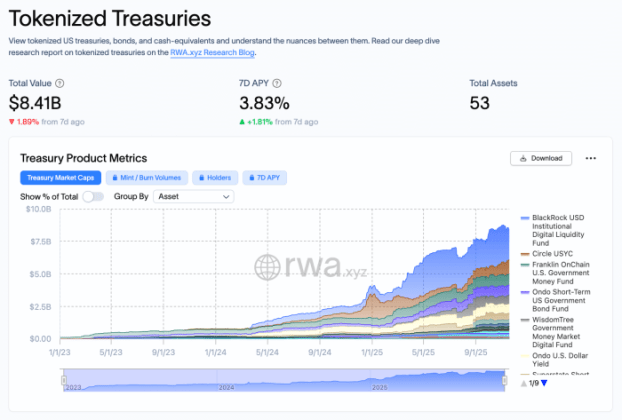
The Maldives deal is part of a broader pivot. Tokenized real‑world assets, or RWAs, have already crossed tens of billions of dollars in value, with tokenized US Treasuries alone valued at $8.41B. The difference now is who is driving the narrative: nation‑states and major brands, not only crypto natives.
Saudi Arabia is positioning itself as a regional tokenization hub. Alongside its hospitality experiments, it has encouraged a growing cluster of blockchain firms, with several thousand Web3 companies reportedly registered and year‑over‑year growth outpacing traditional tech segments.
For investors, that shift changes the risk profile of on‑chain projects.
Tokenization is becoming a standard funding and distribution mechanism for everything from luxury villas to equity markets. In that environment, infrastructure and applications that help creators tokenize their own output start to look less like speculative side bets and more like the way of the future.
While several projects already target this creator tokenization lane, SUBBD ($SUBBD) aims for a wider surface.
How $SUBBD Turns Tokenization Into An AI‑Native Creator Stack
Most Web2 content platforms are effectively centralized tax authorities.
Major subscription hubs can keep 30% or more of gross revenues, while niche creator platforms routinely push effective take‑rates toward 50% to 70% once payment processors and promotional fees are included.
That margin structure leaves little room for experimentation with AI tools, multi‑currency payments, or region‑agnostic access.
SUBBD ($SUBBD) attacks those frictions from three angles.
First, it uses Ethereum smart contracts for payments and access control, so subscription and pay‑per‑view revenue flows directly to creators’ wallets, with platform fees programmable and transparent.
Next, it embeds AI assistants, voice cloning, and AI influencer engines directly into the stack, allowing creators to scale interactions and content output without hiring additional staff.
Finally, it tokenizes access, not only content, so fans can stake, earn XP multipliers, and unlock loyalty tiers through on‑chain behavior.

The tokenomics tie that activity together. As a $SUBBD holder, you can stake for a targeted 20% APY in the first year, with additional benefits including access to exclusive livestreams, behind‑the‑scenes content, and platform discounts.
As staking evolves toward utility‑driven rewards, XP multipliers, and loyalty incentives are designed to direct tokens toward active users rather than passive yield seekers, aligning creator success with fan engagement.
Presale traction suggests that the narrative is resonating. The token presale has already raised over $1.3M, with tokens currently priced at $0.057.
You can HODL the tokens too if you prefer. Based on our SUBBD Token Price Prediction, $SUBBD has the potential to hit a high of $0.48 by the end of 2026, making it an even more compelling reason to invest in the project.
If you are following the Trump–Dar Global experiment, the through‑line is clear: tokenization is moving from exotic edge case to default infrastructure.
Projects like SUBBD ($SUBBD) attempt to extend that infrastructure to the $85B‑plus content creation market, targeting the same investor appetite for on‑chain cash flows but routing it through human and AI creators instead of steel and concrete.
Join the SUBBD Token presale today.
Disclaimer: This article does not constitute investment advice, tax guidance, or a recommendation to buy, sell, or hold any asset.
Authored by Bogdan Patru, Bitcoinist — https://bitcoinist.com/subbd-token-gains-traction-as-trump-saudi-announce-tokenized-hotel-plan

Related Posts