Cardano’s founder Charles Hoskinson says the project has crossed a historic line — full decentralization — and argues that the market still hasn’t understood what that actually means for crypto going into the next cycle. “The best days are ahead of us,” he said on October 30, 2025. “Cardano’s here. We’re fully decentralized. We have a great government. We got many more things coming.”
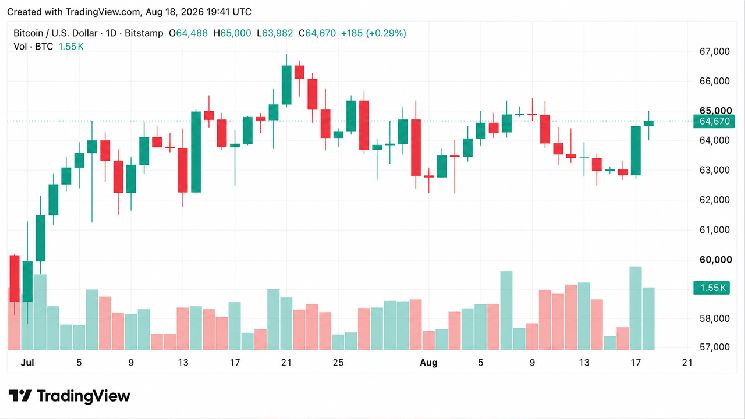
Hoskinson framed the current moment not as a price story but as a legitimacy story. He said crypto keeps getting reduced to charts, even though price has never captured the point. He walked through Bitcoin’s entire boom-and-bust path — from $1 to $30 to $4, then to $250, down to $80, then $1,200, then $20,000 in 2017, down to $4,000, back to $68,000 in 2021, through the Luna/FTX collapse, and then above $100,000 — to make the point that volatility is noise. “All you care about is the price. It’s the price. Price goes up, price goes down,” he said. “But why are we here? Where has the durability come from over the last 15 years?”
Why The Best Is Ahead For Cardano (And Crypto)
His answer: people do not trust legacy systems anymore, and crypto is actively replacing them. He asked viewers directly: “Do you think the money in your pocket is actually going to be worth something in 10 years, 15 years, 20 years? Do you feel listened to? Do you feel valued?” If the answer is no, he said, then “the way we govern things, the way the markets work, the way the economy works, it’s not working for you. Why crypto exists is it starts a conversation about how we do things differently.”
Hoskinson said that conversation has already moved past ideology and into implementation, and he used Cardano’s governance shift as evidence. According to him, Cardano went in about a year “from a federated governance system to a completely open and decentralized governance system,” despite predictions that handing decision-making to a global community would end in chaos.
“Everybody said, ‘Oh, no. You can’t do that… Won’t that result in anarchy and chaos?’” Hoskinson said. His answer was that Cardano did it, the network still runs, and that matters. “We keep showing up. We keep fighting hard,” he said. “That can serve as an example to so many others.”
That point — Cardano as precedent — ran through the entire address. He argued that crypto now has nation-state level relevance, not just speculative relevance. He claimed there is “a better than 50% chance that by 2030, half of all the value in the economy of Argentina will be in cryptocurrencies,” and “a better than 50% chance that the majority of their government will run on a blockchain… their voting systems to their identity systems to their supply chain systems to their money.”
He also said crypto already serves “a half billion people,” and is on trajectory toward a billion users “within the next 3 to 5 years.” In his view, this is not hype. It’s the new baseline: “Every single day we have a trillion plus dollar economy that’s self-evolving, self-growing.”
He also drew a hard line between decentralized crypto and what he called captured, centralized finance using crypto rails. “Asset-backed stablecoins are not cryptocurrencies,” Hoskinson said. They “take advantage of cryptocurrency infrastructure,” but ultimately rely on “the promises and commitments of centralized companies.” He warned that some chains are being built by “centralized actors with an attempt to co-opt and take over the industry.” By contrast, he said, “Real crypto will never die and real crypto cannot be bought.”
The long-term threat surface, in his view, is not just monetary inflation but algorithmic control. Hoskinson said the next 25 years will merge physical and digital life into a single augmented layer in which AI mediates reality. “Every single thing in the physical world will have a digital twin,” he said. “When you’re walking around outside and you look at the pizzeria, your glasses will show you the ratings, the hours, the friends that have gone there.”
He asked: “How do you know that the things that you see in this augmented world are real, and are not adulterated?” His answer was blunt: “The only option is the technology of this industry… And if anybody tells you otherwise, they’re either ignorant or bot or both.” He positioned Cardano’s privacy work — “We’re tackling the privacy side now… We got Midnight coming out” — as part of that fight.
The speech also carried a warning about macro risk. Hoskinson said there is a “non-zero probability” that the United States enters a new depression, a “non-zero probability” of open conflict with China “before the close of this decade,” and even a “non-zero probability that we may no longer have a democracy in the next 10 years or 20 years.”
His claim is that when those systems fracture, crypto will be the toolkit used to rebuild money, voting, identity, and rule enforcement. “At some point, we’re going to have to pick up the pieces and we’re going to have to clean up the mess,” he said. “Do we just want to build it the exact same way… or do we want to build it differently?”
Hoskinson also addressed his own role, calling himself one of the few founders from crypto’s early days who is still active and not retired, not “picked off,” not checked out. He said he recently stepped back, spent time in Switzerland after Milan, and considered walking away to “just retire, go be a rancher.” He said he chose not to: “I’m happiest when I’m here with all of you… being in the revolution.”
He closed by insisting that Cardano is not finished, but is now structurally where it needs to be. “We’re fully decentralized,” he said. “We have a great government.” He praised other ecosystems by name — “Kudos to the Solana ecosystem… Kudos to the Avalanche ecosystem… Kudos to Bitcoin… Kudos to Vitalik and Ethereum” — and said that the industry is “so powerful, especially when it’s united. No one can stop us.”
Then he went back to Cardano. The message to holders was simple: ignore the drawdown. “These little slides in the market, they’re entirely forgettable,” Hoskinson said. “In three weeks, we won’t even think about it. The macro can get bad. Who cares? We’ll win in the end.”
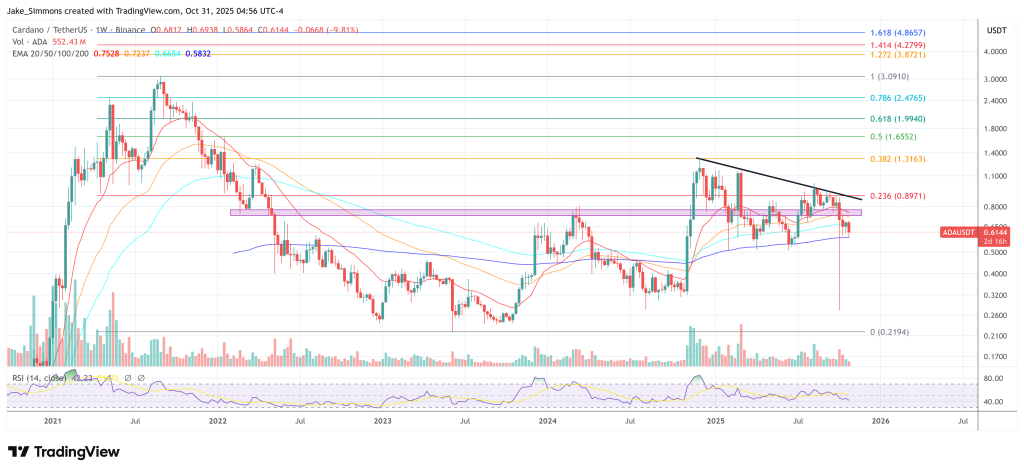
At press time, ADA traded at $0.614.

Related Posts