Ripple chief technology officer David “JoelKatz” Schwartz has resurfaced a years-long thread of speculation around Bitcoin’s origins and his own pre-Ripple work with US government agencies, clarifying once again that he neither possessed “high level” intelligence nor claims special insight into Satoshi Nakamoto’s identity—while acknowledging that a US intelligence provenance for Bitcoin is “not a terrible theory.”
The renewed attention follows a fresh exchange on X on October 23, 2025, in which Schwartz responded to questions about prior employment and nondisclosure obligations—context that traces back to an October 24, 2022 thread where he weighed in on Satoshi debates and litigation risk tied to public claims about identity. “There is nothing defamatory about saying that Craig Wright is not Satoshi, just as there is nothing defamatory about saying that I am not Satoshi,” Schwartz wrote in 2022, adding, “There is nothing inherently wrong with not being Satoshi.”
In the same 2022 exchange, after community member @XRPcryptowolf joked “David Schwartz is Satoshi confirmed jk lol” and floated the notion that “Satoshi is really the CIA or NSA,” the Ripple CTO replied: “That’s not a terrible theory. If the NSA or the CIA happened to stumble on how to make bitcoin, it might make sense that they would implement and deploy it to eliminate the risk that someone hostile to the US would do it first and potentially made billions of dollars.”
Ripple CTO Shuts Down Satoshi Claims
The 2025 follow-ups drilled into Schwartz’s own past work and what, if anything, it implies. In response to a commenter’s claim—“Well, you’ve worked at the NSA, getting high level information, by your own words.” The Ripple CTO flatly rejected the characterization, indirectly doubling down that he isn’t (part of) Satoshi Nakamoto: “I never got anything even remotely resembling high level information. I had to certify that the thing I was working on would meet the NSA’s requirements without even being allowed to see most of them.”
I never got anything even remotely resembling high level information. I had to certify that the thing I was working on would meet the NSA’s requirements without even being allowed to see most of them.
— David ‘JoelKatz’ Schwartz (@JoelKatz) October 23, 2025
He then shared vignettes about the compartmentalization he encountered. “One requirement that I was allowed to see was that you had to be able to stop it from processing classified data if you lost control over it. I was puzzled—if you lost control over it, by definition you can’t stop it, right? It was explained to me that that’s…” He also noted signage he wasn’t permitted to have explained: “They wouldn’t even tell me why there’s little signs all over the place (generally on entrances or containers) that can be set to ‘OPEN’ or ‘CLOSED’ and what ‘OPEN’ and ‘CLOSED’ mean on those signs.”
Schwartz further recounted how, at one point, he recognized the user interface of “one thing I worked on” not through briefings but “because late one night I happened to have the Discovery Channel on and saw our UI on a screen.” He clarified the lineage of that code: “To be precise, that was work I did (on the same core code) for NATO shortly before I adapted it for the NSA. I don’t remember how I found out what the NSA was using it for. I don’t think I should reveal the exact uses, but they’re pretty boring.”
Asked when his nondisclosure agreement would expire, he answered: “I have no idea. They didn’t let me keep a copy and I don’t remember—if I ever even knew. I just hope nobody really cares any more. Plus, I never really knew anything all that secret.”
The through-line between the 2022 and 2025 messages is clear: a willingness to treat state-origin hypotheses for Bitcoin as plausible without endorsing them. “There is nothing inherently wrong with not being Satoshi,” the Ripple CTO emphasized in 2022. By 2025, his clarifications around the nature of his NSA and NATO work add color but not conspiracy: process-driven engineering inside a tightly siloed environment, limited visibility into end use, and no privileged window into intelligence secrets.
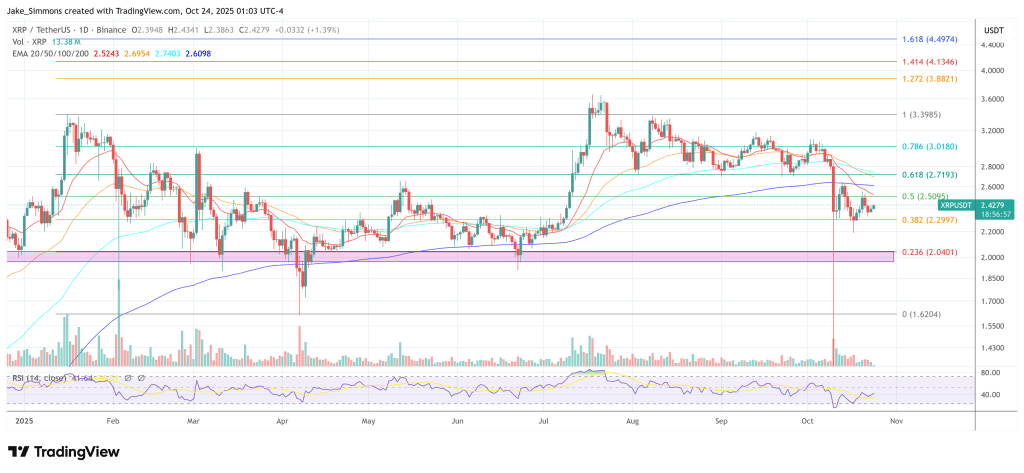
At press time, XRP traded at $2.42.

Related Posts