Florida Representative Webster Barnaby has filed House Bill 183, a reopened attempt to let state officials put public money into digital assets, including Bitcoin and crypto exchange-traded products.
According to the Florida Senate bill text, the proposal would let the Chief Financial Officer and the State Board of Administration manage investments in a range of tokenized holdings and set rules for how those holdings must be kept.
What The Bill Would Allow
Based on reports, HB 183 would permit up to 10% of certain public funds to be invested in “digital assets” and exchange-traded products.
The measure names possible sources such as the General Revenue Fund, the Budget Stabilization Fund, and trust funds, and it would allow the Florida Retirement System Trust Fund to allocate a similar share. Reports also say the bill broadens an earlier Bitcoin-only effort to cover tokenized securities, ETFs, and even NFTs.
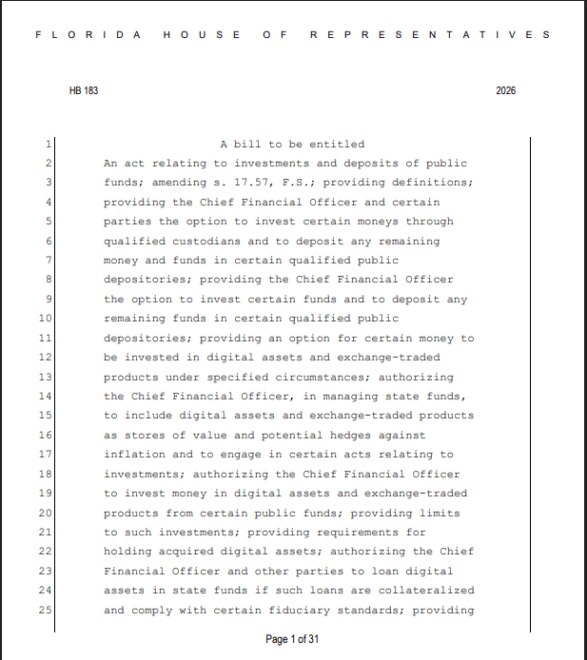
New bill introduced by Florida Rep. Webster Barnaby on Wednesday.
Safeguards And Custody Rules
According to the bill language and summaries, the proposal does not leave custody loose. It lays out specific holding and custody standards, allows assets to be kept by qualified custodians or held through exchange-traded products, and permits lending only when collateralized and consistent with fiduciary duties.
It would also require that any taxes or fees paid in crypto be converted into US currency before being credited to state accounts. Those measures are framed as guardrails to limit direct risk to state coffers.
As usual, Florida is taking the lead on a major issue. I am proud to be running this bill to place Florida on the cutting edge of financial technology, and to set the example for other states to follow! https://t.co/9CaAkMfv1z
— Webster Barnaby (@websterbarnaby) October 16, 2025
Where The Bill Came From And What Failed Before
This move follows an earlier effort that focused on Bitcoin and failed to pass committee. Reports have disclosed that the prior proposal collapsed in June, pushing the sponsor to file a broader, rewritten bill this month.
The new text is being read as a softer, more flexible take on the same idea — one that aims to give officials different routes to hold exposure while spelling out limits.
Stablecoin Measures Filed Alongside Investment Bill
State filings show Rep. Barnaby also introduced House Bill 175 to clarify rules for stablecoin issuers.
According to the bill page and media summaries, qualifying stablecoin issuers would need full collateral backing in US dollars or Treasury securities and public audits at least once a month, and some licensing requirements could be narrowed for those that meet the standards.
The aim appears to be creating a clear, state-level framework for certain payment-focused stablecoins.
Featured image from Playa Largo Ocean Residences, chart from TradingView

Related Posts