Quick Facts:
1️⃣ BlackRock’s spot Bitcoin ETF IBIT surpassed $100B less than two years after its release on January 11, 2024.
2️⃣ Larry Fink announced a long-term plan to tokenize all assets, from funds to stocks and cash.
3️⃣ Fink argues that bubbles don’t impact long-term investors and that time in the market outweighs opportunistic buy-ins.
4️⃣ Bitcoin’s Layer 2 project, Bitcoin Hyper ($HYPER) reaches $23.9M in presale and eyes a Q1 2026 release.
BlackRock’s spot Bitcoin ETF (IBIT) just surpassed $100B in assets under management (AUM), which prompted CEO Larry Fink to announce the company’s tokenization plans.
Fink made the comments during a CNBC interview, where he said:
I do believe we’re just at the beginning of tokenization of all assets, from real estate to equities to bonds, across the board.
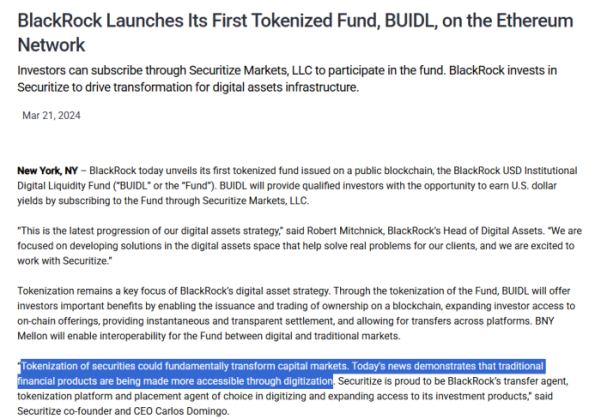
This comes over a year and a half after BlackRock launched its first tokenized fund, BUIDL, on the Ethereum network by partnering with Securitize.
In the official press release, Securitize’s co-founder and CEO, Carlos Domingo, said that BUIDL proves that tokenization is essentially unstoppable and that it will transform the capital market.
With over $1T in AUM, BlackRock’s decision to invest in tokenization tech stems from Bitcoin’s and Ethereum’s success, especially amid 2025’s rampant adoption wave.
This spells good news for Bitcoin Hyper’s ($HYPER) $23.9M presale which feeds Bitcoin’s coming Layer 2 with a projected Q1 2026 public launch.
How BlackRock Could Transform the Capital Market
Fink believes that asset tokenization is imminent and the key step to attracting digital investors into the TradFi market, which pack more unpopular products like retirement funds.
The overarching goal is to allow investors to hold multiple assets together, including funds, cash, and cryptos, which would represent a turning point for the capital market as a whole.
To that end, Fink pushes for ‘time in the market,’ as opposed to opportunistic buy-ins, as an anti-bubble strategy. As he sees it, it’s only opportunistic buyers who push the notion of financial bubbles due to their short time in the market.
This doesn’t happen with long-term investors who ride the bubbles to follow the larger trend.
If you put money to work on January 1st, 2000, a year later you had the Dot Com crysis, six years later you had the financial crisis, you had the COVID crysis; you still would’ve made 8% compound interest over the entire 25 years.
It’s not about if our markets are going up or down […] it’s about being in the market for the entire cycle.
The same mindset applies to the digital market and Bitcoin is the living proof of that. While opportunistic snipers often find themselves in hot waters – last Friday’s market crash anyone? – long-term investors who bought $BTC in 2011 are now up 169,000,000%.
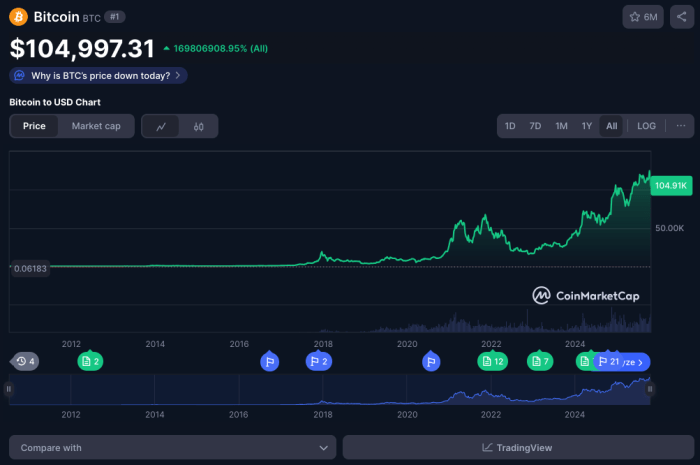
Bitcoin’s recent performance only adds to that. $BTC now trades at just under $106K after a 13.7% drop over the last week, which is painful for leverage traders, but neutral for long-term investors, because Bitcoin will eventually bounce back.
Especially with Bitcoin Hyper just around the corner.
How Bitcoin Hyper Promises to Change the Bitcoin Ecosystem
Bitcoin Hyper ($HYPER) aims to address Bitcoin’s most pressing problem: its performance limitation.
With a hard cap of seven transactions per second (TPS), Bitcoin currently ranks 22nd on the list of the fastest blockchains by TPS. This translates to slow confirmation times, high fees, and lack of scalability.
Hyper relies on tools like the Solana Virtual Machine (SVM) and the Canonical Bridge to change that.
Once the Bitcoin Relay Program confirms incoming transactions in milliseconds, the Bridge then mints the bitcoins on the Hyper layer, allowing you to use the wrapped assets with near-instant finality within the Layer 2 ecosystem.
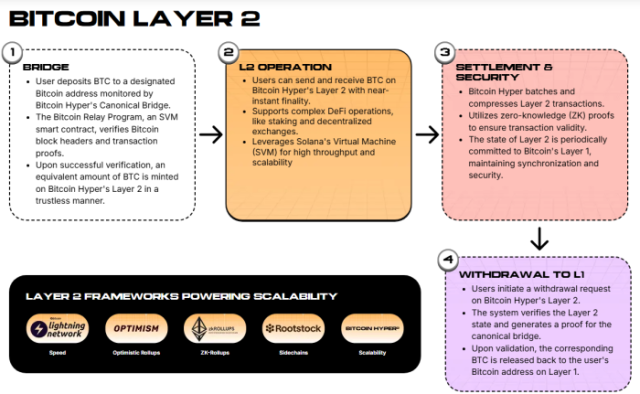
Long-term, Hyper aims to turn Bitcoin into a more feasible option for institutional investors by making the network faster, cheaper, and more scalable.
The project is seeing outstanding investor support, managing to reach $23.9M since its beginning and it’s still growing fast.
$HYPER is available right now at the presale price of $0.013125, which could be the lowest you could ever buy the token at.
Long-term investments, remember?
If you want to get in while you still can, check our guide on how to buy $HYPER and visit the presale page today.
This isn’t financial advice. Do your own research (DYOR) before investing.
Authored by Bogdan Patru, Bitcoinist: https://bitcoinist.com/blackrock-tokenization-bitcoin-etf-100b-hyper-surges

Related Posts