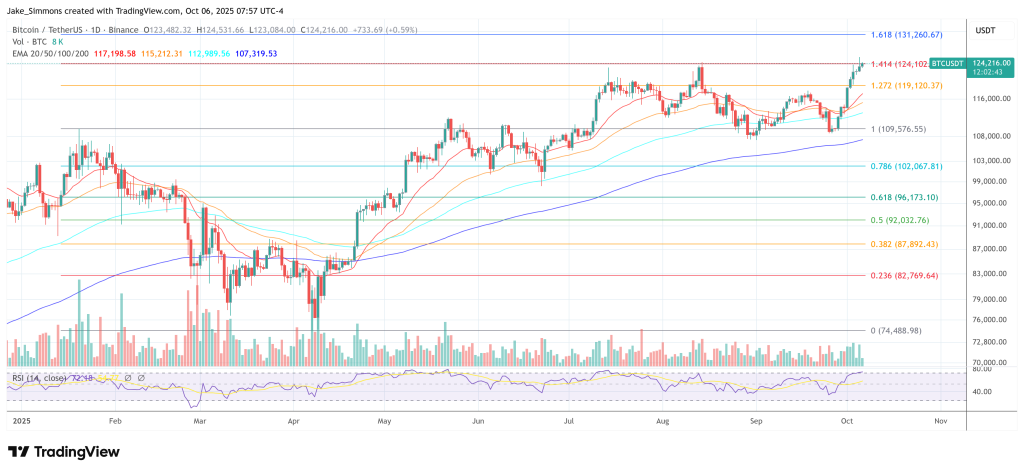
Bitcoin’s dramatic weekend spike to a fresh all-time high of $125,700 lacked real spot demand and was largely the product of leveraged speculation in thin conditions, according to crypto analyst Maartun, who characterized the move as a classic fakeout rather than a durable breakout. “Bitcoin prints a brand new all-time high, $125,700… But hold on a second. The price almost immediately reversed,” he said, framing the question that followed: “Was that move for real?”
The Truth Behind Bitcoin’s Weekend Surge
Maartun argues the answer sits in the futures market. Open interest—capital tied up in outstanding derivatives positions—“didn’t just go up, it absolutely exploded,” rising by more than $2.1 billion during the rally. In his telling, that surge came “over a weekend, which is a time when there are way fewer buyers and sellers around,” amplifying the impact of leveraged positioning in a low-liquidity window. “This whole move was driven by futures, by bets,” he said, adding that the jump in open interest, roughly 5%, turned the market into “a house of cards ready to fall over at the slightest touch.”
Equally important, Maartun says, is what did not happen: an influx of committed spot buyers to underpin the advance. Earlier in the week, he notes, Coinbase showed aggressive spot demand, trading about $110 above other venues—evidence of “real buyers… snapping up Bitcoin.” During the weekend push, that premium vanished. “The gamblers were placing their bets,” Maartun said, “but the investors, the people actually buying Bitcoin, they were sitting this one out.”
With those two “clues”—a derivatives-led surge and the absence of spot confirmation—Maartun’s verdict is unambiguous. “You can call it a fake out, you can call it a swing failure pattern, or you can even call it the head of a head and shoulders pattern… It was a trap. A move that was designed to look like the real deal, but had absolutely no substance behind it.” After the brief print at $125,700, price swiftly retraced “right back down to where the whole move started,” he added.
From here, Maartun identifies a single inflection point: $123,000. “This is the level… that is going to tell us whether the bulls or the bears take control from here,” he said. On confirmation criteria, he is explicit: “What we need to see is a strong, confident close above that $123K mark. That would signal acceptance… and a true breakout is probably coming.”
Failure to reclaim and hold that area, in his view, likely hands momentum back to sellers with an initial drawdown target around $117,500. He also cautions against expecting a repeat head-fake at the same level: “Fakeouts don’t usually happen twice in a row. The second attempt to break a level like this is very often the real deal one way or the other.”
The broader context to Maartun’s assessment is the unusual timing and texture of the move. Weekends in crypto “are normally kind of sleepy,” he said, yet this one delivered “the best weekend performance we’ve seen in four whole months”—a signal, in his analysis, not of rekindled spot enthusiasm but of how quickly leverage can dominate price in quiet order books. Without renewed spot leadership—such as a return of the Coinbase premium or other evidence of net spot accumulation—he sees the market “on a knife’s edge” at the $123,000 line in the sand: “Break out or pull back?”
At press time, Bitcoin held above $124,216.

Related Posts