A senior adviser to Russian President Vladimir Putin has alleged that the United States is preparing to use cryptocurrencies —specifically US dollar stablecoins—alongside gold to “devalue” and ultimately reset its towering national liabilities. Speaking at the Eastern Economic Forum in Vladivostok, Anton Kobyakov framed crypto and gold as “alternative currencies” to the dollar-centric system and argued that Washington aims to harness them to address what he called a crisis of confidence in the greenback.
“Right now, the United States is trying to change the rules on the gold and cryptocurrency markets. Just think about their debt – $35 trillion. These are two alternative currencies to the global market,” Kobyakov said.
He added: “Washington’s actions in this direction clearly demonstrate one of the main American goals. They want to solve the problem of lowering the dollar’s trust. The United States, as it was in the 1930s and 1970s, will solve its financial problems at the expense of the whole world, driving everyone into the cryptocurrency cloud.”
Kobyakov’s most arresting claim was operational: “Over time, when part of the US government debt is placed in stablecoins, the US will devalue this debt. In other words, they have a $35 trillion debt, they drive it into the cryptocurrency cloud, devalue it and start from scratch.” The remarks, which were circulated by Russian state-adjacent outlets, did not include a detailed mechanism for how “placing” sovereign obligations into stablecoins would alter their real value.
Russia just accused the US of using crypto to wipe out its $35T debt.
Putin’s adviser Kobyakov says Washington will shove debt into stablecoins, devalue it, and reset the system.pic.twitter.com/IwmiLYp2ic
— TFTC (@TFTC21) September 8, 2025
Can Bitcoin And Crypto (Stablecoins) Erase The US Debt?
The accusation lands amid two relevant backdrops: a US debt load now measured in the mid-$30 trillions and a fast-expanding stablecoin and tokenized-Treasury ecosystem that nonetheless remains orders of magnitude smaller than public debt. Treasury data and Congressional dashboards put gross federal debt at roughly $37.4 trillion in early September, with about $30.1 trillion held by the public. By contrast, the entire stablecoin market stands in the high-$200 billions, and tokenized US Treasury products total about $7.4 billion—hardly a platform capable of “absorbing” sovereign liabilities at scale.
US policy developments complicate Kobyakov’s narrative in another way. In July, President Donald Trump signed the GENIUS Act, the first federal framework for payment stablecoins. The law requires 100% reserve backing in cash and short-term Treasuries and mandates regular public disclosures—design choices that, if anything, tie stablecoin growth to incremental demand for Treasury bills rather than a mechanism for extinguishing US obligations. That is, more regulated stablecoins typically mean more private-sector buying of T-bills to back those tokens, not fewer Treasuries outstanding.
Kobyakov’s historical analogy—invoking the 1930s and 1970s—references episodes when US authorities changed the monetary regime: FDR’s dollar devaluation against gold in 1933–34 and Nixon’s 1971 closure of the gold window. But translating that precedent into a “stablecoin devaluation” is tenuous.
Stablecoins are issued by private or specially licensed entities and are designed to be redeemed at par; moving government liabilities “into” them would neither novate the debt nor change its legal terms. Any genuine devaluation of dollar-denominated debt would still occur via familiar channels—higher inflation, negative real rates, buybacks at discounts, or maturity transformation—not by wrapping the debt in token form.
Beyond the stablecoin debate, Washington has already sketched an alternative pathway: a Strategic Bitcoin Reserve. On March 6, 2025, the White House issued an executive order establishing a federal bitcoin reserve alongside a US Digital Asset Stockpile to manage government-owned crypto (largely from forfeitures) on a long-term, “budget-neutral” basis; companion legislation—the BITCOIN Act introduced in both chambers—would codify governance and disclosure rules.
US President Donald Trump himself has floated the idea in blunt terms. In an Aug. 2024 Fox Business interview with Maria Bartiromo, he mused: “Who knows? Maybe we’ll pay off our $35 trillion, hand them a little crypto check, right? We’ll hand them a little Bitcoin and wipe out our $35 trillion.” The remark was rhetorical rather than an operational plan, but it prefigured the administration’s March 6, 2025 executive order establishing a Strategic Bitcoin Reserve.
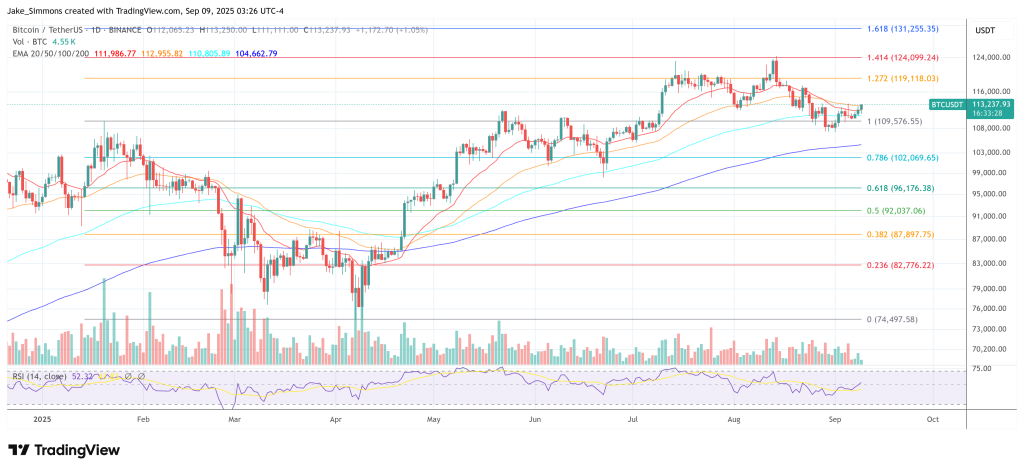
At press time, Bitcoin traded at $113,237.

Related Posts