US President Donald Trump’s son, Eric Trump, has shared some insight into his shift to the crypto industry, the problems with the traditional financial system, and how it was “weaponized” against the Trump family businesses.
Trump Family Pushed Into Crypto
In a recent interview with The Wall Street Journal, Eric Trump detailed how financial institutions “made him” embrace the crypto industry, explaining that after the January 6, 2021, riot at the US Capitol, several banks cut the Trump family off.
Trump shared that hundreds of accounts for the family’s business were shut down without an explicit reason, leaving the Trump Organization “debanked” and “scattering millions across accounts at regional banks before eventually migrating to a new bank,” which he did not name.
“At that time, I realized how fragile the financial system was and how easily it could be weaponized against you,” he affirmed, arguing that the decisions were likely political, leading him to turn to the crypto industry.
According to the interview, Eric Trump, executive vice president at the Trump Organization, began warming up to the industry during his father’s second presidential campaign, as he became aware of the struggles of crypto companies with banking services.
Previously, he told CNBC that being “the most canceled company, probably on Earth,” is what drove the Trump family towards crypto, explaining that his entry into the industry wasn’t a financial bet but “a form of resistance.”
“This whole system was weaponized against them, no different than it had been weaponized against us for different reasons,” Trump told the Wall Street Journal, noting that both conservatives and crypto firms have alleged that banks have denied them services for political or religious reasons.
The Trump administration has made stopping the crackdown on the sector a top priority. Crypto industry leaders have accused the previous administration of using financial exclusion as a weapon against numerous companies and founders, in what many have named “Operation Chokepoint 2.0.”
In December, the Securities and Exchange Commission (SEC) Commissioner Hester Peirce urged the regulatory agency to “stop the chokepoint aspect of government regulation.” Since then, the Commission dropped its “regulation by enforcement” approach, launched its Crypto Task Force, and recently unveiled the “Project Crypto” initiative to modernize securities rules and regulations.
Earlier this month, President Trump addressed this issue, signing an executive order that requires banks to ensure they do not refuse financial services based on political or religious beliefs and directs regulators to review all institutions for any discriminatory practices.
A Gateway To Financial Freedom
Eric Trump also addresses the conflicts of interest allegations, asserting that there’s a separation between the family’s crypto businesses and President Trump’s official businesses. “I literally have nothing to do with Washington, D.C.,” he affirmed.
It’s worth noting that multiple US lawmakers have argued that the Trump family’s crypto ventures, including World Liberty Financial’s (WLFI) USD1 stablecoin and the official TRUMP memecoin, enable corruption and represent a threat to America’s financial system.
Nonetheless, Trump said in the interview that memecoins serve as a “powerful gateway” for newcomers, arguing that “If somebody wants to go in and they want to buy $TRUMP, congratulations, now you have access to Bitcoin, you have access to Ethereum, you have access to USD1, you have access to the United States dollar.”
You just took the first step in actually creating some financial freedom that I think so many people around the world want.
He closed the interview discussing the benefits of tokenizing real-world assets (RWA). “Why is it that if I wanted to refinance Trump Tower, I couldn’t tokenize this asset and put it on the street for billions of people around the world to otherwise invest in it. They love New York. They love Fifth Avenue. They love Trump,” he concluded.
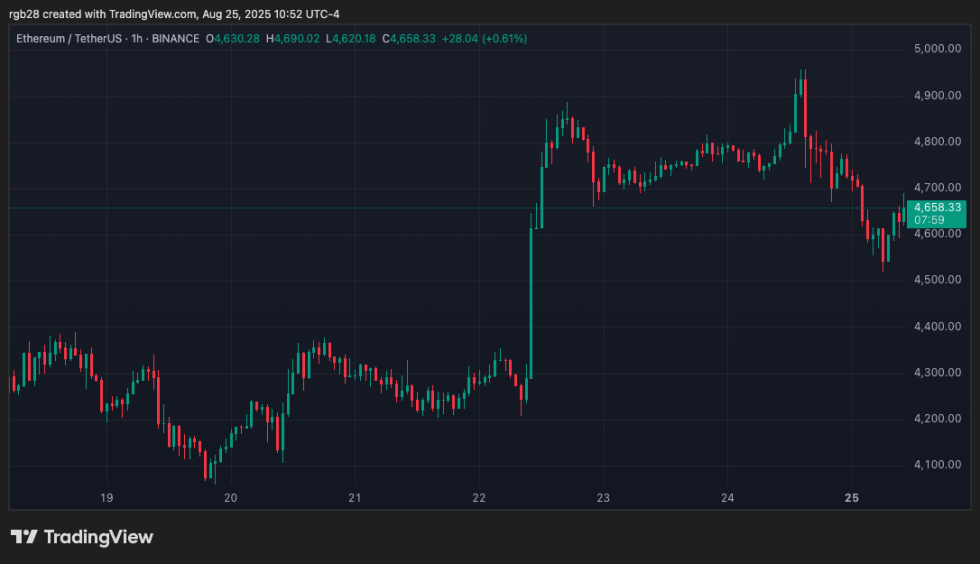
Ethereum (ETH) trades at $4,558 in the one-week chart. Source: ETHUSDT on TradingView

Related Posts