CryptoQuant has pushed back on popular Bitcoin “supply shock” claims, revealing BTC exiting exchanges is just shifting to ETF custody.
Bitcoin Leaving Exchanges Has Just Moved Into ETFs
In a new post on X, on-chain analytics firm CryptoQuant has addressed a popular idea that’s present among cryptocurrency traders: that a decline in the Exchange Reserve implies a supply shock could be coming.
The “Exchange Reserve” here refers to a metric that keeps track of the total amount of Bitcoin that’s being held in wallets associated with all centralized exchanges.
Generally, investors keep their coins on these platforms when they want to use one of the services that they provide, which can include selling. As such, it’s often assumed that the tokens sitting on the exchanges represent the sell supply of the asset.
An increase in it, therefore, could be a bearish signal for the cryptocurrency. Similarly, a decline could prove to be a bullish sign instead, as it suggests the BTC available for trading is becoming scarcer.
This has been the traditional interpretation of what the Exchange Reserve’s trends mean for the market. Today, while the idea does still hold some weight, there is more to the story than just exchanges. Namely, there exists an alternative means of trading Bitcoin now: spot exchange-traded funds (ETFs).
Launched in the US at the start of last year, the spot ETFs are still relatively new, but they have quickly cemented themselves as an important corner of the sector. In other words, the full picture of the market today requires looking not only at the exchanges, but also these new funds.
Below is the chart shared by CryptoQuant that shows the trend in the Bitcoin Exchange Reserve, as well as the holdings of the spot ETFs, over the history of the cryptocurrency:
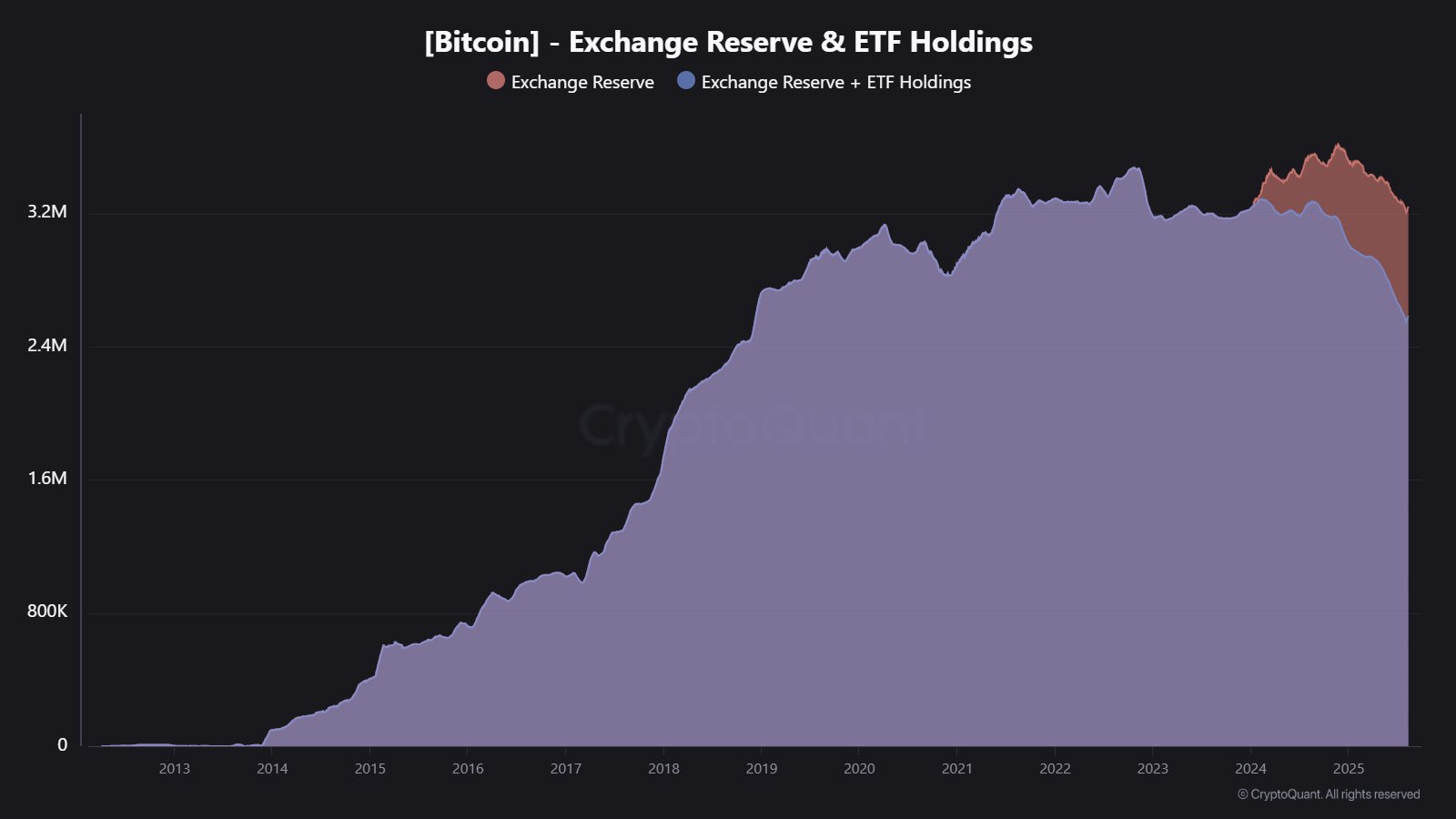
Looks like the Exchange Reserve has been on the decline since a while now | Source: CryptoQuant on X
As displayed in the above graph, the Bitcoin Exchange Reserve has been following a steep downward trajectory since last year, a sign that investors have constantly been withdrawing coins from the custody of these central entities.
This trend has made some traders believe that the asset is becoming scarcer on the market, a classic bullish signal. But as is apparent from the chart, the rise of the ETFs has offset this decline, meaning that the combined supply held across funds and exchanges is in fact unchanged from its baseline from the last few years.
Based on this, CryptoQuant has concluded that the reality isn’t that of a supply shock brewing, but rather that of supply moving from one type of custody to another. “Same coins, different wrapper,” notes the analytics firm.
BTC Price
Bitcoin slipped below $115,000 during the past day, but it appears the coin has found a small rebound as its price is now back at $116,600.
The price of the coin seems to have gone down over the last few days | Source: BTCUSDT on TradingView

Related Posts