The UK’s former Chancellor of the Exchequer, George Osborne, has criticized the government’s approach to the crypto industry, arguing that they must “catch up” or risk being “left behind” during the second wave of digital assets.
UK To Miss Second Crypto Wave?
On Monday, former Chancellor and member of Coinbase’s advisory council, George Osborne, weighed in on Chancellor Rachel Reeves and Bank of England governor Andrew Bailey’s crypto strategy.
In an opinion piece for the Financial Times, Osborne asserted that a decade ago, the government’s message was “If crypto is happening, then we want it to happen here.” However, he considers that “far from being an early adopter, we have allowed ourselves to be left behind.”
The former Chancellor explained that since he used Britain’s first Bitcoin ATM 11 years ago, the UK has had multiple chancellors vowing to support the industry, but “next to nothing has happened.” As a result, they had lost the opportunity to lead the crypto industry while US authorities remained skeptical.
Now, “having missed the first crypto wave, we’re about to miss the second: stablecoins,” he affirmed, noting that, unlike the UK, the EU has legislated crypto, and the US just signed into law the GENIUS Act to make America “the center of the stablecoin revolution.”
We’re still deliberating. The chancellor says she’ll “drive forward” on stablecoins, whatever that means, while the Bank of England’s governor remains unconvinced that commercial banks should issue them. This hesitation risks irrelevance.
A Call To ‘Catch Up’
Osborne argued that UK authorities cannot continue to wait and evaluate the development of the digital revolution, “reminiscent of Nigel Lawson’s Big Bang in the 1980s,” while other financial capitals, including Singapore, Hong Kong, and Abu Dhabi, adopt comprehensive legislative frameworks for crypto asset platforms.
Notably, the UK’s Financial Conduct Authority (FCA) is working to establish a more comprehensive regulatory framework for digital assets starting next year. The financial watchdog has released a Discussion Paper on the features of the upcoming crypto regime as part of its crypto roadmap to expand to a more comprehensive regulatory framework.
The HM Treasury has also published a draft and an explainer document detailing the intended policy outcomes of proposed provisions to establish a complete regime for cryptocurrencies.
The proposed rules are expected to bring exchanges, dealers, and agents into regulatory limits, crack down “on bad actors while supporting legitimate innovation,” and set clear transparency, consumer protection, and operational resilience standards, like traditional financial institutions.
Last week, the FCA announced its plans to lift the current restrictions on crypto exchange-traded notes (cETNs) for retail investors, starting in October. Additionally, it has introduced a new set of reporting rules to ensure crypto investors are not deliberately evading taxes.
According to the former Chancellor, some of the proposed rules, like requiring sterling stablecoins to be backed only by central bank reserves, guarantee that the UK doesn’t lead the sector, as major financial players will continue to innovate “regardless of the Bank of England’s stance.”
Osborne considers that blaming regulators is “a lame excuse,” as the current restrictive approach “ensures the pound won’t even play a supporting role.” He urged ministers to embrace innovation and set the long-awaited framework.
“We became the world’s financial centre because we weren’t afraid of change. On crypto and stablecoins, as on too many other things, the hard truth is this: we’re being completely left behind. It’s time to catch up,” he concluded.
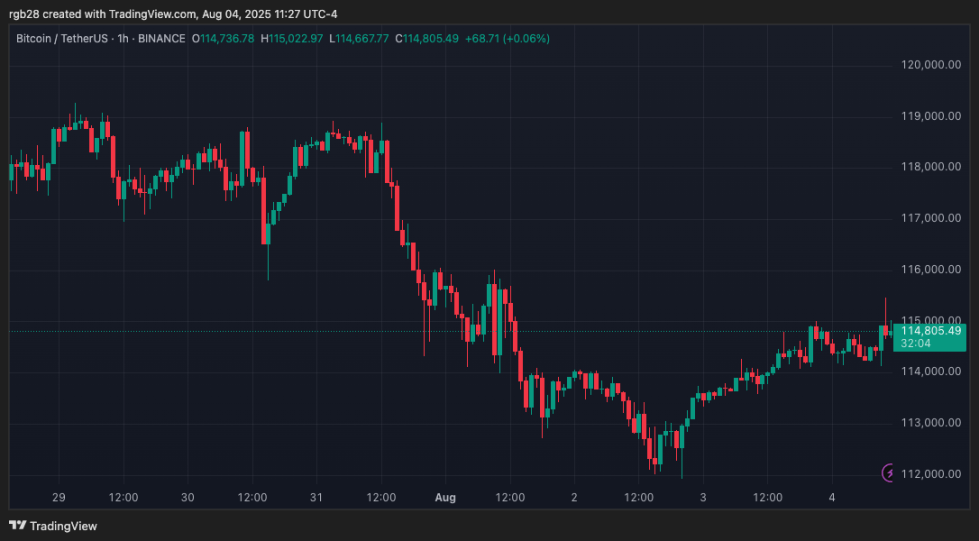
Bitcoin trades at $114,805 in the one-week chart. Source: BTCUSDT on TradingView

Related Posts