Bitcoin Price Volatility Far Lower Than During COVID-19 Crash — What This Means

bitcoinist发布于2025-04-12更新于2025-04-13

文章摘要

Over the past few weeks, the cryptocurrency market has been overwhelmed by a high degree of uncertainty and volatility triggered...

Trusted Editorial content, reviewed by leading industry experts and seasoned editors. Ad Disclosure

Over the past few weeks, the cryptocurrency market has been overwhelmed by a high degree of uncertainty and volatility triggered by the constantly shifting global macroeconomics. This unsettled market condition saw the Bitcoin price dance between $74,000 and $83,000 in the space of a few days.

The price of BTC sank toward $74,000 at the start of the past week as crypto investors panicked after United States President Donald Trump announced new trade tariffs. On Thursday, April 10, the premier cryptocurrency reclaimed the $83,000 level after President Trump paused trade tariffs on all countries except China.

Is Bitcoin Now A ‘Mature Asset’?

The Bitcoin price has been quite reactive to virtually every piece of news in the global trade, demonstrating the highly volatile state of the cryptocurrency market. However, an on-chain analytics expert has explained that the volatility of the current Bitcoin market pales in comparison to past episodes.

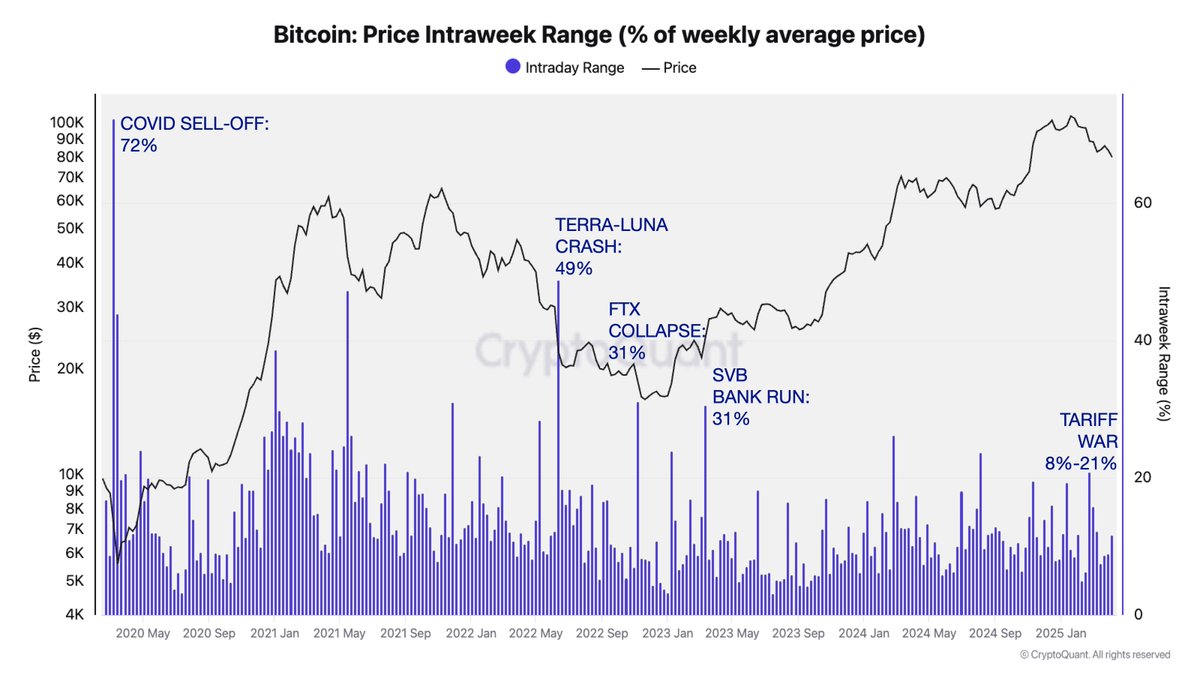
In a new post on the social media platform X, CryptoQuant’s head of research, Julio Moreno, revealed that the Bitcoin price volatility in the ongoing global trade drama has been “so far lower” than that from other past events, such as the COVID-19 crash, Terra-Luna collapse, FTX downfall, and the Silicon Valley Bank (SVB) bank run.

The relevant indicator here is the Price Intraweek Range metric, which estimates the percentage change in the average weekly price of Bitcoin. According to data from CryptoQuant, the Bitcoin Price Intraweek Range climbed to an all-time high of 72% during the COVID-19 market downturn in April 2020.
Bitcoin price

Source: @jjcmoreno on X

The chart above shows that the BTC Intraweek Range metric surged to 49% after the crash of the Terra Luna ecosystem in May 2022. Meanwhile, the indicator reached 31% following the collapse of the Sam-Bankman-Fried-led FTX exchange in late 2022 and the SVB bank run in early 2023.

With the escalating trade tensions between the United States and China, the Bitcoin Price Intraweek Range metric stands between 8% – 21%. This reduced volatility suggests that the premier cryptocurrency has matured as an asset, with deeper liquidity and a better market structure.

The relatively stable price action can be connected to the growing base of long-term holders and steady corporate adoption, as institutional players are beginning to view the world’s largest cryptocurrency less as a high-risk asset and more as a hedge against macroeconomic uncertainties.

Bitcoin Price At A Glance

As of this writing, the price of BTC stands at around $83,700, reflecting a 5% increase in the past 24 hours.

Bitcoin price

The price of BTC returns to above $83,000 on the daily timeframe | Source: BTCUSDT chart on TradingView

Featured image from iStock, chart from TradingView
Editorial Process for bitcoinist is centered on delivering thoroughly researched, accurate, and unbiased content. We uphold strict sourcing standards, and each page undergoes diligent review by our team of top technology experts and seasoned editors. This process ensures the integrity, relevance, and value of our content for our readers.

Opeyemi Sule is a passionate crypto enthusiast, a proficient content writer, and a journalist at Bitcoinist. Opeyemi creates unique pieces unraveling the complexities of blockchain technology and sharing insights on the latest trends in the world of cryptocurrencies. Opeyemi enjoys reading poetry, chatting about politics, and listening to music, in addition to his strong interest in cryptocurrency.

你可能也喜欢

2026年或将如何重新定义以太坊、Solana、Base和Avalanche

2026年,区块链基础设施正经历重大转型,重点从散户采用转向满足日益增长的机构需求。目前,公有链上承载着超过300亿美元的代币化现实世界资产(RWA),暴露出现有网络在处理能力、结算速度、合规性和可靠性方面的不足。因此,以太坊、Solana、Base和Avalanche等主要区块链正在从协议层面进行根本性重构,旨在为机构级金融活动提供支持。 以太坊通过“Glamsterdam”升级,将大幅提高Gas限制并引入新的核心功能,为并行执行做准备。Solana的“Alpenglow”升级则着重重构共识机制,将最终确认时间从12.8秒大幅缩短至约100-150毫秒,并减少网络资源消耗。Base正在开发“Beryl”,旨在通过B20代币标准提供更好的合规资产发行框架。Avalanche的“Octane”升级则在提升交易处理速度的同时,降低企业应用部署成本。 这些升级显示,竞争焦点正从单纯追求速度,转向基础设施的长期可靠性、监管合规性和机构适用性。随着升级在2026至2027年陆续部署并投入生产,能够持续提供稳定结算、合规兼容且抗压能力强的网络,将最有可能吸引未来的大规模代币化资本。技术升级本身不会决定最终赢家,已被验证的实际执行能力和现有生态系统优势(如以太坊在合规标准和流动性上的领先地位)将是关键。

ambcrypto6分钟前

2026年或将如何重新定义以太坊、Solana、Base和Avalanche

ambcrypto6分钟前

Tiger Research:先把 RWA 代币化搬到海外去

文章探讨了在监管尚不完善的地区,金融机构如何通过海外扩张推进实物资产(RWA)代币化。当前RWA市场增长迅速,但监管滞后阻碍了发展。金融机构面临等待立法、使用监管沙盒或进入海外市场的战略选择。文章建议,鉴于RWA的全球性,优先考虑在监管成熟的海外市场积累经验是抢占先机的关键。 跨境RWA业务要求精细规划,涉及六个核心准备领域:选择海外基地与路径(如香港、新加坡、美国)、获取必要牌照、定义代币化资产类型、明确目标投资者范围、设计结算币种与支付流程,以及安排好托管、区块链选择等运营细节。 具体进入路径主要有两种: 1. **直接进入成熟司法管辖区**:例如香港、新加坡或美国。这些地区监管框架相对清晰,并存在可加速落地的成熟平台(如香港的HSBC Orion、美国的Securitize)。机构可利用现有海外实体或与本地平台合作,以降低入场门槛和缩短时间。 2. **采用链上原生路径**:通过与Ondo Global、Plume Nest等具备内建合规能力的链上平台合作,直接设计链上发行与流通结构。这种方式可以绕过在特定地区建立实体存在的复杂程序,实现更快的市场进入和更广泛的流动性对接,但结构设计复杂且监管指引较少。 文章最后通过一个假设案例,说明一家中型券商如何分步骤(评估现有基地与牌照、选择平台、合规与产品设计、搭建托管与运营结构、最终发行验证)在香港完成一次债券代币化发行的完整流程。 核心结论是:在监管空窗期,等待并非最佳策略。金融机构应主动评估并选择适合自身的海外或链上路径,尽快通过实际运营积累经验,因为市场的竞争不会等待监管完全就绪。实现成功销售,完成从结构设计到投资者到位的全流程,才是代币化业务落地的实质。

marsbit17分钟前

Tiger Research:先把 RWA 代币化搬到海外去

marsbit17分钟前

Reddit一张神图疯传,2年后,你的笔记本就能跑Fable 5

近日,r/LocalLLaMA社区的一张趋势图引发热议。该图梳理了历代前沿AI模型从云端发布到在消费级硬件上实现同级本地运行的时间间隔:GPT-3级能力约37个月,GPT-3.5级约17个月,GPT-4级约24个月,Claude 3.5 Sonnet/GPT-4o级约21个月,平均周期约为24.8个月。 依据这一趋势线外推,发帖人预测,目前被视为前沿的Fable/Mythos 5级AI能力,预计将在2028年7月左右,实现在高端笔记本电脑上本地、实用化的运行。这意味着未来用户可能无需依赖云端服务、订阅或担心数据隐私,通过一次性硬件投入即可获得顶级AI能力。 支撑该预测的主要因素包括:模型端通过MoE架构、量化技术、更好的强化学习与数据配方持续提升效率,使同等能力所需算力不断下降;现实端开源模型的追赶速度加快,例如Gemma 4 31B等模型已在多项基准测试中逼近甚至超越早期的Claude Opus与GPT-4水平。 这一趋势预示着AI能力正从云端垄断加速向桌面端民主化扩散。尽管当前存在模型访问的地域性管制,但历史表明,前沿能力难以被长期限制在云端。对于开发者、硬件厂商及整个行业而言,本地化、隐私保护、离线工作流等方向将变得愈发重要。最终,这张图以一种乐观的视角指出:技术扩散的时间力量,可能正悄然改变着AI能力的获取格局。

marsbit38分钟前

Reddit一张神图疯传,2年后,你的笔记本就能跑Fable 5

marsbit38分钟前

交易

现货
活动图片