Charles Hoskinson, the founder of Cardano, has revealed substantial progress in the development and research of new protocols. Via X, Hoskinson stated: “Ouroboros Peras is one of the best prototyped protocols we have—a literate Agda specification, a CIP, simulations, and a working prototype prior to the final paper being published. Already negotiating implementation SoW.”
Moreover, Hoskinson made public that human resources are now allocated to Ouroboros Leios. “Research and innovation are dramatically speeding up. The team is now moving all resources to Leios, and 6.8 FTEs are already working on rapid innovation,” he remarked.
The mention of “implementation SoW” refers to the negotiation of an Implementation Statement of Work, a formal document that outlines the specific tasks, deliverables, timelines, and resources required to implement Ouroboros Peras into the Cardano network. Thus, Hoskinson indicates that the protocol is moving beyond theoretical research and into practical application stages.
Cardano’s Next Leap: Ouroboros Peras
Ouroboros Peras represents an enhancement to the existing Ouroboros Praos protocol, introducing a voting layer designed to achieve fast settlement of transactions. According to the project’s GitHub repository: “We propose Ouroboros Peras, an enhancement to the Ouroboros Praos protocol that introduces a voting layer for fast settlement. It is adaptively secure, supports dynamic participation, and integrates self-healing.”
The primary motivation behind Ouroboros Peras is to address the probabilistic nature of block settlement in the current Ouroboros Praos protocol. Under Praos, the probability that a Cardano block will be rolled back decreases exponentially as the blockchain grows beyond that block. However, this can lead to potentially lengthy wait times before a transaction is considered settled or finalized, which is less than ideal for certain use cases that require rapid confirmation.
Peras introduces a mechanism where blocks can receive a “boost” through a quorum of votes, dramatically reducing the likelihood of those blocks and their predecessors being rolled back. This enhancement is particularly significant for scenarios that demand high assurance in a brief period, such as partner chains, bridges, and centralized exchanges that currently require multiple confirmations before considering a transaction settled.
The protocol is designed to be adaptively secure, supporting dynamic participation and integrating self-healing capabilities. It operates effectively even when adversaries control up to one-quarter of the network’s stake. In cases where adversaries prevent voting quorums, the protocol gracefully falls back to Praos-like behavior, entering a “cool-down period” until the chain heals and achieves chain quality and a common prefix.
For realistic settings of the Peras protocol parameters, blocks can be identified post facto as being settled versus rolled back after as little as two minutes, with overwhelming probability. This post facto settlement probability is crucial for use cases where entities can monitor the ledger for a fixed time to ascertain the permanence of transactions.
Ouroboros Leios
Building on the momentum from Ouroboros Peras, Hoskinson announced that the development team is reallocating all resources to focus on Ouroboros Leios, with 6.8 Full-Time Equivalents (FTEs) dedicated to rapid innovation in this new project.
Ouroboros Leios is a new variant within the Ouroboros family of protocols and is currently in an experimental and exploratory phase. The motivation for developing Leios is to substantially increase throughput—both in terms of data and CPU processing—while maintaining or enhancing the security properties of previous Ouroboros variants.
Existing Ouroboros protocols, including Praos and Genesis, are limited in the throughput they can achieve due to inherent data and communication dependencies within the distributed algorithm. Leios aims to overcome these limitations by redesigning the algorithm to reduce these dependencies, thereby enabling higher data throughput and more efficient CPU processing.
Additionally, Leios presents an opportunity to incorporate modern features into the Cardano blockchain, such as tiered transaction fees with corresponding levels of service priority and faster chain synchronization by eliminating the need to execute every smart contract during synchronization.
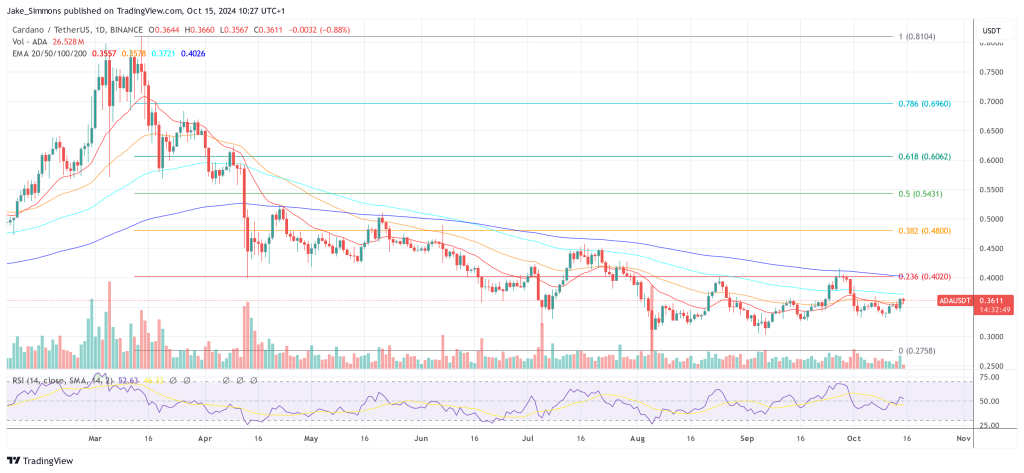
At press time, ADA traded at $0.3611.

Related Posts