Why Did Market Sentiment Collapse Completely in 2025? Deciphering Messari's 100,000-Word Annual Report

marsbitXuất bản vào 2025-12-23Cập nhật gần nhất vào 2025-12-23

Tóm tắt

The 2025 crypto market experienced a historic collapse in sentiment, with the Crypto Fear & Greed Index hitting extreme fear levels of 10, despite the absence of systemic failures like exchange collapses or major bankruptcies. Messari's analysis attributes this not to industry failure, but to a deep structural shift: the market is transitioning from a speculative alpha-seeking environment to one dominated by institutional, long-term asset allocators. The core issue is a misalignment of participant identity. While institutions benefited from clear regulations, ETFs, and corporate treasury adoption (DATs), retail traders and active participants suffered from significantly reduced alpha, ineffective narrative cycles, and chronic underperformance of most assets against Bitcoin. The root cause of the emotional breakdown is identified as a crisis in the traditional global monetary system. With government debt consistently outpacing GDP growth worldwide, savers are systematically penalized through inflation, low real interest rates, and financial repression. Crypto, particularly Bitcoin, is not merely a tool for higher returns but offers a predictable, rules-based, and self-custodial monetary alternative. Bitcoin has decisively won the "monetary" competition. Its 429% price appreciation from 2022-2025 and dominant market share (57.3% of total crypto market cap) reflect its role as a non-sovereign store of value. Its "boring" reliability—lacking narratives or promises—is its great...

This article is based on the annual report "The Crypto Theses 2026" released by Messari in December 2025. The full report exceeds 100,000 words, with an official estimated reading time of 401 minutes. The information herein is for reference only and does not constitute any investment advice or offer. We are not responsible for the accuracy of the content, nor do we assume any consequences arising therefrom.

Introduction | The Worst Year for Sentiment, But Not the Most Fragile Year for the System

If we look only at sentiment indicators, the crypto market in 2025 could almost be pronounced "dead."
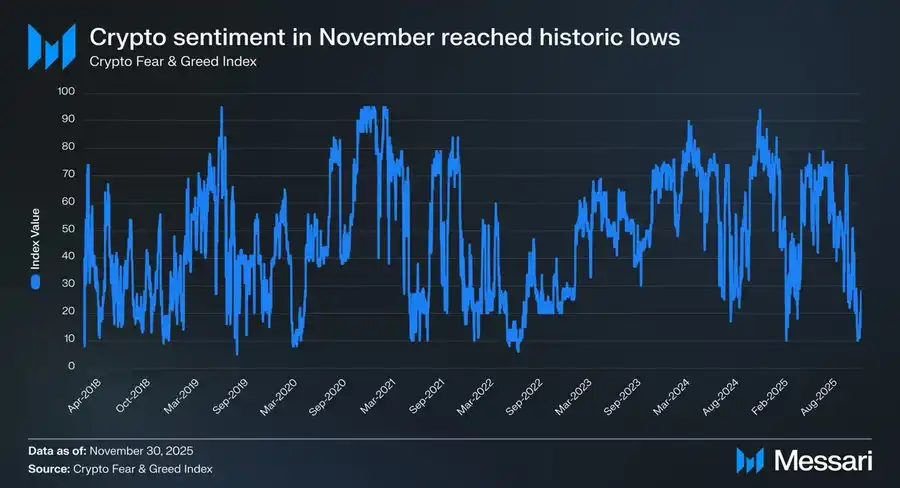
In November 2025, the Crypto Fear & Greed Index fell to 10, entering the "Extreme Fear" zone.

Historically, there have been very few moments when sentiment has fallen to this level:

· March 2020: Liquidity stampede triggered by the global pandemic

· May 2021: Chain reaction of leveraged liquidations

· May–June 2022: Systemic collapse of Luna and 3AC

· 2018–2019: Industry-wide bear market

These periods all share a commonality: the industry itself was failing, and the future was highly uncertain.

But 2025 does not fit this description. No major exchanges misappropriated user assets, no Ponzi projects with market caps of tens of billions of dollars dominated the narrative, the total market capitalization did not fall below the previous cycle's high, stablecoin scale instead hit a new all-time high, and regulatory and institutionalization processes continued to advance.

At the "fact level," this is not a year of industry collapse. However, at the "feeling level," it might be the most painful year for many practitioners, investors, and long-time users.

Why Did Sentiment Collapse?

Messari presents a highly impactful contrast at the beginning of the report:

If you were participating in crypto asset allocation from a Wall Street office building, 2025 might have been the best year since you entered the industry. But if you were staying up late watching charts and searching for Alpha in Telegram and Discord, this is probably the year you missed the "old days" the most.

The same market, two almost diametrically opposed experiences. This is not an accidental mood swing, nor a simple bull-bear switch, but a deeper structural misalignment: the market is changing participants, but most people are still participating in the new system with their old identities.

This Is Not a Market Recap

This article does not intend to discuss short-term price movements, nor does it attempt to answer "will it go up next?".

It is more like a structural explanation:

· Why, while institutions, capital, and infrastructure are continuously strengthening,

· did market sentiment slide to a historic low?

· Why do many people feel "they chose the wrong track," but the system itself has not failed?

In this 100,000-word report, Messari chooses to start from an extremely primitive question: If crypto assets are ultimately a form of "money," then who deserves to be treated as money?

Understanding this is a prerequisite for understanding the complete collapse of market sentiment in 2025.

Chapter 1 | Why Was Sentiment Abnormally Low?

If we look only at the outcome, the sentiment collapse of 2025 is almost "incomprehensible."

In the absence of exchange blow-ups, systemic credit collapses, or core narrative failures, the market nonetheless gave feedback接近 (close to) historical lows in sentiment.

Messari's judgment is very direct: This is an extreme case of "severe decoupling between sentiment and reality."

1. Sentiment Indicators Have Entered a "Historical Anomaly Zone"

The Crypto Fear & Greed Index falling to 10 is not an ordinary correction signal.

In the past decade, this value has only appeared at very few moments, and each time it appeared, it was accompanied by real and profound industry-level crises:

· Breakdown of the funding system

· Collapse of credit chains

· Market doubt about "whether the future exists"

But these problems did not appear in 2025.

No core infrastructure failed, no mainstream assets were liquidated to zero, and no systemic events occurred that could shake the industry's legitimacy. From a statistical perspective, this sentiment reading does not match any known historical template.

2. The Market Did Not Fail; "Personal Experience" Did

The collapse of sentiment did not come from the market itself, but from the subjective experience of the participants. Messari repeatedly emphasizes an overlooked fact in the report: 2025 was a year where the institutional experience was far better than the retail experience.

For institutions, this was an extremely clear, even comfortable environment:

· ETFs provided low-friction, low-risk allocation channels

· DATs (Digital Asset Treasuries) became stable, predictable long-term buyers

· Regulatory frameworks began to clarify, and compliance boundaries gradually became visible

But for a large number of participants under the old structure, this year was exceptionally brutal:

· Alpha significantly decreased

· Narrative rotation failed

· Most assets underperformed BTC for a long time

· The relationship between "degree of effort" and "results" was completely broken

The market did not reject people; it just changed the reward mechanism.

3. "Not Making Money" Was Misinterpreted as "The Industry Is Failing"

The real trigger for sentiment was not price decline, but cognitive dissonance. In past cycles, the implicit assumption of Crypto was: as long as you are diligent enough, early enough, and aggressive enough, you can obtain超额回报 (excess returns).

But 2025 was the first time this assumption was systematically broken.

· Most assets no longer gained premiums for "storytelling"

· L1 ecosystem growth no longer automatically translated into token returns

· High volatility no longer meant high returns

The result was that many participants began to have an illusion: If I didn't make money, then the entire industry must have a problem. Messari's conclusion is恰恰相反 (precisely the opposite): The industry is becoming more like a mature financial system, not a machine that continuously produces speculative红利 (dividends).

4. The Essence of the Sentiment Collapse Is Identity Misalignment

Synthesizing all phenomena, the implicit answer given by Messari is only one: The sentiment collapse of 2025 is essentially an identity misalignment.

· The market is tilting towards "asset allocators," "long-term holders," and "institutional participants"

· But a large number of participants still exist with the identity of "short-term Alpha seekers"

When the system's reward logic changes, and the participation method does not adjust同步 (synchronously), sentiment is必然 (bound to) collapse first. This is not a personal capability issue, but the friction cost of an era角色切换 (role shift).

Summary | Sentiment Did Not Tell You the Truth

The market sentiment of 2025 truly reflected the pain of the participants, but did not accurately reflect the state of the system.

· Sentiment collapse ≠ Industry failure

· Increased pain ≠ Value disappearance

It only提示 (indicated) one thing: the old way of participation is quickly becoming obsolete. Understanding this is a prerequisite for entering the next chapter.

Chapter 2 | The True Root of the Sentiment Collapse: The Monetary System Is Failing

If we stay only at the market structure level, the sentiment collapse of 2025 is still not fully explained. The real problem is not:

· Alpha decreased

· BTC is too strong

· Institutions entered

These are only superficial phenomena. The deeper judgment given by Messari in the report is: The collapse of market sentiment essentially stems from a long-ignored fact—the monetary system we are in is continuously putting pressure on savers.

A Chart That Must Be Faced: Global Government Debt Is Out of Control
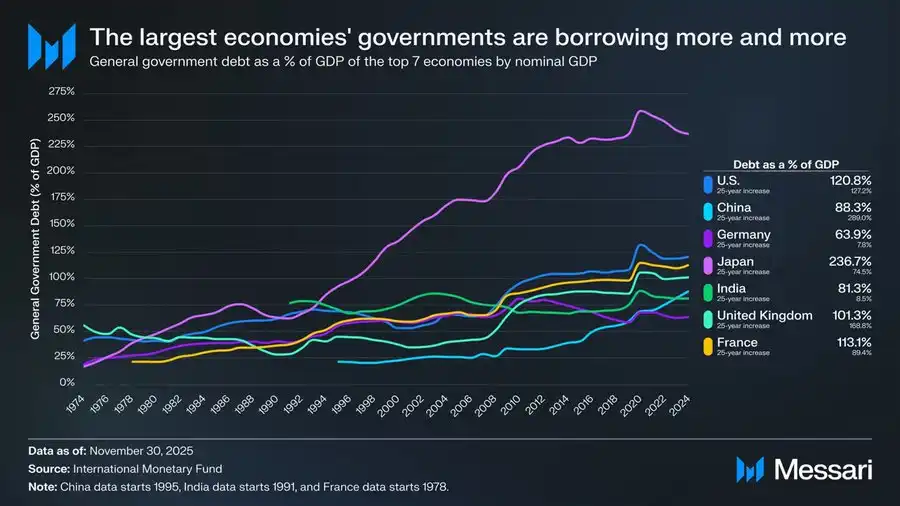
This chart is not a macro background decoration, but the logical starting point of the entire Cryptomoney argument.

Over the past 50 years, the ratio of government debt to GDP in major global economies has shown a highly consistent, almost irreversible upward trend:

· United States: 120.8%

· Japan: 236.7%

· France: 113.1%

· United Kingdom: 101.3%

· China: 88.3%

· India: 81.3%

· Germany: 63.9%

This is not the result of governance failure in a particular country, but a common outcome spanning systems, political structures, and development stages. Whether democratic countries, authoritarian states, developed economies, or emerging markets, government debt has long outpaced economic growth.

What This Chart Really Shows Is Not "High Debt," but "Savings Are Being Systematically Sacrificed"

When government debt growth长期 (long-term) outpaces economic output, the system can only maintain stability in three ways:

1. Inflation

2. Long-term low real interest rates

3. Financial repression (capital controls, withdrawal restrictions, regulatory intervention)

Regardless of which path is adopted, the ultimate cost will be borne by the same group: savers. Messari uses an extremely restrained but heavily weighted sentence in the report: When debt grows faster than economic output, the costs fall most heavily on savers. Translated: When debt outpaces growth, savings are注定 (destined) to be the sacrificed party.

Why Did Sentiment Collapse集中 (concentratedly) in 2025?

Because 2025 is the year when more and more participants clearly realized this for the first time.

Before this:

· "Inflation is only temporary"

· "Cash is always safe"

· "Fiat currency is stable in the long run"

And reality is constantly否定 (negating) these assumptions.

When people发现 (discover):

· Hard work ≠ Wealth preservation

· The act of saving itself is continuously shrinking

· The difficulty of asset allocation has significantly increased

The collapse of sentiment does not come from Crypto, but from a shaken confidence in the entire financial system. Crypto is just where this impact is felt first.

The Significance of Cryptomoney Is Not "Higher Returns"

This is also a point that Messari repeatedly emphasizes but is极易 (very easily) misinterpreted. Cryptomoney does not exist to promise higher returns.

Its core value lies in:

· Predictable rules

· Monetary policy not arbitrarily changed by a single institution

· Assets can be self-custodied

· Value can be transferred cross-border without permission

In other words, what it provides is not a "money-making tool," but: In a world of high debt and low certainty, it重新给予 (re-grants) individuals the right to choose their money.

The Sentiment Collapse Is Actually a Form of "Sobering Up"

When you place this debt chart alongside the 2025 market sentiment, you find a counterintuitive conclusion: The extreme pessimism of sentiment does not mean industry failure, but means more and more people are beginning to realize that the problems of the old system are real.

The problem with Crypto has never been "useless." The real problem is: It no longer produces easy excess returns for everyone.

Summary | From Sentiment, to Structure, to Money Itself

This chapter addresses a fundamental question: Why did market sentiment fall to a historic low in the absence of a systemic crash? The answer is not in the K-line charts, but in the monetary structure.

· Sentiment collapse is the表象 (surface phenomenon)

· Paradigm shift is the过程 (process)

· Monetary system imbalance is the根因 (root cause)

And this is precisely why Messari chose to start the entire report with "money" rather than "applications."

Chapter 3 | Why Only BTC Is Treated as "Real Money"

If you have read this far, you can easily have a question: If the problem lies in the monetary system, then why is the answer BTC, and not something else?

Messari's judgment in the report is exceptionally clear: BTC is no longer on the same competitive dimension as other Crypto assets.

1. Money Is Not a Technical Problem, but a Consensus Problem

This is the first key to understanding BTC. Messari repeatedly emphasizes a fact容易被工程师忽略 (easily overlooked by engineers) in the original text: Money is a social consensus, not a technical optimization problem. In other words:

· Money is not about "who is faster"

· Not "who is cheaper"

· Nor "who has more functions"

But rather who is长期稳定地 (long-term and stably) treated as a store of value. From this perspective, Bitcoin's victory is not mysterious.

2. Three Years of Data Have Written the Answer on Its Face
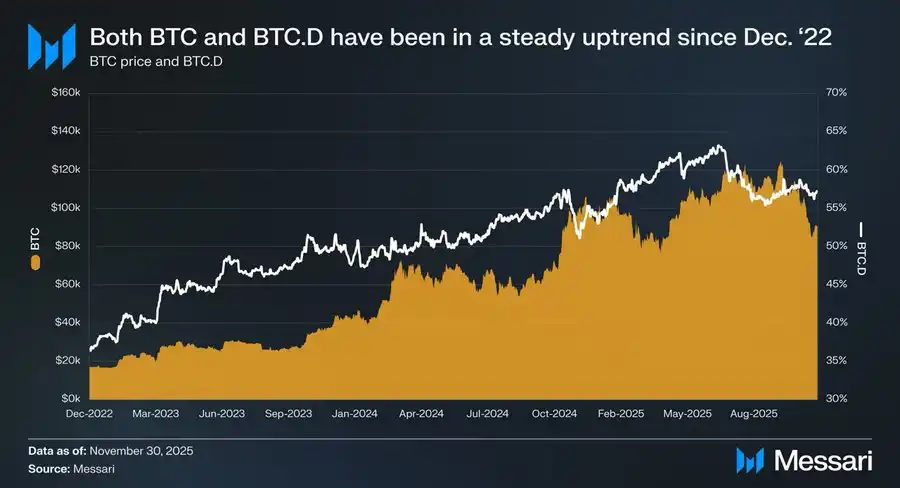
From December 1, 2022, to November 2025:

· BTC rose 429%

· Market cap from $318 billion → $1.81 trillion

· Global asset ranking entered the top ten

And more importantly, the relative performance: BTC.D (Bitcoin Dominance) from 36.6% → 57.3%. In a cycle where "theoretically, altcoins should soar," funds instead持续回流 (continuously flowed back) to BTC. This is not the偶然结果 (accidental result) of a market cycle; this is the market重新做资产分类 (re-categorizing assets).

3. ETFs and DATs Are Essentially "Institutionalizing Consensus"

Messari's evaluation of ETFs is very restrained, but the conclusion is extremely weighty. Bitcoin ETFs are not simply "new buying pressure"; what they truly change is: who is buying + why they are buying + how long they can hold

· ETFs turned BTC into a compliant asset

· DATs made BTC part of corporate balance sheets

· National reserves elevated BTC to the "strategic asset" level

When BTC is held by these actors, it is no longer: "a high-volatility risk asset that can be abandoned at any time" but rather: a monetary asset that must be held long-term and cannot afford to make mistakes. Money, once treated this way,很难再退回去 (is difficult to go back).

4. Why BTC, the More "Boring" It Is, the More It Resembles Money

This might be the most counterintuitive point of 2025:

· BTC has no applications

· No narrative rotation

· No ecosystem stories

· Not even "new things"

But precisely because of this, it meets all the characteristics of "money":

· Does not rely on future promises

· Does not need growth narratives

· Does not require teams to持续交付 (continuously deliver)

It only needs to not fail.

And in a world of high debt and low certainty, "not failing" is itself a scarce asset.

5. BTC's Strength Is Not a Market Failure

Many people's pain comes from an illusion: "BTC's strength means the market is not right." Messari's judgment is恰好相反 (precisely the opposite): BTC's strength is the market becoming more rational.

When the system begins to reward:

· Stability

· Predictability

· Long-term credibility

Then all strategies relying on "high volatility for high returns" will appear increasingly painful. This is not BTC's problem; this is a participation method problem.

Summary | BTC Didn't Win; It Was Chosen

BTC did not "defeat" other assets. It was just repeatedly verified by the market in an era of continuous monetary system failure as:

· The asset that needs the least explanation

· The asset that relies the least on trust

· The asset that needs the fewest promises about the future

This is not the result of a market cycle, but a kind of role confirmation.

Chapter 4 | When the Market Only Needs One Kind of "Money," the L1 Story Begins to Fail

After confirming that BTC has been selected by the market as the "primary Cryptomoney," one question cannot be avoided: If the answer for money already exists, then what is left for Layer 1? Messari does not directly give a conclusion, but after reading this section, a trend is very clear: L1 valuations are being forced to move from "future narratives" back to "real-world constraints."

1. A Harsh but True Fact: 81% of the Market Cap Is in the "Money" Narrative
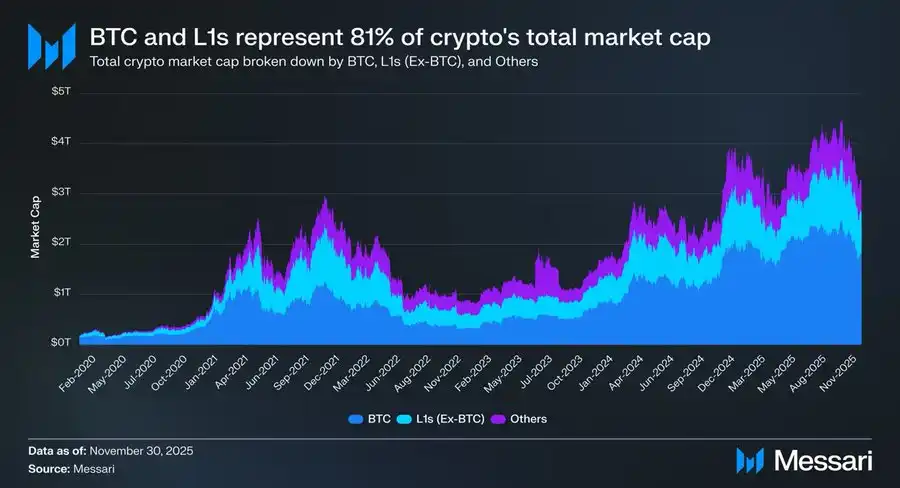
As of the end of 2025, the entire crypto market cap is approximately $3.26T:

· BTC: $1.80T

· Other L1s: approx. $0.83T

· Remaining assets: less than $0.63T

Combined: approximately 81% of the crypto asset market cap is being priced by the market as "money" or "potential money." What does this mean? It means that L1 valuations are早已不是 (long since not) priced on the logic of "application platforms," but on the logic of "does it qualify to be money?"

2. The Problem Is: Most L1s Do Not Qualify

The data provided by Messari is very direct and very冷酷 (cold).
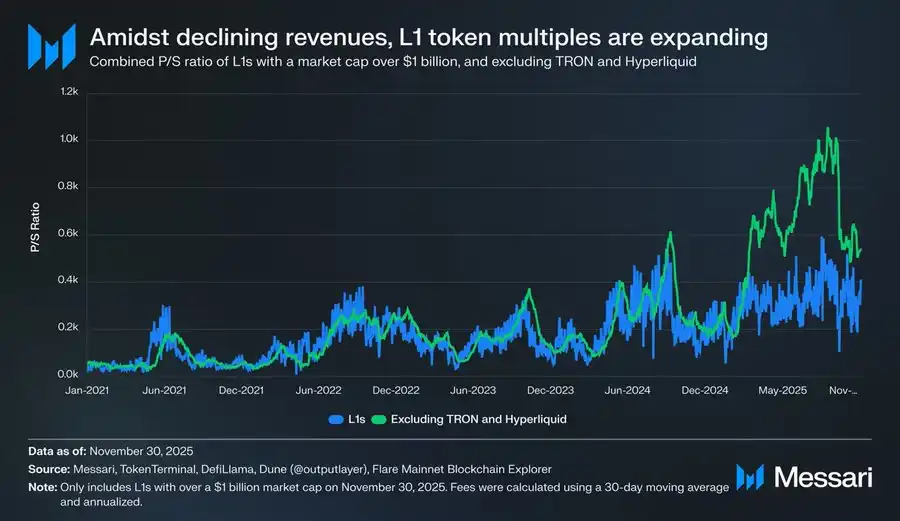
After剔除 (excluding) outliers with abnormally high revenue like TRON and Hyperliquid:

· The overall revenue of L1s continues to decline

· But valuation multiples are却在 (instead) continually rising

The adjusted P/S ratios are as follows:

· 2021: 40x

· 2022: 212x

· 2023: 137x

· 2024: 205x

· 2025: 536x

Meanwhile, total L1 revenue:

· 2021: $12.3B

· 2022: $4.9B

· 2023: $2.7B

· 2024: $3.6B

· 2025 (annualized): $1.7B

This is a剪刀差 (scissors gap) that cannot be reasonably explained by "future growth."

3. L1s Are Not "Undervalued"; They Are "Reclassified"

Many people's pain stems from a misunderstanding: "Are L1s being错杀 (wrongfully killed) by the market?". Messari's judgment is恰恰相反 (precisely the opposite): The market is not wrongfully killing L1s; it is reducing their "monetary imagination space."

If an asset:

· Cannot store value stably

· Cannot be held long-term

· And cannot provide certain cash flow

Then it ultimately only has one pricing method left: high beta risk asset.

4. The Example of Solana Actually Explains Everything

SOL was one of the few L1s that outperformed BTC in 2025. But Messari points out a highly damaging fact:

· SOL ecosystem data grew by 20–30 times

· The price only outperformed BTC by an additional 87%

In other words: to obtain "significant excess returns" relative to BTC, an L1 needs an生态爆发 (ecosystem explosion) of orders of magnitude. This is not "not trying hard enough," but the回报函数 (return function) has been rewritten.

5. When BTC Becomes "Money," the Burden on L1s Actually Becomes Heavier

This is a structural change that many people have not realized. Before BTC's monetary status was clear:

· L1s could tell the story of "becoming money in the future"

· The market was willing to pay提前付费 (prepay) for this possibility

Now:

· BTC has solidified its position

· The market is no longer willing to pay the same premium for a "second money"

Thus, L1s face a more difficult question: If not money, then what exactly are you?

Summary | The Problem of L1s Is Not Competition, but Positioning

L1s did not "lose to BTC." What they lost is:

· In the dimension of money

· The market no longer needs more answers

And once they lose the shelter of the "monetary narrative," all valuations must重新接受现实约束 (re-accept real-world constraints).

This is the direct source of the sentiment collapse for a large number of participants in 2025.

Tiền kỹ thuật số thịnh hành

Câu hỏi Liên quan

QWhy did market sentiment in the crypto space collapse in 2025, according to the Messari report?

AThe collapse in market sentiment was not due to a systemic failure of the industry, but rather a structural shift where the market began rewarding stability, predictability, and long-term credibility (like BTC) over high-risk, high-reward strategies. This caused a severe cognitive and identity mismatch for participants still using old, speculative methods.

QWhat fundamental issue does the Messari report identify as the root cause of the 2025 sentiment crash?

AThe root cause is the ongoing failure of the global traditional monetary system, where government debt growth has consistently outpaced economic output for decades. This systemically sacrifices savers through inflation, low real interest rates, and financial repression, eroding confidence in traditional finance.

QHow does the report explain Bitcoin's (BTC) dominant performance and its role in the 2025 market?

ABTC is no longer competing on the same plane as other crypto assets. It has been selected by the market as 'money' due to its predictable rules, immutable monetary policy, self-custody, and permissionless value transfer. Its 'boring' and reliable nature makes it a scarce asset in a high-debt, low-certainty world, and it is now treated as a long-term hold by institutions, corporations (DATs), and even national reserves.

QWhat does the data show about the valuation of Layer 1 (L1) blockchains compared to their fundamentals in 2025?

AThe data shows a severe and growing disconnect. The aggregate Price-to-Sales (P/S) ratio for L1s skyrocketed to 536x in 2025, while their total annualized revenue plummeted to $1.7B. This indicates that their valuations were not based on current fundamentals or cash flow but on a narrative that has now been reclassified by the market.

QWhy did the strong performance of Bitcoin (BTC) cause pain for many investors and participants in 2025?

AThe pain was caused by a paradigm shift in the market's reward mechanism. Participants who were accustomed to earning alpha through aggressive speculation, narrative trading, and investing in altcoins found that these strategies failed. The market began systematically rewarding long-term holders and institutional asset allocators instead, making the 'old way' of participating ineffective and emotionally painful.

Nội dung Liên quan

Tuần tới cần chú ý|Đạo luật CLARITY dự kiến được biểu quyết tại Thượng viện; SpaceX, Circle công bố báo cáo tài chính (3.8-9.8)

**Tóm tắt các sự kiện quan trọng từ ngày 3 đến 9 tháng 8:** **Tuần tới sẽ có nhiều sự kiện đáng chú ý trong lĩnh vực tiền điện tử và công nghệ:** * **Pháp luật & Quy định:** Dự luật CLARITY Act, nhằm thiết lập khung quy định liên bang cho tiền điện tử, có khả năng được đưa ra biểu quyết toàn thể tại Thượng viện Mỹ vào tuần tới. Các nhà đàm phán cần đạt được 60 phiếu ủng hộ trước ngày 7/8. * **Báo cáo tài chính:** Nhiều công ty lớn sẽ công bố báo cáo tài chính quý II/2026, bao gồm **SpaceX (ngày 4/8)**, công ty khai thác Bitcoin **Hut 8 (ngày 4/8)**, **Circle (ngày 5/8)** và công ty khai thác liên quan đến gia đình Trump là **American Bitcoin (ngày 3/8)**. * **Sự kiện SpaceX:** Bên cạnh báo cáo tài chính, cổ phiếu của SpaceX sẽ bắt đầu được mở khóa từ ngày 6/8, với đợt đầu tiên có thể lên tới 12% tổng số cổ phiếu. * **Dữ liệu kinh tế:** Báo cáo việc làm phi nông nghiệp (Non-Farm) quan trọng của Mỹ cho tháng 7 sẽ được công bố vào ngày 7/8. * **Cập nhật công nghệ:** * **XRP Ledger:** Phiên bản mới xrpld 3.3.0 với 5 tính năng mới dự kiến phát hành vào tuần tới. * **Grok:** Elon Musk thông báo Grok 4.6 dự kiến ra mắt vào khoảng ngày 7/8. * **Bitcoin:** Việc gửi tín hiệu bắt buộc cho BIP-110 sẽ bắt đầu vào khoảng ngày 8/8. * **Ngừng hoạt động:** Một số dịch vụ tiền điện tử sẽ ngừng hoạt động vào ngày 3/8, bao gồm công cụ theo dõi danh mục DeFi **Zapper** và ví **Ctrl Wallet**. * **Niêm yết & Hủy niêm yết:** Sàn Upbit Hàn Quốc sẽ hủy niêm yết token AQT và AERGO từ ngày 3/8. Trong khi đó, công ty robot **宇树科技 (Unitree Robotics)** sẽ tiến hành thăm dò giá ban đầu cho đợt IPO trên STAR Market vào ngày 5/8.

marsbit16 phút trước

Tuần tới cần chú ý|Đạo luật CLARITY dự kiến được biểu quyết tại Thượng viện; SpaceX, Circle công bố báo cáo tài chính (3.8-9.8)

marsbit16 phút trước

Cổ phiếu giảm mạnh hơn cả tiền điện tử, tiền đã đi đâu?

Tác giả: Cathy, Baihua Blockchain Vào ngày 28 và 29 tháng 7, chỉ số Kospi của Hàn Quốc hai ngày liên tiếp kích hoạt cơ chế ngắt mạch (circuit breaker), một sự kiện chưa từng có trong lịch sử. Cổ phiếu bán dẫn toàn cầu lao dốc, đặc biệt là SK Hynix – cổ phiếu trọng số lớn nhất, giảm khoảng 23% sau hai ngày. Điều trớ trêu là, trong khi thị trường chứng khoán biến động dữ dội như tiền mã hóa, Bitcoin lại thể hiện sự ổn định tương đối, phục hồi gần 15% từ mức thấp tháng 7. Bài viết phân tích rằng đợt sụt giảm này không phải là sự hoảng loạn toàn thị trường, mà là một cuộc "giải tỏa đòn bẩy cưỡng chế" nhắm vào các giao dịch đầu cơ tập trung nhất, như lĩnh vực bán dẫn và AI. Các yếu tố thúc đẩy bao gồm báo cáo lợi nhuận không đạt kỳ vọng của SK Hynix, sự cạnh tranh tiềm tàng từ Trung Quốc, và việc Ngân hàng Nhật Bản tăng lãi suất khiến các khoản đầu tư mang theo (carry trade) bằng Yên phải thoái vốn. Vậy tiền từ thị trường chứng khoán có chảy vào Bitcoin không? Câu trả lời là không. Bitcoin "kháng sụt giảm" vì nó đã trải qua đợt bán tháo lớn vào tháng 5 và tháng 6, với dòng tiền ròng rút kỷ lục khỏi các ETF Bitcoin Mỹ. Tiền thực sự đã chảy vào tài sản an toàn truyền thống như vàng, với hệ số tương quan giữa Bitcoin và vàng giảm xuống mức rất thấp. Điều này cho thấy Bitcoin hiện được coi là tài sản mạo hiểm để tìm kiếm lợi nhuận, chứ không phải nơi trú ẩn an toàn. Bài viết kết luận rằng để dòng tiền thực sự quay trở lại với Bitcoin, cần ba điều kiện: áp lực thanh khoản toàn cầu giảm bớt, Fed cắt giảm lãi suất mà không gây ra suy thoái, và Đạo luật CLARITY được thông qua để giải tỏa lo ngại về quy định. Mặc dù tiền chưa chảy vào, Bitcoin đã tự định vị mình như một tài sản có tương quan thấp với Nasdaq, một đặc điểm mà các tổ chức có thể tìm kiếm để đa dạng hóa danh mục đầu tư sau cú sốc AI.

marsbit16 phút trước

Cổ phiếu giảm mạnh hơn cả tiền điện tử, tiền đã đi đâu?

marsbit16 phút trước

Đối thoại với Ray Dalio: Chúng ta đang ở trong bong bóng AI, 1% danh mục đầu tư của tôi là Bitcoin

Ray Dalio, người sáng lập Bridgewater Associates, trong một cuộc phỏng vấn đã chỉ ra rằng thế giới hiện tại đang trong một "AI bubble" (bong bóng AI) cổ điển, với giá tài sản tăng vọt và đầu cơ quá mức. Ông cảnh báo bong bóng có thể vỡ do lãi suất tăng, nguồn cung cổ phiếu dư thừa hoặc khi nhà đầu tư cần tiền mặt trả nợ, dẫn đến suy thoái kinh tế. Đồng thời, Dalio mô tả một "chu kỳ lớn" kéo dài khoảng 80 năm, bao gồm ba động lực chồng chéo: khoảng cách giàu nghèo và xung đột nội bộ, thâm hụt ngân sách chính phủ khổng lồ và thay đổi địa chính trị. Ông nhấn mạnh rằng Mỹ và Anh đang đối mặt với những thách thức trong giai đoạn suy yếu này. Để bảo vệ của cải, Dalio khuyến nghị đa dạng hóa danh mục đầu tư với cổ phiếu, vàng, trái phiếu, bất động sản thay vì chỉ giữ tiền mặt. Ông tiết lộ khoảng 1% danh mục của mình là Bitcoin, nhưng vẫn ưa chuộng vàng vật chất hơn do tính ổn định và vai trò tiền tệ dự trữ. Về tác động của AI, Dalio cho rằng nó không chỉ thay thế lao động chân tay mà còn cả tư duy, làm trầm trọng thêm bất bình đẳng thu nhập. Con người cần phát huy trí tuệ cảm xúc và trực giác - những thứ AI chưa có - và học cách hợp tác với AI. Cuối cùng, ông phân tích những rủi ro của thuế tài sản và xu hướng thế giới có thể trở nên "khu vực hóa" hơn, với các khối như châu Mỹ và châu Á - Thái Bình Dương, trong bối cảnh sự thống trị toàn cầu của Mỹ đang suy yếu.

marsbit4 giờ trước

Đối thoại với Ray Dalio: Chúng ta đang ở trong bong bóng AI, 1% danh mục đầu tư của tôi là Bitcoin

marsbit4 giờ trước

Hơn 7.2 nghìn tỷ won trong một ngày, ngoại hải nước ngoài mua ròng kỷ lục vào thứ Sáu! Phố Wall: Cơn gió ngược về mặt vốn của thị trường chứng khoán Hàn Quốc đã tan biến

Dòng vốn nước ngoài đổ mạnh vào thị trường chứng khoán Hàn Quốc (KOSPI) với mức mua ròng kỷ lục 7,2 nghìn tỷ won chỉ trong ngày 31/7, đánh dấu sự đảo chiều rõ rệt sau nhiều tháng bán ròng mạnh. Theo báo cáo từ Citigroup, áp lực bán từ dòng vốn nước ngoài đã giảm đáng kể, với mức bán ròng tháng 7 thu hẹp còn 9,8 nghìn tỷ won so với mức 48,4 và 44,5 nghìn tỷ won trong tháng 6 và tháng 5. Đồng thời, các quỹ hưu trí và quỹ đầu tư trong nước cũng chuyển sang vị thế mua ròng 1,0 nghìn tỷ won trong tháng 7. Một yếu tố hỗ trợ khác là quy định mới từ Ủy ban Dịch vụ Tài chính Hàn Quốc (FSC), có hiệu lực từ 31/7, siết chặt điều kiện đầu tư vào các ETF có đòn bẩy đối với nhà đầu tư cá nhân. Quy định này đã ngay lập tức làm giảm khoảng 50% khối lượng giao dịch của các ETF này, góp phần kỳ vọng giảm bớt biến động cho thị trường. Citigroup duy trì mục tiêu chỉ số KOSPI ở mức 10.000 điểm, dựa trên các yếu tố thuận lợi như ngành chip bán dẫn ổn định, định giá thị trường thấp, nền tảng kinh tế vững mạnh và các chính sách hỗ trợ. Họ nhận định áp lực dòng vốn ngược chiều đang giảm dần, tạo điều kiện cho các yếu tố cơ bản và chính sách tích cực phát huy tác dụng.

marsbit4 giờ trước

Hơn 7.2 nghìn tỷ won trong một ngày, ngoại hải nước ngoài mua ròng kỷ lục vào thứ Sáu! Phố Wall: Cơn gió ngược về mặt vốn của thị trường chứng khoán Hàn Quốc đã tan biến

marsbit4 giờ trước

Giao dịch

Giao ngay

Bài viết Nổi bật

AGENT S là gì

Agent S: Tương Lai của Tương Tác Tự Động trong Web3 Giới thiệu Trong bối cảnh không ngừng phát triển của Web3 và tiền điện tử, các đổi mới đang liên tục định nghĩa lại cách mà cá nhân tương tác với các nền tảng kỹ thuật số. Một dự án tiên phong như vậy, Agent S, hứa hẹn sẽ cách mạng hóa tương tác giữa con người và máy tính thông qua khung tác nhân mở của nó. Bằng cách mở đường cho các tương tác tự động, Agent S nhằm đơn giản hóa các nhiệm vụ phức tạp, cung cấp các ứng dụng chuyển đổi trong trí tuệ nhân tạo (AI). Cuộc khám phá chi tiết này sẽ đi sâu vào những phức tạp của dự án, các tính năng độc đáo của nó và những tác động đối với lĩnh vực tiền điện tử. Agent S là gì? Agent S đứng vững như một khung tác nhân mở đột phá, được thiết kế đặc biệt để giải quyết ba thách thức cơ bản trong việc tự động hóa các nhiệm vụ máy tính: Thu thập Kiến thức Cụ thể theo Miền: Khung này học một cách thông minh từ nhiều nguồn kiến thức bên ngoài và kinh nghiệm nội bộ. Cách tiếp cận kép này giúp nó xây dựng một kho lưu trữ phong phú về kiến thức cụ thể theo miền, nâng cao hiệu suất của nó trong việc thực hiện nhiệm vụ. Lập Kế Hoạch Qua Các Tầm Nhìn Nhiệm Vụ Dài Hạn: Agent S sử dụng lập kế hoạch phân cấp tăng cường kinh nghiệm, một cách tiếp cận chiến lược giúp phân chia và thực hiện các nhiệm vụ phức tạp một cách hiệu quả. Tính năng này nâng cao đáng kể khả năng quản lý nhiều nhiệm vụ con một cách hiệu quả và hiệu suất. Xử Lý Các Giao Diện Động, Không Đều: Dự án giới thiệu Giao Diện Tác Nhân-Máy Tính (ACI), một giải pháp đổi mới giúp nâng cao tương tác giữa các tác nhân và người dùng. Sử dụng các Mô Hình Ngôn Ngữ Lớn Đa Phương Thức (MLLMs), Agent S có thể điều hướng và thao tác các giao diện người dùng đồ họa đa dạng một cách liền mạch. Thông qua những tính năng tiên phong này, Agent S cung cấp một khung vững chắc giải quyết các phức tạp liên quan đến việc tự động hóa tương tác giữa con người với máy móc, mở ra nhiều ứng dụng trong AI và hơn thế nữa. Ai là Người Tạo ra Agent S? Mặc dù khái niệm về Agent S là hoàn toàn đổi mới, thông tin cụ thể về người sáng lập vẫn còn mơ hồ. Người sáng lập hiện vẫn chưa được biết đến, điều này làm nổi bật giai đoạn sơ khai của dự án hoặc sự lựa chọn chiến lược để giữ kín các thành viên sáng lập. Bất chấp sự ẩn danh, sự chú ý vẫn tập trung vào khả năng và tiềm năng của khung này. Ai là Các Nhà Đầu Tư của Agent S? Vì Agent S còn tương đối mới trong hệ sinh thái mã hóa, thông tin chi tiết về các nhà đầu tư và những người tài trợ tài chính của nó không được ghi chép rõ ràng. Sự thiếu vắng thông tin công khai về các nền tảng đầu tư hoặc tổ chức hỗ trợ dự án dấy lên câu hỏi về cấu trúc tài trợ và lộ trình phát triển của nó. Hiểu biết về sự hỗ trợ là rất quan trọng để đánh giá tính bền vững và tác động tiềm năng của dự án. Agent S Hoạt Động Như Thế Nào? Tại cốt lõi của Agent S là công nghệ tiên tiến cho phép nó hoạt động hiệu quả trong nhiều bối cảnh khác nhau. Mô hình hoạt động của nó được xây dựng xung quanh một số tính năng chính: Tương Tác Giống Như Con Người: Khung này cung cấp lập kế hoạch AI tiên tiến, cố gắng làm cho các tương tác với máy tính trở nên trực quan hơn. Bằng cách bắt chước hành vi của con người trong việc thực hiện nhiệm vụ, nó hứa hẹn nâng cao trải nghiệm người dùng. Ký Ức Tường Thuật: Được sử dụng để tận dụng các trải nghiệm cấp cao, Agent S sử dụng ký ức tường thuật để theo dõi lịch sử nhiệm vụ, từ đó nâng cao quy trình ra quyết định của nó. Ký Ức Tình Huống: Tính năng này cung cấp cho người dùng hướng dẫn từng bước, cho phép khung này cung cấp hỗ trợ theo ngữ cảnh khi các nhiệm vụ diễn ra. Hỗ Trợ OpenACI: Với khả năng chạy cục bộ, Agent S cho phép người dùng duy trì quyền kiểm soát đối với các tương tác và quy trình làm việc của họ, phù hợp với tinh thần phi tập trung của Web3. Tích Hợp Dễ Dàng với Các API Bên Ngoài: Tính linh hoạt và khả năng tương thích với nhiều nền tảng AI khác nhau đảm bảo rằng Agent S có thể hòa nhập liền mạch vào các hệ sinh thái công nghệ hiện có, làm cho nó trở thành lựa chọn hấp dẫn cho các nhà phát triển và tổ chức. Những chức năng này cùng nhau góp phần vào vị trí độc đáo của Agent S trong không gian tiền điện tử, khi nó tự động hóa các nhiệm vụ phức tạp, nhiều bước với sự can thiệp tối thiểu của con người. Khi dự án phát triển, các ứng dụng tiềm năng của nó trong Web3 có thể định nghĩa lại cách mà các tương tác kỹ thuật số diễn ra. Thời Gian Phát Triển của Agent S Sự phát triển và các cột mốc của Agent S có thể được tóm tắt trong một dòng thời gian nêu bật các sự kiện quan trọng của nó: 27 tháng 9, 2024: Khái niệm về Agent S được ra mắt trong một bài nghiên cứu toàn diện mang tên “Một Khung Tác Nhân Mở Sử Dụng Máy Tính Như Một Con Người,” trình bày nền tảng cho dự án. 10 tháng 10, 2024: Bài nghiên cứu được công bố công khai trên arXiv, cung cấp một cái nhìn sâu sắc về khung và đánh giá hiệu suất của nó dựa trên tiêu chuẩn OSWorld. 12 tháng 10, 2024: Một video trình bày được phát hành, cung cấp cái nhìn trực quan về khả năng và tính năng của Agent S, thu hút thêm sự quan tâm từ người dùng và nhà đầu tư tiềm năng. Những dấu mốc trong dòng thời gian không chỉ minh họa sự tiến bộ của Agent S mà còn chỉ ra cam kết của nó đối với sự minh bạch và sự tham gia của cộng đồng. Những Điểm Chính Về Agent S Khi khung Agent S tiếp tục phát triển, một số thuộc tính chính nổi bật, nhấn mạnh tính đổi mới và tiềm năng của nó: Khung Đổi Mới: Được thiết kế để cung cấp cách sử dụng máy tính trực quan giống như tương tác của con người, Agent S mang đến một cách tiếp cận mới cho việc tự động hóa nhiệm vụ. Tương Tác Tự Động: Khả năng tương tác tự động với máy tính thông qua GUI đánh dấu một bước tiến tới các giải pháp tính toán thông minh và hiệu quả hơn. Tự Động Hóa Nhiệm Vụ Phức Tạp: Với phương pháp mạnh mẽ của nó, nó có thể tự động hóa các nhiệm vụ phức tạp, nhiều bước, làm cho các quy trình nhanh hơn và ít sai sót hơn. Cải Tiến Liên Tục: Các cơ chế học tập cho phép Agent S cải thiện từ các trải nghiệm trước đó, liên tục nâng cao hiệu suất và hiệu quả của nó. Tính Linh Hoạt: Khả năng thích ứng của nó trên các môi trường hoạt động khác nhau như OSWorld và WindowsAgentArena đảm bảo rằng nó có thể phục vụ một loạt các ứng dụng rộng rãi. Khi Agent S định vị mình trong bối cảnh Web3 và tiền điện tử, tiềm năng của nó để nâng cao khả năng tương tác và tự động hóa quy trình đánh dấu một bước tiến quan trọng trong công nghệ AI. Thông qua khung đổi mới của mình, Agent S minh họa cho tương lai của các tương tác kỹ thuật số, hứa hẹn một trải nghiệm liền mạch và hiệu quả hơn cho người dùng trên nhiều ngành công nghiệp khác nhau. Kết luận Agent S đại diện cho một bước nhảy vọt táo bạo trong sự kết hợp giữa AI và Web3, với khả năng định nghĩa lại cách chúng ta tương tác với công nghệ. Mặc dù vẫn còn ở giai đoạn đầu, những khả năng cho ứng dụng của nó là rộng lớn và hấp dẫn. Thông qua khung toàn diện của mình giải quyết các thách thức quan trọng, Agent S nhằm đưa các tương tác tự động lên hàng đầu trong trải nghiệm kỹ thuật số. Khi chúng ta tiến sâu hơn vào các lĩnh vực tiền điện tử và phi tập trung, các dự án như Agent S chắc chắn sẽ đóng một vai trò quan trọng trong việc định hình tương lai của công nghệ và sự hợp tác giữa con người với máy tính.

Tổng lượt xem 1.1kXuất bản vào 2025.01.14Cập nhật vào 2025.01.14

AGENT S là gì

Làm thế nào để Mua S

Chào mừng bạn đến với HTX.com! Chúng tôi đã làm cho mua Sonic (S) trở nên đơn giản và thuận tiện. Làm theo hướng dẫn từng bước của chúng tôi để bắt đầu hành trình tiền kỹ thuật số của bạn.Bước 1: Tạo Tài khoản HTX của BạnSử dụng email hoặc số điện thoại của bạn để đăng ký tài khoản miễn phí trên HTX. Trải nghiệm hành trình đăng ký không rắc rối và mở khóa tất cả tính năng. Nhận Tài khoản của tôiBước 2: Truy cập Mua Crypto và Chọn Phương thức Thanh toán của BạnThẻ Tín dụng/Ghi nợ: Sử dụng Visa hoặc Mastercard của bạn để mua Sonic (S) ngay lập tức.Số dư: Sử dụng tiền từ số dư tài khoản HTX của bạn để giao dịch liền mạch.Bên thứ ba: Chúng tôi đã thêm những phương thức thanh toán phổ biến như Google Pay và Apple Pay để nâng cao sự tiện lợi.P2P: Giao dịch trực tiếp với người dùng khác trên HTX.Thị trường mua bán phi tập trung (OTC): Chúng tôi cung cấp những dịch vụ được thiết kế riêng và tỷ giá hối đoái cạnh tranh cho nhà giao dịch.Bước 3: Lưu trữ Sonic (S) của BạnSau khi mua Sonic (S), lưu trữ trong tài khoản HTX của bạn. Ngoài ra, bạn có thể gửi đi nơi khác qua chuyển khoản blockchain hoặc sử dụng để giao dịch những tiền kỹ thuật số khác.Bước 4: Giao dịch Sonic (S)Giao dịch Sonic (S) dễ dàng trên thị trường giao ngay của HTX. Chỉ cần truy cập vào tài khoản của bạn, chọn cặp giao dịch, thực hiện giao dịch và theo dõi trong thời gian thực. Chúng tôi cung cấp trải nghiệm thân thiện với người dùng cho cả người mới bắt đầu và người giao dịch dày dạn kinh nghiệm.

Tổng lượt xem 2.1kXuất bản vào 2025.01.15Cập nhật vào 2026.06.02

Làm thế nào để Mua S

Thảo luận

Chào mừng đến với Cộng đồng HTX. Tại đây, bạn có thể được thông báo về những phát triển nền tảng mới nhất và có quyền truy cập vào thông tin chuyên sâu về thị trường. Ý kiến ​​của người dùng về giá của S (S) được trình bày dưới đây.

活动图片