When 'Stability' Begins to Fluctuate: A Complete Review and Structural Analysis of the USD1 Depegging Incident

marsbitXuất bản vào 2026-02-25Cập nhật gần nhất vào 2026-02-25

Tóm tắt

USD1, a stablecoin issued by World Liberty Financial (WLFI), experienced a brief depegging event on February 23, with its secondary market price dropping to around $0.98. WLFI attributed the incident to a "coordinated attack," claiming reserves and redemption mechanisms remained unaffected, and the price quickly recovered. The event raised questions about whether the depegging was a liquidity issue or a solvency crisis. Unlike TerraUSD's algorithmic collapse in 2022, USD1’s price dip appeared more related to temporary market liquidity stress rather than fundamental reserve failures. However, the incident highlighted that stablecoin stability relies not only on assets but also on market trust. USD1 operates under a centralized reserve model, where risks involve reserve transparency, asset liquidity, and market depth. In a low-liquidity, risk-averse market environment, even minor instability can trigger concerns about collateral devaluation, liquidations, and broader financial contraction. While the rapid price recovery suggests no systemic solvency issue, the event underscores how stablecoin depegging—even if temporary—can amplify market anxiety, reduce leverage, and increase funding costs. Trust, once questioned, takes time to restore, and credit repricing often precedes price changes in stressed markets.

Author: 137Labs

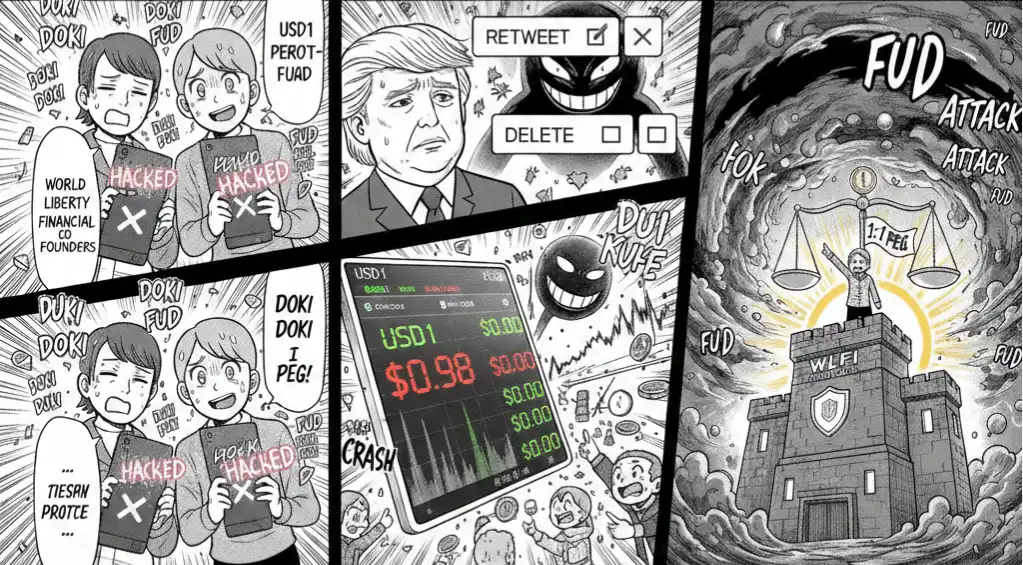
On February 23, a stablecoin named USD1 suddenly showed a significant discount in the secondary market.

On-chain quotes once fell to around 0.98 USDT, and social media quickly amplified the news.
The project team, World Liberty Financial (WLFI), subsequently stated publicly that this was a "coordinated attack" and emphasized that the reserve and redemption mechanisms were unaffected.

The price then recovered.

But the problem had already emerged——

When a "stablecoin" begins to trade at a discount, is it merely a liquidity friction, or a precursor to a crack in the credit structure?

I. Timeline: From the Wicking to the "Attack" Narrative

Based on reports from CoinDesk, The Block, Decrypt, WuBlockchain, PANews, ChainCatcher, and others, the sequence of events is roughly as follows:

1️⃣ Abnormal Volatility in the Secondary Market

  • USD1 quickly fell to around 0.98 in some trading pairs

  • The discount lasted for a short time

  • The price subsequently recovered

Unlike the brief depegging of USD Coin in 2023 due to banking risks, no clear systemic banking shock occurred this time.

2️⃣ WLFI's Official Response

WLFI stated externally:

  • This was an organized short attack coupled with a public opinion coordination attack

  • Reserve assets showed no abnormalities

  • Redemption function is normal

  • The 1:1 peg structure remains unchanged

This explanation was subsequently reported by Chinese media including WuBlockchain and ChainCatcher.

3️⃣ Social Media Amplification Effect

The event spread rapidly on platform X.

Some related tweets were deleted, fueling further market speculation.
In the current emotionally charged market environment, "deletion behavior" is often interpreted as a signal, not a random operation.

Thus, the question shifted from "Is the price depegged?" to:

  • Is there a reserve risk?

  • Is there a concentrated bank run?

  • Is there insufficient information disclosure?

II. The Nature of Depegging: A Liquidity Problem or a Solvency Problem?

Judging a stablecoin depegging event hinges on distinguishing between two completely different risk structures.

The first is a liquidity shock.
In this case, reserves are still sufficient, the redemption mechanism remains unimpeded, but due to insufficient trading depth, market maker withdrawal, or concentrated selling pressure, the secondary market experiences a brief imbalance. Once the arbitrage mechanism kicks in, the price usually recovers quickly.

The second is a solvency crisis.
If the reserve assets themselves are problematic, or if the assets suffer from maturity mismatches and cannot be liquidated immediately, then the depegging is no longer a trading-level fluctuation but a repricing of the balance sheet. In this case, the discount often widens persistently, accompanied by redemption delays or a collapse in trust.

Based on the information disclosed so far, USD1 is closer to the former.

It is completely different from the algorithmic death spiral of TerraUSD (UST) in 2022. UST's collapse stemmed from mechanism failure, while USD1's wicking更像 (more like) a liquidity tilt within a short period.

But even so, this event still holds significance.

Because the true anchor of a stablecoin is not just the reserve assets, but market trust.

Once trust is questioned, the price reacts ahead of the fundamentals.

III. The Credit Structure of Stablecoins: Where Exactly is Their "Stability"?

Stablecoins are essentially the "base money" of the crypto market.

Their credit support generally comes from three models:

  1. Algorithmic

  2. Collateralized

  3. Centrally Custodied Reserve-backed

USD1 belongs to a more centralized reserve structure.

The risk of this model lies not in the algorithm, but in:

  • Reserve Transparency

  • Asset Liquidity

  • Maturity Structure

  • Market Making Depth

Once the market suspects that reserves are discounted or face liquidation risks, the price often falls first.
This is highly similar to a "shadow bank run" in traditional finance—as soon as depositors start to doubt, the act of withdrawal itself amplifies the risk.

IV. Why Was the Market Reaction Particularly Sensitive This Time?

The fear index was already at an extreme low that day.

In an environment where liquidity was already tight:

  • Leverage levels decreased

  • Risk appetite weakened

  • The market became highly sensitive to uncertainty

Stablecoins are not just trading tools; they are the cornerstone of lending and liquidity.

Once a discount appears, the chain reaction may include:

  • Decrease in collateral ratios

  • Triggering of liquidations

  • Further compression of leverage

  • Capital outflow from the market

Therefore, even though the price recovered quickly, the psychological shock did not disappear simultaneously.

V. Is the "Attack" Narrative Valid?

WLFI attributed this volatility to a "coordinated attack".

Short attacks and public opinion resonance are not uncommon in the crypto market.
When trading depth is insufficient and market sentiment is fragile, prices are easily subject to amplified volatility.

But whether an attack can be sustained depends on one core factor:

Does the market believe the reserves are real, redeemable, and sustainable?

If the reserve structure is transparent and redemptions remain smooth, attacks often find it difficult to be effective in the long term;
If reserve disclosure is insufficient, panic is more easily self-reinforcing.

VI. The Differences Between USD1, USDC, USDT, and the True Meaning of This Depegging

Historically, USDC fell to $0.88 in 2023 due to banking risks; its problem stemmed from exposure to custodian bank risks and limitations on the pace of reserve liquidation.

Meanwhile, Tether has experienced minor depegging multiple times, usually during extreme panic phases or under concentrated withdrawal pressure, but the key to its eventual recovery lies in the continuous availability of the redemption mechanism and the verification of reserve redemption capability.

USD1 currently seems to be in the midst of a "trust stress test".

This event is closer to a liquidity shock than a solvency crisis.
The rapid price recovery indicates that a systemic bank run has not yet formed.

But what is truly worth paying attention to is not that single price of 0.98, but whether the market has begun to reassess the risk premium of "stability".

Stablecoins are the monetary base of the crypto market.

When the market questions their safety, the impact transmits outward along the credit chain:

  • Leverage decreases

  • Lending contracts

  • Collateral assets are repriced

  • Capital flows back to mainstream assets or exits the market

Even if the event itself is just short-term volatility, it will increase the cost of future financing and liquidity.

Depegging is never just a price problem; it is a credit pricing problem.

The price can recover quickly,
but trust takes time to repair.

USD1's depegging may not necessarily evolve into a systemic risk,
but it reminds the market——

During periods of liquidity contraction,
credit always changes before the price.

And once credit begins to be revalued,
the entire risk structure也随之 (also随之 -也随之) changes accordingly.


Câu hỏi Liên quan

QWhat was the main event described in the article regarding the USD1 stablecoin?

AOn February 23rd, the USD1 stablecoin experienced a significant discount, with its price dropping to approximately 0.98 USDT on secondary markets.

QHow did the issuer, World Liberty Financial (WLFI), characterize the price drop of USD1?

AWLFI characterized the event as a 'coordinated attack,' stating that the reserve and redemption mechanisms were unaffected and the 1:1 peg structure remained intact.

QWhat is the fundamental difference between a liquidity shock and a solvency crisis for a stablecoin, as explained in the article?

AA liquidity shock involves sufficient reserves and a functioning redemption mechanism, with the price drop caused by temporary market imbalances like insufficient trading depth. A solvency crisis involves problems with the reserve assets themselves, where the de-pegging is a repricing of the balance sheet due to issues like asset quality or maturity mismatches.

QAccording to the article, what are the key risk factors for a centralized reserve-backed stablecoin like USD1?

AThe key risk factors are reserve transparency, asset liquidity, maturity structure, and market-making depth.

QWhat broader market implication does the article suggest from the USD1 de-pegging event, even if it was temporary?

AThe event suggests that market trust, the true anchor of a stablecoin, can be shaken. This can lead to a re-evaluation of risk premiums, resulting in decreased leverage, contracted lending, repricing of collateral assets, and potential capital outflows, thereby increasing future financing and liquidity costs.

Nội dung Liên quan

Claude ra mắt tính năng mới: Ghi màn hình + Giọng nói, chưng cất Kỹ năng (Skill) với một cú nhấp chuột để tự động hóa công việc

Claude vừa ra mắt tính năng "Ghi lại Kỹ năng", cho phép người dùng tạo kỹ năng tự động hóa bằng cách ghi màn hình và giải thích bằng giọng nói. Tính năng này hiện có sẵn cho người dùng Pro, Max và Team trên ứng dụng desktop Claude Cowork. Người dùng chỉ cần thực hiện quy trình công việc trên máy tính, vừa làm vừa mô tả bằng lời nói, sau đó Claude sẽ tự động phân tích và tạo ra một "Skill" có thể tái sử dụng, được gọi bằng lệnh gạch chéo (/). Điểm đột phá của tính năng này là bỏ qua bước "viết" hướng dẫn phức tạp thủ công, giúp chuyển đổi tri thức ngầm và kinh nghiệm thực tế thành quy trình tự động một cách dễ dàng. Nó không chỉ là công cụ nâng cao hiệu suất, mà còn làm giảm đáng kể rào cản trong việc số hóa và lưu giữ quy trình nghiệp vụ chuyên môn, điều mà các hệ thống quản lý tri thức truyền thống thường gặp khó khăn. Bài viết cũng đề cập đến mặt khác của tự động hóa: một trường hợp cho thấy mối quan hệ hợp tác lâu năm có thể bị thay thế bởi một bộ kỹ năng được tạo sẵn. Nghiên cứu từ Harvard Business School chỉ ra rằng khi AI phát triển, giá trị công việc sẽ dịch chuyển từ "biết cách làm" sang "biết cách làm những việc người khác không thể làm". Tính năng mới của Claude đẩy nhanh xu hướng này, biến quy trình cá nhân thành tài sản tự động có thể chia sẻ và vận hành ngay lập tức.

marsbit4 phút trước

Claude ra mắt tính năng mới: Ghi màn hình + Giọng nói, chưng cất Kỹ năng (Skill) với một cú nhấp chuột để tự động hóa công việc

marsbit4 phút trước

Cho AI "ăn" nhiễu cũng tăng điểm, nghiên cứu này giúp nhiễu thực hiện chuyển dịch tích cực

Bài báo giới thiệu một phương pháp học chuyển tiếp mới có tên **Semi-Supervised Noise Adaptation (SSNA)** (Điều chỉnh Nhiễu Bán Giám sát), đã được xuất bản tại ICML 2026. Phương pháp này cho thấy ngay cả **dữ liệu nhiễu ngẫu nhiên**, không chứa thông tin ngữ nghĩa nào (ví dụ: được lấy mẫu từ phân phối Gaussian), cũng có thể giúp cải thiện hiệu suất của mô hình học máy trong các tình huống có ít dữ liệu được gắn nhãn. Nhóm nghiên cứu đề xuất một khuôn khổ gọi là **Noise Adaptation Framework (NAF)**. NAF tạo ra các nhiễu ngẫu nhiên và tổ chức chúng thành các cấu trúc phân biệt rõ ràng giữa các lớp (cụm) trong không gian biểu diễn chung. Cấu trúc phân loại này sau đó được chuyển giao (căn chỉnh) sang dữ liệu mục tiêu thực tế, từ đó cung cấp ranh giới phân loại rõ ràng hơn và nâng cao khả năng học. Trong thử nghiệm, với chỉ 4 mẫu được gắn nhãn cho mỗi lớp, NAF đã cải thiện đáng kể độ chính xác so với phương pháp học có giám sát cơ bản (ERM) trên nhiều bộ dữ liệu như CIFAR-10 (+12.35%), CIFAR-100 (+7.61%), và các bộ dữ liệu khác. Phương pháp này cũng hiệu quả với các tác vụ phân loại văn bản. Nghiên cứu nhấn mạnh rằng yếu tố then chốt không phải là bản thân dữ liệu nhiễu ngẫu nhiên, mà là **cấu trúc phân biệt được tạo ra** giữa các lớp nhiễu đó trong không gian biểu diễn. Ngay cả khi không có ngữ nghĩa thực, việc chuyển giao cấu trúc này vẫn có thể hỗ trợ học tập. Điều này mở ra hướng tiếp cận mới cho việc học chuyển tiếp trong các tình huống khó tiếp cận dữ liệu nguồn thực tế do vấn đề riêng tư, bản quyền hoặc hạn chế về chi phí.

marsbit5 phút trước

Cho AI "ăn" nhiễu cũng tăng điểm, nghiên cứu này giúp nhiễu thực hiện chuyển dịch tích cực

marsbit5 phút trước

Nhân viên "đắc dụng" của Nhà Trắng kiếm hơn 100.000 USD nhờ dự đoán dựa trên thông tin nội bộ

Mới đây, một nhân viên Nhà Trắng đã bị phát hiện sử dụng thông tin nội bộ để giao dịch kiếm lời trên thị trường dự đoán. Nhân vật chính là Gabriel Perez, người phụ trách vận hành máy nhắc lời cho các bài phát biểu của cựu Tổng thống Trump từ năm 2016. Với quyền tiếp cận bản thảo bài nói trước, Perez đã đặt cược vào các từ khóa cụ thể mà Trump sẽ "đề cập" trong hơn chục bài phát biểu, thu lợi hơn 100.000 USD chỉ trong khoảng ba tháng. Sàn giao dịch dự đoán Kalshi, nơi Perez thực hiện giao dịch, đã phát hiện hoạt động bất thường, đóng băng tài khoản của anh ta và báo cáo lên Ủy ban Giao dịch Hàng hóa Tương lai Mỹ (CFTC). Perez hiện đã bị đình chỉ công tác không lương. Tuy nhiên, khác với hai vụ buộc tội hình sự trước đó liên quan đến một binh sĩ đặc nhiệm và một kỹ sư Google, Perez chỉ phải đối mặt với hành động dân sự của CFTC, chủ yếu là hoàn trả lợi nhuận và cam kết không tái phạm. Vụ việc làm nổi bật tính dễ bị thao túng của các thị trường dự đoán thể loại "đề cập", nơi người có thông tin nội bộ hoặc chính người phát biểu có thể dễ dàng kiểm soát kết quả. Đây là trường hợp nội gián thứ ba bị công bố trong lĩnh vực này. Để ứng phó, các nền tảng như Kalshi đang siết chặt quy định, yêu cầu người dùng tiết lộ thông tin công việc nhằm hạn chế giao dịch nội gián. Sự kiện này đặt ra câu hỏi về tính toàn vẹn của thị trường dự đoán, vốn được kỳ vọng phản ánh trí tuệ đám đông, nhưng thực tế có thể trở thành công cụ kiếm lời cho số ít người nắm thông tin đặc quyền.

marsbit1 giờ trước

Nhân viên "đắc dụng" của Nhà Trắng kiếm hơn 100.000 USD nhờ dự đoán dựa trên thông tin nội bộ

marsbit1 giờ trước

Nhân viên sử dụng teleprompter cho Nhà Trắng kiếm hơn 100,000 USD nhờ dự đoán bằng nội bất.

Bài viết tiết lộ vụ bê bối giao dịch nội gián liên quan đến một nhân viên Nhà Trắng. Gabriel Perez, người phụ trách điều khiển máy nhắc lời cho các bài phát biểu của cựu Tổng thống Trump, đã lợi dụng thông tin nội bộ về nội dung bài diễn văn để đặt cược trên thị trường dự đoán Kalshi, kiếm lời hơn 100.000 USD trong ba tháng. Anh ta có thể biết trước các từ khóa cụ thể sẽ được nhắc đến. Tuy nhiên, không phải lần nào cũng thành công vì Trump thường nói ngoài kịch bản. Hành vi của Perez bị phát hiện nhờ hệ thống giám sát của Kalshi, dẫn đến việc tài khoản bị đóng băng và anh ta bị đình chỉ công việc. Mặc dù phải hoàn trả lợi nhuận, Perez không phải đối mặt với truy tố hình sự vì cơ quan chức năng cho rằng hành động này không gây hại cho an ninh quốc gia mà chỉ là vấn đề đạo đức. Bài viết cũng chỉ ra rằng thị trường dự đoán loại "đề cập" rất dễ bị thao túng, với chi phí gian lận thấp và lợi nhuận tiềm năng cao, và dẫn thêm các ví dụ khác như CEO Coinbase Brian Armstrong. Để tăng cường tuân thủ, Kalshi đã yêu cầu người dùng tiết lộ nơi làm việc. Vụ việc của Perez cho thấy nỗ lực thanh lọc giao dịch nội gián trong lĩnh vực thị trường dự đoán, nhưng đồng thời cũng làm dấy lên câu hỏi về tính chính xác và bản chất của các nền tảng này.

Odaily星球日报1 giờ trước

Nhân viên sử dụng teleprompter cho Nhà Trắng kiếm hơn 100,000 USD nhờ dự đoán bằng nội bất.

Odaily星球日报1 giờ trước

Các trang trại khai thác Bitcoin đang biến thành nhà máy AI

Bài báo phân tích xu hướng chuyển đổi từ lĩnh vực tiền điện tử (Crypto) sang trí tuệ nhân tạo (AI), tập trung vào ba loại tài sản chính được kế thừa từ chu kỳ Crypto trước. **1. Cơ sở hạ tầng từ các trang trại khai thác Bitcoin:** Các công ty khai thác như Crusoe, CoreWeave, TeraWulf và nhiều công ty khác đang chuyển đổi trung tâm dữ liệu của họ để phục vụ AI. Giá trị cốt lõi không nằm ở phần cứng cũ (máy đào ASIC khó tái sử dụng cho AI), mà ở các tài sản như nguồn điện ổn định, đất đai, giấy phép kết nối lưới điện và kinh nghiệm vận hành. Khi lợi nhuận từ khai thác Bitcoin giảm và nhu cầu điện cho AI tăng, những cơ sở hạ tầng này trở thành tài sản chiến lược, với nhiều hợp đồng cho thuê dài hạn trị giá hàng tỷ USD được ký kết với các tập đoàn AI lớn. **2. Con người và kỹ năng từ hệ sinh thái Crypto:** Các kỹ sư và doanh nhân từng làm việc trong lĩnh vực Crypto đang áp dụng kinh nghiệm của họ vào AI. Ví dụ điển hình là Alex Atallah (đồng sáng lập OpenSea) với OpenRouter - một nền tảng tổng hợp API cho hàng trăm mô hình AI, tương tự cách OpenSea kết nối người mua và bán NFT. Một ví dụ khác là Fal.ai (người sáng lập từng làm tại Coinbase), chuyên tối ưu hóa việc triển khai các mô hình sinh ra hình ảnh/video. **3. Vốn từ chu kỳ Crypto trước:** Các khoản lợi nhuận khổng lồ từ Crypto đang được tái đầu tư vào AI. Jed McCaleb (người sáng lập Mt.Gox, Ripple) đã dùng 5 tỷ USD để mua GPU và thành lập Voltage Park. Các quỹ đầu tư mạo hiểm (VC) Crypto như Paradigm cũng đang rót vốn vào các công ty AI như Nous Research. Một trường hợp đặc biệt là khoản đầu tư từ FTX (sàn giao dịch đã phá sản) vào Anthropic và Cursor, sau này tăng giá trị lên rất nhiều lần. Bài báo kết luận rằng bản thân Crypto không "biến thành" AI, mà các nguồn lực (cơ sở hạ tầng, con người, vốn) tích lũy được từ thời kỳ bùng nổ trước đang được chuyển dịch một cách tự nhiên sang lĩnh vực mới đang cần chúng nhất - trí tuệ nhân tạo.

链捕手1 giờ trước

Các trang trại khai thác Bitcoin đang biến thành nhà máy AI

链捕手1 giờ trước

Giao dịch

Giao ngay
活动图片