Written by: Trend Research

On Monday, the three major U.S. stock indices closed slightly lower, with the S&P 500 and Dow Jones falling from their record highs set last Friday. The factors weighing on the broader market included the prolonged delay in the agreement to reopen the Strait of Hormuz, oil prices surging over 5% in a single day, rising Treasury yields, and pressure on tech stock valuations. Despite news of Nvidia's $500 billion AI financing plan, its stock fell nearly 3%, while the optical communication sector plunged collectively, with Coherent dropping over 14%. Chinese concept stocks bucked the trend, with the Nasdaq Golden Dragon China Index rising nearly 2%, becoming a rare bright spot in Monday's session. Oil prices have once again become the pricing center, with market concerns about inflation and interest rates heating up.
Hormuz Agreement Remains Uncertain, Oil Prices Surge, Treasury Yields Climb
The most critical variable on Monday was oil prices. Signals released by Iran over the weekend indicated that even if an agreement were reached, it would not immediately lead to the resumption of navigation in the Strait of Hormuz. On Monday, Trump stated on social media that he noted Iran is demanding compensation for losses suffered in military conflicts over the past five months. He similarly demanded compensation from Iran and has instructed that this demand be included in all future negotiations. Trump also claimed the U.S. military has "100% control" of the Strait of Hormuz, which is "now open," but Iran occasionally still lays mines, which the U.S. military clears.
With the agreement's prospects unclear, oil prices surged. WTI September crude oil futures rose 5.05% to close at $82.13 per barrel, and Brent October crude oil futures rose 4.99% to close at $87.72 per barrel, both hitting new highs for August. Brent crude has risen for four consecutive trading days. The U.S. Strategic Petroleum Reserve fell below 300 million barrels for the first time since 1983, further intensifying supply-side concerns.
The surge in oil prices directly pushed up Treasury yields. The 10-year Treasury yield settled near 4.71%, rising about 6 basis points intraday; the 2-year Treasury yield settled around 4.24%, rising about 4 basis points intraday. As yields rise, the discount rate for growth stocks increases, putting tech stocks in the forefront of the pressure.
Tech Stocks Under Pressure, Nvidia's $500 Billion Financing News Turns into a Headwind
The "Magnificent Seven" stocks showed a clear divergence on Monday. Microsoft and Amazon both rose over 1%, benefiting from safe-haven flows towards more stable cash flow leaders. Apple fell 1.5% after multiple institutions downgraded its rating, with six issuing sell signals—the highest since 2012. Nvidia closed down nearly 3%, Google A fell about 0.5%, Meta declined about 0.3%, and Tesla dropped about 0.8%.
Nvidia's decline was somewhat counterintuitive. News emerged that Nvidia is seeking to raise up to $500 billion in a consortium with Wall Street giants like Apollo, Blackstone, GIP (BlackRock), Brookfield, Goldman Sachs, and KKR to finance AI infrastructure projects, with capital entirely from third parties. However, the market seemed more concerned about the signal behind the enlarged financing scale: capital expenditure needs for AI infrastructure continue to expand while financing costs are rising. Following the news, Nvidia's credit default swap (CDS) prices saw their largest single-day increase in two weeks, with bond market concerns spilling over into the stock price.
Intel announced plans for a $15 billion common stock offering, closing down over 4%. With the stock already at elevated levels, the market voted with its feet on the large-scale offering.
Optical Communication Sector Plunges, Memory Stocks Mixed
The optical communication sector suffered a significant pullback on Monday. Coherent fell over 14%, and Lumentum dropped over 8%. Optical communication stocks had accumulated substantial gains earlier, and investors chose to take profits amid tightening macro conditions.
Memory stocks were mixed. SanDisk rose over 2%, while SK Hynix and Seagate Technology fell over 1%. SK Hynix announced plans to build new wafer fabs in Yongin and Cheongju, South Korea, with a total investment of about 54 trillion won, approximately $38.4 billion. The news of massive capacity expansion failed to lift the stock price, reflecting continued market division over the supply-demand dynamics and capital efficiency of memory chips.
The Philadelphia Semiconductor Index closed down about 1.2% on Monday; specific numerical values were not provided in the Monday closing report. Chip stocks faced overall pressure, with the sharp decline in optical communication and Intel's offering news leading the semiconductor sector to underperform the broader market.
Chinese Concept Stocks Buck the Trend, Outperform for Multiple Consecutive Sessions
While U.S. stocks faced overall pressure, Chinese concept stocks became a rare bright spot on Monday. The Nasdaq Golden Dragon China Index rose nearly 2%, having outperformed the U.S. market for multiple consecutive trading days. Alibaba closed up about 3%, leading the gains among Chinese ADRs.
Global capital seems to be applying a different pricing logic to Chinese stocks amid macroeconomic uncertainty. The weighting of geopolitical risks and the interest rate environment on Chinese stocks appears to be diminishing, with individual company fundamentals and valuations becoming more dominant factors. Whether the trend of Chinese stocks continuously outperforming can persist will be a key window for observing capital flows going forward.
Gold Rises for Second Day, Bitcoin Falls Below $64,000
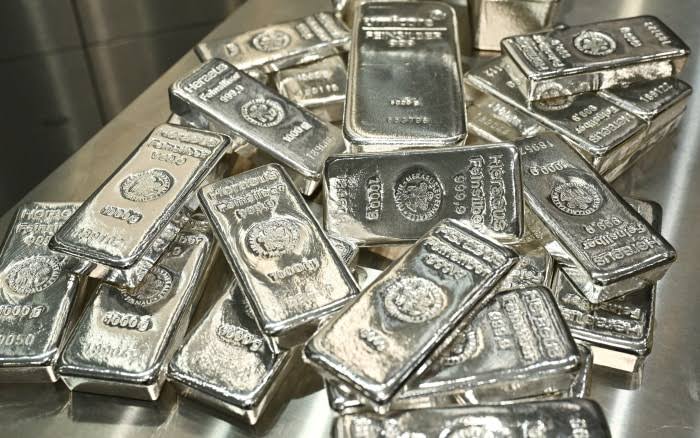
Gold rose for the second consecutive trading day. Spot gold rose 1.1% to $4,389.29 per ounce, briefly rising over 1% during the session to hit a new high in over two months. Spot silver rose 3.57% to $65.75 per ounce. The surge in oil prices boosted inflation expectations, attracting capital to gold as a hedge.
Bitcoin fell below $64,000 during the session, dropping over 2% from its daily high; Ethereum traded around $1,890, down about 1% over 24 hours. The U.S. dollar index rebounded, moving away from a one-and-a-half-month low. The Japanese yen fell as much as 1% to a low for August. Offshore Chinese yuan moved away from a three-year high. With oil prices surging and interest rate expectations heating up, capital is actively repositioning.
Watch for Tuesday: A Quiet Window Before CPI
No major U.S. economic data is scheduled for release on Tuesday; the market will continue digesting the impact of rising oil prices and yields. Oil price movements remain the largest uncertain variable, with Trump and Iran's mutual compensation demands complicating the Hormuz negotiations further. The market will closely watch for follow-up news on Nvidia's $500 billion financing plan and whether stocks like Coherent in the optical communication sector can stabilize and halt their decline.