The On-Chain Evolution of Private Credit: From Ledgers to Investable Products

深潮Xuất bản vào 2025-12-18Cập nhật gần nhất vào 2025-12-18

Tóm tắt

Private credit is undergoing a significant on-chain evolution, transitioning from a ledger-based operational upgrade to a distributable, investable product. While the total value of tokenized private credit has surged to around $24 billion, only 12% of the $19.3 billion in active loans tracked on RWA.xyz are held in transferable tokenized form. The market is split between "representative" tokenization—where blockchain serves as a transparent record-keeping system for off-chain loans—and "distributable" tokenization, where loans are natively issued and held as transferable tokens on-chain. The latter is growing rapidly, offering benefits like enhanced liquidity, faster settlement, and improved transparency. Figure dominates the market with a 73% share but uses blockchain only for record-keeping. In contrast, platforms like Maple are driving the shift toward fully distributable tokenized credit. This shift could standardize and scale private credit distribution by reducing intermediation, enabling programmable compliance, and improving portability—key advancements for an asset class that represents less than 2% of the $1.6 trillion global private credit market.

Author: Prathik Desai

Compiled by: Block Unicorn
Preface

On tokenized real-world asset (RWA) platforms, private credit is at a pivotal moment. Over the past year, tokenized private credit has been the fastest-growing category, surging from less than $50,000 to approximately $2.4 billion.

If stablecoins (whose payment channels cover all on-chain activities) are excluded, tokenized private credit ranks second only to on-chain commodities. Top tokenized commodities include Tether and Paxos's gold-backed currencies, as well as Justoken's tokens backed by cotton, soybean oil, and corn. This appears to be a serious category, with real borrowers, cash flows, underwriting mechanisms, and yields—and it is less dependent on market cycles compared to commodities.

But the story only becomes complex when you dig deeper.

This $2.4 billion in outstanding tokenized private credit represents only a small fraction of the total outstanding loans. This suggests that only a portion of these assets can truly be held and transferred on-chain in tokenized form.

In today's article, I will examine the reality behind the numbers of tokenized private credit and what these numbers mean for the future of this category.

Let's dive right in.

The Dual Nature of Tokenized Private Credit

The total active loans on the RWA.xyz platform are slightly over $19.3 billion. However, only about 12% of these assets can be held and transferred in tokenized form. This highlights the dual nature of tokenized private credit.

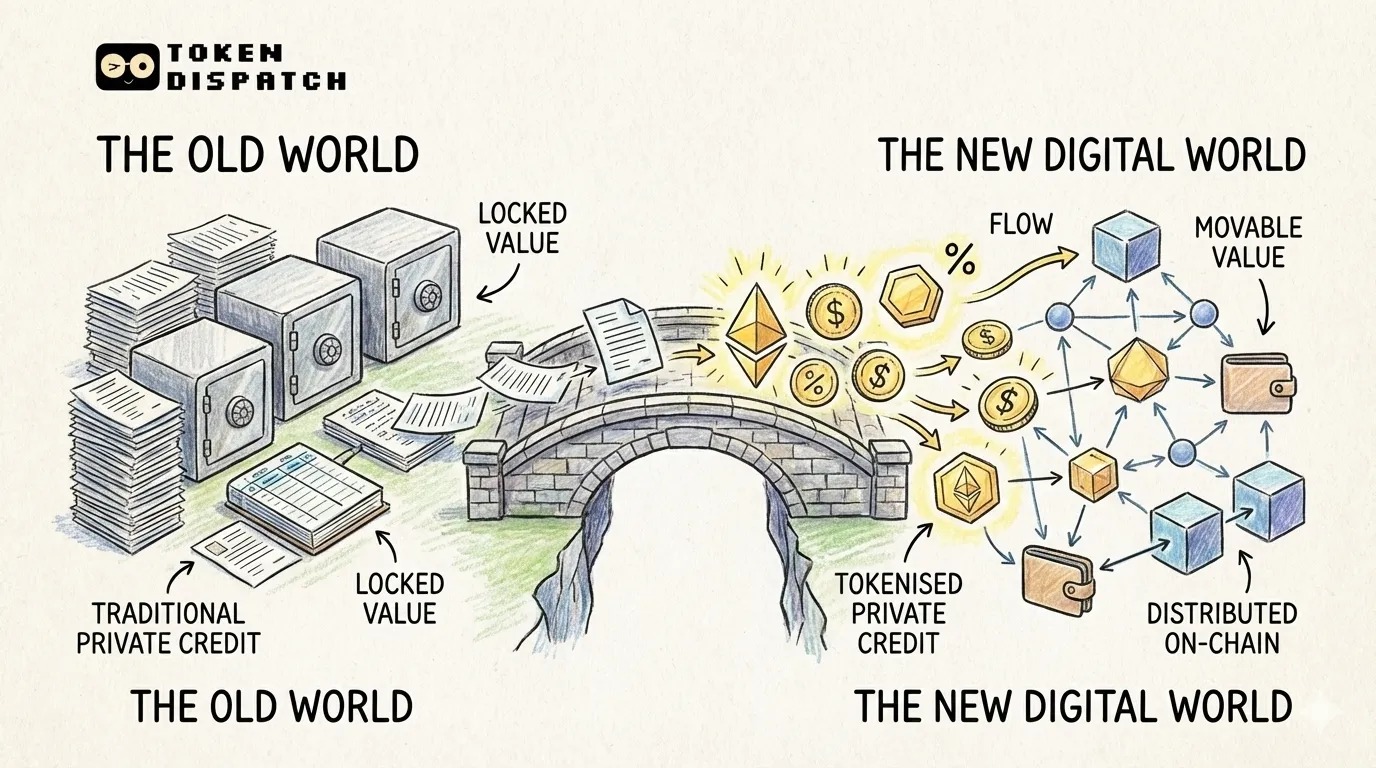
One aspect is "representative" tokenized private credit, where the blockchain merely provides operational upgrades by establishing an on-chain ledger of outstanding loans recorded from the traditional private credit market. The other aspect is the distribution upgrade, where blockchain-driven markets coexist with traditional (or off-chain) private credit markets.

The former is used solely for recording and reconciliation, documented on a public ledger. The latter, however, can be transferred to wallets for transactions.

Once you understand this classification system, you won't ask whether private credit is on-chain. Instead, you'll pose a sharper question: How much private credit originates from the blockchain? The answer to this question might offer some insights.
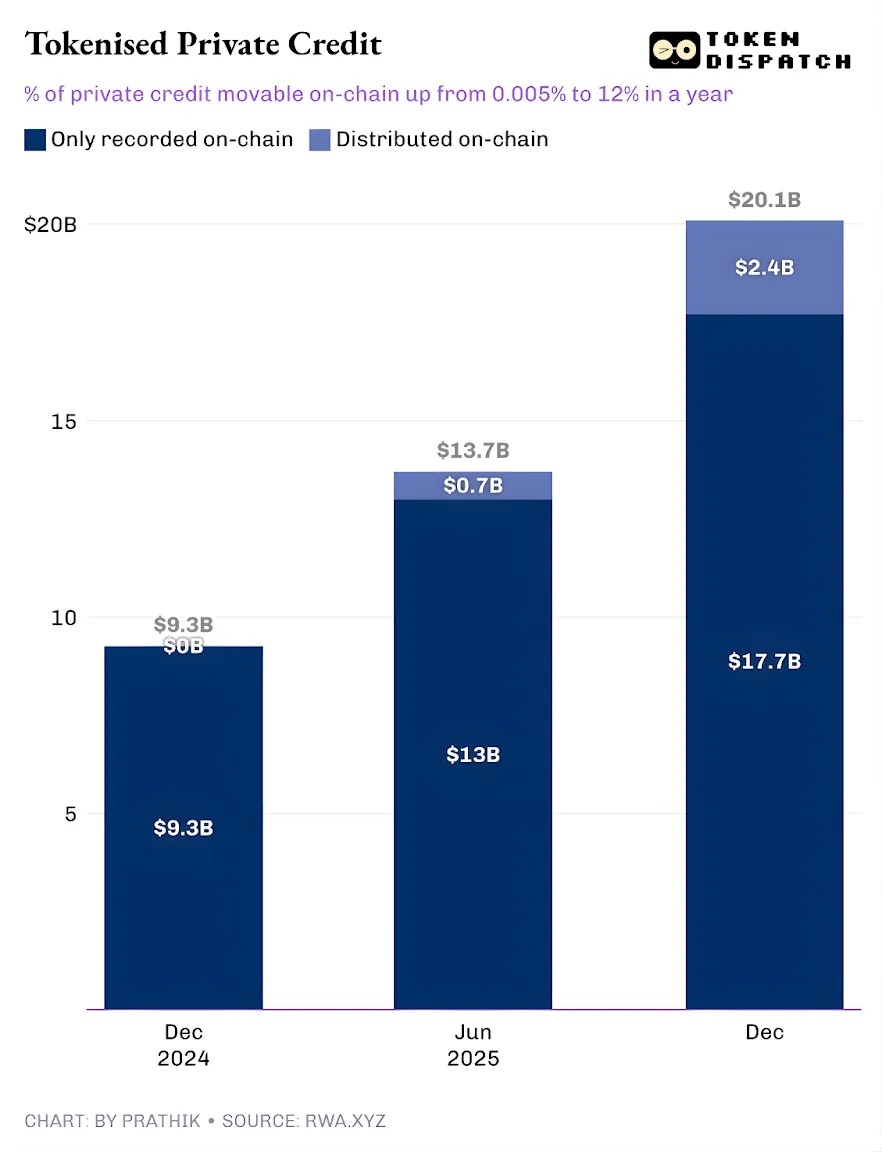
The trajectory of tokenized private credit is encouraging.

Until last year, almost all tokenized private credit was merely an operational upgrade. The loans already existed, borrowers made timely payments, platforms operated normally, and the blockchain simply recorded these activities. All tokenized private credit was only recorded on-chain and could not be transferred as tokens. Within a year, this share of on-chain transferable assets has climbed to 12% of the total trackable private credit.

It showcases the growth of tokenized private credit as a distributable on-chain product. This enables investors to hold fund shares, pool tokens, notes, or structured investment exposures in tokenized form.

If this distributed model continues to expand, private credit will no longer resemble a loan ledger but rather an investable on-chain asset class. This shift will change the benefits lenders derive from transactions. Beyond yields, lenders will gain a tool with greater operational transparency, faster settlement, and more flexible custody. Borrowers will access funding that isn't dependent on a single distribution channel, which could be highly beneficial in risk-averse environments.

But who will drive the growth of the distributable private credit market?

The Figure Effect

Currently, the majority of outstanding credit comes from a single platform, while the rest of the ecosystem forms a long tail.

Since October 2022, Figure has dominated the tokenized private credit market, but its market share has dropped from over 90% in February to 73% today.
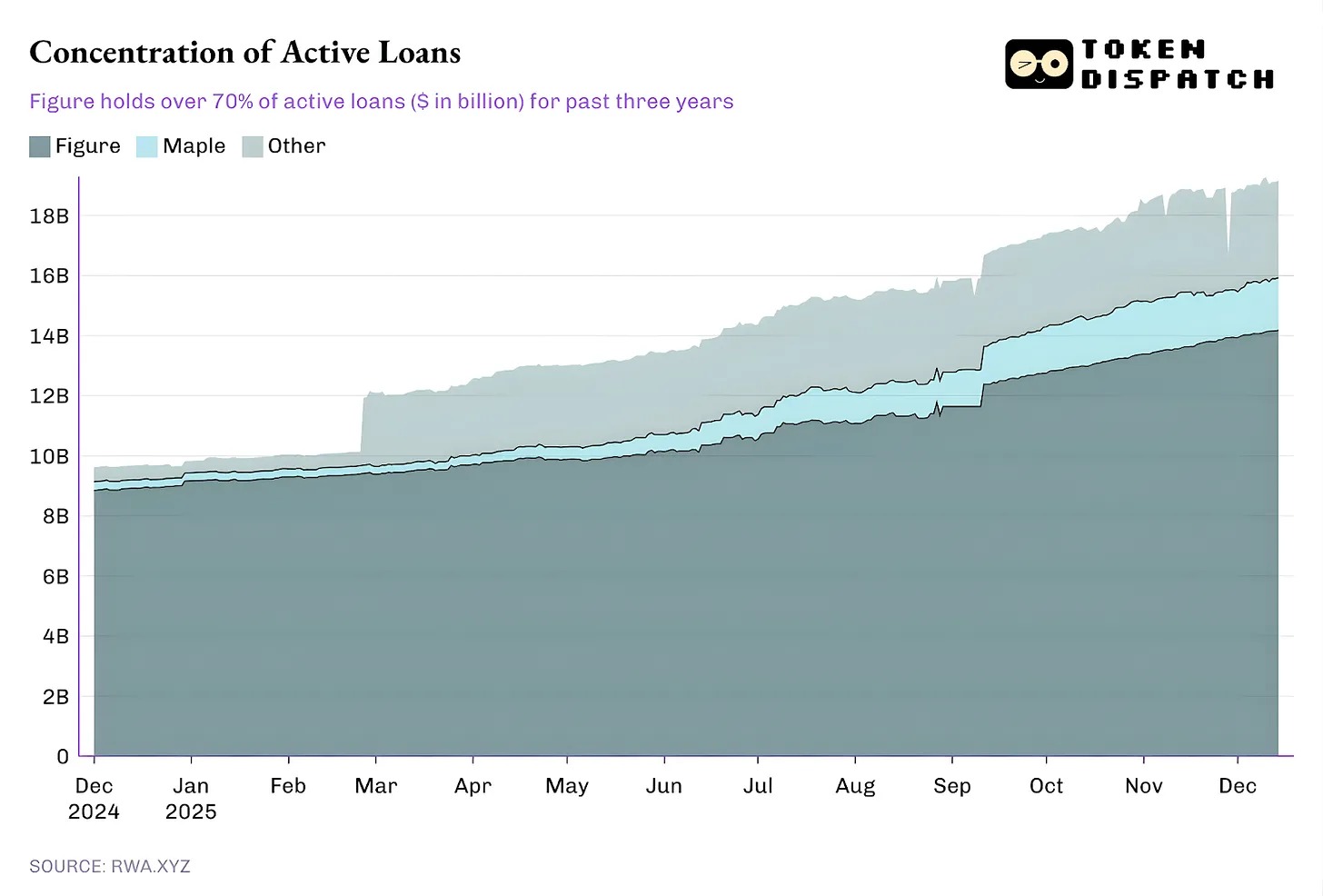
But what's more interesting is Figure's private credit model.

Although tokenized private credit now exceeds $14 billion, all the value of this industry leader is reflected in "representative" asset value, while the distributed value remains zero. This indicates that Figure's model is an operational pipeline that records loan issuance and ownership on the Provenance blockchain.

Meanwhile, some smaller players are driving the distribution of tokenized private credit.
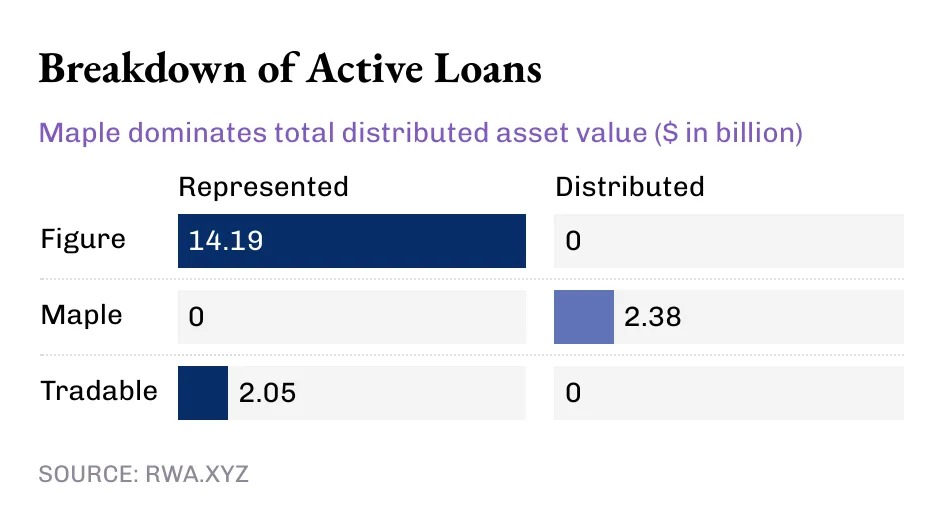
Figure and Tradable hold all their tokenized private credit as representative value, while Maple's value is entirely distributed via the blockchain.

From a macro perspective, the vast majority of the $19 billion in active on-chain loans are recorded on the blockchain. But the trend over the past few months is undeniable: more and more private credit is being distributed via blockchain. Given the immense growth potential of tokenized private credit, this trend will only intensify.

Even at $19 billion, RWAs currently account for less than 2% of the total $1.6 trillion private credit market.

But why is "movable, not just recorded" private credit important?

Movable private credit offers more than just liquidity. Gaining exposure to private credit off-platform through tokens provides portability, standardization, and faster distribution speed.

Assets acquired through traditional private credit channels trap holders within a specific platform's ecosystem. Such ecosystems have limited transfer windows and cumbersome secondary market trading processes. Additionally, secondary market negotiations are slow and primarily led by professionals. This gives existing market infrastructure far more power than asset holders.

Distributable tokens can reduce these frictions by enabling faster settlement, clearer ownership changes, and simpler custody.

More importantly, "movability" is a prerequisite for the large-scale standardized distribution of private credit, which has historically been lacking. In the traditional model, private credit appears in the form of funds, business development companies (BDCs), and collateralized loan obligations (CLOs), each adding multiple layers of intermediaries and opaque fees.

On-chain distribution offers a different path: programmable wrappers enforce compliance (whitelisting), cash flow rules, and information disclosure at the tool level, rather than through manual processes.


Câu hỏi Liên quan

QWhat is the current size of the tokenized private credit market, and how does it compare to the total outstanding private credit market?

AThe tokenized private credit market has grown to approximately $24 billion. However, this represents only a small fraction, about 1.2%, of the total $1.6 trillion private credit market.

QWhat is the key difference between 'representative' and 'distributable' tokenized private credit?

A'Representative' tokenized private credit uses the blockchain solely as an operational upgrade to record and reconcile loans from the traditional market on a public ledger. 'Distributable' tokenized private credit allows the assets to be held and transferred as tokens, enabling them to be portable and traded in a blockchain-driven market.

QWhich company is the current market leader in tokenized private credit, and what is unique about its model?

AFigure is the current market leader, holding 73% of the tokenized private credit market. Its model is unique because its entire $14+ billion in value is classified as 'representative' value, meaning the loans are recorded on the Provenance blockchain for operational purposes but are not distributable as transferable tokens.

QWhat are the potential benefits of 'distributable' tokenized private credit over traditional private credit instruments?

ADistributable tokenized private credit offers benefits such as portability, faster settlement, clearer ownership changes, simpler custody, and the potential for standardized, large-scale distribution. It reduces reliance on a single platform's ecosystem and the complex, slow processes of traditional secondary markets dominated by intermediaries.

QWhat does the growth of the distributable segment indicate for the future of private credit?

AThe growth of the distributable segment indicates a shift where private credit is evolving from being a simple on-chain ledger of loans into a true, tradable asset class. This transformation promises greater operational transparency, faster settlement, and more flexible custody options for lenders, while providing borrowers with access to capital that is not reliant on a single distribution channel.

Nội dung Liên quan

Kỹ sư hậu huấn luyện OpenAI Weng Jiayi đề xuất giả thuyết mới về Agentic AI

Thập kỷ qua, AI phát triển chủ yếu dựa vào mô hình lớn hơn với nhiều dữ liệu và năng lực tính toán hơn. Gần đây, kỹ sư OpenAI Weng Jiayi đã đề xuất một hướng đi mới có tên "Heuristic Learning" (HL) - Học theo phỏng đoán. Trong thí nghiệm, ông sử dụng Codex (dựa trên GPT-5.4) để duy trì một hệ thống tự động viết, chạy thử, phân tích nhật ký, xem video phát lại và sửa mã nguồn chiến lược cho trò chơi Atari Breakout. Qua nhiều vòng lặp, Codex đã tạo ra một chiến lược thuần Python đạt điểm tối đa lý thuyết 864. Kinh nghiệm được mã hóa thành phần mềm có thể đọc, sửa, kiểm tra và kiểm toán, thay vì chỉ nằm trong các tham số mạng nơ-ron khó giải thích. HL được định nghĩa là một hệ thống học trong đó đối tượng được cập nhật là cấu trúc phần mềm, không phải trọng số mạng nơ-ron, sử dụng phản hồi từ môi trường, kiểm thử, nhật ký và video. So với Deep RL, HL có ưu điểm về khả năng giải thích, hiệu quả mẫu theo đơn vị thay đổi mã, khả năng bảo toàn kiến thức cũ thông qua kiểm thử hồi quy và ít bị "lãng quên thảm khốc". Thử nghiệm mở rộng trên 57 trò chơi Atari cho thấy HL đạt hiệu suất ngang bằng các thuật toán RL cổ điển như PPO ở một số trò, nhưng bộc lộ hạn chế ở các nhiệm vụ đòi hỏi lập kế hoạch dài hạn như Montezuma's Revenge. Nếu được chứng minh, HL có thể có ý nghĩa lớn trong: 1) Điều khiển robot cho các nhiệm vụ cấu trúc ổn định, giảm phụ thuộc vào suy luận mạng nơ-ron thời gian thực; 2) Các kịch bản an toàn quan trọng, nơi tính kiểm tra được của mã nguồn là giá trị thương mại; 3) Học liên tục được kỹ thuật hóa thông qua các công cụ phần mềm truyền thống; 4) Giúp Agent tích lũy kinh nghiệm thành tài sản mã nguồn có thể tái sử dụng và chia sẻ. Tóm lại, Weng Jiayi đưa ra giả thuyết rằng trong kỷ nguyên AI có khả năng lập trình, kinh nghiệm có thể được chuyển đổi thành phần mềm có thể đọc và bảo trì, bổ sung cho mô hình học sâu truyền thống. Tuy nhiên, con đường này vẫn cần được thử nghiệm thêm ở các nhiệm vụ phức tạp hơn.

marsbit21 phút trước

Kỹ sư hậu huấn luyện OpenAI Weng Jiayi đề xuất giả thuyết mới về Agentic AI

marsbit21 phút trước

Claude của bạn sẽ mơ đêm nay, đừng làm phiền nó

Bài viết thảo luận về cách các công ty AI như Anthropic sử dụng các thuật ngữ mang tính con người như "mơ" (dreaming), "ghi nhớ" (memory) và "suy nghĩ" (thinking) để mô tả các chức năng kỹ thuật của AI Agent, qua đó làm mờ đi ranh giới giữa máy móc và con người. Cụ thể, tính năng "mơ" của Claude thực chất là một quá trình xử lý tự động ngoại tuyến, nơi Agent phân tích lại nhật ký hoạt động từ các tác vụ trước đó để tìm ra mẫu hành vi và tối ưu hóa hiệu suất trong tương lai, tương tự cơ chế củng cố ký ức khi ngủ của con người. Các nền tảng AI khác như Hermes Agent và OpenClaw cũng có cơ chế tự học tương tự. Bài viết chỉ ra rằng việc sử dụng ngôn ngữ nhân cách hóa này không chỉ là một chiến lược tiếp thị, nhằm tạo cảm giác AI là một thực thể sống có nội tâm, mà còn ảnh hưởng đến cách chúng ta phân bổ trách nhiệm khi có sự cố xảy ra, từ công cụ chuyển sang "chủ thể" hành vi. Đồng thời, nó đề cập đến thách thức kỹ thuật về bộ nhớ dài hạn (context window) của AI và nhu cầu về các cơ chế như "mơ" để lọc và lưu giữ thông tin quan trọng, trong bối cảnh các công ty như Subquadratic đang phát triển mô hình với ngữ cảnh cực dài lên đến 12 triệu token. Cuối cùng, tác giả dự đoán sự xuất hiện của các tính năng như "mơ giữa ban ngày" (daydreaming) để AI lên kế hoạch cho các tác vụ trong tương lai, và nhấn mạnh rằng việc thừa nhận bản chất máy móc của AI khó khăn hơn chúng ta tưởng khi ngôn ngữ đang liên tục được định hình lại.

marsbit24 phút trước

Claude của bạn sẽ mơ đêm nay, đừng làm phiền nó

marsbit24 phút trước

Cổ phiếu CoreWeave do Đoàn Vĩnh Bình mua vào lúc đáy, đang biến thành trường chiến ác liệt giữa phe mua và phe bán

Tác giả: Deep TechFlow Ngày 8 tháng 5, CoreWeave (CRWV), nhà cung cấp điện toán đám mây AI, giảm mạnh 11,4%, đóng cửa ở mức 114,15 USD. Đây là một lần "giảm sau báo cáo" khác kể từ IPO năm ngoái. Điểm đáng chú ý là Đoàn Vĩnh Bình, được biết đến như môn đồ của Buffett, vừa mở vị thế đầu tiên vào CoreWeave trong quý 4/2025 với khoảng 20 triệu USD, gần mức thấp nhất năm của cổ phiếu này. CoreWeave là một tài sản AI gây tranh cãi nhất trên thị trường chứng khoán Mỹ. Một bên là câu chuyện "người bán cuốc" với khoản đặt hàng tồn đọng gần 1000 tỷ USD và mối quan hệ sâu sắc với NVIDIA. Bên kia là thực tế tài chính: thua lỗ mở rộng khi quy mô tăng và việc những người trong công ty liên tục bán cổ phiếu. Báo cáo quý 1 làm rõ sự chia rẽ này. **Báo cáo Q1: Doanh thu tăng gấp đôi nhưng thua lỗ mở rộng, Hướng dẫn Q2 làm giảm định giá** Doanh thu Q1 đạt 2,08 tỷ USD, tăng 112%, vượt kỳ vọng. Tuy nhiên, lỗ ròng mở rộng lên 740 triệu USD. Hướng dẫn doanh thu Q2 từ 2,45 đến 2,6 tỷ USD thấp hơn kỳ vọng thị trường. Chi tiêu vốn năm 2026 được điều chỉnh tăng. Lợi nhuận hoạt động điều chỉnh chỉ là 21 triệu USD, với biên lợi nhuận hoạt động chỉ 1%. CEO Michael Intrator tuyên bố công ty đã đạt quy mô siêu lớn (hyperscale), dự báo doanh thu hàng năm có thể vượt 30 tỷ USD vào cuối năm 2027. **Luận điểm phe mua: Đơn hàng 1000 tỷ USD, gắn bó chặt chẽ với NVIDIA** Số dư đơn hàng chưa thực hiện (RPO) cuối Q1 là 99,4 tỷ USD. Khách hàng mới bao gồm Anthropic, Meta và Jane Street. NVIDIA tiếp tục mua 2 tỷ USD cổ phiếu loại A, củng cố mối quan hệ đa tầng. CoreWeave cũng huy động thành công 8,5 tỷ USD tài trợ bằng nợ với chi phí thấp, và triển vọng xếp hạng tín nhiệm được S&P nâng lên "Tích cực". **Luận điểm phe bán: Quy mô càng lớn càng không sinh lời, nợ chồng chất** Chi tiêu vốn Q1 là 6,8 tỷ USD, dự kiến tăng mạnh trong Q2. Chi phí lãi vay dự báo tăng. Tổng nợ khoảng 25 tỷ USD, đòn bẩy cao so với các nhà cung cấp dịch vụ đám mây truyền thống. Mô hình mở rộng chủ yếu dựa vào vay nợ dựa trên hợp đồng. Biên lợi nhuận thực tế rất mỏng (khoảng 4%), và ban lãnh đạo cho rằng đây là điểm thấp nhất do hiệu ứng pha loãng từ việc mở rộng quy mô nhanh chóng. **Người trong công ty liên tục bán ra, tương phản với hành động mua vào của Đoàn Vĩnh Bình** CEO và những người sáng lập khác tiếp tục bán cổ phiếu sau báo cáo. Điều này trái ngược với động thái mở vị thế của Đoàn Vĩnh Bình trong quý 4/2025, khi cổ phiếu giảm hơn 65% từ đỉnh. Tuy nhiên, CoreWeave chỉ chiếm 0,12% tổng danh mục của ông, cho thấy đây là một vị thế thử nghiệm nhỏ, trong khi trọng tâm vẫn là NVIDIA. **Câu hỏi then chốt hiện tại: Điểm ngoặt hay cạm bẫy?** Phe mua nhìn thấy khu rừng tiềm năng (đơn hàng, khách hàng, quan hệ với NVIDIA). Phe bán chỉ thấy cái cây hiện tại (biên lợi nhuận thấp, thua lỗ, nợ cao, người trong cuộc bán ra). Giá cổ phiếu CoreWeave vẫn tăng mạnh so với đầu năm và từ thời điểm IPO. Khi câu chuyện phe mua dựa trên tương lai xa, còn phe bán dựa trên số liệu hiện tại, mỗi báo cáo tài chính đều trở thành chiến trường. Báo cáo Q2 sắp tới sẽ là phép thử thực sự cho lời hứa phục hồi biên lợi nhuận của ban lãnh đạo.

marsbit31 phút trước

Cổ phiếu CoreWeave do Đoàn Vĩnh Bình mua vào lúc đáy, đang biến thành trường chiến ác liệt giữa phe mua và phe bán

marsbit31 phút trước

Phiên bản Trung Quốc của "Lễ hội Người Lửa Công nghệ" lần đầu ra mắt tại Thượng Hải, muShanghai kiến tạo "Thành phố bùng nổ" dành cho các cực khách toàn cầu

Từ ngày 10/5 đến ngày 6/6/2026, muShanghai đã khởi động thí nghiệm "Thành phố bật tắt" (Pop-up City) tại Thượng Hải, do cộng đồng mã nguồn mở quốc tế The Mu khởi xướng và đồng tổ chức với Trung tâm Alibaba Hồng Kiều. Sự kiện kéo dài 28 ngày này quy tụ các nhà phát triển, nhà nghiên cứu và doanh nhân từ hơn 50 quốc gia để cùng khám phá các khả năng hợp tác mới giữa con người và công nghệ trong thời đại AI. Được mệnh danh là "Lễ hội Người đốt lửa công nghệ" phiên bản Trung Quốc, muShanghai thu hút hơn 800 người tham gia được tuyển chọn từ 2000 đơn đăng ký toàn cầu. Chương trình được chia thành bốn tuần chủ đề chính: Tuần AI (thảo luận về mô hình lớn, an toàn AI và ứng dụng tiêu dùng), Tuần Công nghệ Sinh học (chống lão hóa, phòng thí nghiệm AI), Tuần Robot (trình diễn công nghệ, thời trang cyber) và Tuần Văn hóa (xã hội tương lai, trò chơi độc lập). Hơn 100 sự kiện sẽ được tổ chức, bao gồm chương trình khai mạc ClawCon 2026, chợ sáng tạo ngoài trời và các triển lãm. Là đơn vị đồng tổ chức, Trung trung tâm Alibaba Hồng Kiều cung cấp không gian và dịch vụ hỗ trợ toàn diện, định vị là "bến đỗ đầu tiên" cho các tài năng quốc tế đến Trung Quốc khởi nghiệp. The Mu, cộng đồng đứng sau sự kiện, có kinh nghiệm tổ chức các "thành phố bật tắt" thành công ở Argentina, San Francisco và cả Triển lãm Thế giới Osaka 2025. MuShanghai không chỉ là một lễ hội công nghệ cao mà còn là cầu nối quan trọng giúp hệ sinh thái đổi mới sáng tạo của Trung Quốc kết nối với toàn cầu, tạo ra một "thành phố song song" cho giới geek toàn thế giới cùng xây dựng.

marsbit32 phút trước

Phiên bản Trung Quốc của "Lễ hội Người Lửa Công nghệ" lần đầu ra mắt tại Thượng Hải, muShanghai kiến tạo "Thành phố bùng nổ" dành cho các cực khách toàn cầu

marsbit32 phút trước

Giao dịch

Giao ngay
Hợp đồng Tương lai
活动图片




