# Bài viết Liên quan Latin America

Trung tâm Tin tức HTX cung cấp những bài viết mới nhất và phân tích chuyên sâu về "Latin America", bao gồm xu hướng thị trường, cập nhật dự án, phát triển công nghệ và chính sách quản lý trong ngành tiền kỹ thuật số.

The Rise of Stablecoins in Latin America Is Not, in Essence, a 'Victory for Crypto Technology'

The Rise of Stablecoins in Latin America: Not a Victory for Crypto, But for Remittance Infrastructure Stablecoin adoption in Latin America isn't primarily driven by belief in crypto technology. It's a pragmatic solution to a centuries-old problem: getting money home. The article draws parallels to the traditional "silver letters" (银信) system used by Chinese diaspora, where trust and execution relied on tight-knit community networks. The core pain point is remittances—the lifeblood for millions of families. Existing systems are often slow, expensive, and opaque. Stablecoins like USDT and USDC are not seen as speculative crypto assets but as "digital dollars in your phone." They address critical local needs: Argentinians use them as a hedge against hyperinflation, Venezuelans as a lifeline for essential goods, while in Brazil and Mexico, they facilitate cross-border payments and freelance payouts. The real challenge isn't the blockchain transfer itself, but the "on-ramps" and "off-ramps"—how to convert local currency into stablecoins and, crucially, how recipients can access the funds as spendable local currency via systems like Pix (Brazil) or SPEI (Mexico). The battlefield is building the infrastructure that seamlessly connects these ends. Regulators are less focused on "crypto adoption" and more on controlling what becomes a parallel foreign exchange system, concerned with AML, consumer protection, and capital flows. The future lies in stablecoins becoming an invisible, efficient middle layer in a new remittance stack, where the user only cares about one thing: the money arrived.

marsbit06/26 11:56

The Rise of Stablecoins in Latin America Is Not, in Essence, a 'Victory for Crypto Technology'

marsbit06/26 11:56

Two Giants' Credit Expansion: Loan Balances of $9.9 Billion vs. $14.6 Billion, Brazil Emerges as the Main Battlefield

Title: Two Giants "Credit" Surge: Loan Balances of 99 Billion vs. 146 Billion USD, Brazil Emerges as Main Battlefield Summary: The article compares the rapid expansion of credit businesses by two major e-commerce and fintech players, Sea (via Monee) and Mercado Libre (via Mercado Pago), in overseas markets like Southeast Asia and Latin America, contrasting with a slowing domestic Chinese credit market. Using Q1 2026 financial data, it highlights their significant growth. Sea's Monee reached a loan balance of $99 billion, up 71% year-over-year (YoY), contributing 17.5% to Sea's total revenue. Mercado Pago's loan balance hit $146 billion, up 87% YoY, contributing 45% to its parent company's revenue. Both maintained stable risk metrics (e.g., Monee's 90+ day NPL at 1.1%) despite rapid scaling. Brazil is identified as a key and accelerating growth market for both. Sea's Brazilian operations saw loan volumes exceed $10 billion, growing 250% YoY, with SPayLater GMV penetration still low (~10%) indicating high potential. Sea also secured a key Brazilian financial credit license (SCFI). Mercado Libre's Brazil segment contributed over half (54%) of total group revenue, with its credit business there generating $11.24 billion in revenue, up 89% YoY and accounting for 12.7% of global revenue. Mercado Pago's credit portfolio, especially credit cards (46% of loans, +105% YoY), is a strategic focus, described as crucial as building logistics was a decade ago. Its net interest margin after loss (NIMAL) remains high at 17.8%. The article concludes that while Brazil presents immense opportunities, the success is largely driven by these integrated "e-commerce + fintech" giants with proprietary transaction data and ecosystems, making it challenging for standalone fintech players to compete effectively.

链捕手06/22 13:16

Two Giants' Credit Expansion: Loan Balances of $9.9 Billion vs. $14.6 Billion, Brazil Emerges as the Main Battlefield

链捕手06/22 13:16

Latin America's Payments Landscape Is Not What You Think It Is

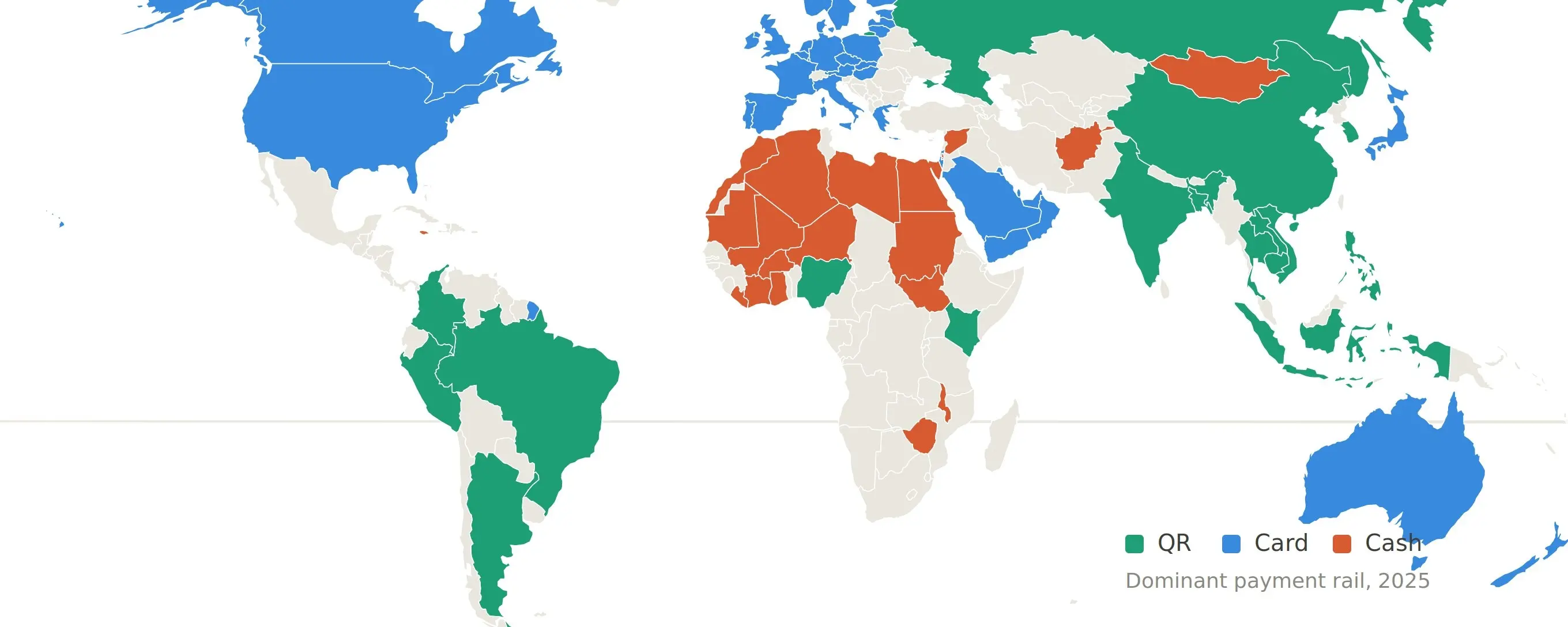
This report challenges common misconceptions about Latin America's payment landscape, based on over 500 hours of firsthand research. Key findings include: 1) Crypto card transaction volume primarily comes from high-net-worth individuals receiving USDT salaries, not retail spending. 2) QR code payments (e.g., Brazil's Pix, Argentina's Mercado Pago) are the dominant payment method across most emerging markets, not cards. 3) A major untapped opportunity lies in enabling cross-border interoperability between domestic instant payment systems. 4) Payment competition is shifting from customer acquisition to owning the settlement layer (e.g., acquiring banks). 5) Latin America is not a single market; Brazil, Mexico, Argentina, and smaller "forgotten five" countries (e.g., Guatemala, Honduras) have vastly different dynamics. 6) Stablecoin-to-fiat conversion margins are collapsing toward zero, pushing companies to build value-added services on top. 7) Future payment winners will be multi-country brands, not single-corridor specialists. 8) Marketing must target specific user segments (e.g., digital nomads, unbanked immigrants) with tailored messaging, not a generic "Brazilian" audience. 9) Contrary to perception, Latin American regulators are often ahead of the US in creating frameworks for digital assets and instant payments, with clear licensing deadlines. The core takeaway is that the region's payment rules are being rewritten, moving beyond cards and stablecoin arbitrage towards integrated, cross-border QR-based solutions.

链捕手06/21 08:50

Latin America's Payments Landscape Is Not What You Think It Is

链捕手06/21 08:50

活动图片