SEC Drops Case, CZ Pardoned, Justin Sun Settles: Trump's Crypto Business Gains Momentum

marsbitXuất bản vào 2026-03-09Cập nhật gần nhất vào 2026-03-09

Tóm tắt

On March 5, Justin Sun reached a $10 million settlement with the SEC to resolve a civil fraud lawsuit, without admitting wrongdoing. This follows a broader trend of regulatory easing under the Trump administration, including the dismissal of the SEC’s case against Binance and the presidential pardon of its founder, CZ. A Reuters analysis reveals that Trump-affiliated crypto ventures, particularly World Liberty Financial’s token and the USD1 stablecoin, have significantly benefited from this regulatory pullback. Trump’s businesses reportedly earned $802 million from crypto in the first half of 2025. USD1, now the sixth-largest stablecoin with $4.4 billion in circulation, has become a key revenue generator. The article highlights a feedback loop: reduced regulatory friction boosts market activity, from which Trump-linked tokenomics directly profit through structured revenue-sharing and distribution advantages. This has raised concerns over potential conflicts of interest, even without evidence of direct coordination. While the broader U.S. crypto market benefits secondarily, the most concentrated gains flow to Trump’s ecosystem.

Author: CryptoSlate

Compiled by: Deep Tide TechFlow

Deep Tide Insight: This article goes beyond simply reporting Justin Sun's settlement with the SEC, placing this $10 million resolution within a broader policy context—since President Trump took office, the SEC's enforcement pressure on crypto giants has systematically receded, with the primary beneficiary being Trump's own token and stablecoin projects. Using quantifiable data ($802 million in revenue, $4.4 billion USD1 circulation), the article outlines the transmission mechanism between policy and private gain, making it essential reading for anyone tracking the direction of U.S. crypto regulation.

Full Text:

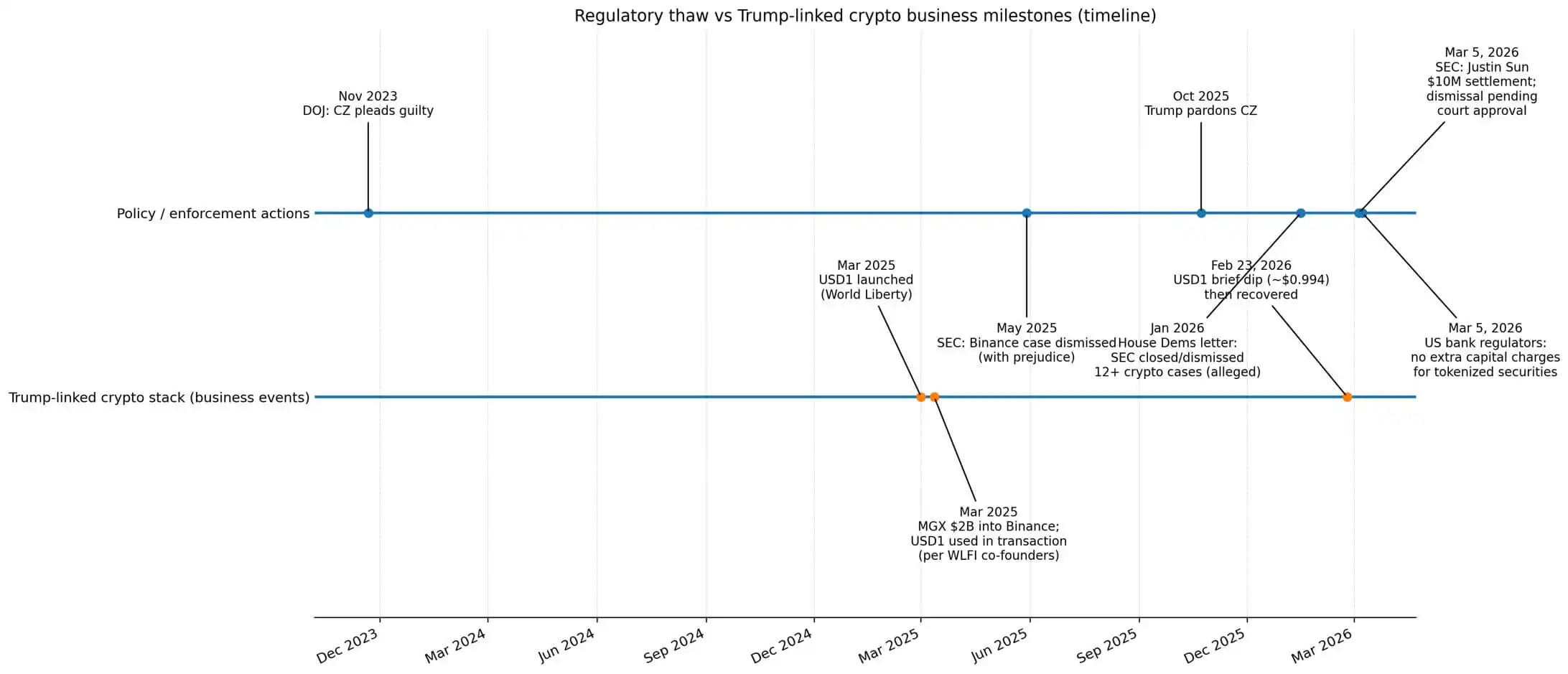
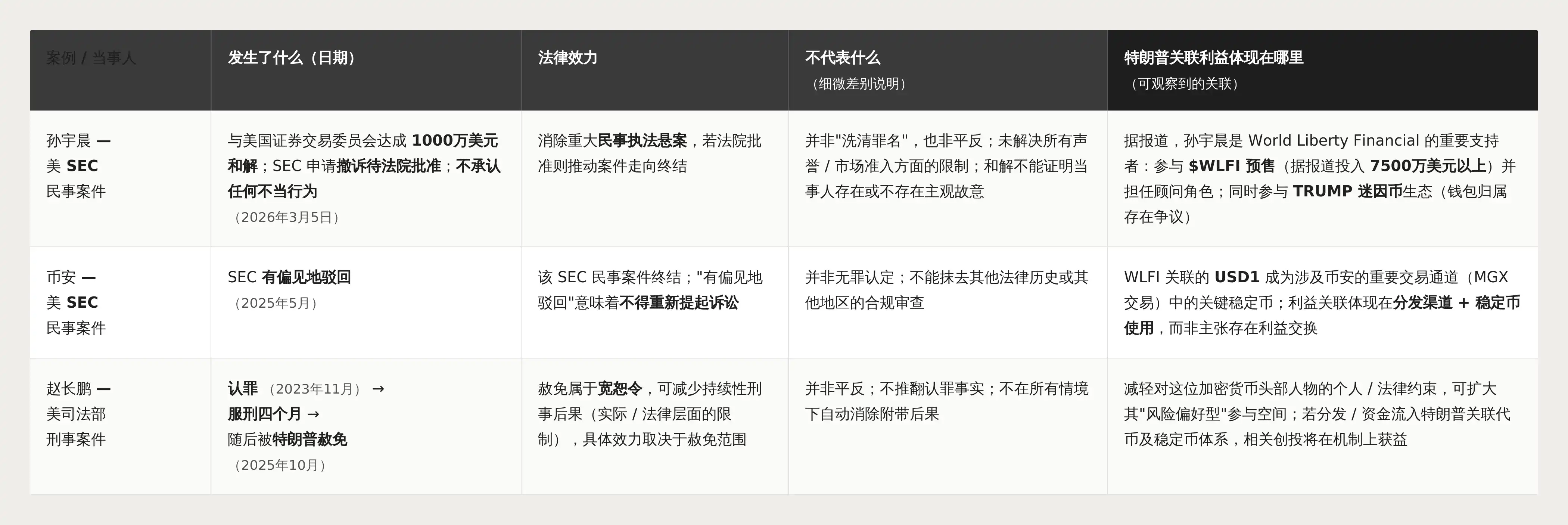
On March 5th, Justin Sun reached a $10 million settlement with the SEC, resolving a civil fraud lawsuit. The case accused him of profiting $31 million through wash trading-like operations and undisclosed celebrity promotions.

The settlement, which requires court approval and does not include any admission of wrongdoing, will lead to the dismissal of the case.

On the same day, U.S. banking regulators announced that banks holding tokenized securities would not face additional capital requirements compared to traditional securities. This technology-neutral classification represents another brick removed from the wall of crypto regulation.

Sun's settlement coincides with the one-year anniversary of the regulatory pullback under the Trump administration.

In May 2025, the SEC's civil lawsuit against Binance was dismissed with prejudice (cannot be refiled). In October 2025, Trump pardoned Binance founder Changpeng Zhao (CZ)—who had pleaded guilty in November 2023 to charges of anti-money laundering violations and operating an unlicensed money transmitting business, paid billions in fines, and served a four-month sentence.

In January 2026, Democratic members of the House Financial Services Committee sent a joint letter noting that the SEC had dismissed or terminated at least twelve crypto-related cases since January 2025.

The beneficiaries are not just the broader U.S. crypto market. Trump's own crypto network has quietly positioned itself to capture disproportionate private gains from the distribution channels and business relationships controlled by these entrepreneurs.
Presidential Proximity Tokenomics

In less than a year, two globally renowned crypto entrepreneurs have been freed from major U.S. legal constraints.

Sun's settlement ends the civil fraud case but is not a finding of innocence. Binance's SEC civil case was dismissed with prejudice. CZ's pardon is an act of judicial clemency, not an overturning of the facts to which he pleaded guilty.

Simultaneously, crypto projects linked to the Trump family have become direct beneficiaries of the crypto market's renewed activity.

Reuters estimated that the Trump Organization generated $802 million from crypto operations in the first half of 2025 alone, far surpassing other business lines, with the token economics of World Liberty Financial constituting the largest share.

World Liberty's charter stipulates that 75% of token sale revenue, after operational expenses, flows to Trump family entities. The stablecoin component USD1, launched in March 2025, added another revenue stream through collateral reserve earnings, which Reuters estimated could generate tens of millions annually at scale.

Justin Sun became one of the most visible buyers of World Liberty tokens, investing at least $75 million into the WLFI token pre-sale and joining as an advisor.

He also participated in the TRUMP Memecoin ecosystem, with reports linking a "SUN" wallet and HTX-related activity to significant holdings, though specific ownership remains disputed.

Binance's connection to the Trump crypto ecosystem is linked through another channel: Abu Dhabi-backed MGX invested $2 billion in Binance in March 2025, the largest institutional-level transaction in crypto history.

A World Liberty co-founder confirmed that USD1 was used in this MGX-Binance transaction.

Reports found that when the total circulating supply of USD1 was only about $2.1 billion, a single wallet held approximately $2 billion USD1, highlighting how a single conduit dominated early supply.

By February 2026, according to Artemis data, USD1 had grown to become the sixth-largest stablecoin, with a circulation of approximately $4.4 billion.

On February 23rd, USD1 briefly dipped to around $0.994, which World Liberty attributed to a "coordinated attack" on its X account, before the peg was restored.

The high concentration of early USD1 supply in the MGX-Binance channel, followed by growth, created a distribution advantage that World Liberty's revenue structure could directly monetize.
The Feedback Loop from Policy to Profit

This business design means: The ebb in enforcement and gradual guidance from regulators are lowering friction.

Reduced friction leads to increased activity, and increased activity enables the token and stablecoin economies linked to Trump to monetize.

Trump becomes the largest private beneficiary of these outcomes without needing to personally orchestrate regulatory results. This overlap is mechanical: as legal pressure eases on players who control distribution channels—like Binance's exchange listing power or Sun's investment capacity—the projects that capture this re-energized activity benefit, and World Liberty's token and stablecoin structures are恰好 positioned at these key junctures.

Stablecoins have evolved from niche crypto infrastructure to macro-level collateral. A February 2026 Bank for International Settlements working paper found that a two standard deviation net inflow into dollar stablecoins could depress three-month Treasury yields by about 2.5 to 3.5 basis points, rising to 5 to 8 basis points during periods of Treasury scarcity.

Stablecoin growth now generates measurable demand for safe assets, embedding these tools into interest rate and Treasury pipelines.

A European Central Bank working paper documented a "deposit substitution mechanism": the proliferation of stablecoins reduces retail deposits, limiting bank intermediation activity.

Eurozone evidence provides a rigorous analytical framework for U.S. banks' opposition to stablecoin interest-bearing functions. This directly corresponds to the current U.S. legislative impasse. The Clarity Act is stalled again, primarily due to bank opposition to stablecoin interest (fearing accelerated deposit outflows) and ongoing disputes over ethics and anti-money laundering provisions related to Trump-linked projects.

According to DeFiLlama data, the total stablecoin market cap is approximately $313 billion, with 3.7% growth over 30 days. Even without new legislation, the U.S. is functionally lowering the operating costs for crypto businesses, and Trump's crypto ecosystem has positioned itself as the "toll booth" for distribution growth.

Second-Order Beneficiaries and Structural Constraints

The first-order private beneficiaries are Trump's crypto network. The second-order public beneficiaries are the broader U.S. crypto market—lower enforcement risk premiums, faster product launches, more U.S.-facing projects.

This distinction is important because it separates correlation from causation without ignoring the observable flow of benefits. Settlements are not findings of innocence, dismissals are with prejudice, pardons are clemency, not an overturning of pleaded facts.

Even if a direct link between enforcement outcomes and private business ties cannot be proven, the distribution and revenue outcomes are visible and quantifiable.

SEC Chairman Paul Atkins stated in February 2026, following previous White House-led staff reductions, that the agency was re-hiring. He responded to accusations that the SEC's dismissal of crypto cases was politically motivated, noting many decisions predated his tenure.

The thaw extends beyond individuals. U.S. regulators now favor "exemptive relief" for tokenized security experiments, while the UK favors sandbox mechanisms—a divergence creating cross-border friction, even as U.S. policy overall leans permissive.

The next constraint may not be legal, but legislative and political.

Banks see stablecoins as a deposit substitution threat. Ethics clauses in proposed legislation could structurally limit the scale of Trump-linked projects, even as the market grows; or they could land weakly, allowing faster expansion.

Entrepreneurs who gained civil clearance or criminal pardons still face reputational and market access constraints if future enforcement agencies take a harder line.

Regulatory pressure could re-emerge as policy risk rather than pure legal risk.

Why This Matters

The concentration of benefits flowing to Trump's crypto projects raises conflict-of-interest questions,无需 requiring proof of a quid pro quo.

Revenue sharing, stablecoin reserve earnings, and distribution touchpoints are all documented in public filings and reports. Policy shifts—reduced enforcement, gradual guidance, civil dismissals, and pardons—reduce friction.

The private capture of this reduced friction is most apparent in projects where tokenomics and stablecoin growth translate directly into President-linked income.

Trump did not need to be the primary beneficiary of the regulatory pullback for the beneficiary to be observable.

As Trump-era regulators relieve legal pressure on crypto figureheads, the clearest private upside accrues to Trump's own token and stablecoin system, with the wider U.S. market as the second-order beneficiary. This pattern holds regardless of motive, and the numbers make it清晰可辨.


Câu hỏi Liên quan

QWhat was the outcome of the legal case between Justin Sun and the SEC, and what were the allegations?

AJustin Sun reached a $10 million settlement with the SEC to resolve a civil fraud lawsuit. The case alleged that he profited $31 million through wash trading-like operations and undisclosed celebrity promotions. The settlement, which requires court approval, does not include any admission of wrongdoing, and the case is set to be dismissed.

QHow has the regulatory environment for cryptocurrency in the U.S. changed under the Trump administration, according to the article?

AUnder the Trump administration, there has been a systematic retreat in SEC enforcement pressure on crypto giants. This includes the dismissal of the SEC's civil lawsuit against Binance in May 2025, the pardon of Binance founder CZ in October 2025, and the dismissal or termination of at least a dozen crypto-related cases since January 2025, as noted in a Democratic lawmakers' letter.

QWhat are the key financial figures mentioned for Trump's associated crypto projects, World Liberty Financial and USD1?

AThe Trump Organization generated $802 million from crypto businesses in the first half of 2025, largely from World Liberty Financial's token economics. Its stablecoin, USD1, had a circulating supply of approximately $4.4 billion by February 2026, making it the sixth-largest stablecoin. A single wallet was reported to hold around $2 billion of the early USD1 supply.

QHow does the article describe the connection between policy changes and private profit for Trump's crypto network?

AThe article describes a 'feedback loop' where reduced regulatory friction and enforcement retreat lead to increased crypto market activity. This activity directly benefits Trump's associated token and stablecoin projects, which are positioned to capture revenue through their economic structures. The projects mechanically benefit from the renewed activity of key players like Binance and Justin Sun, whose legal pressures have been lifted.

QWhat are some of the potential future challenges or constraints mentioned for the crypto industry and Trump's projects specifically?

AFuture constraints are predicted to be legislative and political rather than purely legal. Banks view stablecoins as a threat to deposits and oppose their interest-bearing功能. Proposed legislation could impose structural limits on Trump-associated projects through ethics and anti-money laundering clauses. Even cleared entrepreneurs could face reputational and market access constraints if future administrations adopt a tougher enforcement stance.

Nội dung Liên quan

GensynAI : Đừng để AI lặp lại sai lầm của Internet

Trong vài tháng qua, sự bùng nổ của ngành AI đã thu hút nhiều nhân tài từ lĩnh vực crypto chuyển hướng sang. Một câu hỏi lớn được đặt ra là: blockchain liệu có thể trở thành một phần của cơ sở hạ tầng AI? Trong khi nhiều dự án AI + Crypto tập trung vào tầng ứng dụng, Gensyn tiếp cận lớp lõi và tốn kém nhất: **huấn luyện mô hình**. Gensyn xây dựng một mạng lưới huấn luyện AI mở, kết nối các tài nguyên GPU phân tán toàn cầu. Các nhà phát triển có thể gửi tác vụ huấn luyện, trong khi các nút cung cấp sức mạnh tính toán. Mạng lưới xác minh kết quả và phân phối phần thưởng. Điều đáng chú ý không chỉ là "phi tập trung" mà là giải pháp cho vấn đề then chốt: sức mạnh tính toán đang ngày càng tập trung vào các ông lớn, tạo ra rào cản cho sự phát triển AI. Bài viết nêu bật bốn điểm chính về Gensyn: 1. **Tiếp cận tầng cơ sở hạ tầng lõi**: Gensyn tham gia trực tiếp vào khâu huấn luyện - phần đòi hỏi kỹ thuật cao và tiêu tốn nhiều tài nguyên nhất, có khả năng tạo ra rào cản nền tảng. 2. **Cung cấp mô hình hợp tác mở**: Thay vì phụ thuộc vào các nền tảng đám mây tập trung đắt đỏ, Gensyn huy động GPU nhàn rỗi, cho phép điều phối tài nguyên linh hoạt, tối ưu chi phí và hiệu quả cho cả nhóm AI quy mô vừa và nhỏ. 3. **Rào cản kỹ thuật là lợi thế cạnh tranh**: Thách thức thực sự nằm ở việc xác minh kết quả huấn luyện và đảm bảo độ tin cậy trong môi trường phân tán. Các cơ chế như xác minh xác suất và hệ thống phối hợp nút của Gensyn tạo nên lợi thế công nghệ quan trọng. 4. **Đã hình thành vòng lặp thương mại thực tế**: Gensyn đáp ứng một nhu cầu thị trường có thật và đang tăng trưởng – đó là sự thiếu hụt GPU cho nhu cầu huấn luyện AI toàn cầu, chứ không đơn thuần là một câu chuyện công nghệ. Ranh giới giữa Crypto và AI đang dần mờ đi. AI cần cơ chế phối hợp tài nguyên, khuyến khích và hợp tác toàn cầu – những thế mạnh của Crypto. Gensyn hướng tới việc biến năng lực huấn luyện thành một hệ thống mở và có thể hợp tác, không còn là độc quyền của một số ít gã khổng lồ, từ đó thúc đẩy sự phát triển của cả ngành.

marsbit13 giờ trước

GensynAI : Đừng để AI lặp lại sai lầm của Internet

marsbit13 giờ trước

3 Năm, 5 Lần Tăng Trưởng: Sự Hồi Sinh Của Nhà Máy Kính Trăm Tuổi

Theo CRU, nhu cầu về cáp quang từ các trung tâm dữ liệu AI đã tăng 75.9% trong một năm, khiến khoảng cách cung-cầu mở rộng từ 6% lên 15%. Giá cáp quang cũng tăng hơn 3 lần trong vài tháng. Để giải quyết tình trạng thiếu hụt năng lực sản xuất, NVIDIA đã đầu tư tổng cộng 45 tỷ USD vào chuỗi cung ứng quang học, bao gồm 20 tỷ USD cho Lumentum (máy phát laser), 20 tỷ USD cho Coherent (chip quang silicon) và 5 tỷ USD cho Corning (cáp quang). Corning, công ty thủy tinh 175 năm tuổi, đã trở thành một mắt xích quan trọng trong cơ sở hạ tầng AI nhờ cam kết mở rộng năng lực sản xuất cáp quang lên 10 lần. Cổ phiếu của họ đã tăng khoảng 6 lần từ cuối năm 2023. Nguyên nhân chính đến từ nhu cầu cấu trúc: các trung tâm dữ liệu AI yêu cầu loại cáp quang đặc biệt có tổn hao cực thấp, mật độ cao và chống uốn cong tốt - những lĩnh vực Corning có thế mạnh kỹ thuật sâu. Doanh thu từ mảng truyền thông quang học của Corning cho khách hàng doanh nghiệp đã tăng gấp đôi lên hơn 3 tỷ USD từ 2023 đến 2025, với các hợp đồng dài hạn từ Meta, NVIDIA và hai khách hàng lớn khác. Mặc dù không phải là nhà sản xuất cáp quang lớn nhất thế giới về thị phần, Corning dẫn đầu về công nghệ sợi cao cấp phục vụ AI và đang hợp tác trực tiếp với NVIDIA và Broadcom trong lĩnh vực Quang học Đóng gói Chung (CPO). Tuy nhiên, định giá hiện tại của cổ phiếu đã phản ánh nhiều kỳ vọng tăng trưởng. Các yếu tố then chốt cần theo dõi bao gồm tiến độ triển khai thực tế của CPO, quy mô của các hợp đồng khách hàng lớn chưa tiết lộ, và sự phát triển của công nghệ cáp quang lõi rỗng có thể thay đổi cục diện ngành.

marsbit15 giờ trước

3 Năm, 5 Lần Tăng Trưởng: Sự Hồi Sinh Của Nhà Máy Kính Trăm Tuổi

marsbit15 giờ trước

Trong thời đại AI, chính tổ chức mới là hào sâu phòng thủ

Trong thời đại AI, khi sản phẩm, giao diện và công nghệ ngày càng dễ sao chép, hào rào cạnh tranh thực sự của một công ty không còn nằm ở những yếu tố hữu hình đó, mà chính là ở **tổ chức của nó**. Các công ty vĩ đại như OpenAI, Anthropic hay Palantir không chỉ thu hút nhân tài, mà họ còn phát minh ra những hình thái tổ chức mới - những "cỗ máy" cho phép một kiểu người cụ thể phát triển và cống hiến hết mình. Họ cạnh tranh bằng **bản sắc**, cung cấp cho những người đầy tham vọng một lộ trình rõ ràng để trở thành phiên bản tốt nhất của chính họ, thông qua sứ mệnh, quyền lực, vị thế và phần thưởng thực tế. Đối với người sáng lập, câu hỏi then chốt không phải là "làm thế nào để kể một câu chuyện hay hơn", mà là "kiểu người nào chỉ có thể thực sự là chính họ khi ở đây?". Câu trả lời phải được thể hiện trong cấu trúc tổ chức: nếu tin rằng tiếp xúc khách hàng là then chốt, thì vị trí đó phải có địa vị cao; nếu tin vào tốc độ, quyền quyết định phải được phân quyền. Đối với cá nhân lựa chọn công ty, cần phân biệt rõ giữa cảm giác "được chọn" (mang tính cảm xúc) và "được thấy" (mang tính cấu trúc). Một nơi làm việc đáng giá phải cam kết chuyển hóa giá trị của bạn thành quyền hạn, phạm vi trách nhiệm và lợi ích kinh tế cụ thể, chứ không chỉ là những lời hứa về tương lai. Tóm lại, AI có thể làm nhiều thứ trở nên dễ sao chép, nhưng không thể dễ dàng tạo ra một hình thái tổ chức mới - một cỗ máy có thể tập trung đúng người, trao đúng quyền lực và tạo ra lợi thế cộng dồn theo thời gian. **Chính hình thái tổ chức mới này mới là hào rào thực sự trong tương lai.**

marsbit15 giờ trước

Trong thời đại AI, chính tổ chức mới là hào sâu phòng thủ

marsbit15 giờ trước

Giao dịch

Giao ngay
Hợp đồng Tương lai

Bài viết Nổi bật

Làm thế nào để Mua SUN

Chào mừng bạn đến với HTX.com! Chúng tôi đã làm cho mua SUN (SUN) trở nên đơn giản và thuận tiện. Làm theo hướng dẫn từng bước của chúng tôi để bắt đầu hành trình tiền kỹ thuật số của bạn.Bước 1: Tạo Tài khoản HTX của BạnSử dụng email hoặc số điện thoại của bạn để đăng ký tài khoản miễn phí trên HTX. Trải nghiệm hành trình đăng ký không rắc rối và mở khóa tất cả tính năng. Nhận Tài khoản của tôiBước 2: Truy cập Mua Crypto và Chọn Phương thức Thanh toán của BạnThẻ Tín dụng/Ghi nợ: Sử dụng Visa hoặc Mastercard của bạn để mua SUN (SUN) ngay lập tức.Số dư: Sử dụng tiền từ số dư tài khoản HTX của bạn để giao dịch liền mạch.Bên thứ ba: Chúng tôi đã thêm những phương thức thanh toán phổ biến như Google Pay và Apple Pay để nâng cao sự tiện lợi.P2P: Giao dịch trực tiếp với người dùng khác trên HTX.Thị trường mua bán phi tập trung (OTC): Chúng tôi cung cấp những dịch vụ được thiết kế riêng và tỷ giá hối đoái cạnh tranh cho nhà giao dịch.Bước 3: Lưu trữ SUN (SUN) của BạnSau khi mua SUN (SUN), lưu trữ trong tài khoản HTX của bạn. Ngoài ra, bạn có thể gửi đi nơi khác qua chuyển khoản blockchain hoặc sử dụng để giao dịch những tiền kỹ thuật số khác.Bước 4: Giao dịch SUN (SUN)Giao dịch SUN (SUN) dễ dàng trên thị trường giao ngay của HTX. Chỉ cần truy cập vào tài khoản của bạn, chọn cặp giao dịch, thực hiện giao dịch và theo dõi trong thời gian thực. Chúng tôi cung cấp trải nghiệm thân thiện với người dùng cho cả người mới bắt đầu và người giao dịch dày dạn kinh nghiệm.

Tổng lượt xem 672Xuất bản vào 2024.12.12Cập nhật vào 2025.03.21

Làm thế nào để Mua SUN

Thảo luận

Chào mừng đến với Cộng đồng HTX. Tại đây, bạn có thể được thông báo về những phát triển nền tảng mới nhất và có quyền truy cập vào thông tin chuyên sâu về thị trường. Ý kiến ​​của người dùng về giá của SUN (SUN) được trình bày dưới đây.

活动图片