Author:Pavel Paramonov
Compiled by: Deep Tide TechFlow
Crypto Cards Have No Future: Why Are They Just a Stopgap?
My overall view is that crypto cards exist only as a temporary solution to two well-known problems: one is to bring cryptocurrency into the mainstream, and the other is to ensure that cryptocurrency can be accepted as a payment method globally.
However, crypto cards are still cards after all. If someone truly embraces the core values of cryptocurrency but still believes in a future dominated by cards, they may need to rethink their vision.
All Crypto Card Companies Will Eventually Die Out
In the long run, crypto card companies are likely to die out, but traditional bank cards will not. Crypto cards actually add an abstraction layer: they are not a true cryptocurrency use case. The issuer of the cards is still a bank. Although these cards may have different logos, designs, or user experiences (UX), they are essentially just an extension of abstraction. Abstraction does make the user experience more convenient, but the underlying process remains unchanged.
Currently, various Layer 1 blockchains (L1) and Rollup solutions are keen to compare their transactions per second (TPS) and infrastructure with Visa and Mastercard. For years, their goal has been to "replace" or even more aggressively "overthrow" the positions of Visa, Mastercard, American Express (AmEx), and other payment processors.
But this goal cannot be achieved through crypto cards—crypto cards do not replace existing payment networks; instead, they add more value to Visa and Mastercard.
Traditional payment networks like Visa and Mastercard remain critical "gatekeepers," holding the power to set rules and define compliance standards.
More importantly, they always retain the option to ban your card, block your company, or even block the bank you work with.
Therefore, crypto cards are not the ultimate solution for the future payment revolution but rather a transitional tool that will eventually be replaced by purer, more decentralized technologies.
Why is the crypto industry, which has always pursued "permissionlessness" and "decentralization," now willing to hand all this over to payment processors?
Your card is Visa, not Ethereum;
Your card is a traditional bank, not MetaMask;
You are still spending fiat currency, not cryptocurrency.
In fact, most of your favorite "crypto card" companies have done almost nothing except print their own logo on the card. They are just riding the narrative hype and may disappear in a few years. Moreover, even the digital cards issued now may not be usable by 2030.
Making Crypto Cards Is Becoming Easier
Today, it is very easy to make your own crypto card—and in the future, you might even be able to make one yourself!
Same Problems + More Fees
The most apt analogy I can think of is "App-Specific Sequencing" (ASS). Yes, the idea of applications autonomously processing transactions and profiting from them sounds cool, but this is only temporary: infrastructure costs are decreasing, communication technology is maturing, and economic issues exist at a higher level, not a lower one.
Crypto cards are the same: yes, you can deposit cryptocurrency and let the card convert it into fiat for payment, but the problems of centralization and permissioned access remain.
It is undeniable that crypto cards are useful in the short term: retailers do not need to adopt new payment methods, and spending cryptocurrency becomes "invisible." However, this is only a transitional stage toward the true goal of cryptocurrency believers:
Goal: Pay directly with stablecoins, Solana, Ethereum, Zcash, etc. No need for indirect payment methods like USDT → crypto card → bank → fiat.
Each additional layer of abstraction means an extra layer of fees: exchange rate spreads, withdrawal fees, transfer fees, and even a share of custody earnings. These fees may seem insignificant, but they accumulate over time—"a penny saved is a penny earned."
Crypto cards may be a short-term solution, but in the long run, they are not the ultimate answer to achieving decentralized payments.
Using Crypto Cards Does Not Mean You Are "Unbanked" or "Bankless"
There is a popular belief that people who use crypto cards are "unbanked" or "bankless." But this is not true. There is still a bank behind the crypto card, and the bank needs to report some user details to the government of its country. Of course, not all data, but at least some information.
If you are an EU citizen or resident, the government will know about your bank account interest income, large suspicious transactions, certain investment income, account balances, etc. If the underlying bank is in the U.S., they know even more.
From a cryptocurrency perspective, this situation has both good and bad aspects. Good aspect: Transparency and verifiability are improved, but these rules also apply to standard debit or credit cards issued by your local bank. Bad aspect: It is neither anonymous nor pseudonymous: the bank still sees your real name, not an EVM or SVM address. At the same time, you still need to complete KYC (Know Your Customer).
Limitations Still Exist
Some might say that the advantage of crypto card lies in its convenience: download the app, complete KYC, wait 1-2 minutes for verification, top up with cryptocurrency, and then it's ready to use. Indeed, this convenience is a major highlight, but it is not available to everyone.
Russia, Ukraine, Syria, Iraq, Iran, Myanmar, Lebanon, Afghanistan, and half of Africa—citizens of these countries cannot use cryptocurrency for daily spending without residency status in other countries.
But you might say, this is only 10-20 countries where most crypto cards are unavailable, what about the other 150+ countries? The issue is not whether "most people" can use it, but the core values of cryptocurrency: a decentralized network, equal nodes, equal financial access, and equal rights for all. Crypto cards do not align with these values because they are not真正的 cryptocurrency products.
Max Karpis provided an excellent analysis of why "neobanks" are doomed to fail.
In fact, the only time I truly used cryptocurrency for payment was when booking a flight on Trip.com. They recently added the option to pay with stablecoins, where you can pay directly from your wallet, and this payment method is available to everyone globally.

My sincere recommendation: Don't use Booking, use Trip.com to experience真正的 crypto payment. Here, you will find a true cryptocurrency use case and payment experience. I believe the final form of the future will be like this: wallet user experience (UX) will be optimized for payments and spending, or (less likely) they will evolve into crypto cards (if crypto payments become popular in some way).
Crypto Cards Function Similarly to Cross-Chain Liquidity Bridges
Another interesting observation is that self-custodial crypto cards function very similarly to cross-chain liquidity bridges.
This point only applies to self-custodial cards: cards issued by centralized exchanges (CEX) are not self-custodial, so exchanges like Coinbase are not obligated to mislead users into thinking they have full control over their funds.
A useful scenario for CEX cards is providing proof of funds for government, visa applications, or similar activities. When you use a crypto card linked to your CEX balance, technically, you are still within the same ecosystem.
But self-custodial crypto cards are different: they function like liquidity bridges. In this model, you lock funds (cryptocurrency) on chain A (crypto balance) and unlock them as fiat on chain B (real world).
The role of this bridging mechanism in the crypto card space is like the shovel during the California Gold Rush—a valuable link between crypto-native users and businesses hoping to issue their own cards.
@stablewatchHQ conducted an in-depth analysis of this bridging mechanism, essentially defining it as a "Card-as-a-Service" (CaaS) model. This is a key point that many people最容易 overlook when discussing crypto cards. These CaaS platforms provide the infrastructure for issuing branded cards.
Rain: The Core Protocol Behind Crypto Cards
You may not know this, but half of your favorite crypto cards are likely powered by @raincards. Rain is one of the most fundamental protocols in the neobank system because it handles almost all the technical support behind crypto cards. What those crypto card companies do is simply add their brand logo to the card (although it sounds harsh, this is the truth).
To help you understand how Rain works and how easy it is to set up a crypto card, I特意 made this chart.

(Zoom in to see more clearly.)
Rain enables businesses to issue their own crypto cards, and frankly, Rain's execution model could even extend beyond the cryptocurrency space to become broader infrastructure. Therefore, do not mistakenly think that teams need to raise tens of millions of dollars to launch a crypto card. They don't need that; they just need Rain.
I mention Rain multiple times because people generally overestimate the effort required to issue a crypto card. Maybe in the future, I will write a dedicated article about Rain, as this technology is severely underestimated.
Crypto Cards: No Privacy, No Anonymity
The lack of privacy and anonymity in crypto cards is not a problem with the cards themselves but rather with those promoting them who overlook this issue under the guise of so-called "crypto values."
Privacy is not a widely applied feature of cryptocurrency. Pseudonymity (pseudo-anonymity) does exist because we see addresses, not names. However, if you are someone with strong on-chain analysis skills like ZachXBT, Wintermute's Igor Igamberdiev, or Paradigm's Storm, you can significantly narrow down the association between an address and its real identity.
Of course, the situation is worse with crypto cards—they don't even have pseudonymity. Because when you open a crypto card, you need to complete KYC, and in reality, you are not opening a crypto card but a bank account.
If you are in the EU, your crypto card provider will still submit some data to the government for tax or other government-related purposes. Now, you have given the government an additional opportunity to track you: directly linking your crypto address to your real identity.
Future Currency: Personal Data?
Cash still exists (currently the only anonymous payment method, aside from the seller seeing you) and will continue to exist for a long time. But eventually, everything will become digital. And the current digital payment system offers no benefits to consumer privacy: the more you spend, the higher the fees you pay, and in exchange, they know more about you. What a "great" deal!
Privacy has become a luxury today, and in the crypto card ecosystem, this situation will continue. An interesting idea is that if we can achieve truly good privacy protection, to the extent that businesses and institutions are willing to pay for it (not like Facebook exploiting user data, but based on our voluntary consent), then privacy could become a form of currency in the future, or even the only form of currency in a jobless, AI-driven world.
If the Future of Crypto Cards Is Bleak, Why Develop Tempo, Arc Plasma, and Stable?
The answer is simple—to lock users into the ecosystem.
Most non-custodial cards choose to use L2 networks (like MetaMask on @LineaBuild) or independent L1 networks (like Plasma Card using @Plasma). Due to high fees and long transaction confirmation times, Ethereum and Bitcoin are generally unsuitable for such operations. Although there are also cards using Solana, it is still a minority currently (not intending to start another debate here).
Of course, businesses choose different blockchains not only for infrastructure reasons but also for economic benefits. For example, MetaMask chose to use Linea not because Linea is the fastest or most secure, but because Linea and MetaMask are part of ConsenSys' larger ecosystem.
I specifically use MetaMask as an example here because it chose Linea. As most people know, almost no one actually uses Linea, and it lags far behind other L2s like Base or Arbitrum in competition.
But ConsenSys made a smart decision to use Linea as the underlying support for its card because this can lock users into the ecosystem. By providing a good user experience (UX), users gradually become accustomed to using it without needing to use it every day. Linea naturally attracts liquidity, transaction volume, and other metrics, rather than through liquidity mining activities or begging users to bridge.
This strategy is similar to what Apple did when it launched the iPhone in 2007, keeping users in the iOS system and gradually habituating them to the point where they cannot easily switch to other ecosystems. Never underestimate the power of habit.
EtherFi: The Only Crypto Card That Truly Embodies the Crypto Spirit
After some thought, I concluded that @ether_fi is probably the only viable crypto card that most aligns with the core理念 of cryptocurrency. (This research was not sponsored by EtherFi, but even if it were, I wouldn't mind.)
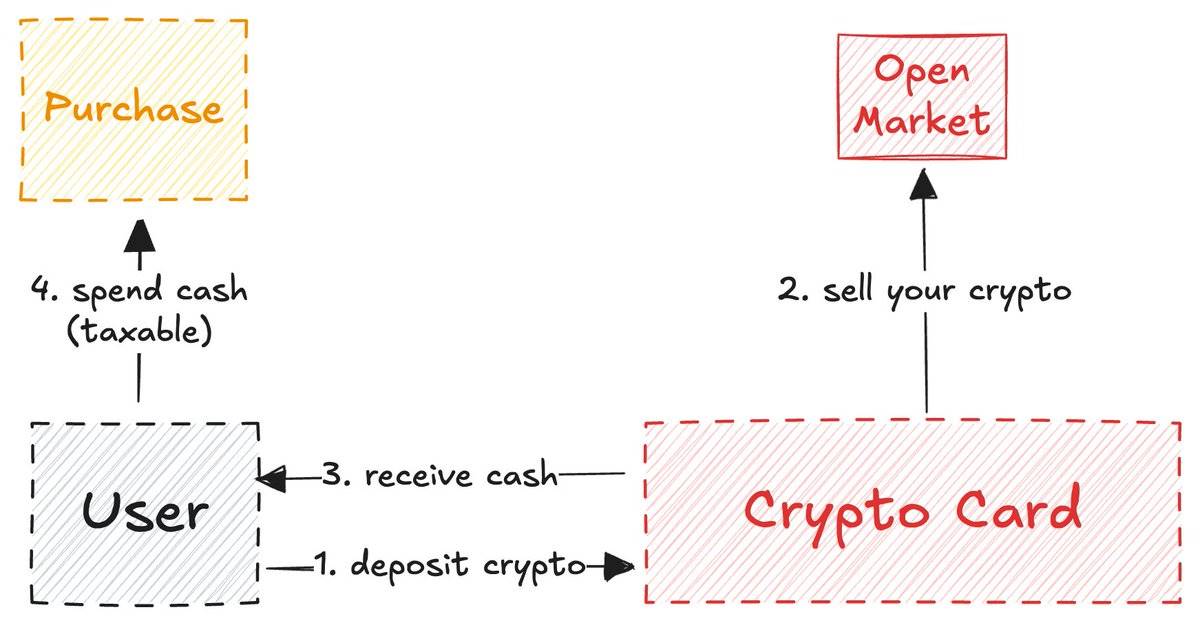
In most crypto cards, the cryptocurrency you deposit is sold, and the balance is topped up as cash (similar to the liquidity bridge model I mentioned earlier).
EtherFi is different: It never sells your cryptocurrency; instead, it uses your cryptocurrency as collateral to provide you with a cash loan while earning yield on your crypto assets.
EtherFi's model is similar to Aave. Most DeFi users hope to seamlessly obtain cash loans through crypto assets, and EtherFi has achieved this. You might ask: "How is this different from a regular crypto card? I can also top up with cryptocurrency and use the crypto card like a regular debit card; this extra step seems unnecessary."
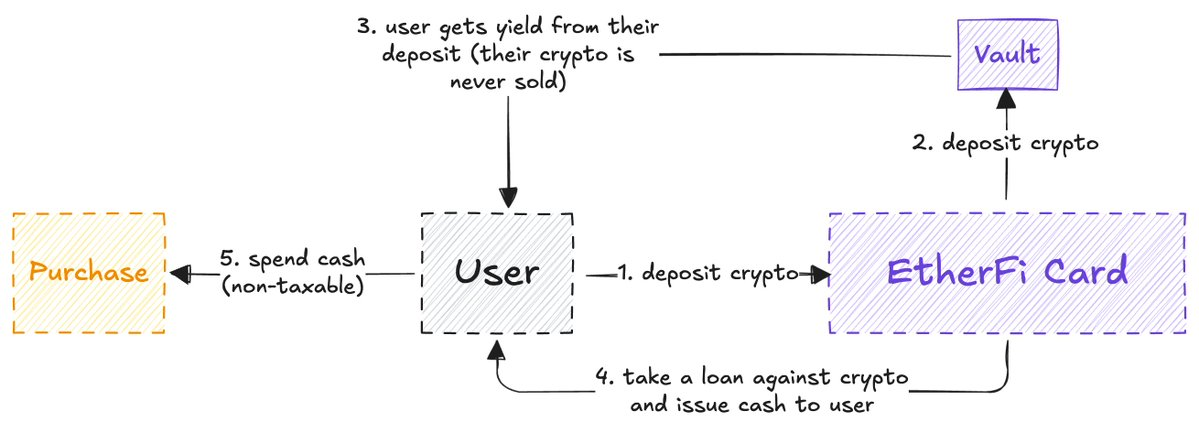
Simply put, the difference lies in taxation: Selling your cryptocurrency is a taxable event, sometimes with higher tax burdens than daily spending. For most crypto cards, every operation is taxed, and eventually, you end up paying more taxes to the government. (Again, using crypto cards does not mean "bankless.")
EtherFi improves on this because you are not actually selling your cryptocurrency but obtaining a loan against it.
Just this point (plus no foreign exchange fees for USD, cashback, and other benefits) makes EtherFi the best example of the convergence of DeFi and TradFi (traditional finance).
Most crypto cards try to伪装成 "crypto-native," but in reality, they are just a liquidity bridge. EtherFi's goal is first to serve crypto users, not to push cryptocurrency to the masses. Their strategy is to bring cryptocurrency to native users and let native users spend it in front of the masses until the masses realize how cool this method is.
Among all crypto cards, EtherFi is probably the only one that can withstand the test of time.
I prefer to see crypto cards as an experimental field, but unfortunately, most teams只是利用 narrative hype without giving due recognition to the underlying systems and actual developers.
We will wait and see where technological progress and innovation lead us. Currently, the crypto card field is indeed expanding in a "globalized" (horizontal growth) manner, but it lacks substance in "vertical growth." And for early-stage technologies like crypto cards focused on consumer payments, vertical growth is crucial.