Author: Cheng Manqi
Two days in a row, large model startups Zhipu and MiniMax went public on the Hong Kong stock market. Compared to the several listing feasts of the mobile internet era, the IPOs in the large model field do not occur after the major battles have concluded. It is not a reward for the winners, but the drumbeat for the next round of competition.
After Zhipu and MiniMax landed in the secondary market one after the other, they will initiate larger-scale private placements. This is a field where commercialization remains uncertain, but continuous R&D investment is definite. The substantive meaning of an IPO is to obtain more resources more efficiently.
On the eve of MiniMax's listing, we interviewed the MiniMax team and several of their investors to jointly recount the multiple perspectives on the large model startup opportunity over the past three-plus years, as well as the characteristics of this company.
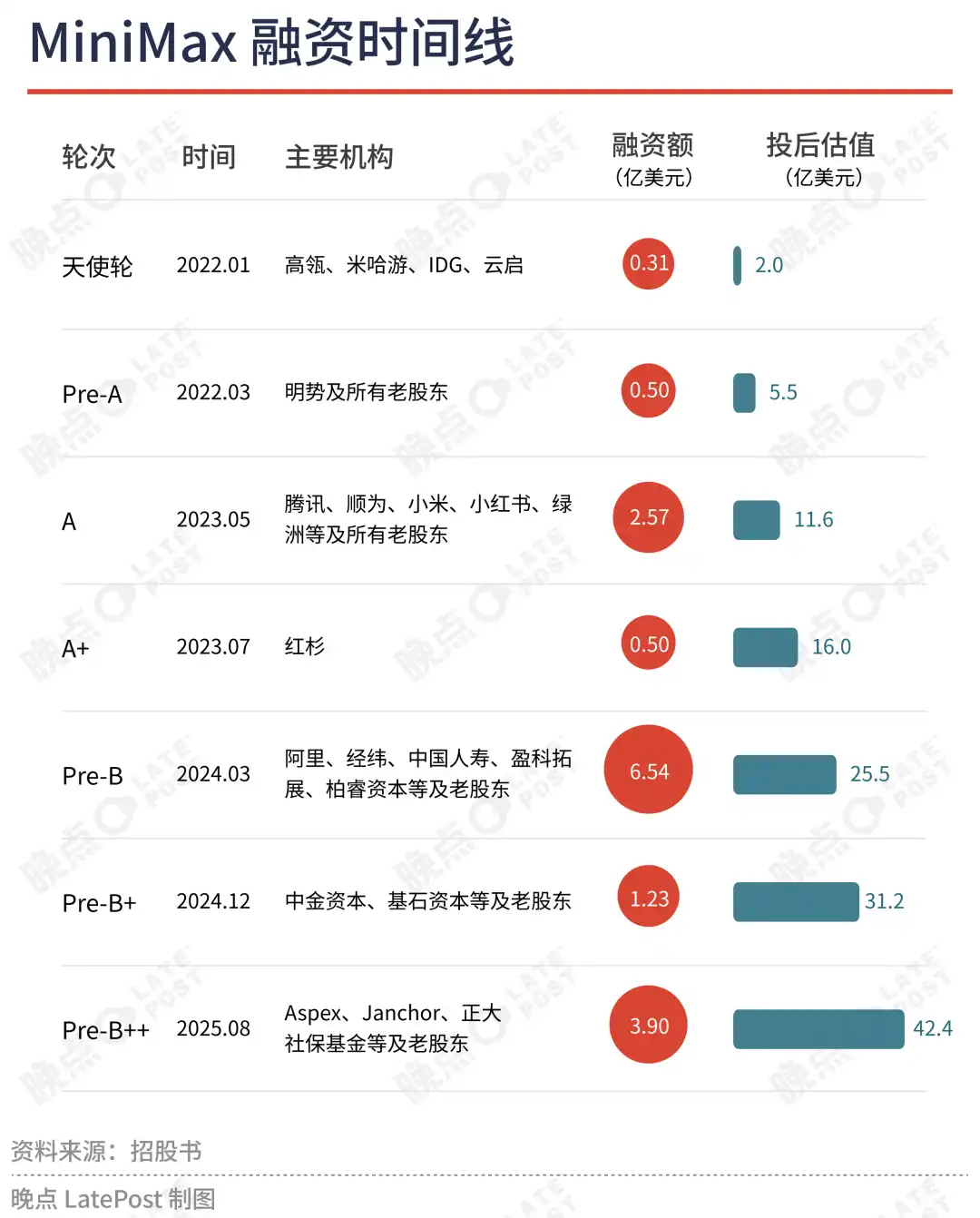
In the 7 rounds of financing before the IPO, 30 institutions invested a total of $1.5 billion in MiniMax. Alibaba invested the most money; Hillhouse was the first-round lead investor and, based on shareholding, is the second-largest external shareholder after Alibaba; Mingshi Capital participated in the most rounds.
Before going to the Hong Kong Stock Exchange to ring the bell this morning (January 9th), MiniMax founder Yan Junjie shared his thoughts with LatePost:
We hope we will have the opportunity to make greater contributions to the improvement of the entire industry's intelligence level. We have initially explored a path of pure grassroots AI entrepreneurship. Although the challenges ahead are still significant, we would feel honored if it could inspire the development of the AI innovation and entrepreneurship ecosystem.
As of the midday close, MiniMax's stock price rose more than 78% from the issue price of HK$165 to HK$294, with a market capitalization reaching HK$89.8 billion.
Setting Off Before the Boom
Hillhouse: Earliest Investor, Largest External Financial Investor
MiniMax was founded in early 2022, on the eve of the ChatGPT boom. Hillhouse was its first investor.
During the创业筹备期 (startup preparation period), at MiniMax's Beijing office at the time, Hillhouse partner Li Liang spoke with Yan Junjie and Yun Yeyi for 3 hours, then presented a TS (Term Sheet) with a blank valuation: You can write down the valuation and investment amount you want. Yan Junjie provided the planned numbers: raise $30 million, valuation $200 million.
Before starting the business, Yan Junjie and Yun Yeyi were colleagues at SenseTime. Yan Junjie, born in 1989, grew up in a county town in Henan and received his Ph.D. from the Institute of Automation, Chinese Academy of Sciences. During his 7 years at SenseTime, Yan Junjie rose from researcher to become SenseTime's youngest vice president, successively serving as executive dean of the research institute, and responsible for businesses like smart cities and gaming; Yun Yeyi graduated from Johns Hopkins University and was formerly the head of strategy in the CEO's office at SenseTime.
Xue Zizhao, the first Hillhouse investor to contact MiniMax, told LatePost that a few days before the meeting with Li Liang, Yan Junjie gave the Hillhouse team a 9-hour "technology lesson": Scaling Laws of Transformer architecture models, progress on GPT-3, reinforcement learning done by DeepMind, image generation brought by diffusion models, how CLIP combines images and language... "At that time, very few people could piece these technologies together. Personally, it was hard to believe it would definitely work, but in hindsight, IO's (Yan Junjie's) judgments written then were all correct."
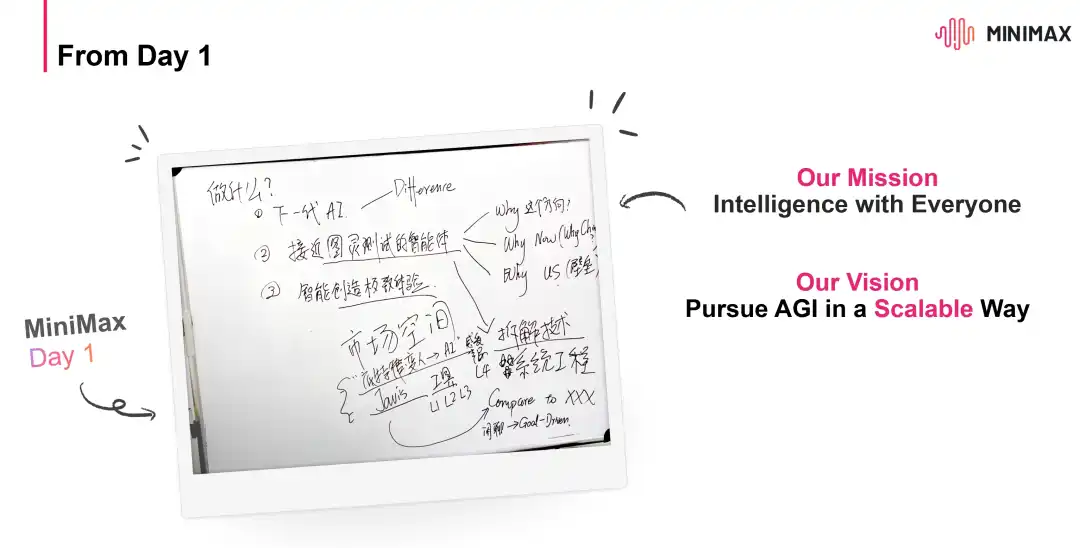
In MiniMax's early days, the team deconstructed technological changes and market opportunities on a whiteboard.
MiniMax's idea was to work on text, speech, and image models simultaneously, using large models and multimodal technology to create AI applications that can serve ordinary people. This was the vision established at MiniMax's founding: Intelligence with everyone.
Hillhouse judged at the time that this was a systems engineering project; the team needed not only to understand algorithms but also comprehensive capabilities in hardware底层 (underlying hardware), data, engineering, and applications. Yan Junjie had led a team of over 1000 people at SenseTime and had experience in algorithms, engineering, organization, and AI commercialization.
In less than two weeks, Hillhouse completed the TS, investment committee, and secured the lead investment in MiniMax's angel round. Sequoia, which contacted MiniMax about a week later, did not get into this round. A year and a half later, in July 2023, in the fourth round of financing with a pre-money valuation of $1.55 billion, Sequoia became a shareholder of MiniMax.
In November 2022, Zhang Lei organized a small-scale trip to the Middle East. The few entrepreneurs同行 (traveling together) included BYD founder Wang Chuanfu and Horizon Robotics founder Yu Kai, as well as the then-unknown Yan Junjie, who had been创业 (entrepreneuring) for less than a year.
In the VIP lounge of the Qatar World Cup, Yan Junjie used his not-so-fluent English to explain to Middle Eastern friends what AGI (Artificial General Intelligence) was. Half a month later, this term, which was relatively niche at the time, spread throughout the world with the release of ChatGPT.
Xue Zizhao, the earliest Hillhouse investor to contact MiniMax, officially joined MiniMax in 2023: "Invested myself into it."
Hillhouse invested in MiniMax multiple times after the angel round. Before the IPO, it held a total of 7.14% of MiniMax's shares, second only to Alibaba, making it MiniMax's second-largest external investor and largest financial investor.
MiHoYo's Liu Wei: "Super smart is overrated, while resilience is underrated"
In early 2021, MiHoYo founder Cai Haoyu once said in a speech: he wanted to "create a virtual world where 1 billion people live by 2030". MiniMax's initially envisioned application form fit this: using multimodal technology to create AI agents that interact with ordinary people (Note: "AI agent" here refers to "AI characters", not the now commonly referred to AI Agent). MiHoYo's three founders, "Da Wei Ge" Liu Wei and "Luo Ye" Luo Yuhao, had also known the MiniMax team for a long time. They learned about Yan Junjie's创业 (startup) almost simultaneously with Hillhouse, and the investment followed naturally.
MiHoYo is the type of investor founders like the most. Yun Yeyi told LatePost: They don't particularly inquire about the company's operational details. Every time we meet, we talk more about "philosophies of life", which is based on trust in the team.
Yan Junjie personally experienced the ups and downs of the last AI boom. "I've experienced losing for a year and a half straight, and I've also experienced winning consistently after doing things right." Yan Junjie recently reviewed the setbacks in doing face recognition at SenseTime in an interview with Luo Yonghao. After逆风追赶 (catching up against the wind) under great pressure, he gained stronger technical confidence.
He also witnessed the entire computer vision era and the industry-wide困顿 (difficulties) of starting high and going low. A founder of one of the "AI Four Little Dragons" once commented on Yan Junjie: He has tasted the bitterness of AI 1.0.
Last year, talking about large models, Liu Wei said to us: Among large model entrepreneurs, the Super smart part is always overrated, while resilience is always underrated. But entrepreneurship is a marathon, and resilience is invaluable.
Yunqi, IDG Join, Angel Round Concludes
Yun Yeyi was familiar with several investors during his time at SenseTime, including his Johns Hopkins alumnus Chen Yu, managing partner of Yunqi Partners, and Niu Kuiguang, a partner at IDG who had invested in SenseTime multiple times.
These two institutions quickly joined MiniMax's angel round lineup. Chen Yu had earlier exchanged views on technology trends with Yan Junjie and Yun Yeyi. After Yan Junjie officially decided to start a business, after a dinner in Shanghai, Chen Yu当场说想投 (said on the spot he wanted to invest): "I wanted to bet on a route that could potentially颠覆 (overturn) the existing technical solutions. It was all small models before. Yan Junjie saw the value of foundational large models relatively early."
Niu Kuiguang contacted Yun Yeyi shortly after MiHoYo and Hillhouse issued their TSs, called in the morning, and flew to Shanghai that evening to meet with Yan Junjie and the core team, quickly finalizing the investment.
Throughout the angel round, MiniMax raised a total of $31 million with a valuation of $200 million. This was almost the same as the team's initial plan—to raise $30 million with a post-money valuation of $200 million. MiniMax declined offers to take more money for a higher valuation.
Mingshi: The Only New Shareholder in MiniMax's Second Round, The Institution That Invested in the Most Rounds of MiniMax
Before the release of ChatGPT, MiniMax had two rounds of financing. The only new shareholder in the second round was Mingshi Capital. Mingshi founding partner Huang Mingming and Mingshi partner Xia Ling first met Yan Junjie in the lobby of a hotel in Beijing, where Yan Junjie was reading a paper on his iPad. Even now, he still maintains the habit of spending at least an hour browsing new papers every day.
The first meeting lasted over 2 hours. Yan Junjie's starting point was technological change. Xia Ling heard about AGI from Yan Junjie for the first time. He chatted while searching on the spot. Now, many people's first reaction in the same situation is no longer to Baidu it, but to ask ChatGPT or Doubao.
"Frankly, I wasn't very sensitive to AGI at the time, but he quickly talked about how GPT is an end-to-end data-driven model." Mingshi had invested in Li Auto for 7 rounds. Since 2021, a major trend in the smart driving field has been the significant improvement brought by end-to-end models.
Yan Junjie also discussed how technological changes alter business logic: the long-term difficulty for the previous batch of AI companies was that the models at the time were not general enough. For different scenarios and tasks, it was often necessary to retrain the model. But large models are "One Model for all", which means AI commercialization can break away from the old path of定制开发 (custom development) for to B and to G.
In early 2022, Xia Ling met Yan Junjie twice more. Shortly before this, at Mingshi's year-end summary meeting, Xia Ling did a推演 (deduction) of AI technology trends for the next 5 years. When he told Yan Junjie his ideas like "multimodal technology is worth redoing Adobe", Agency, and smarter robots, the other put down his chopsticks and shared what direction MiniMax specifically wanted to do.
The next time they met happened to be on February 14th. This time Xia Ling wanted to verify: Does MiniMax prefer to C or to B? "to C," Yan Junjie said, they would not take the old path of customized to B projects again, which was also what Xia Ling had in mind. They talked so投入 (absorbedly) that neither ate much. There were no flowers on this holiday; Xia Ling packed a plate of squid flowers to take home.
Similar to Hillhouse, Mingshi also valued Yan Junjie's comprehensive experience from algorithms and engineering to business. This was verified in the year of investment: In the second half of 2022, after training several versions of text models, MiniMax began searching nationwide for GPUs.正好 (Coincidentally), a batch of autonomous driving companies exited, and many GPU computing powers were returned. MiniMax rented computing power at half the price after the large model boom arrived.
Mingshi founding partner Huang Mingming described Yan Junjie's determination when starting the business: "At that time, ChatGPT had not been released, OpenAI was also lukewarm, and Yan Junjie, who had already reached mid-to-senior management at SenseTime, jumped out to start a business." Mingshi is one of the institutions that invested in the most rounds of MiniMax. Counting the cornerstone investment in the IPO and the 7 rounds of investment before listing, Mingshi invested in 6 out of 8 rounds.
ChatGPT Arrives, Everything Changes
Investment Spectacle Under Rapid Consensus
In October 2022, MiniMax launched its first product, Glow. Without much promotion, it accumulated over a million二次元 (anime-style) users within 2 months. For a startup that had been officially operating for less than a year, trying a new path of AI to C, this was a pretty good start. But soon, the giant wave raised by ChatGPT, which launched in November, made Glow a small splash.
Under rapid consensus, MiniMax directly benefited on one hand. It quickly initiated a third round in early 2023, raising a total of $260 million, more than 3 times the sum of the previous two rounds, with a post-money valuation reaching $1.157 billion. Strategic investors like Tencent, Xiaomi, Xiaohongshu, and new shareholders like Shunwei, Oasis, etc., joined. All old shareholders continued to invest.
On the other hand, MiniMax was no longer one of the only few choices in the market. The Hundred Model War began, and a batch of startups with各自特点 (their own characteristics) and advantages emerged: Wang Huiwen invested $50 million himself to establish Light Years Beyond; Wang Xiaochuan, who created super apps like Sogou Input法, founded Baichuan AI; Li Kaifu established 01.AI. Among the new technical forces were Zhipu, which also started earlier and was founded in 2019; Moonlight, founded by Yang Zhilin, who developed XLNet and Transformer-XL, whose academic background is directly related to large language models. These companies all quickly obtained financing. Some investors invested in multiple companies simultaneously, such as Alibaba, Tencent, and Shunwei.
MiniMax's strategy was to retain more initiative and not dilute shares too quickly. Tencent originally wanted to invest more in MiniMax's third round, but最终 (in the end) MiniMax took $50 million from Tencent.
ByteDance Backs Out, Sequoia Joins the Game
In May 2023, Wang Huiwen ended Light Years Beyond due to health reasons. Another important player who would later influence China's large model landscape also made a choice: ByteDance.
ByteDance had already formed a large model team at the time but was considering external investments as well. Similar to Google investing in Anthropic; Tencent and Alibaba pursuing both in-house development and investment. By around June 2023, ByteDance had issued investment intentions to two large model companies, MiniMax and StepFun, which had just been assembled.
But after a高层会 (high-level meeting) around mid-year, ByteDance decided not to invest externally in large model companies anymore. Zhang Yiming's attitude was: Why don't we develop large models ourselves? We should do it ourselves, and we can do it well ourselves.
Around the same time, Sequoia China led MiniMax's A+ round. By this time, Hillhouse's three rounds of Super Pro-rata (priority investment rights) had ended.
In this round, MiniMax raised $50 million, and the post-money valuation reached $1.6 billion. Sequoia added support in subsequent rounds. This is also one of the largest investments Sequoia China has made in the large model field to date. Before the IPO, Sequoia China held 3.81% of MiniMax's shares, making it the third-largest financial investor. Sequoia also invested in large model companies like Light Years Beyond, Moonlight, StepFun, etc.
According to LatePost, Sequoia and Hillhouse discussed their respective shares in this round down to three decimal places.
Alibaba Makes a Large Investment, That Spring Festival That Changed Many Destinies
In the previous AI boom, Alibaba was both an important supporter and had微妙 (subtle) competition with startups, just like the relationship between big tech and AI startups at this moment.
Alibaba was simultaneously on the boards of SenseTime and Megvii. In 2017, both companies were interested in acquiring the third-largest player in China's security field: Uniview, to find a hardware carrier for visual AI, by acquiring Uniview's parent company,千方科技 (Qianfang Technology). But in the end, Alibaba acquired Qianfang for 3.7 billion RMB, bringing Uniview into its fold, to help Alibaba Cloud expand into the政企 (government and enterprise) market.
Times have changed. Alibaba Cloud gradually phased out政企 (government and enterprise) business focused on private deployment. After the large model boom, Alibaba's employee No. 6, Wu Yongming, returned in 2023 to serve as Group CEO and Cloud CEO. He proposed Alibaba Cloud's new strategy: AI-driven, public cloud first.
Alibaba began investing widely in large model companies, the main customers for AI computing power on the cloud. In the second half of 2023, Alibaba successively invested in Zhipu, Baichuan AI, and 01.AI.
By the end of 2023, Alibaba began contacting both MiniMax and Moonlight simultaneously.
This was the key round for Moonlight's later rise. At that time, Moonlight was originally seeking investment from Xiaohongshu and others at a pre-money valuation of $900 million. But before the Spring Festival, Alibaba jumped in, and the pre-money valuation jumped to $1.5 billion, with Alibaba investing nearly $800 million in a big move.
Early-stage companies are generally cautious about accepting such large investments because the stake is too high. But the influence brought by Alibaba was immediate: the $800 million investment quickly became headline news in the AI industry;配合 (coupled with) Kimi's product投放 (placement) and growth in the first half of 2024, Moonlight's buzz reached its peak.
Alibaba initially also wanted to account for about 30%~40% of MiniMax's shares. Later, the双方谈下来的方案 (solution negotiated by both parties) was to accept a $400 million investment from Alibaba. This was MiniMax's 5th round of financing,交割 (settled) in March 2024, with a total financing amount of $654 million. MiniMax's post-money valuation reached $2.55 billion. New shareholders joining同期 (during the same period) included Matrix Partners China, China Life Insurance, etc.
Before the IPO, Alibaba held over 13% of MiniMax's shares, making it the largest external shareholder.
Insurance Capital, Manufacturing Family Offices, As More Institutions Invest in Large Models
After Alibaba's large investment in large models in early 2024, the frequency of financing in the foundational model field明显降低 (significantly decreased) from 2024 to 2025. Tech giants like ByteDance and Alibaba increased their comprehensive investment in AI models and products, with manpower and computing power several times that of startups, and control over traffic and advertising platforms. DeepSeek, which暂时不考虑商业化压力 (temporarily does not consider commercialization pressure) and focuses on model R&D, is极致、简单、纯粹 (extremely, simple, pure), squeezing a batch of typical startups that need financing out of the spotlight. Fewer companies could continue to raise money, and fewer investors could invest large sums.
More types of investors beyond venture capital became shareholders of MiniMax, including China's earliest insurance capital doing equity investment—China Life Investment; PCCW Expansion managed by Richard Li; Bairui Capital established with separate funding from Li Ping, co-founder and vice chairman of CATL, etc. They provided different perspectives on large models.
China Life: Saw a Team That Inspires Confidence
"Not very old, but very determined, always smiling, and speaking unhurriedly." This was Gu Yechi's first impression of Yan Junjie. Gu Yechi is the head of equity business at China Life Investment Insurance Asset Management Company. He worked in regulatory agencies for ten years and later did equity investment for another ten years.
China Life is insurance capital; it cannot make mistakes, which is more important than obtaining excess returns. After meeting almost all the founders of leading large model companies, Gu Yechi and the China Life investment team chose MiniMax, investing in two consecutive rounds in early and late 2024.
Gu Yechi meets Yan Junjie about once every two months. He believes Yan Junjie is a founder who is "authentic, has前瞻性深度思考 (forward-looking deep thinking),笃信技术 (firmly believes in technology), and is一以贯之 (consistent)": "In 2023, Junjie started talking about MoE (Mixture of Experts), then trained MoE, which is also the mainstream architecture in the industry now; more than a year ago, he told me that large model companies should rely mainly on technology rather than投流 (traffic investment), and they later did just that. Now this is also the mainstream narrative in the industry."
"This makes us very放心 (feel at ease)," Gu Yechi said.
Bairui Capital: Wanting to Find Scientists Who Can Become Entrepreneurs
"If it weren't for the MiniMax project, we might not necessarily invest in large models." Wang Limin, managing partner of Bairui Capital, told LatePost.
Bairui Capital is a venture capital institution supported by Li Ping, vice chairman of CATL, as the sole出资人 (capital provider). Li Ping co-founded CATL in 2010 and currently serves as its vice chairman.
After ChatGPT, Bairui Capital, which originally focused on advanced manufacturing and hard tech, also began studying the generative AI revolution driven by large language models. They were not in a hurry to make a move.
In November 2023, Li Ping and the Bairui team had a preliminary investment intention after talking with Yan Junjie for 3 hours at Jinjiang Hotel in Shanghai. Bairui later participated in MiniMax's fourth round of financing, which was交割 (settled) in early 2024. This was also Bairui's first investment in software information technology.
Yan Junjie's cost control awareness, MiniMax's提前布局 (early layout) of computing power at the time, and the idea of exploring applications in batches and generating blood for R&D as early as possible felt familiar to Bairui. CATL went through a similar process in the early development of automotive power batteries: relying on bus and commercial vehicle businesses to form the first commercial closed loop first, using the income from these early businesses to invest in subsequent R&D, improving battery performance, and driving a steep decline in battery costs.
"Yan Junjie is very清醒 (clear-headed) that large model startups today, especially Chinese large model startups, don't have that much money to burn, nor that many most advanced computing power clusters. Chinese large model companies must走自己的路 (take their own path) and develop their own foundational models under conditions of limited cost and computing power."
"One thing we learned from Robin (Zeng Yuqun) is that a top scientist also needs top商业思维 (business thinking) to run a company well," Wang Limin said.
"Staying in the Wave"
Over the past three-plus years, consensus formed quickly and was overturned even faster: 2023 was a追随赛 (follower race), everyone anchored to GPT-4; 2024 began with Alibaba's huge bet and ended with Doubao's later rise; in 2025, DeepSeek open-sourced a world-class reasoning model at an extremely low cost, the world's top startups reached valuations of hundreds of billions of dollars, and the question of who would become China's OpenAI lost its meaning.
MiniMax's way of survival is not to极致强化 (extremely strengthen a certain long board) but to constantly adjust its footing, approaching the direction of using AI to serve ordinary people.
It both makes large language models and does not give up multimodal generation, because Yan Junjie believes that AI serving ordinary people needs to be smart and also needs multimodal interaction of vision and speech. It makes models and also makes applications; Yan Junjie once said, "If there is no product to承接 (carry it), even if you have technical progress, it ultimately isn't yours." It does the domestic market and also does overseas.
Companion AI apps like星野/Talkie (Hoshino/Talkie), content-generating apps like海螺 AI (Conch AI) and MiniMax Voice, and the open platform's API business each bring MiniMax about 3成 (30%) of its revenue, a balanced 1:1:1.
And in the technology sector directly负责 (responsible) by Yan Junjie, he is willing to take risks. In the second half of 2023, MiniMax invested almost all its R&D resources into making MoE (Mixture of Experts) models, failing twice in training; in 2024, it invested 80% of its resources into making a new model with a linear attention architecture, namely the M1 released in early 2025. These were heavy bets on the technical directions he saw with the highest上限 (ceiling) at the time.
Trying商业化 (commercialization) possibilities everywhere and focusing technical R&D with concentrated force are two sides of the same coin. Just like the name MiniMax, in the face of great uncertainty, use limited resources to find the极小 (extremely small) probability of success.
In early 2025, Yan Junjie said he hoped to always stay in the wave: "First, to be able to participate in pushing the wave to continue happening; second, we can let the company develop sustainably."
So, first, stay in the wave.