MACD Real Backtest: Can Technical Indicators Lead You to Profit?

marsbitXuất bản vào 2026-01-17Cập nhật gần nhất vào 2026-01-17

Tóm tắt

Based on a comprehensive 5-year backtest of the MACD trading strategy on BTC and ETH, this analysis delivers a sobering reality check for traders. The key finding is that 90% of short-term trading activity, particularly lower timeframes (15m, 30m, 1h), underperforms a simple "buy and hold" strategy due to transaction costs, noise, and psychological strain. The "benchmark" returns for simply holding the assets were +48.86% for BTC and +53.00% for ETH. The data reveals that MACD strategy performance is highly dependent on timeframe and leverage: * **Short Timeframes (15m, 30m, 1h):** Nearly all configurations resulted in significant losses or complete liquidation (-100%), severely underperforming the buy-and-hold benchmark. * **4-Hour Timeframe:** This was the only timeframe where the MACD strategy consistently generated alpha. * **BTC 4h (1x leverage):** ~+96% return, successfully outperforming buy-and-hold by avoiding major bear markets. * **ETH 4h (1x leverage):** ~+205% return, dramatically outperforming its buy-and-hold benchmark due to ETH's strong trend-following characteristics. * **Leverage Impact:** Leverage (2x, 3x) on the 4h timeframe amplified these gains effectively (e.g., ETH 4h 3x leverage yielded +552%). However, higher leverage (5x) often led to diminished returns due to funding fees and volatility decay, despite increased risk. The "Death Matrix" of results shows that short-term, high-leverage trading is akin to gambling" with a near-...

Author: Michel Athayde

Warning: This is a sobering report

Have you ever had these illusions:

  • "The 4-hour chart is too slow, I'll do 5-minute short-term trading, 1% compound interest per day, and I'll be the world's richest person in a year."

  • "Spot trading earns too slowly, I'll use 3x, 5x leverage. As long as the direction is right, the money I make will be several times that of others."

To verify these "get-rich-quick fantasies," we not only backtested the 4-hour chart but also dragged out the 15-minute (15m), 30-minute (30m), and 1-hour (1H) charts to "whip their corpses";

We not only looked at spot trading but also simulated the real outcomes of 200% (2x), 300% (3x), and 500% (5x) leveraged positions in extreme market conditions.

The conclusion is extremely brutal: Without leverage, 90% of us, after messing around for these 5 years, wouldn't even beat "foolishly hoarding coins."

Baseline Data: The "Passing Grade" You Must Beat

Before evaluating any strategy, we must first see how much you can earn by "doing nothing." Based on spot data from the past 5 years:

  • BTC Pure Spot: +48.86%

  • ETH Pure Spot: +53.00%

    (Note: This means if you bought 5 years ago and uninstalled the APP, you would now have about a 50% profit. This is the "passing grade" that any strategy must beat.)

MACD Strategy Data Summary

I backtested the performance of MACD on BTC/ETH over different timeframes and leverage levels for the past 5 years:
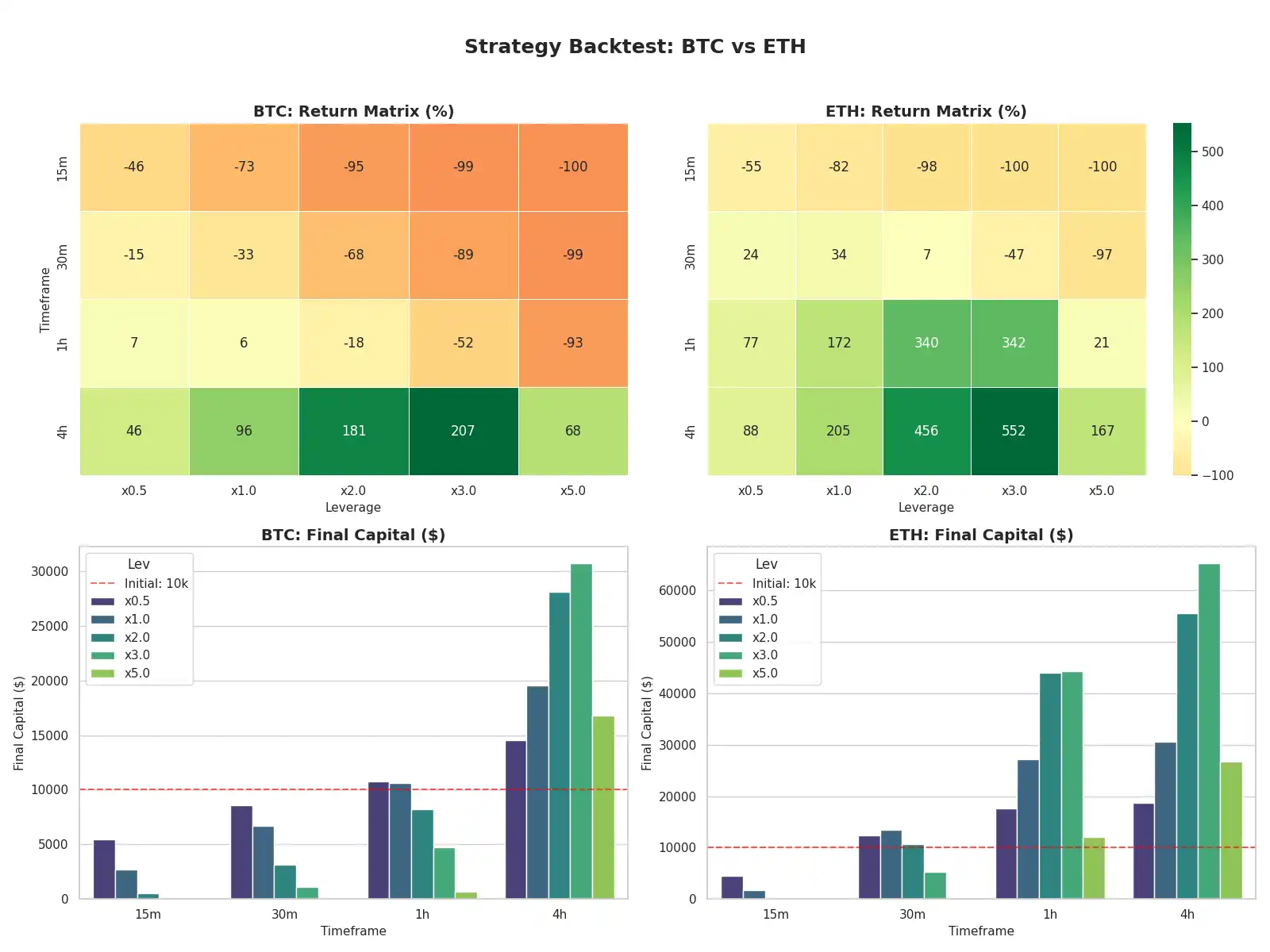
English Label (Chart Label) Chinese Meaning (Meaning)
Strategy Backtest Strategy Backtest Analysis
Return Matrix (%) Return Heatmap (Redder colors indicate more loss, greener colors indicate more profit)
Final Capital ($) Final Capital (Initial capital is 10,000 U)
Timeframe (TF) Timeframe (15m, 30m, 1h, 4h)
Leverage (Lev) Leverage Multiplier (x0.5, x1.0, x2.0, x3.0, x5.0)
Initial: 10k Initial Capital (Red dashed baseline)
  1. Top Left & Top Right (Heatmap - Return Rate):

    • Danger Zone (Red/Dark Orange): Concentrated in short timeframes like 15m and 30m. Especially with high leverage (x3.0, x5.0), capital is almost wiped out (-99%, -100%).

    • Golden Zone (Dark Green): Concentrated in the 4h timeframe. ETH's performance on the 4h chart is particularly outstanding, with almost all blocks being green.

  2. Bottom Left & Bottom Right (Bar Chart - Final Capital):

    • <极p data-path-to-node="11,1,1,0,0">Red Dashed Line (10k): This is the break-even line. Bars below the red line represent losses, bars above represent profits.

    • BTC vs ETH: Notice the ETH 4h bars in the bottom right corner. When using x2.0 or x3.0 leverage, the capital bars are extremely tall, far exceeding BTC's performance. This verifies that ETH's volatility brings higher excess returns during trending markets.

I. Painful Lesson: 90% of Short-Term Operations Are "Negative Optimization"

The data reveals a brutal fact: On small and medium timeframes (15m, 30m, 1h), the MACD strategy not only failed to create excess returns (Alpha) but also significantly underperformed "foolish coin hoarding" due to overtrading and friction costs.

1. BTC 1-Hour Timeframe's "Busy Work"

  • Strategy Performance: BTC 1h x1.0 return rate is +6%.

  • Benchmark Performance: BTC spot hoarding return rate is +48.86%.

  • In-depth Interpretation:

    At the 1-hour level, you stared at the charts diligently for 5 years, executed thousands of golden cross/death cross trades with MACD, paid huge fees to the exchange, and only made 6% in the end. If you had done nothing, you would have made 49%.

    Conclusion: Running the MACD strategy on the 1H timeframe essentially destroys value. Your frantic operations look impressive, but the收益 turns from positive to negative (relative to opportunity cost).

2. The Complete Rout of Short-Term Trading (15m / 30m)

  • All Strategies: All resulted in losses or liquidation.

  • Compared to Benchmark: Compared to the +50% positive return of hoarding, short-term strategies represent a -100% devastating blow.

  • Cause of Death Analysis:

    • Noise: Most fluctuations at the 15m level are meaningless random walks.

    • Fee Erosion: Frequent opening positions incur手续费 and slippage, eating away at the principal like termites.

    • Mental Breakdown: High-frequency stop-losses lead to operational distortion.

II. The Only Way to Outperform: "Excess Returns" on the 4-Hour Timeframe

Only when the timeframe is extended to 4 hours does the MACD strategy demonstrate the ability to beat "coin hoarding." This is the only reason quantitative trading exists.

1. BTC 4h: A Narrow Victory

  • MACD x1.0 (Spot): Return approximately +96%.

  • Hoarding Benchmark: +48.86%.

  • Winning Logic:

    MACD successfully helped BTC avoid the main下跌浪 of the deep bear market (e.g., the big drop in 2022) at the 4H level. Although it made a little less during the bull market's initial and final phases, the advantage gained from being空仓 for risk avoidance ultimately allowed it to outperform buy-and-hold.

2. ETH 4h: Absolute Crushing

  • MACD x1.0 (Spot): Return approximately +205%.

  • Hoarding Benchmark: +53.00%.

  • MACD x3.0 (Optimal Leverage): Return +552%.

  • Winning Logic:

    ETH has extremely strong trend characteristics. Hoarders enjoyed the rise but also fully endured the -80% drawdown. The MACD strategy preserved profits by being空仓 during the bear market and compounded them in the next bull market. A return 4 times that of hoarding (205% vs 53%) proves the huge value of timing on ETH.

III. The True Meaning of Leverage: Amplifying "Win Rate" or Amplifying "Gambling Nature"?

Combined with the baseline data, we can redefine the role of leverage.

1. x2.0 - x3.0: The Secret of the Golden Zone

  • BTC 4h x3.0 (+207%) vs BTC Hoarding (+48.86%):

    With 3x leverage, the strategy放大 the return by 4 times. This is a healthy放大 ratio, indicating the strategy captured the real trend, and leverage played a "pushing the boat with the current" role.

  • ETH 4h x3.0 (+552%) vs ETH Hoarding (+53.00%):

    The return was放大 by 10 times! This is the peak performance of quantitative trading - achieving class-leaping returns on high-volatility assets with reasonable leverage and the correct timeframe.

2. x5.0: The "Inversion" of Return Rate

  • ETH 4h x5.0 (+167%):

    Note! Although it beat hoarding (+53%), it significantly underperformed the low-leverage strategy (+552%).

  • Warning: When you increase leverage to 5x, you are essentially working for the exchange (high funding fees) and giving money to the market (high volatility erosion). You bear the risk of liquidation and归零, but only get mediocre returns.

IV. Your "Death Matrix" Report (The Death Matrix)

To make you give up hope, we list the final outcomes under different configurations.

Asset Timeframe Leverage Status Final Return Rate Outcome Evaluation
BTC 15m x5.0 💥 Liquidated -100% Certain Death. Pure gambling, fees alone can eat you alive.
BTC 15m x1.0 -73% Slow suicide. Worse than putting money in the bank.
BTC 1h x1.0 +6% Busy work. Underperformed hoarding (+49%), wasted 5 years of youth.
BTC 4h x1.0 +96% Excellent. Beat hoarding by double, stable mentality.
BTC 4h x3.0 +207% Outstanding. Maximized returns, controllable risk.
--- --- --- --- --- ---
ETH 15m x5.极0 💥 Liquidated -100% Certain Death. Victim of noise trading.
ETH 1h x1.0 +172% Acceptable. ETH is volatile, can make some money short-term, but tiring.
ETH 4h x1.0 +205% Excellent. 4 times the return of hoarding, and no need to stay up late.
ETH 4h x3.0 +552% King. This is the holy grail zone of quantitative trading.
ETH 4h x5.0 +167% Mediocre. Risk increases dramatically, returns反而 decrease (funding fees + erosion).

V. Final Decision Guide: What Should You Do?

Based on the passing grade of hoarding (+50%), we give the final strategy recommendations:

  1. If you don't want to bother / have no time / have a weak mentality:

    • Strategy: Pure Hoarding (Buy & Hold) or MACD 4h x1.0 (Spot).

    • Expectation: ~50% - 100% return.

    • Cost: Need to endure asset drawdowns, but this is infinitely better than losing money through胡乱操作.

  2. If you want to beat the market (BTC):

    • Strategy: MACD 4h (x1.5 - x2.0).

    • Expectation: ~150% - 200% return.

    • Key: Must strictly stop loss, only trade the 4H large timeframe, never look at 15m.

  3. If you pursue excess returns (ETH):

    • Strategy: MACD 4h (x2.0 - x3.0).

    • Expectation: ~400% - 550% return.

    • Key: This is the optimal sweet spot. Utilize ETH's high volatility + moderate leverage. Remember, do not exceed 3x.

  4. If you are a gambler / short-term trader:

    • Strategy: MACD 15m/1h + x5.0 or higher.

    • Expectation: -100% (Zero out).

    • Warning: Data proves this cannot beat hoarding, and is even worse than donating the money.

Core Conclusion

"Since spot hoarding only yielded about 50% over 5 years, this反而 proves the value of excellent quantitative strategies."

However, this value is limited to the 4-hour level.

On timeframes below 1 hour, all your efforts are counterproductive, worse than simply doing nothing.

Only by standing at the golden intersection of 4H + 3x can you truly laugh at those who "hold until death."

(The data in this article is based on historical backtesting and does not represent future returns. The market is risky, use leverage cautiously.)


Câu hỏi Liên quan

QWhat is the key finding of the MACD backtest regarding short-term trading on smaller timeframes like 15m and 30m?

AThe backtest reveals that MACD strategies on short-term timeframes (15m, 30m, and even 1h) are disastrous. They resulted in significant losses or complete liquidation (-100%), severely underperforming the simple 'buy and hold' strategy. This is due to market noise, high transaction fee erosion, and the psychological strain of frequent stop-losses.

QWhat was the performance of the simple 'buy and hold' (HODL) strategy for BTC and ETH over the 5-year period?

AThe 'buy and hold' strategy, which serves as the performance benchmark, yielded a return of +48.86% for BTC and +53.00% for ETH over the past 5 years.

QUnder which specific conditions did the MACD strategy generate significant alpha and outperform the 'buy and hold' benchmark?

AThe MACD strategy significantly outperformed the benchmark only on the 4-hour (4h) timeframe. For BTC 4h with 1x leverage, it achieved about +96% return. For ETH 4h, it was even more successful, achieving approximately +205% with 1x leverage and a stellar +552% with 3x leverage, by effectively avoiding major bear market drawdowns.

QWhy does the 5x leverage strategy on ETH 4h underperform the 3x leverage strategy, according to the article?

AThe 5x leverage strategy on ETH 4h underperforms the 3x strategy (yielding +167% vs. +552%) because the higher leverage leads to excessive funding fee costs and increased volatility drag, significantly eating into profits and increasing the risk of ruin without providing a commensurate return.

QWhat is the final recommended strategy for someone seeking alpha on ETH, and what is the critical warning associated with it?

AThe recommended strategy for seeking alpha on ETH is using the MACD indicator on the 4-hour timeframe with 2.0x to 3.0x leverage, targeting returns of ~400% to 550%. The critical warning is to never exceed 3x leverage, as higher leverage (like 5x) increases risk dramatically while reducing potential returns due to fees and磨损 (wear and tear).

Nội dung Liên quan

Strategy nợ bao nhiêu? Có khả năng vỡ nợ không?

Công ty MicroStrategy (MSTR) hiện nắm giữ 843.706 Bitcoin (trị giá ~531 tỷ USD) tính đến ngày 3/6/2026. Tuy nhiên, công ty đang gánh khoản nợ lớn, bao gồm 6,754 tỷ USD trái phiếu chuyển đổi và 15,482 tỷ USD cổ phiếu ưu đãi vĩnh viễn. Nghĩa vụ thanh toán lãi và cổ tức hàng năm lên tới khoảng 1,712 tỷ USD. Gánh nặng chủ yếu đến từ cổ phiếu ưu đãi, đặc biệt là đợt STRC trị giá ~8,5 tỷ USD với cổ tức hiện tại ~11.5%/năm (~978 triệu USD/năm). Doanh thu phần mềm chỉ ~500 triệu USD/năm là không đủ để chi trả. Gần đây, công ty đã lần đầu bán 32 Bitcoin (trị giá 2,5 triệu USD) để trả cổ tức, phá vỡ lời hứa "không bao giờ bán" trước đây, khiến thị trường lo ngại. Mặc dù vậy, khả năng vỡ nợ trong ngắn hạn được đánh giá là thấp. Dự trữ tiền mặt hiện khoảng 900 triệu USD có thể chi trả nghĩa vụ trong khoảng 7 tháng. Bitcoin không bị thế chấp cho các khoản nợ, nên không có rủi ro thanh lý bắt buộc. Rủi ro lớn nhất là nếu giá Bitcoin không tăng và việc phát hành cổ phiếu ưu đãi mới (STRC) ngừng trệ, buộc công ty phải bán Bitcoin thường xuyên để trả cổ tức, tạo ra vòng xoáy giảm giá. MicroStrategy đã chuyển từ mô hình nắm giữ Bitcoin thuần túy sang một "ngân hàng Bitcoin" tinh vi, sử dụng đòn bẩy tín dụng công khai. Công ty vẫn an toàn trong ngắn hạn (2026), nhưng sự tồn tại lâu dài của mô hình này phụ thuộc vào việc giá Bitcoin tiếp tục tăng và khả năng huy động vốn từ thị trường.

marsbit1 phút trước

Strategy nợ bao nhiêu? Có khả năng vỡ nợ không?

marsbit1 phút trước

Anthropic cảnh báo về sự xuất hiện của AGI: Vì nhân loại hay vì IPO?

Anthropic đã xuất bản một bài viết có tiêu đề "When AI builds itself" (Khi AI tự xây dựng chính mình), thảo luận về khái niệm "cải tiến đệ quy" (recursive self-improvement) - khi AI bắt đầu tham gia vào thiết kế, đào tạo và tối ưu hóa các phiên bản kế tiếp của chính nó. Công ty chia sẻ dữ liệu nội bộ cho thấy Claude, AI của họ, hiện viết hơn 80% mã code được tích hợp, xử lý các nhiệm vụ mở với tỷ lệ thành công 76% và tham gia vào cả quy trình nghiên cứu, trong một trường hợp đạt kết quả vượt trội so với con người. Anthropic cảnh báo về rủi ro tiềm ẩn khi AI có thể tự cải tiến nhanh chóng, kêu gọi thế giới xem xét làm chậm hoặc tạm dừng phát triển AI tiên tiến để xã hội và nghiên cứu an toàn có thể bắt kịp. Tuy nhiên, thông điệp này được đưa ra trong bối cảnh Anthropic đang chuẩn bị IPO, làm dấy lên câu hỏi về động cơ thực sự. Bài viết có thể được xem như một cách xây dựng câu chuyện cho thị trường vốn, nhấn mạnh lợi thế cạnh tranh độc đáo của Anthropic: Claude không chỉ là sản phẩm mà còn là công cụ sản xuất then chốt, tạo ra một "bánh đà" phát triển tự thúc đẩy. Điều này tạo sự tương phản với OpenAI, công ty gần đây cũng đề cập đến dấu hiệu ban đầu của "cải tiến đệ quy" nhưng trong một báo cáo tập trung vào quản trị và chính sách. Bài viết của Anthropic, vì vậy, vừa là một lời cảnh báo an toàn, vừa là một tuyên bố chiến lược định vị họ ở vị trí tiên phong trong cuộc đua AI.

marsbit1 giờ trước

Anthropic cảnh báo về sự xuất hiện của AGI: Vì nhân loại hay vì IPO?

marsbit1 giờ trước

Coinbase Nhắm Đến Tội Phạm Tiền Mã Hóa, Đóng Băng 3 Triệu USD Liên Quan Đến Hoạt Động Lừa Đảo

Coinbase đã đóng băng hơn 3 triệu USD tiền mã hóa liên quan đến các mạng lưới lừa đảo hoạt động tại Đông Nam Á, trong một chiến dịch phối hợp giữa cơ quan thực thi pháp luật Hoa Kỳ và khu vực tư nhân. Hoạt động này là một phần của "Tuần lễ Phá vỡ" do Lực lượng Đặc nhiệm Trung tâm Chống lừa đảo của Bộ Tư pháp Hoa Kỳ dẫn đầu, nhằm vào các đường dây lừa đảo đã chiếm đoạt hàng tỷ USD từ người Mỹ. Chiến dịch đa ngành có sự tham gia của các cơ quan như FBI, Bí mật Hoa Kỳ cùng cảnh sát các nước như Thái Lan, Anh, Australia. Về phía tư nhân, các công ty như Meta, Microsoft, Starlink đã hỗ trợ gỡ bỏ máy chủ và công cụ lưu trữ. Hơn 1,4 triệu tài khoản mạng xã hội và email bị vô hiệu hóa, và nhiều vụ bắt giữ đã được thực hiện. Các hình thức lừa đảo chính là lừa đảo đầu tư và "giết lợn" (pig butchering). FBI báo cáo tổn thất từ các vụ lừa đảo liên quan đến tiền mã hóa và AI năm 2025 vượt 11 tỷ USD. Đây là đợt bắt giữ tài sản mới nhất, sau khi hơn 701 triệu USD tiền mã hóa bị phong tỏa vào tháng 4. Coinbase nhấn mạnh blockchain cung cấp hồ sơ giao dịch vĩnh viễn, là công cụ hữu ích cho điều tra chứ không chỉ bị lợi dụng cho tội phạm.

bitcoinist1 giờ trước

Coinbase Nhắm Đến Tội Phạm Tiền Mã Hóa, Đóng Băng 3 Triệu USD Liên Quan Đến Hoạt Động Lừa Đảo

bitcoinist1 giờ trước

Dựa trên dữ liệu roadshow, Phố Wall hiện đang nhìn SpaceX thế nào

SpaceX đặt giá IPO là 135 USD/cổ phiếu, với tổng định giá khoảng 1,77 nghìn tỷ USD. Thông qua tài liệu chào bán, công ty định vị mình là một tổ hợp hạ tầng tích hợp ba lĩnh vực: Vũ trụ (phóng tên lửa), Kết nối (Starlink) và Trí tuệ nhân tạo (AI). Dữ liệu cho thấy Starlink đang có lãi, trong khi mảng AI vẫn đang lỗ. Định giá này khiến Phố Wall chia rẽ sâu sắc. Một số nhà đầu tư và phân tích chấp nhận định giá cao, coi SpaceX là một nền tảng hạ tầng độc đáo khó sao chép, xứng đáng hưởng "mức phí bảo hiểm nền tảng". Số khác tỏ ra thận trọng. Morningstar định giá hợp lý chỉ 780 tỷ USD, trong khi Aswath Damodaran ước tính khoảng 1,22-1,29 nghìn tỷ USD. Các quỹ lớn như Scottish Mortgage định giá khoảng 1,25 nghìn tỷ USD. Khoảng cách lớn giữa các con số phản ánh sự khác biệt trong cách định giá: dựa trên dòng tiền cơ bản hay câu chuyện tăng trưởng tương lai. Ba điểm then chốt sẽ quyết định hành trình của SpaceX sau IPO: khả năng tạo ra dòng tiền ổn định từ Starlink, việc hiện thực hóa tiềm năng khổng lồ từ mảng AI, và câu hỏi về cơ cấu quản trị khi Elon Musk nắm quyền kiểm soát tuyệt đối. Cuối cùng, SpaceX không còn chỉ là một công ty tên lửa; nó là một câu chuyện phức hợp về hạ tầng, và thị trường đang phải cân nhắc sẽ trả bao nhiêu cho toàn bộ bầu trời phía sau những tên lửa đó.

marsbit1 giờ trước

Dựa trên dữ liệu roadshow, Phố Wall hiện đang nhìn SpaceX thế nào

marsbit1 giờ trước

Giao dịch

Giao ngay
Hợp đồng Tương lai
活动图片