Farewell to the Copper Era: Understanding the Logic of the AI Silicon Photonics Industry Chain and Key US Stock Players

marsbitXuất bản vào 2026-05-19Cập nhật gần nhất vào 2026-05-19

Tóm tắt

**Summary: The Era of Silicon Photonics and Key AI Infrastructure Stocks** The article delves into the transition from copper-based interconnects to silicon photonics (SiPh) as a critical enabler for next-generation AI data centers. It explains that copper faces fundamental physical limits—the bandwidth wall, density wall, and power wall—at high data rates (1.6T+), making a material shift essential. Silicon photonics, which integrates components like lasers, modulators, and detectors onto a silicon chip, offers a solution by leveraging mature CMOS manufacturing for cost-effective, high-volume production. A key challenge is that silicon itself is not an efficient light source, making Indium Phosphide (InP) lasers a critical and supply-constrained component. A major industry catalyst was NVIDIA's 2025 GTC announcement, declaring optical interconnects a "standard" from its Rubin platform onward, followed by strategic investments to secure the supply chain. The industry is structured in four key layers: 1. **Foundries:** TSMC leads with its COUPE platform, while Tower Semiconductor (specialized SiPh foundry) and GlobalFoundries are major players. 2. **Core Component Suppliers:** Lumentum is highlighted as the sole volume manufacturer of the crucial 200G/lane EML laser, with orders locked by NVIDIA through 2027. 3. **Module & System Manufacturers:** Coherent holds significant market share, with Chinese manufacturers like InnoLight also noted for scale. 4. **System Integrato...

Author: Godot

The two hottest sectors in AI are storage and photonics. Previously, I wrote a framework on storage (Understanding the Profit Pools and Industry Landscape of AI Storage Tiers). This article focuses on photonics.

Silicon photonics (Silicon Photonics) is used for communication between computing chips, replacing traditional copper wires, as clearly shown in the diagram below.

Terms you might come across but find confusing, such as LPO (Linear-drive Pluggable Optics), CPO (Co-packaged Optics), OCS (Optical Circuit Switching), and Optical I/O (Optical Input/Output), represent different technical approaches to implementing silicon photonics.
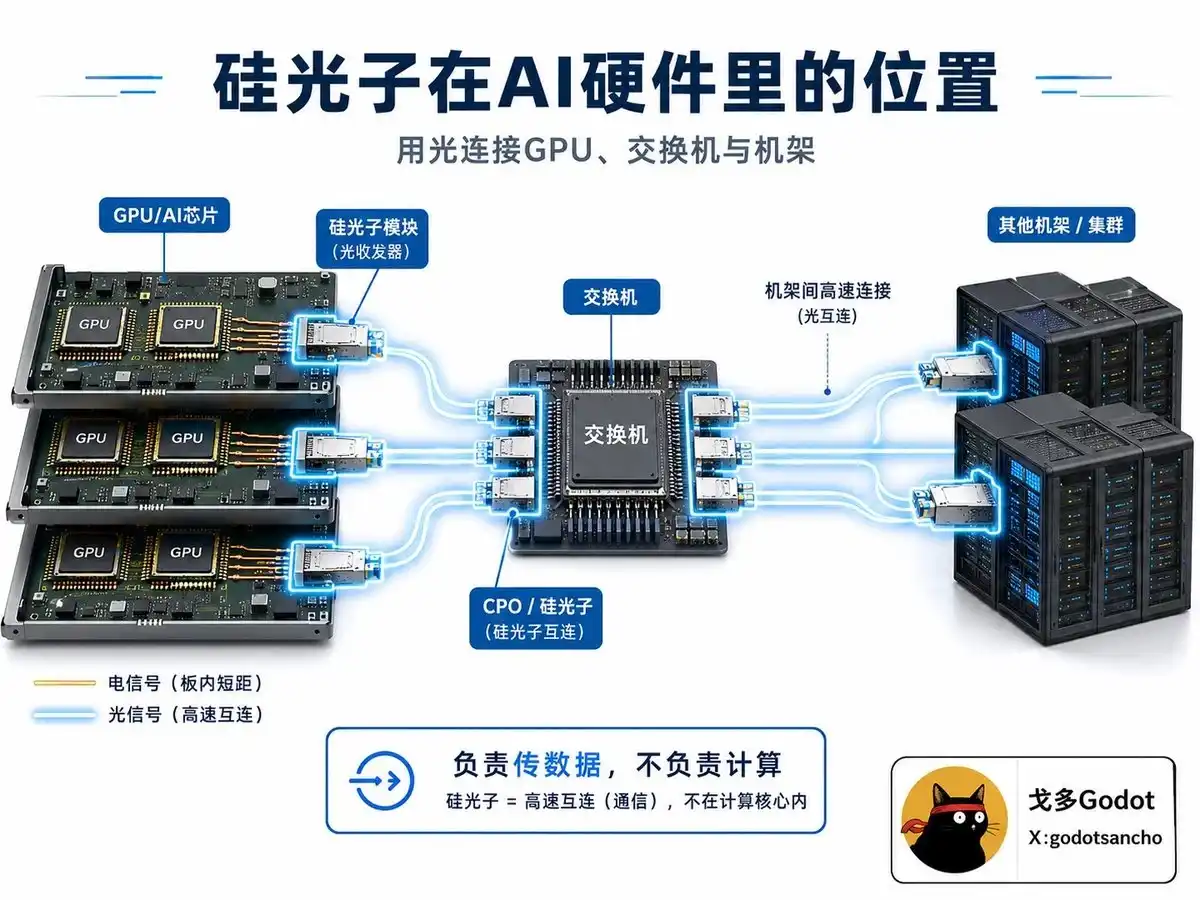
Typically, chips communicate using copper wires. Silicon photonic chips integrate components like lasers (which generate light), modulators (which "modulate" light), and *detectors* (which "receive" light) directly onto silicon wafers, enabling communication via photons.

So, why replace copper? And why use silicon photonics instead of other alternatives?

First, copper wires nearly reach their physical limits when transmitting signals above 1.6T, leading to signal degradation. Switching materials becomes imperative. This is the most critical issue and a necessary change. The technical term is the "bandwidth wall."

Second, copper is a tangible physical entity. As GPU clusters expand, there simply isn't enough space for all the copper wiring. This is another compelling reason to replace copper. Photonics are different; optical interfaces can be soldered directly next to switch chips, eliminating the need for extensive cabling. The term for this is the "scale wall."

Third, copper consumes too much power. In facilities consuming hundreds of megawatts, silicon photonics can save tens of thousands of kilowatt-hours daily—energy otherwise wasted on copper wire communication. After switching to photonics, this power can be redirected to GPUs for actual computation. This is termed the "power wall."

More interestingly, silicon photonics can leverage the mature CMOS manufacturing processes of the existing semiconductor industry, eliminating the need to build entirely new factories from scratch, thus enabling low-cost, high-volume production.

Of course, silicon photonics also has a drawback: silicon itself cannot emit light efficiently and must rely on Indium Phosphide (InP) materials. This has become the most critical bottleneck in the entire supply chain.

The Evolution of Silicon Photonics Technology

The most significant watershed moment was in March 2025 when NVIDIA, at its GTC conference, launched the Quantum-X and Spectrum-X photonic switches. Jensen Huang announced that starting from the next-generation Rubin architecture, "optical interconnect is not an option, it's a requirement."

A week later, NVIDIA announced a combined $4 billion investment in Coherent and Lumentum to secure key supply chains.

The paper on the silicon-based photoelectric effect was published in the 1980s. From 2004 to 2014, Intel and IBM manufactured silicon-based optical modulators.

In the previous decade, hyperscale cloud service providers like AWS, Google, and Meta adopted silicon photonics, though at the time it was only a part of fiber optic communication.

Current Industry Landscape

1) The Foundation: Foundries

They manufacture photonic chips. TSMC $TSM leads with its COUPE process. Tower Semiconductor $TSEM specializes in silicon photonics foundry services, with its silicon photonics revenue growing 70% year-over-year in 2025. GlobalFoundries $GFS, through its acquisition of Singapore's AMF, has become the world's largest dedicated silicon photonics foundry.

2) The Second Tier: Core Component Suppliers

They provide components like lasers and modulators, primarily Indium Phosphide (InP) lasers. Globally, fewer than five companies can manufacture high-speed EML lasers.

Lumentum $LITE is the only manufacturer capable of mass-producing 200G/lane EML lasers, a core component for 1.6T optical modules. To lock in its capacity, NVIDIA has secured orders extending beyond 2027.

3) The Third Tier: Module and System Manufacturers

They assemble components into finished products. Coherent holds about 25% of the global optical transceiver market share. Chinese companies like InnoLight, Eoptolink, and Accelink are significant contenders in terms of manufacturing scale and cost competitiveness.

4) The Top Tier: System Integrators

This layer includes NVIDIA, Cisco, Broadcom $AVGO, and Marvell $MRVL.

In summary,

NVIDIA $NVDA

Holds a dominant position, deciding the interconnect standards for AI data centers and securing supply chains through strategic investments.

Broadcom $AVGO

The absolute leader in networking switch chips, commanding nearly 80% market share in Ethernet switches. The Tomahawk 6-Davisson is the world's first 102.4 Tbps CPO switch.

Marvell $MRVL

Broadcom's strongest challenger, dominating the PAM4 optical DSP market with a 60-70% share. Recently acquired Celestial AI to enter the chip-to-chip optical interconnect space.

Lumentum $LITE

The most critical supplier of EML lasers. The world's only manufacturer capable of mass-producing 200G/lane EML lasers. NVIDIA has locked in orders until after 2027.

Coherent $COHR

An integrated player across the entire supply chain, with a presence from materials and lasers to modules. FY2025 revenue was $5.8 billion, making it the market leader in optical transceiver share.

TSMC $TSM

The process standard-setter. Its 65nm silicon photonics process is in mass production. The COUPE platform is currently the most advanced 3D heterogeneous integration solution, and NVIDIA's CPO roadmap is deeply tied to it.

Tower Semiconductor $TSEM

The purest beneficiary of the silicon photonics foundry trend. Its silicon photonics revenue grew 70% year-over-year in 2025. It is investing $650 million to triple its capacity. It has the highest potential for valuation elasticity among all the mentioned players.

Lightmatter / Ayar Labs (Unlisted · IPO Candidates)

Lightmatter, valued at $4.4 billion, focuses on 3D photonic interconnects. Ayar Labs has received investments from AMD, Intel, and NVIDIA, working on optical I/O chiplets. Both are potential major IPO candidates.

Valuation Logic Shift Driven by the Silicon Photonics Boom

Take an example. Previously, Wall Street valued Tower Semiconductor as a regular analog foundry, with a Price-to-Sales (P/S) ratio of around 2-3x.

But when its silicon photonics business grew from 5% to 30%-40% of total revenue, the market began to revalue it as a scarce asset within AI infrastructure, potentially lifting its P/S ratio to 6-10x.

Lumentum and Coherent, once viewed as telecom component suppliers, are now being redefined as indispensable providers of AI interconnect components. BofA analyst Vivek Arya raised Marvell's target price to $200, underpinned by valuing Marvell as an AI infrastructure platform rather than a communications chipmaker.

Evercore ISI's assessment of Cisco is similar. As silicon photonics products penetrate hyperscale data centers, Cisco's core AI-related revenue could potentially explode from $3 billion to $12-$15 billion over the next 3-4 years.

The Moat of the Silicon Photonics Industry

The silicon photonics industry exhibits clear winner-take-most characteristics, as every single process has been refined over a long period *before* the AI boom.

InP lasers: Globally, fewer than five companies can mass-produce high-end EML lasers, with a capacity expansion cycle of 3-5 years. This is the most critical bottleneck in the entire supply chain.

TSMC's COUPE process: The technological barrier of 3D heterogeneous integration puts competitors at least two generations behind, requiring years of yield experience accumulation.

Foundry PDK ecosystem: Once a customer designs with a specific foundry's Process Design Kit (PDK), the switching cost is extremely high—redesigning and recertification can take 12-18 months.

Thermal management and packaging: CPO requires managing the coupling of electrical, thermal, and optical domains within a few millimeters of space, which cannot be achieved without years of system integration experience.

The supplier certification process for giants like AWS and Google typically takes 12-24 months. Once certified, customer stickiness is extremely strong.

Risks and Cold-headed Considerations

The growth of the entire industry chain is highly dependent on the capital expenditures of the five hyperscale cloud giants: Microsoft, Google, Meta, Amazon, and Oracle.

There is substitutability among technical paths like LPO, CPO, OCS, and Optical I/O. If one route is disrupted by another, previously invested capital may face depreciation or write-downs.

Research firms like LightCounting judge that truly large-scale CPO deployment will not arrive until after 2028. Before that, transitional solutions like LPO will dominate volumes.

Therefore, betting on the success of the *industry* is safer than betting on the success of a *single company*.


Tiền kỹ thuật số thịnh hành

Câu hỏi Liên quan

QAccording to the article, what are the three major limitations (or 'walls') of using copper interconnects in high-performance AI systems that silicon photonics aims to overcome?

AThe article outlines three major limitations of copper: 1) The Bandwidth Wall: Copper wires hit a physical limit for transmitting signals above 1.6T, leading to signal degradation. 2) The Scale Wall: As GPU clusters grow, physical copper wiring takes up too much space, whereas optical interfaces can be placed directly next to switch chips. 3) The Power Wall: Copper interconnects consume significant power, with silicon photonics potentially saving tens of thousands of kilowatt-hours per day in large facilities, freeing up power for GPUs to compute.

QWhy is Indium Phosphide (InP) a critical 'chokepoint' in the silicon photonics supply chain?

AInP is a critical chokepoint because silicon itself is not an efficient light emitter. High-performance lasers, particularly the essential Electro-absorption Modulated Lasers (EML) needed for high-speed data transmission, are made from Indium Phosphide. The article states there are fewer than five companies globally capable of manufacturing high-end EML lasers, and capacity expansion takes 3-5 years.

QName two companies positioned in the 'Core Components Supplier' layer of the silicon photonics industry chain as described in the article and explain their key advantage.

ATwo companies in the core components layer are Lumentum (LITE) and Coherent (COHR). Lumentum's key advantage is being the world's only company capable of mass-producing the 200G/lane EML laser, a core component for 1.6T optical modules, with NVIDIA having locked in its capacity through 2027. Coherent, as a full-industry-chain integrator, holds about 25% of the global optical transceiver market share, with a strong position from materials to modules.

QHow is the valuation logic changing for companies like Tower Semiconductor due to the rise of AI silicon photonics?

APreviously, Tower Semiconductor (TSEM) was valued as an ordinary analog foundry with a price-to-sales ratio of 2-3x. As its silicon photonics business is forecasted to grow from 5% to potentially 30-40% of revenue, the market is beginning to revalue it as a scarce AI infrastructure asset. This could push its price-to-sales ratio to a range of 6-10x.

QWhat is one major risk factor highlighted for the silicon photonics industry's growth, aside from dependence on hyperscaler capital expenditure?

AA major risk factor is technological substitution. Different technical paths like LPO, CPO, OCS, and Optical I/O are competing. If one technology path is ultimately displaced by another, the capital invested in the former could face depreciation and impairment risks.

Nội dung Liên quan

Sau ba quý liên tiếp suy giảm, thị trường tiền điện tử có thể đón cửa sổ ổn định trong quý III?

Thị trường tiền mã hóa vừa trải qua quý tồi tệ nhất kể từ năm 2022, với vốn hóa giảm 12.6% xuống 2.1 nghìn tỷ USD, khối lượng giao dịch sụt giảm và dòng tiền rút mạnh khỏi các quỹ ETF Bitcoin. Bitcoin và Ethereum lần lượt giảm 14.2% và 25.4% trong quý, đánh dấu sự đảo ngược so với mối tương quan trước đây với các tài sản rủi ro như Nasdaq. Dòng vốn ETF chứng khoán Mỹ ghi nhận dòng ròng rút khoảng 46.7 tỷ USD trong quý II, báo hiệu áp lực bán. Tuy nhiên, dấu hiệu tích cực ban đầu xuất hiện khi các nhà đầu tư dài hạn bắt đầu tích lũy trở lại và dòng ETF có đợt thu hút ngắn hạn. Toàn bộ thị trường hiện tập trung vào cuộc họp của Cục Dự trữ Liên bang Mỹ (FOMC) vào cuối tháng 7. Các tín hiệu chính sách tiền tệ sẽ quyết định xu hướng: tín hiệu ôn hòa có thể đẩy Bitcoin lên vùng 68,000-84,000 USD, trong khi lập trường cứng rắn có thể kéo giá về vùng 50,000-56,000 USD. Tiến trình pháp lý của Đạo luật CLARITY gần như đình trệ, làm giảm kỳ vọng và gia tăng phí rủi ro cho toàn ngành. Trong bối cảnh ảm đạm, hai lĩnh vực nổi bật là thị trường dự đoán (tăng trưởng 48.7%) và bộ sưu tập kỹ thuật số được mã hóa (tăng ~143%), cho thấy sự chuyển dịch nhu cầu thực tế. Nhìn chung, thị trường thiếu động lực cho một đợt tăng trưởng mạnh dựa trên tâm lý. Các quyết định giao dịch trong quý III sẽ chủ yếu xoay quanh diễn biến giá, lựa chọn chính sách và kỳ vọng lãi suất.

marsbit12 giờ trước

Sau ba quý liên tiếp suy giảm, thị trường tiền điện tử có thể đón cửa sổ ổn định trong quý III?

marsbit12 giờ trước

Giao Dịch SpaceX, Đã Mở Khóa: SPCXON Được Giao Dịch Trên WEEX

SpaceX đã thực hiện đợt IPO lớn nhất lịch sử vào tháng 6/2026, nhưng nhiều nhà giao dịch không thể tiếp cận do các rào cản như hạn chế môi giới và khu vực. Sàn giao dịch tiền điện tử WEEX đã giới thiệu SPCXON/USDT, một công cụ token hóa cho phép tiếp cận biến động giá của SpaceX thông qua tài khoản crypto được quyết toán bằng USDT, mà không cần môi giới Mỹ hay tài khoản ngân hàng. Sản phẩm này, xây dựng trên nền tảng cổ phiếu token hóa của Ondo, dành cho các nhà giao dịch bên ngoài Hoa Kỳ. Trường hợp đầu tư dựa trên đà tăng doanh thu Starlink và các cột mốc Starship, trong khi các yếu tố cần thận trọng bao gồm định giá cao, lượng cổ phiếu lưu hành công chúng ít và sự kiện mở khóa cổ phiếu nội bộ sắp tới. Lưu ý quan trọng: SPCXON cung cấp mức tiếp xúc với hiệu quả kinh tế, không phải quyền sở hữu cổ phiếu trực tiếp, và có thể giao dịch ở mức cao hơn hoặc thấp hơn giá trị tài sản ròng. WEEX tích hợp SPCXON cùng các sản phẩm TradFi token hóa khác như MicroStrategy (MSTRON) và Micron (MUON) vào một tài khoản thống nhất, cho phép luân chuyển giữa crypto và cổ phiếu dễ dàng. Sàn cũng đang chạy chiến dịch TradFi Trading Challenge với quỹ thưởng $50,000.

TheNewsCrypto12 giờ trước

Giao Dịch SpaceX, Đã Mở Khóa: SPCXON Được Giao Dịch Trên WEEX

TheNewsCrypto12 giờ trước

BIT Trading Hours: BTC Vẫn Chịu Áp Lực Từ Đường MA 200 Tuần, Bị Từ Chối Có Thể Tái Khởi Động Đợt Giảm, Ngành Lưu Trữ và Bán Dẫn Tăng Mạnh Đêm Qua Bắt Đầu Giảm Trong Khung Giờ Giao Dịch Ban Đêm

Bitcoin (BTC) hiện giao dịch quanh mức $66,000, đối mặt với vùng kháng cự mạnh gần $68,000 - nơi tập trung nhiều lệnh mua trước đó có thể chốt lời. Về mặt kỹ thuật, BTC đang nằm giữa đường trung bình động 200 tuần (MA ~$63,333) và đường trung bình động hàm mũ 200 tuần (EMA ~$68,328). Việc không thể vượt qua mức $68,000 có thể kéo giá về kiểm tra lại vùng hỗ trợ $63,000. Thị trường hiện có tính thanh khoản thấp và được xem là đang trong đợt phục hồi nhẹ. Trên thị trường chứng khoán Mỹ, các chỉ số tương lai giảm nhẹ. Nhóm cổ phiếu bán dẫn và lưu trữ, vốn tăng mạnh vào đêm trước, đã điều chỉnh giảm trong phiên giao dịch ngoài giờ. Tuy nhiên, Super Micro Computer (SMCI) tăng mạnh sau báo cáo doanh thu và đơn đặt hàng tích cực. Dầu thô tăng (trên $91) và lợi suất trái phiếu kho bạc Mỹ tăng cao tiếp tục gây áp lực lên thị trường cổ phiếu và làm dấy lên lo ngại lạm phát. Tại châu Á, thị trường Hàn Quốc phục hồi nhẹ cùng với cổ phiếu công nghệ, trong khi Nhật Bản thận trọng do đồng Yên yếu kỷ lục. Các sự kiện quan trọng sắp tới bao gồm báo cáo thu nhập từ các gã khổng lồ công nghệ như Alphabet, Tesla, IBM; sự kiện AI của AMD; và cuộc họp chính sách tiền tệ của Ngân hàng Trung ương châu Âu.

marsbit12 giờ trước

BIT Trading Hours: BTC Vẫn Chịu Áp Lực Từ Đường MA 200 Tuần, Bị Từ Chối Có Thể Tái Khởi Động Đợt Giảm, Ngành Lưu Trữ và Bán Dẫn Tăng Mạnh Đêm Qua Bắt Đầu Giảm Trong Khung Giờ Giao Dịch Ban Đêm

marsbit12 giờ trước

Chủ tịch CFTC cũ, Chủ tịch Circle Tarbert: Một mặt khuyên bạn chủ nghĩa dài hạn, mặt kia tự mình thoái vốn 30 triệu USD

Tác giả: Zen, PANews Trước tình cảnh cổ phiếu Circle (CRCL) giảm 70% so với đỉnh và bị hạ xếp hạng, Chủ tịch Heath Tarbert - cựu Chủ tịch CFTC - trong một cuộc phỏng vấn ngày 14/7 đã kêu gọi các nhà đầu tư kiên nhẫn và tập trung vào tầm nhìn dài hạn của công ty. Tuy nhiên, hành động của ông lại trái ngược hoàn toàn. Kể từ khi Circle IPO, Tarbert đã không ngừng bán cổ phiếu CRCL thông qua kế hoạch giao dịch 10b5-1 được lập trước, thu về tổng cộng khoảng 30 triệu USD. Ông chưa từng mua lại cổ phiếu trên thị trường mở, ngay cả khi giá cổ phiếu lao dốc. Bài viết nêu bật sự mâu thuẫn giữa lời nói "chủ nghĩa dài hạn" và hành động "thoái vốn" mạnh tay của Tarbert. Sự nghiệp của ông được mô tả là điển hình của "cánh cửa xoay" chính trị-thương mại Mỹ: từ các vị trí cấp cao tại Bộ Tài chính và CFTC, ông nghỉ hưu chỉ 27 ngày trước khi gia nhập Citadel Securities - một nhà tạo lập thị trường lớn - vào thời điểm công ty này đang đối mặt với cuộc điều tra của Quốc hội sau sự kiện GameStop. Sau đó, ông chuyển sang Circle, nơi ông được cho là đã sử dụng kinh nghiệm và quan hệ quản lý để giúp công ty vượt qua các rào cản pháp lý và niêm yết thành công. Bài báo đặt câu hỏi liệu Tarbert có thực sự tin vào tương lai dài hạn của Circle hay không, khi mà ông liên tục chốt lời trong khi lại khuyên các cổ đông nhỏ lẻ giữ vị thế. Nó gợi ý rằng mô hình của ông là tận dụng tối đa kiến thức về chu kỳ chính sách và cơ hội thị trường để biến các nguồn lực và uy tín tích lũy được thành lợi thế nghề nghiệp và tài chính cá nhân, trong khi rủi ro dài hạn được chuyển sang cho các nhà đầu tư tin tưởng vào những tường thuật công khai của ông.

marsbit13 giờ trước

Chủ tịch CFTC cũ, Chủ tịch Circle Tarbert: Một mặt khuyên bạn chủ nghĩa dài hạn, mặt kia tự mình thoái vốn 30 triệu USD

marsbit13 giờ trước

Gate Research: Làn sóng "phố Wall hóa" trong các sản phẩm tài chính tiền điện tử - Cạnh tranh hay Hội tụ?

Gate Research Institute: Sự hòa hợp hay cạnh tranh trong làn sóng "phố Wall hóa" các sản phẩm tài chính tiền mã hóa? Từ tầm nhìn ban đầu về một hệ thống tài chính phi tập trung, loại bỏ trung gian của Bitcoin, thị trường tiền mã hóa đang chứng kiến sự hội tụ mạnh mẽ với tài chính truyền thống (TradFi). Các quỹ ETF Bitcoin, tài sản thế giới thực được mã hóa (RWA) và trái phiếu chính phủ trên chuỗi cho thấy các tổ chức như BlackRock, Fidelity đang đưa tài sản mã hóa vào hệ thống phát hành, định giá, lưu ký và phân phối truyền thống. Tuy nhiên, đây không phải là một trò chơi tổng bằng không. Xu hướng này thể hiện sự bổ sung lẫn nhau: TradFi cung cấp khung pháp lý, mạng lưới phân phối rộng và sự tin cậy, trong khi Crypto mang lại tính mở, thanh khoản toàn cầu 24/7 và khả năng thanh toán lập trình được. Hai hướng đi tiêu biểu minh chứng cho sự hội tụ hai chiều: các sàn giao dịch tiền mã hóa (CEX) như Gate mở rộng sang giao dịch cổ phiếu thực, ETF thông qua cơ sở hạ tầng môi giới truyền thống; trong khi các công ty môi giới truyền thống như Robinhood tích hợp tài sản mã hóa và phát triển tài sản mã hóa (như cổ phiếu mã hóa) để thu hút người dùng. Mục tiêu chung của cả hai hướng là tranh giành "tài khoản tài chính tổng hợp" thế hệ tiếp theo - một điểm vào duy nhất nơi người dùng có thể giao dịch đa dạng tài sản từ cổ phiếu, tiền mã hóa đến RWA. Sự tăng trưởng mạnh mẽ của thị trường RWA, đặc biệt là cổ phiếu mã hóa, bất chấp xu hướng thị trường giảm, cho thấy đây là một xu hướng cấu trúc thực sự. Kết luận, "phố Wall hóa" không có nghĩa là thị trường tiền mã hóa bị TradFi thôn tính. Thay vào đó, đây là một sự chuyển đổi hai chiều, nơi cả hai hệ thống đang cùng nhau định hình lại thị trường vốn thành một cấu trúc hỗn hợp hiệu quả và toàn cầu hơn, với trải nghiệm người dùng liền mạch cho nhiều loại tài sản khác nhau.

marsbit13 giờ trước

Gate Research: Làn sóng "phố Wall hóa" trong các sản phẩm tài chính tiền điện tử - Cạnh tranh hay Hội tụ?

marsbit13 giờ trước

Giao dịch

Giao ngay

Bài viết Nổi bật

Làm thế nào để Mua ERA

Chào mừng bạn đến với HTX.com! Chúng tôi đã làm cho mua Caldera (ERA) trở nên đơn giản và thuận tiện. Làm theo hướng dẫn từng bước của chúng tôi để bắt đầu hành trình tiền kỹ thuật số của bạn.Bước 1: Tạo Tài khoản HTX của BạnSử dụng email hoặc số điện thoại của bạn để đăng ký tài khoản miễn phí trên HTX. Trải nghiệm hành trình đăng ký không rắc rối và mở khóa tất cả tính năng. Nhận Tài khoản của tôiBước 2: Truy cập Mua Crypto và Chọn Phương thức Thanh toán của BạnThẻ Tín dụng/Ghi nợ: Sử dụng Visa hoặc Mastercard của bạn để mua Caldera (ERA) ngay lập tức.Số dư: Sử dụng tiền từ số dư tài khoản HTX của bạn để giao dịch liền mạch.Bên thứ ba: Chúng tôi đã thêm những phương thức thanh toán phổ biến như Google Pay và Apple Pay để nâng cao sự tiện lợi.P2P: Giao dịch trực tiếp với người dùng khác trên HTX.Thị trường mua bán phi tập trung (OTC): Chúng tôi cung cấp những dịch vụ được thiết kế riêng và tỷ giá hối đoái cạnh tranh cho nhà giao dịch.Bước 3: Lưu trữ Caldera (ERA) của BạnSau khi mua Caldera (ERA), lưu trữ trong tài khoản HTX của bạn. Ngoài ra, bạn có thể gửi đi nơi khác qua chuyển khoản blockchain hoặc sử dụng để giao dịch những tiền kỹ thuật số khác.Bước 4: Giao dịch Caldera (ERA)Giao dịch Caldera (ERA) dễ dàng trên thị trường giao ngay của HTX. Chỉ cần truy cập vào tài khoản của bạn, chọn cặp giao dịch, thực hiện giao dịch và theo dõi trong thời gian thực. Chúng tôi cung cấp trải nghiệm thân thiện với người dùng cho cả người mới bắt đầu và người giao dịch dày dạn kinh nghiệm.

Tổng lượt xem 826Xuất bản vào 2025.07.17Cập nhật vào 2026.06.02

Làm thế nào để Mua ERA

Thảo luận

Chào mừng đến với Cộng đồng HTX. Tại đây, bạn có thể được thông báo về những phát triển nền tảng mới nhất và có quyền truy cập vào thông tin chuyên sâu về thị trường. Ý kiến ​​của người dùng về giá của ERA (ERA) được trình bày dưới đây.

活动图片












