Ethereum's 'Barrier Lake' Moment: Fundamentals Up, ETH Down

marsbitXuất bản vào 2026-01-22Cập nhật gần nhất vào 2026-01-22

Tóm tắt

Ethereum is experiencing a paradoxical "dammed lake" moment in 2026, with strong fundamental growth contrasting with stagnant ETH prices. Key metrics like staking scale, TVL, and stablecoin dominance have hit record highs, yet the token's value remains disconnected. The staking ecosystem has reached $120 billion, with 36 million ETH staked. However, centralization risks persist, as the top 5 providers control 48% of staked ETH. Vitalik Buterin has proposed a native DVT (Distributed Validator Technology) solution to enhance decentralization, security, and resilience against single points of failure. Ethereum's TVL surpassed $300 billion, reflecting a mature and diversified ecosystem. It maintains a 58% dominance in stablecoin market share, reinforcing its role as a global settlement layer. Regulatory developments like the "Genius Act" are expected to further boost institutional stablecoin adoption. Despite record-high transaction volumes (2.49 million daily average), low gas fees (0.03 Gwei) have enabled widespread "address poisoning" attacks, inflating on-chain activity without genuine demand. Additionally, L2 growth has come at the cost of mainnet revenue, with L2s paying only $10 million to Ethereum despite earning $129 million in 2025. A significant valuation disconnect exists: Ethereum hosts 59% of crypto's TVL but only 14% of its total market cap. This suggests ETH is deeply undervalued, as the network evolves into a "digital oil field" underpinning real-world asset ...

Author: Jae, PANews

In 2026, Ethereum had a magical start. On one side, there is a prosperous scene with indicators such as staking scale, TVL, and stablecoin share repeatedly hitting new highs; on the other side, there is a serious "decoupling" between the token price and the ecosystem fundamentals.

At this moment, Ethereum may be at a "barrier lake" moment. Upstream are technical dividends like native DVT, the Fusaka upgrade, and deep asset accumulation; downstream are concerns about centralization, failed value capture, and mispriced markets.

Trillion-dollar staking scale cannot hide centralization risks; Vitalik aims to counter with DVT solution

New highs in staking, empty exit queues—Ethereum's staking ecosystem recently delivered a seemingly perfect report card.

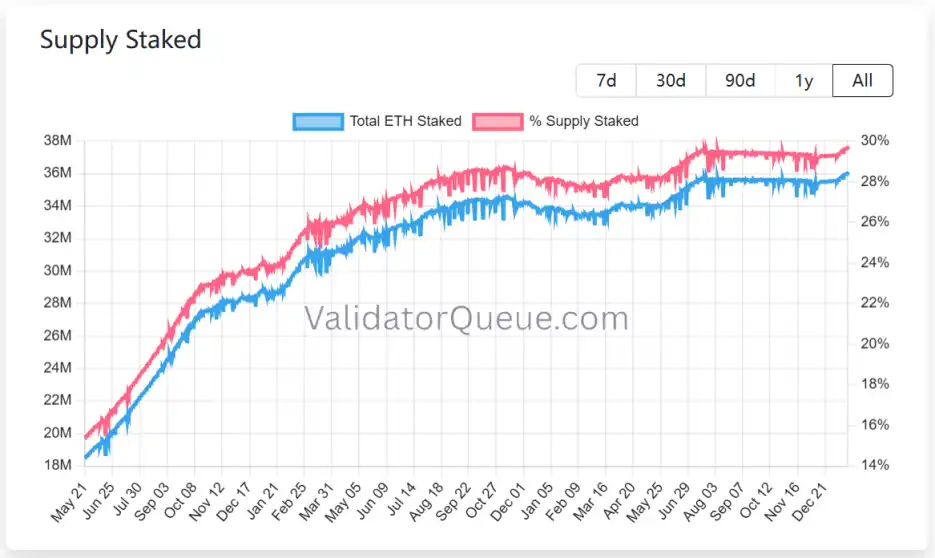
According to ValidatorQueue data, as of January 22, 2026, Ethereum's staking scale reached a historical high of nearly $1.2 trillion, with over 36 million ETH staked, accounting for about 30% of the circulating supply.
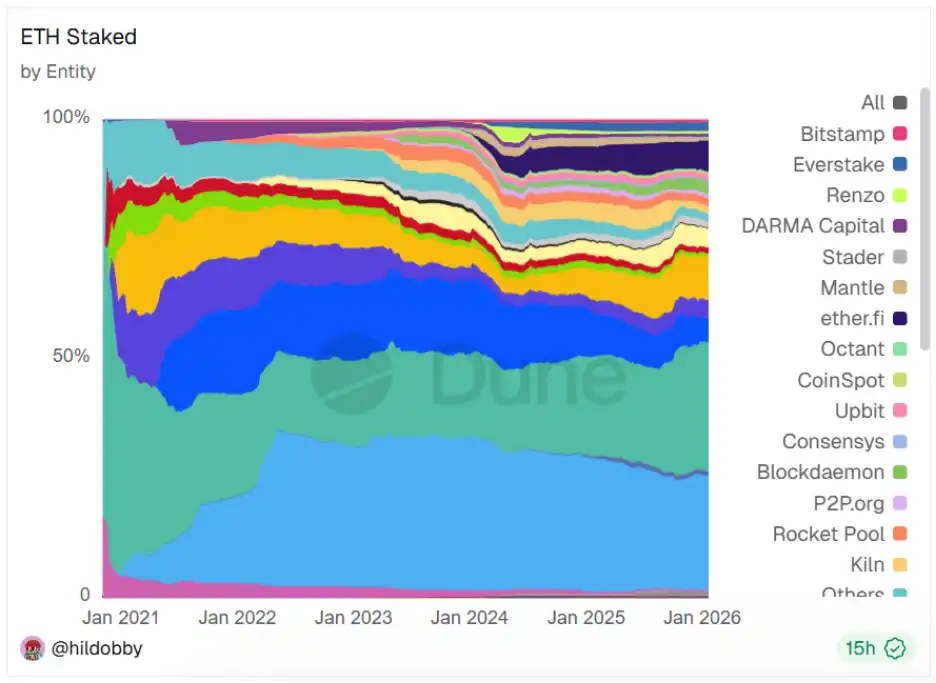
However, behind the prosperous scene lurk centralization risks. The top 5 liquid staking providers alone control nearly 18 million ETH, holding a 48% market share. This high concentration not only goes against the original intention of decentralization but also exposes the network to single points of failure and censorship risks, thereby affecting network security and the healthy development of the ecosystem.

On January 21, Vitalik formally proposed the "native DVT (Distributed Validator Technology) staking" solution on the Ethereum Research Forum, aiming to address the chronic issues of validator single points of failure and staking centralization, thereby enhancing Ethereum's security and decentralization.

First, Vitalik admitted that in the past, Ethereum, in pursuit of user growth, led to excessive centralization in node operation and block building. Native DVT will strive to eliminate reliance on single physical nodes or single cloud service providers like AWS.

Second, the high market share of liquid staking providers like Lido has always been a major concern for the community. Native DVT attempts to further lower the staking barrier, allowing small and medium validators to participate, thereby improving Ethereum's Nakamoto coefficient.
Finally, Vitalik indicated a greater focus on censorship resistance and quantum threat resistance. Native DVT allows validators to distribute nodes across different geographical locations and different clients, significantly enhancing the network's resilience to geopolitical risks or specific client vulnerabilities.

Related reading: Ethereum at a Crossroads: Quantum Threat Looms, Wall Street Capital's Dual Squeeze

The native DVT solution proposes 4 technical pillars:

  1. Multi-private key cluster management: Allows one validator identity to register up to 16 independent private keys.
  2. Threshold signature mechanism: A block proposal or attestation is only considered valid if more than 2/3 of the associated nodes (e.g., 11 out of 16) sign simultaneously.
  3. Protocol-level integration: Unlike third-party DVT solutions like SSV or Obol, native DVT runs directly at the consensus layer, eliminating the need for complex external coordination layers and lowering the operational barrier.
  4. Low performance overhead: This design only adds one round of delay during block production, has no impact on attestation speed, and is compatible with any signature scheme.

If the native DVT solution is implemented, it will have a profound impact on the validator ecosystem, reducing single points of failure risk and improving validator redundancy and fault tolerance.

For individual stakers, they will be able to team up or rent multiple inexpensive servers to achieve "non-downtime" operation at a lower cost, significantly reducing the pressure of being slashed.

For institutional validators, they will no longer need to build expensive and complex custom failover systems; native DVT will provide a standardized fault-tolerant solution, thereby reducing operational costs.

For the entire staking track, the native DVT solution may reshape the landscape of Ethereum's liquid staking market. Small service providers and independent validators will gain a more level playing field, while the advantages of large service providers may be diminished.

Although the native DVT proposal is still in the conceptual stage and requires approval from the Ethereum community to be implemented, it clearly points to Ethereum's future direction: no longer sacrificing security for short-term efficiency and adoption rates, but instead using native technical means to reclaim lost ground in sovereignty and trustlessness. This is also Vitalik's vision for this year.

TVL breaks through $300 billion, firmly holding the capital stronghold

In early 2026, Ethereum reached a historic moment as the TVL of on-chain applications broke through the $300 billion mark. This milestone is not just a numerical increase but also represents the Ethereum ecosystem structure becoming increasingly diversified.

The funds settled in the Ethereum ecosystem are no longer just speculative bubbles. According to Onchain research director Leon Waidmann, these funds are active in on-chain applications such as DeFi, stablecoins, RWA, and staking, representing real economic activity. Ethereum leads other networks in dimensions such as liquidity depth, composability, predictability, and user and capital reserves; the network effect is becoming apparent.

When the TVL scale crosses the $300 billion threshold, Ethereum is no longer just an application platform but a global settlement protocol capable of carrying sovereign-level assets. This magnitude means that any competitor trying to challenge Ethereum's position must not only compete on performance but also match Ethereum in liquidity depth.

If TVL is Ethereum's "muscle," then stablecoins are its "blood." As of January 22, Ethereum's market share in the stablecoin领域 has reached about 58%. Against the backdrop of growing global on-chain demand for dollars, Ethereum, as the primary launchpad for stablecoins, has built a deep liquidity moat for its ecosystem.
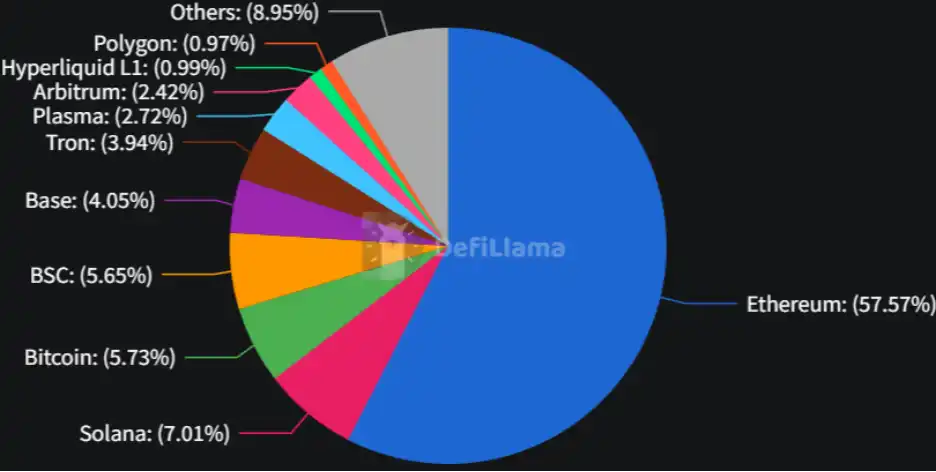
Electrical Capital emphasized in a report that stablecoins on Ethereum are not only a medium of exchange but also serve as collateral supporting DeFi loans worth over $19 billion.

The introduction of regulatory frameworks like the "Genius Act" is a further shot in the arm; adoption of stablecoins by mainstream payment companies and traditional financial institutions is set to explode.

USDC's share on Ethereum is climbing steadily, further cementing its position as a compliant "passport"; while yield-bearing stablecoin protocols like Ethena weave ETH's staking yield into the underlying returns of stablecoins, and their large-scale adoption also strengthens the deep coupling between ETH and the stablecoin ecosystem.

Although in 2025, public chains like Solana, Polygon, and Tron challenged Ethereum in the areas of small payments and high-frequency transfers, its dominance in institutional funds, large transactions, and DeFi integration remains unshakable.

As long as Ethereum maintains its position as the stablecoin "settlement hub," even if other chains have an advantage in the number of transactions, its "liquidity black hole" effect will continue to play a role.

21shares predicts that the stablecoin market size could reach $1 trillion in 2026. This means that, as the underlying settlement asset, the stablecoin liquidity settled on Ethereum will directly translate into long-term demand for ETH.

Becoming a "poison playground," L2s divert mainnet revenue

Recently, Ethereum staged a counterintuitive spectacle: its 7-day moving average number of transactions reached 2.49 million, hitting a new historical high, more than double the same period last year.
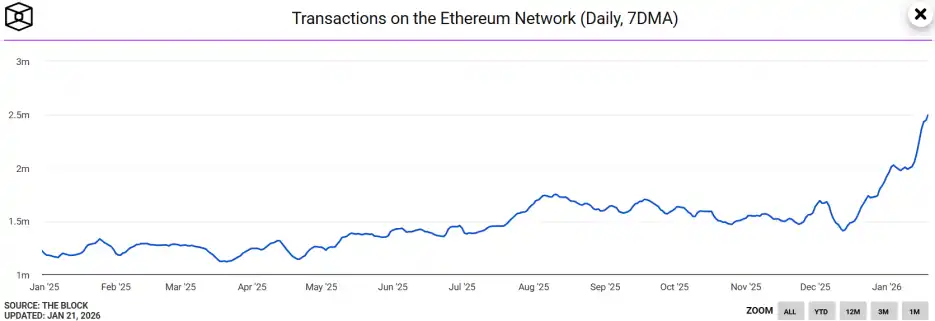
Simultaneously, Ethereum's 7-day moving average Gas fee dropped to a historical low below 0.03 Gwei, with the cost of a single transfer being only about $0.15.
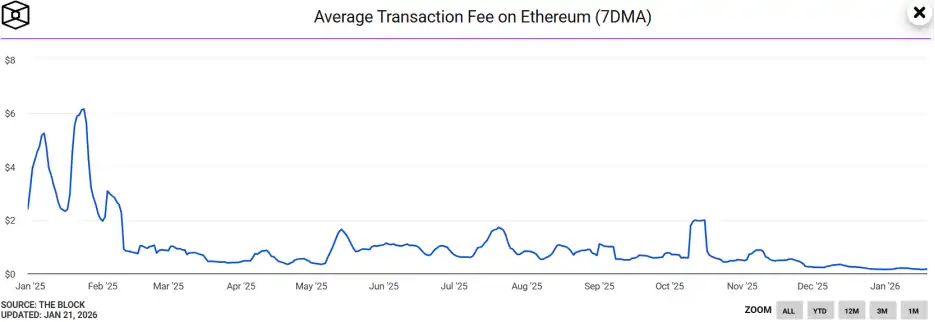
Puzzlingly, although on-chain activity on the Ethereum network surged, the price of ETH reacted tepidly. Security researcher Andrey Sergeenkov stated that this might stem from large-scale "address poisoning" attacks rather than genuine demand growth.

Research found that about 80% of the abnormal growth in new addresses on Ethereum is related to stablecoins, and about 67% of new active addresses had their first transfer worth less than $1, fitting the characteristics of a "dust attack."

This phenomenon is thanks to the arrival of the Fusaka upgrade last December.

The Fusaka upgrade is considered a "technical gift package" from Ethereum to the ecosystem. Its main innovation is the introduction of PeerDAS (Peer Data Availability Sampling), performing an effective "data reduction surgery" on the network.

PeerDAS allows nodes to verify the data availability of an entire block by sampling only part of the data, greatly enhancing the network's capacity to carry Blob data (L2 data storage space).

Related reading: Ethereum Activates Fusaka Upgrade, L2 Gas Fees Drop Another 60%

As the Fusaka upgrade significantly reduced transaction fees, low-cost attacks like dust attacks became feasible. This indicates that Ethereum's record transaction volume might be inflated by junk transactions, weakening the credibility of demand enhancement and causing the market not to view it as a catalyst for ETH price increases.

Misfortune seldom comes alone. Besides the false demand caused by "address poisoning attacks," Ethereum is also experiencing the "growing pains" of mainnet value capture.

To foster the expansion of the L2 ecosystem, the Ethereum mainnet took the initiative in 2025 to offer concessions, significantly reducing the "toll fees" L2s pay upstream.

Growthepie data pointed out that L2s' total revenue in 2025 was $129 million, but the fees paid to the mainnet plummeted to only $10 million. This means the Ethereum mainnet sacrificed over $100 million in potential revenue.

This strategy of cutting flesh to subsidize, while promoting the growth of the L2 ecosystem, has also raised questions from the community about ETH's value capture ability. If the mainnet revenue cannot grow in the long term, the amount of ETH burned will drop significantly, affecting its deflationary expectations.

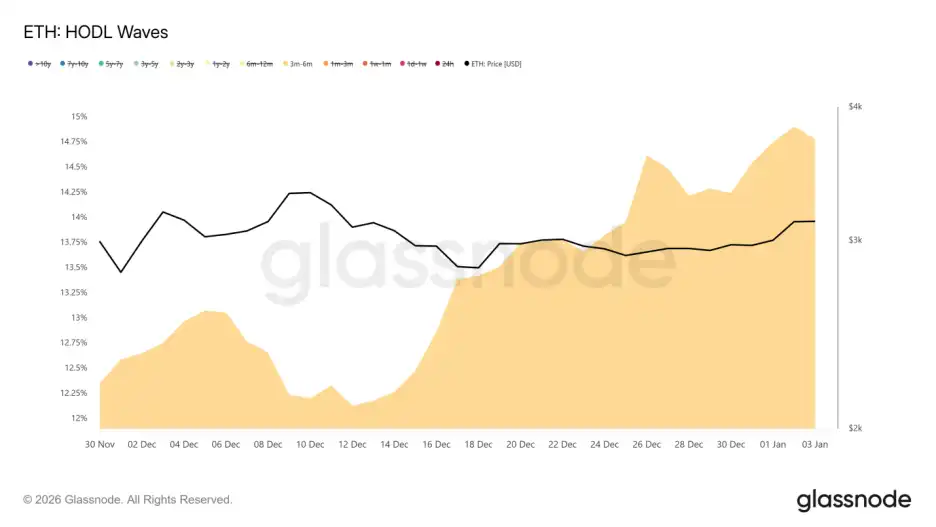
Furthermore, HODL Waves indicators show that a large amount of new holdings occurred between July and October 2025. These medium-to-long-term holders showed a significant willingness to exit at breakeven when the price approached $3,200, which also partly explains why on-chain data performance is impressive, but the ETH price faces resistance in the short term.
The "Digital Oil Field" under valuation inversion

On one side is the extreme prosperity of ecological data, on the other is the serious lag of market pricing; ETH is deeply mired in the quagmire of "valuation inversion."

In the pricing logic of the crypto market, the ratio between a public chain token's market capitalization and the scale of assets its ecosystem carries is a key metric for measuring the chain's capital efficiency and valuation rationality.

But as crypto KOL rip.eth pointed out, Ethereum currently carries 59% of the entire crypto market's TVL, but its native token ETH's market capitalization only accounts for 14% of the total crypto market cap.

This imbalance in ratio might mean that Ethereum is currently in a value洼地, the most undervalued public chain.
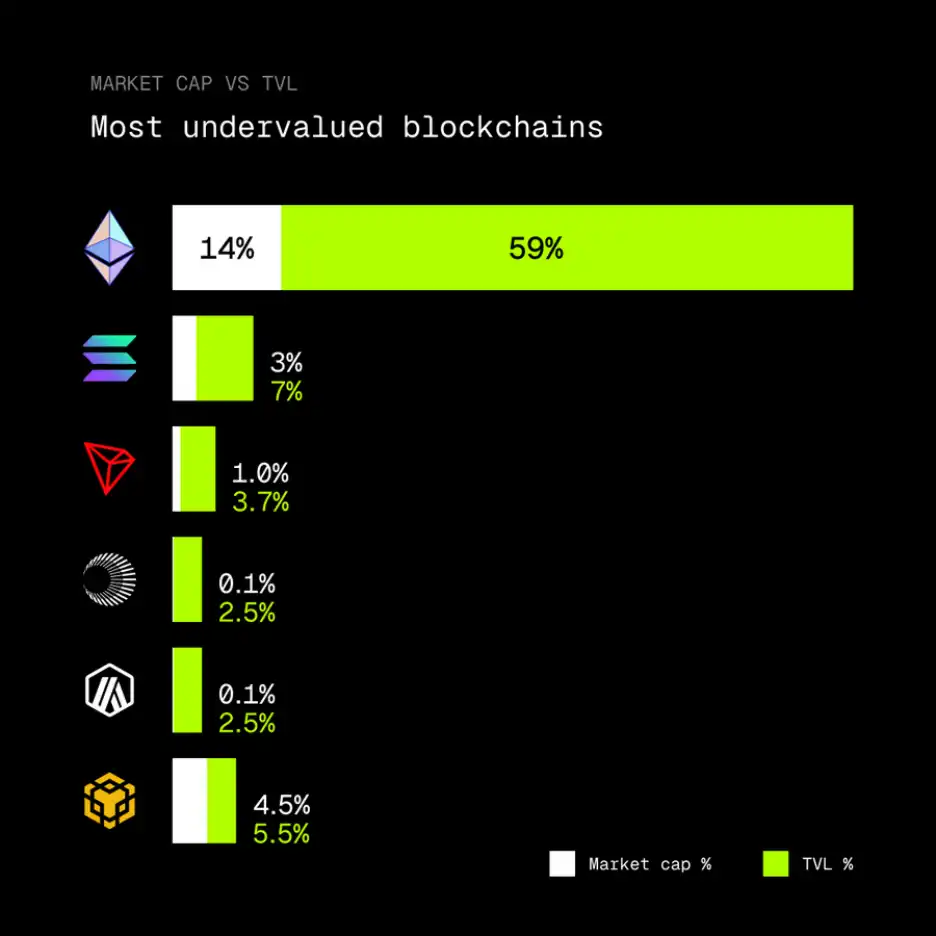
The deep-seated reason for this inversion might be that Ethereum is undergoing a profound role transformation, gradually evolving into a "digital oil field," but this is not being fully priced in.

A large amount of TVL is locked in staking protocols, DeFi contracts, and the L2 ecosystem, leading to a change in liquidity logic. Currently, market funds prefer to chase the oil (ecosystem applications) but overlook the产权 value of the oil field itself (Ethereum).

Simultaneously, with the continuous expansion of RWA, Ethereum is becoming the settlement base for traditional financial assets. This cash flow yield-generating capability will further促使 its MC/TVL ratio return to a reasonable range.

In reality, behind Ethereum's prosperity, it is walking a "tightrope": technical upgrades enhance performance but may also distort real data; ecosystem subsidies are somewhat eroding the mainnet's value capture ability; addressing the long-term risks of staking centralization, the native DVT proposal will be key to maintaining the bottom line of decentralization.

It can be said that Ethereum's challenge is no longer simply scaling but has升级 to finding a dynamic balance point in the impossible triangle of maintaining decentralization, sustaining technical advantages, and strengthening value capture. But as the market shifts its perception or enters a repair cycle driven by fundamentals, this "valuation barrier lake" may release enormous energy.


Câu hỏi Liên quan

QWhat is the 'dammed lake' moment that Ethereum is currently facing, as described in the article?

AEthereum is in a 'dammed lake' moment, characterized by a disconnect between its strong fundamentals—such as record-high staking scale, TVL, and stablecoin market share—and its stagnant or declining ETH token price. Upstream, it has technical upgrades and deep asset deposits, while downstream, it faces centralization risks, failed value capture, and market mispricing.

QWhat centralization risk exists within Ethereum's staking ecosystem despite its high total value locked?

ADespite a staking scale of nearly $120 billion, there is a high centralization risk where the top 5 liquid staking providers control nearly 18 million ETH, accounting for 48% of the market share. This concentration poses threats of single points of failure and censorship risks, contradicting Ethereum's decentralized principles.

QWhat is Vitalik Buterin's proposed 'native DVT staking' solution aimed at addressing?

AVitalik Buterin's proposed 'native DVT (Distributed Validator Technology) staking' solution aims to combat validator centralization and single points of failure. It seeks to eliminate reliance on single physical nodes or cloud providers like AWS, lower the staking barrier for smaller validators, and enhance Ethereum's Nakamoto coefficient, thereby improving network security and decentralization.

QHow has the Fusaka upgrade contributed to the phenomenon of 'address poisoning attacks' on Ethereum?

AThe Fusaka upgrade introduced PeerDAS (Peer Data Availability Sampling), which significantly reduced transaction fees by enabling nodes to verify data availability through sampling. This cost reduction made low-cost 'address poisoning attacks' (or dusting attacks) feasible, where a large volume of small, spam transactions artificially inflates on-chain activity metrics, creating a false impression of demand growth.

QWhy is Ethereum described as being in a 'valuation inversion' or undervalued despite its high TVL?

AEthereum is described as undervalued because it hosts 59% of the total value locked (TVL) in the crypto market, yet its native token ETH only accounts for 14% of the total crypto market capitalization. This imbalance suggests a 'valuation inversion,' where the market may be underpricing Ethereum's role as a foundational 'digital oil field' that generates value through its ecosystem, while investors focus more on the applications built on top of it rather than the base layer asset.

Nội dung Liên quan

Giao dịch

Giao ngay
Hợp đồng Tương lai

Bài viết Nổi bật

AGENT S là gì

Agent S: Tương Lai của Tương Tác Tự Động trong Web3 Giới thiệu Trong bối cảnh không ngừng phát triển của Web3 và tiền điện tử, các đổi mới đang liên tục định nghĩa lại cách mà cá nhân tương tác với các nền tảng kỹ thuật số. Một dự án tiên phong như vậy, Agent S, hứa hẹn sẽ cách mạng hóa tương tác giữa con người và máy tính thông qua khung tác nhân mở của nó. Bằng cách mở đường cho các tương tác tự động, Agent S nhằm đơn giản hóa các nhiệm vụ phức tạp, cung cấp các ứng dụng chuyển đổi trong trí tuệ nhân tạo (AI). Cuộc khám phá chi tiết này sẽ đi sâu vào những phức tạp của dự án, các tính năng độc đáo của nó và những tác động đối với lĩnh vực tiền điện tử. Agent S là gì? Agent S đứng vững như một khung tác nhân mở đột phá, được thiết kế đặc biệt để giải quyết ba thách thức cơ bản trong việc tự động hóa các nhiệm vụ máy tính: Thu thập Kiến thức Cụ thể theo Miền: Khung này học một cách thông minh từ nhiều nguồn kiến thức bên ngoài và kinh nghiệm nội bộ. Cách tiếp cận kép này giúp nó xây dựng một kho lưu trữ phong phú về kiến thức cụ thể theo miền, nâng cao hiệu suất của nó trong việc thực hiện nhiệm vụ. Lập Kế Hoạch Qua Các Tầm Nhìn Nhiệm Vụ Dài Hạn: Agent S sử dụng lập kế hoạch phân cấp tăng cường kinh nghiệm, một cách tiếp cận chiến lược giúp phân chia và thực hiện các nhiệm vụ phức tạp một cách hiệu quả. Tính năng này nâng cao đáng kể khả năng quản lý nhiều nhiệm vụ con một cách hiệu quả và hiệu suất. Xử Lý Các Giao Diện Động, Không Đều: Dự án giới thiệu Giao Diện Tác Nhân-Máy Tính (ACI), một giải pháp đổi mới giúp nâng cao tương tác giữa các tác nhân và người dùng. Sử dụng các Mô Hình Ngôn Ngữ Lớn Đa Phương Thức (MLLMs), Agent S có thể điều hướng và thao tác các giao diện người dùng đồ họa đa dạng một cách liền mạch. Thông qua những tính năng tiên phong này, Agent S cung cấp một khung vững chắc giải quyết các phức tạp liên quan đến việc tự động hóa tương tác giữa con người với máy móc, mở ra nhiều ứng dụng trong AI và hơn thế nữa. Ai là Người Tạo ra Agent S? Mặc dù khái niệm về Agent S là hoàn toàn đổi mới, thông tin cụ thể về người sáng lập vẫn còn mơ hồ. Người sáng lập hiện vẫn chưa được biết đến, điều này làm nổi bật giai đoạn sơ khai của dự án hoặc sự lựa chọn chiến lược để giữ kín các thành viên sáng lập. Bất chấp sự ẩn danh, sự chú ý vẫn tập trung vào khả năng và tiềm năng của khung này. Ai là Các Nhà Đầu Tư của Agent S? Vì Agent S còn tương đối mới trong hệ sinh thái mã hóa, thông tin chi tiết về các nhà đầu tư và những người tài trợ tài chính của nó không được ghi chép rõ ràng. Sự thiếu vắng thông tin công khai về các nền tảng đầu tư hoặc tổ chức hỗ trợ dự án dấy lên câu hỏi về cấu trúc tài trợ và lộ trình phát triển của nó. Hiểu biết về sự hỗ trợ là rất quan trọng để đánh giá tính bền vững và tác động tiềm năng của dự án. Agent S Hoạt Động Như Thế Nào? Tại cốt lõi của Agent S là công nghệ tiên tiến cho phép nó hoạt động hiệu quả trong nhiều bối cảnh khác nhau. Mô hình hoạt động của nó được xây dựng xung quanh một số tính năng chính: Tương Tác Giống Như Con Người: Khung này cung cấp lập kế hoạch AI tiên tiến, cố gắng làm cho các tương tác với máy tính trở nên trực quan hơn. Bằng cách bắt chước hành vi của con người trong việc thực hiện nhiệm vụ, nó hứa hẹn nâng cao trải nghiệm người dùng. Ký Ức Tường Thuật: Được sử dụng để tận dụng các trải nghiệm cấp cao, Agent S sử dụng ký ức tường thuật để theo dõi lịch sử nhiệm vụ, từ đó nâng cao quy trình ra quyết định của nó. Ký Ức Tình Huống: Tính năng này cung cấp cho người dùng hướng dẫn từng bước, cho phép khung này cung cấp hỗ trợ theo ngữ cảnh khi các nhiệm vụ diễn ra. Hỗ Trợ OpenACI: Với khả năng chạy cục bộ, Agent S cho phép người dùng duy trì quyền kiểm soát đối với các tương tác và quy trình làm việc của họ, phù hợp với tinh thần phi tập trung của Web3. Tích Hợp Dễ Dàng với Các API Bên Ngoài: Tính linh hoạt và khả năng tương thích với nhiều nền tảng AI khác nhau đảm bảo rằng Agent S có thể hòa nhập liền mạch vào các hệ sinh thái công nghệ hiện có, làm cho nó trở thành lựa chọn hấp dẫn cho các nhà phát triển và tổ chức. Những chức năng này cùng nhau góp phần vào vị trí độc đáo của Agent S trong không gian tiền điện tử, khi nó tự động hóa các nhiệm vụ phức tạp, nhiều bước với sự can thiệp tối thiểu của con người. Khi dự án phát triển, các ứng dụng tiềm năng của nó trong Web3 có thể định nghĩa lại cách mà các tương tác kỹ thuật số diễn ra. Thời Gian Phát Triển của Agent S Sự phát triển và các cột mốc của Agent S có thể được tóm tắt trong một dòng thời gian nêu bật các sự kiện quan trọng của nó: 27 tháng 9, 2024: Khái niệm về Agent S được ra mắt trong một bài nghiên cứu toàn diện mang tên “Một Khung Tác Nhân Mở Sử Dụng Máy Tính Như Một Con Người,” trình bày nền tảng cho dự án. 10 tháng 10, 2024: Bài nghiên cứu được công bố công khai trên arXiv, cung cấp một cái nhìn sâu sắc về khung và đánh giá hiệu suất của nó dựa trên tiêu chuẩn OSWorld. 12 tháng 10, 2024: Một video trình bày được phát hành, cung cấp cái nhìn trực quan về khả năng và tính năng của Agent S, thu hút thêm sự quan tâm từ người dùng và nhà đầu tư tiềm năng. Những dấu mốc trong dòng thời gian không chỉ minh họa sự tiến bộ của Agent S mà còn chỉ ra cam kết của nó đối với sự minh bạch và sự tham gia của cộng đồng. Những Điểm Chính Về Agent S Khi khung Agent S tiếp tục phát triển, một số thuộc tính chính nổi bật, nhấn mạnh tính đổi mới và tiềm năng của nó: Khung Đổi Mới: Được thiết kế để cung cấp cách sử dụng máy tính trực quan giống như tương tác của con người, Agent S mang đến một cách tiếp cận mới cho việc tự động hóa nhiệm vụ. Tương Tác Tự Động: Khả năng tương tác tự động với máy tính thông qua GUI đánh dấu một bước tiến tới các giải pháp tính toán thông minh và hiệu quả hơn. Tự Động Hóa Nhiệm Vụ Phức Tạp: Với phương pháp mạnh mẽ của nó, nó có thể tự động hóa các nhiệm vụ phức tạp, nhiều bước, làm cho các quy trình nhanh hơn và ít sai sót hơn. Cải Tiến Liên Tục: Các cơ chế học tập cho phép Agent S cải thiện từ các trải nghiệm trước đó, liên tục nâng cao hiệu suất và hiệu quả của nó. Tính Linh Hoạt: Khả năng thích ứng của nó trên các môi trường hoạt động khác nhau như OSWorld và WindowsAgentArena đảm bảo rằng nó có thể phục vụ một loạt các ứng dụng rộng rãi. Khi Agent S định vị mình trong bối cảnh Web3 và tiền điện tử, tiềm năng của nó để nâng cao khả năng tương tác và tự động hóa quy trình đánh dấu một bước tiến quan trọng trong công nghệ AI. Thông qua khung đổi mới của mình, Agent S minh họa cho tương lai của các tương tác kỹ thuật số, hứa hẹn một trải nghiệm liền mạch và hiệu quả hơn cho người dùng trên nhiều ngành công nghiệp khác nhau. Kết luận Agent S đại diện cho một bước nhảy vọt táo bạo trong sự kết hợp giữa AI và Web3, với khả năng định nghĩa lại cách chúng ta tương tác với công nghệ. Mặc dù vẫn còn ở giai đoạn đầu, những khả năng cho ứng dụng của nó là rộng lớn và hấp dẫn. Thông qua khung toàn diện của mình giải quyết các thách thức quan trọng, Agent S nhằm đưa các tương tác tự động lên hàng đầu trong trải nghiệm kỹ thuật số. Khi chúng ta tiến sâu hơn vào các lĩnh vực tiền điện tử và phi tập trung, các dự án như Agent S chắc chắn sẽ đóng một vai trò quan trọng trong việc định hình tương lai của công nghệ và sự hợp tác giữa con người với máy tính.

Tổng lượt xem 642Xuất bản vào 2025.01.14Cập nhật vào 2025.01.14

AGENT S là gì

Làm thế nào để Mua S

Chào mừng bạn đến với HTX.com! Chúng tôi đã làm cho mua Sonic (S) trở nên đơn giản và thuận tiện. Làm theo hướng dẫn từng bước của chúng tôi để bắt đầu hành trình tiền kỹ thuật số của bạn.Bước 1: Tạo Tài khoản HTX của BạnSử dụng email hoặc số điện thoại của bạn để đăng ký tài khoản miễn phí trên HTX. Trải nghiệm hành trình đăng ký không rắc rối và mở khóa tất cả tính năng. Nhận Tài khoản của tôiBước 2: Truy cập Mua Crypto và Chọn Phương thức Thanh toán của BạnThẻ Tín dụng/Ghi nợ: Sử dụng Visa hoặc Mastercard của bạn để mua Sonic (S) ngay lập tức.Số dư: Sử dụng tiền từ số dư tài khoản HTX của bạn để giao dịch liền mạch.Bên thứ ba: Chúng tôi đã thêm những phương thức thanh toán phổ biến như Google Pay và Apple Pay để nâng cao sự tiện lợi.P2P: Giao dịch trực tiếp với người dùng khác trên HTX.Thị trường mua bán phi tập trung (OTC): Chúng tôi cung cấp những dịch vụ được thiết kế riêng và tỷ giá hối đoái cạnh tranh cho nhà giao dịch.Bước 3: Lưu trữ Sonic (S) của BạnSau khi mua Sonic (S), lưu trữ trong tài khoản HTX của bạn. Ngoài ra, bạn có thể gửi đi nơi khác qua chuyển khoản blockchain hoặc sử dụng để giao dịch những tiền kỹ thuật số khác.Bước 4: Giao dịch Sonic (S)Giao dịch Sonic (S) dễ dàng trên thị trường giao ngay của HTX. Chỉ cần truy cập vào tài khoản của bạn, chọn cặp giao dịch, thực hiện giao dịch và theo dõi trong thời gian thực. Chúng tôi cung cấp trải nghiệm thân thiện với người dùng cho cả người mới bắt đầu và người giao dịch dày dạn kinh nghiệm.

Tổng lượt xem 1.3kXuất bản vào 2025.01.15Cập nhật vào 2025.03.21

Làm thế nào để Mua S

Thảo luận

Chào mừng đến với Cộng đồng HTX. Tại đây, bạn có thể được thông báo về những phát triển nền tảng mới nhất và có quyền truy cập vào thông tin chuyên sâu về thị trường. Ý kiến ​​của người dùng về giá của S (S) được trình bày dưới đây.

活动图片