After Laying Off 30,000 Employees, Oracle Hires a CFO Who Managed Power Plants

marsbitXuất bản vào 2026-04-08Cập nhật gần nhất vào 2026-04-08

Tóm tắt

Oracle, the global enterprise database giant, laid off approximately 30,000 employees, sparking widespread discussion. Shortly after, the company appointed Hilary Maxson as its new CFO with a compensation package of $297 million. Maxson’s background is notable: she spent nearly a decade as group CFO at Schneider Electric, a major energy management firm, and previously worked for 12 years at AES Corporation, a U.S. power company. Her entire career has revolved around the energy sector—managing power plants, grids, and data center energy solutions. This appointment signals a strategic shift for Oracle. After 12 without a dedicated CFO, the company is pivoting from its traditional software business toward cloud and AI infrastructure. Oracle’s cloud infrastructure revenue surged 84% year-over-year, with a capital expenditure budget of around $50 billion this year—almost entirely allocated to AI data center construction. The company has secured massive contracts, including one with OpenAI exceeding $300 billion, contributing to a total backlog of $553 billion. Data centers, especially at the gigawatt scale, require enormous power—equivalent to a nuclear power plant’s output—making energy management critical. Oracle is no longer just a software company; it’s transforming into an energy-intensive infrastructure provider. While Wall Street remains optimistic, the stock has fallen about 24% this year, reflecting investor concerns over this high-cost, capital-intensive transitio...

Author: Curry, Deep Tide TechFlow

The most talked-about layoff news in the tech world recently involves Oracle, the world's largest enterprise database company; most banks and airlines worldwide run its software in their backend systems.

According to CNBC, the company laid off approximately 30,000 employees. A few days later, it appointed a new CFO with a total compensation package of $29.7 million.

30,000 people out, one person in.

Those leaving received severance pay equivalent to a few months' salary on average, while the newcomer's contract alone is worth a year's wages for a thousand people.

This sparked heated discussions on Reddit, with over 6,000 comments. Most are angry that one executive's salary equals that of many workers, feeling the new CFO is overpaid.

Executive pay being multiples or even tens of times higher than that of ordinary employees at major companies is not a new topic. But beyond the compensation itself, what caught my attention is the resume of this new CFO.
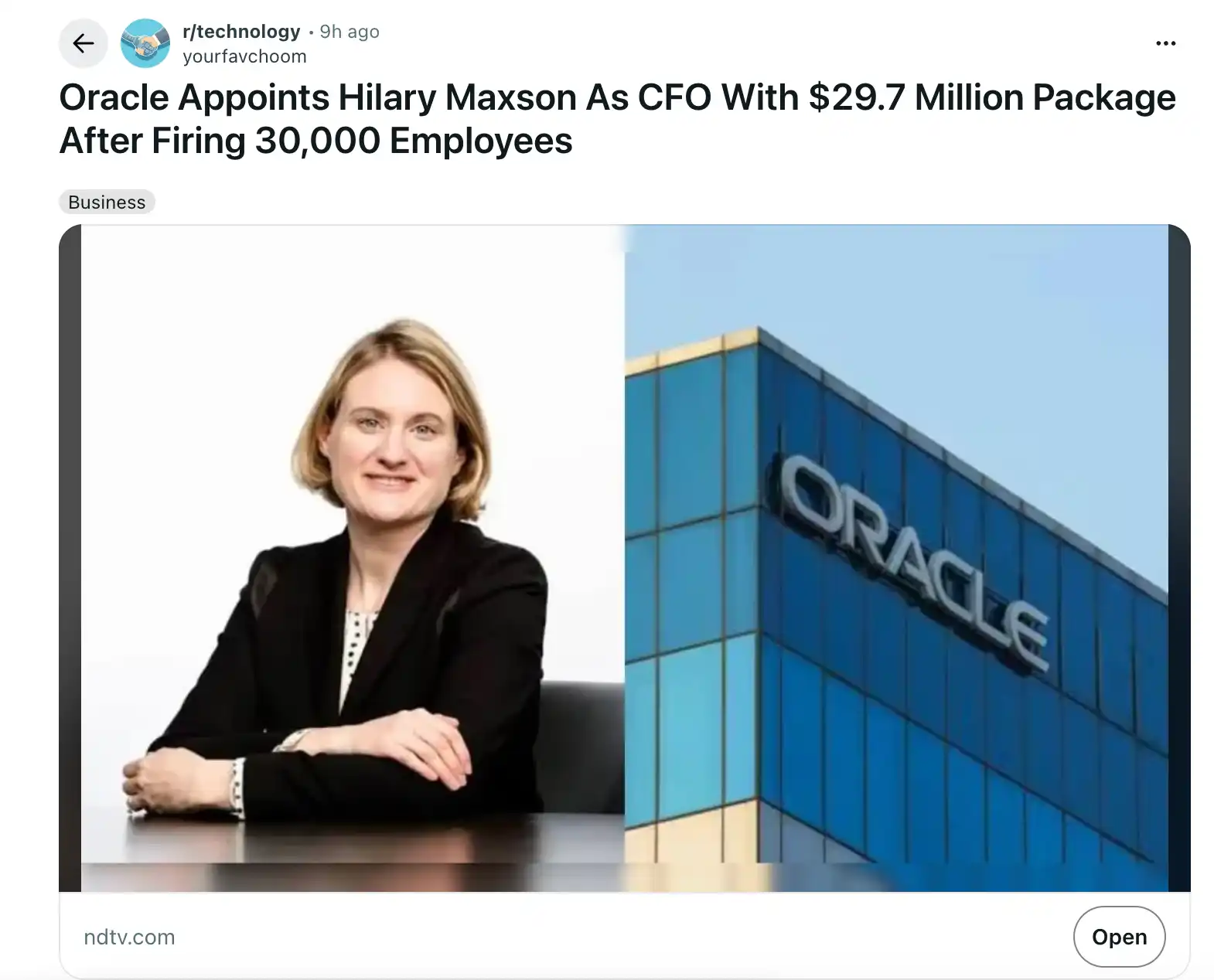
The new CFO is Hilary Maxson.

Before joining Oracle, she was the group CFO at Schneider Electric for nearly a decade. Schneider Electric is one of the world's largest energy management companies, with core businesses in power supply solutions for data centers and grids, generating over $45 billion in annual revenue.

Prior to that, she worked at AES Corporation for 12 years. AES is a longstanding U.S. power company focused on building and managing power plants and grids.

In other words, Oracle spent $29.7 million to hire someone whose entire career has revolved around electricity. She has managed power plants, grids, and companies that supply power to data centers... and now she's been hired as CFO by a company that has sold database software for 47 years?

There's another little-known fact about this choice.

Oracle has not had a dedicated CFO for the past 12 years; finances were managed concurrently by former CEO Safra Catz. According to CNBC, after Catz transitioned to executive vice chairman in late 2025, an interim financial officer temporarily filled the role for half a year.

The fact that the company is now specifically reinstating this position and recruiting from the energy industry is more significant than the salary figure itself.
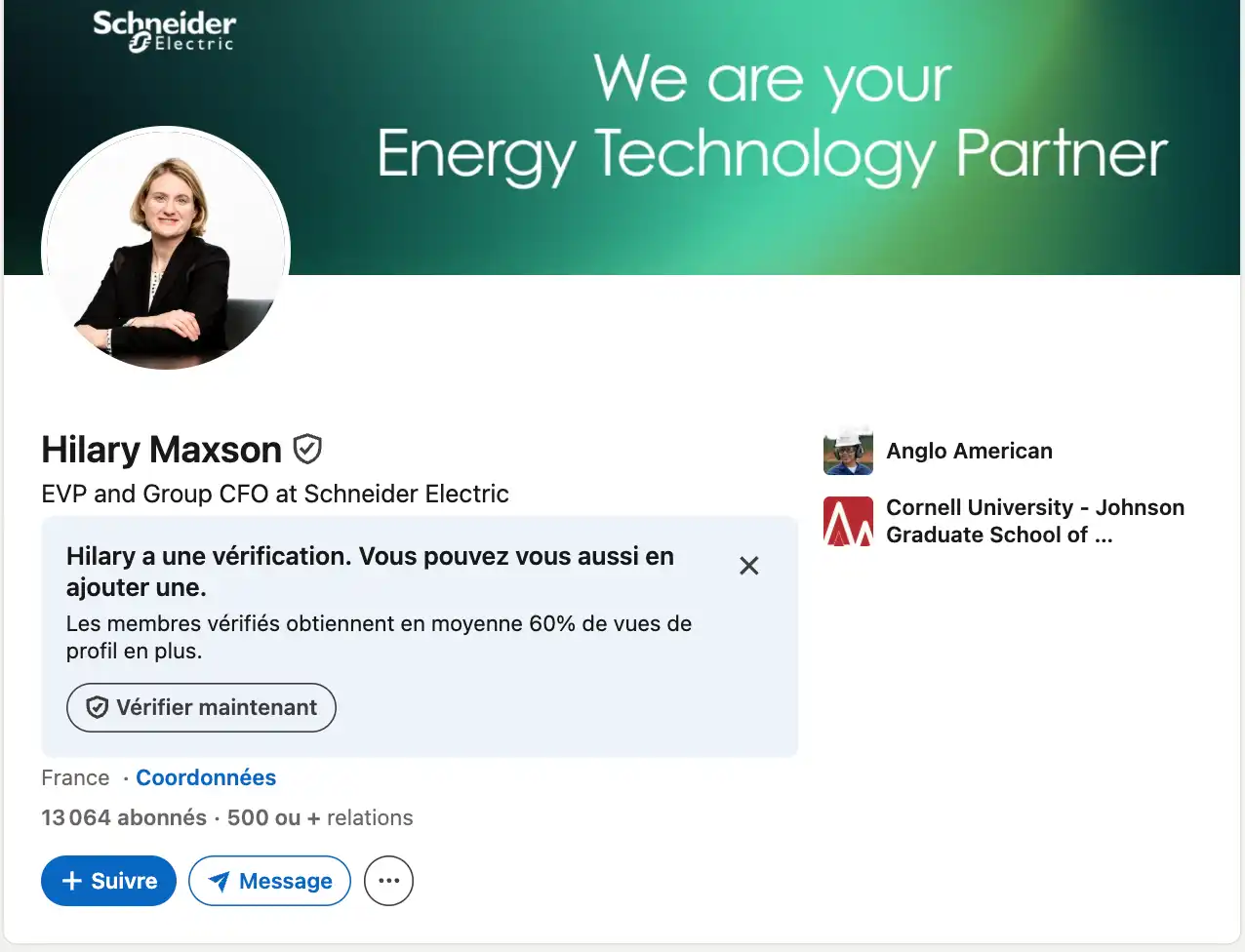
Bloomberg Intelligence analysts interpret this appointment as a sign that Oracle's growth focus has shifted from databases and software to cloud infrastructure, hence hiring a CFO from an industrial company.

The numbers tell the same story.

According to Oracle's latest earnings report, the company's cloud infrastructure revenue increased by 84% year-over-year. This year's capital expenditure budget is about $50 billion, almost entirely allocated to AI data center construction, more than double last year's amount. To raise funds, the company plans to secure $50 billion through debt and equity financing. The total value of pending contracts has surged to $553 billion, with one deal with OpenAI alone exceeding $300 billion, according to public information.

A company lays off 30,000 people maintaining old businesses and then entrusts money and authority to someone from the power industry. Reading this move, Oracle's management likely no longer sees itself as purely a software company.

But the capital market isn't buying it yet. Oracle's stock has fallen about 24% this year.

Investors' concerns are specific. Oracle historically made money by selling database software and enterprise applications, with high profit margins where people were the biggest cost. But AI is rewriting the business logic; large models can automatically write SQL and manage databases, gradually eroding the technological barrier Oracle has relied on for 47 years.

Oracle's response is to completely change tracks.

Instead of just selling software, it's turning to building data centers for AI companies. According to public information, Oracle previously signed an infrastructure contract with OpenAI exceeding $300 billion, part of the Stargate data center plan; similar agreements exist with Meta and xAI, pushing the total value of pending contracts to $553 billion.

This year's capital expenditure budget is about $50 billion, almost entirely poured into data center construction.
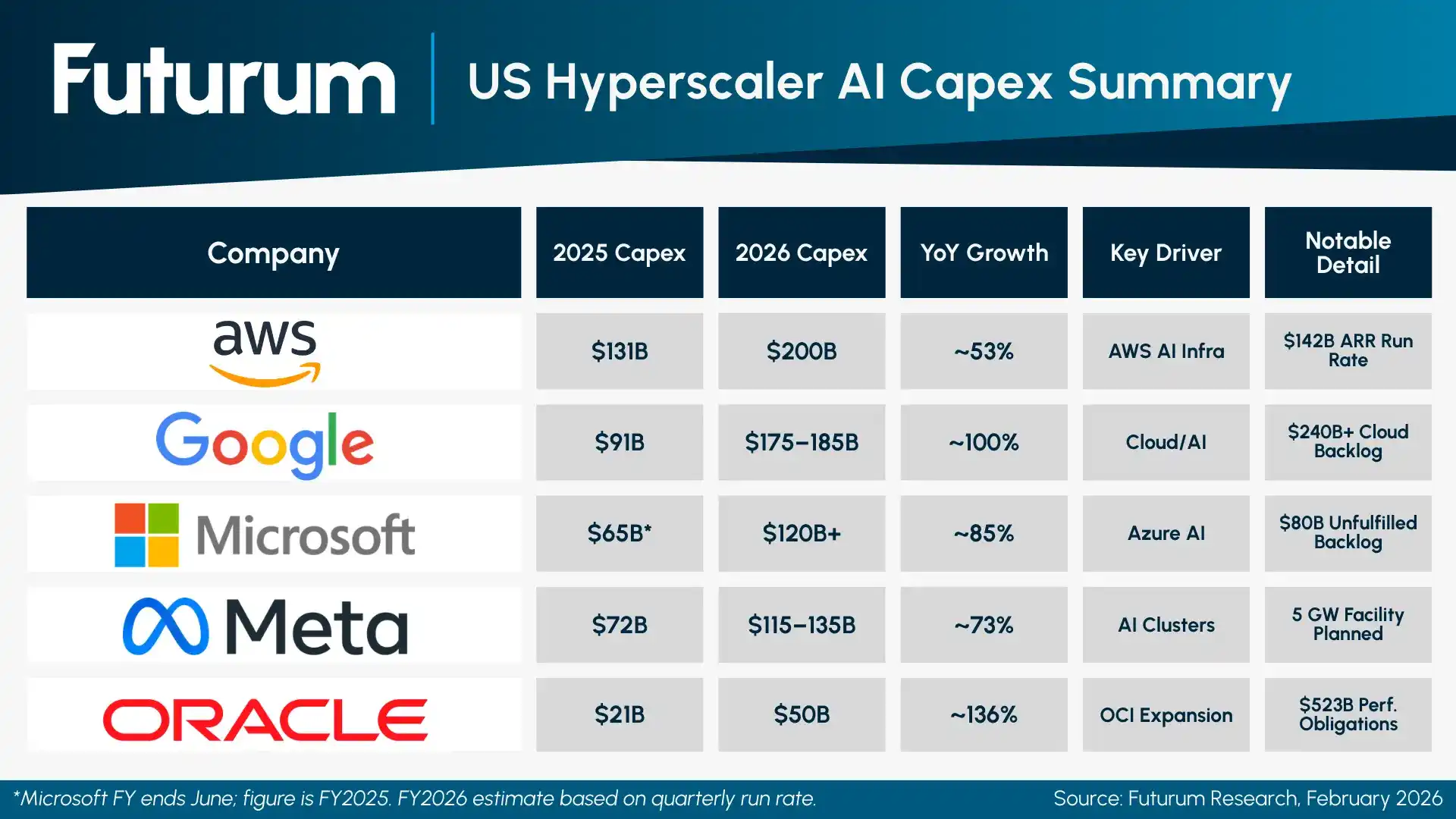
The two biggest expenses for data centers are chips and electricity. Cooling requires electricity, GPU operations require electricity; the annual electricity bill for a large AI data center can reach hundreds of millions of dollars.

Oracle is now building "gigawatt-scale" data center clusters. What is a gigawatt? Roughly equivalent to the output of a nuclear power plant.

This explains why they're hiring from the power industry.

The new CFO has managed power plants, grids, and companies that supply power to data centers. Oracle no longer needs a financial leader who understands software profit rates, but someone who knows how to spend tens of billions building power infrastructure and ultimately make these investments profitable.

Wall Street analysts are currently optimistic; 27 have given buy ratings, with an average target price of $245, implying about a 70% upside potential. But the gap between a 25% stock drop and analysts predicting a doubling hinges on the same question: whether Oracle can truly transform from a software company into an energy infrastructure company.

At least, they've taken a step in terms of personnel structure. Those leaving are people who wrote code for decades; those entering are people who managed electricity for twenty years.

Sometimes, to understand where a company is heading, you don't need to翻 its strategy PPT. Just see who it hires.

Câu hỏi Liên quan

QWhy did Oracle hire a CFO from the energy industry, specifically with a background in managing power plants and grids?

AOracle is shifting its focus from traditional software to cloud and AI infrastructure, which requires massive data centers with enormous power demands. The new CFO, Hilary Maxson, has expertise in managing large-scale energy infrastructure and costs, which aligns with Oracle's need to build and operate energy-intensive data centers efficiently.

QWhat is the significance of Oracle's new CFO having worked at companies like Schneider Electric and AES Corporation?

AHer experience at Schneider Electric (managing power supply for data centers and grids) and AES Corporation (building and managing power plants) provides her with critical skills in handling the high energy costs and infrastructure requirements of Oracle's new AI data center projects, which consume power at a scale comparable to nuclear plants.

QHow does Oracle's shift to AI data centers impact its financial strategy and capital expenditure?

AOracle plans to spend approximately $50 billion in capital expenditures, mostly on AI data center construction, doubling last year's budget. This shift requires massive funding through debt and equity financing, reflecting a move from high-margin software to capital-intensive infrastructure investments.

QWhat are the market and investor reactions to Oracle's strategic changes and new CFO appointment?

AOracle's stock has fallen about 24% this year, as investors are concerned about the transition from profitable software to lower-margin infrastructure. However, analysts are optimistic, with 27 giving a 'buy' rating and an average target price of $245, suggesting potential upside if Oracle succeeds in its transformation.

QHow does the appointment of Hilary Maxson reflect Oracle's broader business transformation?

AHiring a CFO from the energy sector, after laying off 30,000 employees mostly from traditional software roles, signals that Oracle is prioritizing infrastructure and energy management over its legacy database business. This aligns with its large contracts with AI companies like OpenAI and Meta, focusing on building power-hungry data centers.

Nội dung Liên quan

Đối thoại Giáp Hàng丨Nhìn lại hành trình hai mươi năm thanh toán Trung Quốc vươn ra biển lớn

Đây là bản tóm tắt tiếng Việt của cuộc phỏng vấn với Giả Hàng về hành trình hai thập kỷ thanh toán Trung Quốc ra thế giới: Giả Hàng, một chuyên gia với hơn 20 năm kinh nghiệm tại Ngân Liên, Ant Group và giờ là Chủ tịch DCS Singapore, chia sẻ góc nhìn về việc xây dựng mạng lưới thanh toán toàn cầu mới. Ông đúc kết từ ba chặng đường chính: **1. Thời Ngân Liên: Thách thức vượt Visa/Mastercard** Ông từng dẫn dắt Ngân Liên quốc tế, cố gắng đưa thẻ Trung Quốc vào mạng lưới chấp nhận toàn cầu. Bài học lớn: sức mạnh thực sự của tổ chức thẻ không nằm ở tiêu chuẩn kỹ thuật, mà ở **cơ chế phân phối lợi ích và quản trị** đã tạo nên hiệu ứng mạng lưới khó sao chép. Ngân Liên, giống như JCB trước đó, dù theo sát khách du lịch Trung Quốc để mở rộng mạng lưới nhưng không thể phát triển phát hành thẻ địa phương, nên khó cạnh tranh toàn diện. **2. Thời Ant Group và Alipay+: Kết nối ví điện tử** Tại Ant, ông đề xuất và xây dựng Alipay+, một mạng lưới kết nối các ví địa phương ở nhiều quốc gia thay vì tự triển khai ví toàn cầu. Tuy có thành công nhất định, Alipay+ vẫn gặp hạn chế cốt lõi: nó vẫn là **cùng một loại hình** cạnh tranh trực tiếp với Visa/Mastercard (thanh toán) mà không tạo ra giá trị đột phá mới. Mô hình thanh toán bằng mã QR thiếu một cơ chế phân chia lợi ích bền vũng như hệ thống hoàn tiền của thẻ. **3. Hiện tại với Stablecoin tại DCS: Một cơ hội khác biệt** Hiện tại, ông dẫn dắt DCS Singapore, tập trung vào cầu nối thanh toán bằng stablecoin. Ông tin rằng stablecoin có tiềm năng tạo nên **mạng lưới thanh toán toàn cầu mới thực sự**, không phải bằng cách thay thế Visa/Mastercard trong thanh toán tiêu dùng, mà bằng cách **tái tổ chức luồng chuyển tiền cơ bản**, thách thức hệ thống tài khoản ngân hàng truyền thống. Nó có thể thâm nhập từ thanh toán chéo biên giới đến thị trường địa phương ở các nước đang phát triển, tạo ra một vòng tuần hoàn mới cho tiền số. **Tổng kết:** Xuyên suốt 20 năm, câu hỏi lớn vẫn là làm thế nào xây dựng mạng lưới thanh toán toàn cầu kế tiếp. Bí quyết không chỉ ở công nghệ mới, mà còn ở **giá trị người dùng mới, cơ chế phân phối lợi ích mới và hệ thống quản trị mới**. Hành trình tìm kiếm câu trả lời vẫn đang tiếp diễn, với stablecoin là một hướng đi đầy hứa hẹn.

marsbit15 phút trước

Đối thoại Giáp Hàng丨Nhìn lại hành trình hai mươi năm thanh toán Trung Quốc vươn ra biển lớn

marsbit15 phút trước

Giá cổ phiếu Circle sụt giảm 76%, stablecoin đồng HKD ra mắt trong vòng 2 tuần tới

Giá cổ phiếu Circle (CRCL) đã giảm khoảng 76% từ mức đỉnh vào tháng 6 năm ngoái, phản ánh việc thị trường định giá lại triển vọng của công ty trong bối cảnh cạnh tranh gia tăng và lãi suất cao. Chủ tịch Circle Heath Tarbert bày tỏ sự tự tin vào các kế hoạch dài hạn như việc mở rộng USDC sang các tình huống thanh toán thực tế, ví dụ như thỏa thuận với JCB của Nhật Bản. Tuy nhiên, vị thế dẫn đầu của Circle đang bị thách thức bởi các đối thủ mới. Open USD, một stablecoin được hỗ trợ bởi khoảng 140 công ty, đang thu hút đối tác bằng cách chia sẻ lợi nhuận từ tài sản dự trữ. Hơn nữa, Visa đã ra mắt nền tảng stablecoin hỗ trợ Open USD, tạo thêm áp lực cạnh tranh lên USDC. Ở một diễn biến khác, Tether (USDT) phải đối mặt với thách thức tuân thủ theo Đạo luật GENIUS của Mỹ, yêu cầu cấu trúc dự trữ phải chủ yếu là tiền mặt và trái phiếu kho bạc. Họ có khoảng hai năm để điều chỉnh. Tại Hong Kong, thị trường stablecoin đang nóng lên với việc chuẩn bị ra mắt stablecoin HKD gắn với đồng đô la Hong Kong (HKDAP) bởi Zodia Custody, một công ty được hỗ trợ bởi Ngân hàng Standard Chartered. Điều này cho thấy cuộc đua đang chuyển từ việc giành được giấy phép sang việc triển khai hiệu quả trong các luồng thanh toán thực tế. Tóm lại, ngành stablecoin đang chuyển từ giai đoạn một người chiến thắng chiếm tất cả sang một thị trường cạnh tranh đa dạng, nơi lợi thế quy mô và khả năng thực thi sẽ quyết định người chiến thắng.

marsbit21 phút trước

Giá cổ phiếu Circle sụt giảm 76%, stablecoin đồng HKD ra mắt trong vòng 2 tuần tới

marsbit21 phút trước

Dưới Vòng Vây của Tư Bản, Phi Tập Trung Hóa Là Tuyến Phòng Thủ Duy Nhất Của Các Blockchain Công Cộng

Bài viết của Omid Malekan, Phó giáo sư Tài chính tại Trường Kinh doanh Columbia, lập luận rằng trong thế giới tiền mã hóa, phi tập trung hóa không chỉ là một đặc điểm trong thiết kế giao thức, mà là phòng tuyến duy nhất và không thể thay thế để chống lại sự thao túng của tư bản và các tập đoàn. Tác giả, với góc nhìn thực tế và Machiavellian, chỉ ra rằng bản chất của doanh nghiệp là theo đuổi lợi nhuận và quyền lực. Do đó, bất kỳ blockchain nào có thể bị kiểm soát hoặc có điểm yếu về quản trị cuối cùng sẽ bị các tổ chức truyền thống thâu tóm hoặc làm cho thoái hóa. Các cuộc tấn công bên ngoài như phân nhánh 51% tuy nguy hiểm, nhưng mối đe dọa lớn hơn đến từ việc giành quyền kiểm soát nội bộ bởi các lợi ích tư bản. Lịch sử các mạng lưới thanh toán (Visa, Mastercard) và nền tảng truyền thông xã hội cho thấy rõ con đường "thoái hóa nền tảng" này. Bài viết phê phán mạnh mẽ các giải pháp thay thế như blockchain được phép (permissioned) hoặc các mạng lớp 1, lớp 2 quá tập trung, coi chúng chỉ là cơ sở dữ liệu có thể bị tắt bất cứ lúc nào và không thể chống lại sự thao túng. Các liên minh doanh nghiệp này thực chất có thể củng cố sự độc quyền của các gã khổng lồ hiện có hơn là thúc đẩy đổi mới. Theo tác giả, việc các tổ chức tài chính truyền thống ủng hộ các giải pháp "phi tập trung giả mạo" có thể chỉ là một chiến thuật trì hoãn nhằm làm chậm lại sự phổ biến của công nghệ thực sự phi tập trung. Kết luận, tác giả thừa nhận Ethereum có nhiều khiếm khuyết và chi phí vận hành cao để duy trì tính phi tập trung. Tuy nhiên, trong bối cảnh hiện tại, nó vẫn là giải pháp tối ưu nhất - một điểm cân bằng Nash - nơi tài sản sẽ tự nhiên chảy về cơ sở hạ tầng an toàn và trung lập nhất để tránh khỏi sự "vây bắt" của tư bản. Những người theo đuổi các giải pháp thỏa hiệp có thể phải trả giá trong thực tế khắc nghiệt của ngành.

Foresight News30 phút trước

Dưới Vòng Vây của Tư Bản, Phi Tập Trung Hóa Là Tuyến Phòng Thủ Duy Nhất Của Các Blockchain Công Cộng

Foresight News30 phút trước

Giao dịch

Giao ngay
活动图片