Another historic moment.
Last night (Beijing time, July 10), the global memory leader SK hynix officially began trading on the Nasdaq, with its share price surging over 18% at one point during the session. It closed with a market capitalization of a staggering $1.22 trillion (approximately RMB 83 trillion).
Notably, SK hynix raised $26.5 billion in this offering. This not only set a new record for the largest U.S. IPO by a foreign company but also became the second-largest IPO in global history, surpassed only by SpaceX's listing last month.
This global listing sensation is the culmination of a remarkable comeback story spanning over forty years. Originally spun off from Hyundai Group in 1983, its predecessor, Hyundai Electronics, once teetered on the brink of bankruptcy before being taken over by SK Group. When it developed the first-generation HBM in 2013, few could have predicted this company would become the global memory powerhouse it is today.
Memory companies are undoubtedly raking in profits this year. Next up, it's time for a familiar name from China—ChangXin Technology—to take the stage.
From Near-Bankruptcy to the World's Second-Largest IPO
SK hynix's comeback journey is astonishing.
The story begins in 1983 when South Korea's Hyundai Group established Hyundai Electronics Co., Ltd., entering the semiconductor industry. After two years, it successfully mass-produced the 256K DRAM (Dynamic Random-Access Memory) and listed on the Korean Exchange in 1996. In 1999, Hyundai Electronics acquired LG Semiconductor, a deal that rapidly expanded its scale and even pushed its DRAM market share briefly past Samsung's. However, the debt legacy from LG Semiconductor planted a hidden danger.
The crisis soon erupted. Entering the 21st century, the global memory industry plunged into a deep downturn. DRAM prices collapsed continuously, and Hyundai Electronics, already burdened with massive debt, faced a broken capital chain, edging towards bankruptcy. In 2001, Hyundai Electronics was forced to spin off its memory business, which became the independent entity Hynix Semiconductor, placed under the trusteeship of a creditor bank consortium led by Korean state-owned banks.
For the next decade, Hynix Semiconductor languished in a prolonged trough, repeatedly facing rumors of bankruptcy and liquidation, with no one daring to touch this "hot potato." It wasn't until 2011 that Korea's SK Group decided to acquire Hynix Semiconductor—a controversial move at the time, with rating agency Standard & Poor's even issuing a negative outlook.
In 2012, Hynix Semiconductor was officially renamed SK hynix, embarking on its path to rebirth.
SK hynix set its sights on HBM (High Bandwidth Memory), a chip capable of high-speed data transfer. Back then, the industry widely considered the HBM market to be niche, with a long and uncertain return on R&D investment. SK hynix's pursuit of this path stemmed from its early judgment in 2009 that Through-Silicon Via (TSV) and wafer-level packaging technologies could overcome memory performance limitations, leading to in-depth research and development.
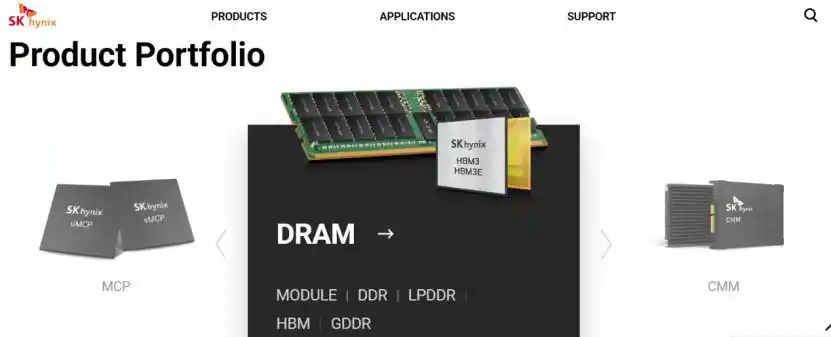
Based on these technologies, SK hynix partnered with AMD to launch the first-generation commercial HBM product in 2013, becoming an industry pioneer. Unfortunately, as the high-performance computing market was not yet mature enough for widespread HBM adoption, the market response did not explode as anticipated.
But SK hynix didn't stop; instead, it decided to double down on investment. During this process, SK hynix applied mass reflow molded underfill technology to HBM2E, shifting the market landscape. Subsequently, it developed its MR-MUF technology for HBM3 and HBM3E, integrating thin-chip stacking, thermal performance, and production efficiency.
The turning point came in 2022. With the debut of ChatGPT, the AI wave began sweeping the globe. NVIDIA became the biggest winner with its advanced GPU chips, while SK hynix became a key supplier of HBM3 for NVIDIA's H100 chips, completely reversing its fortunes.
Today, SK hynix holds a 58% market share, ranking first in the global HBM market.
In this U.S. IPO, SK hynix raised $26.5 billion through the issuance of American Depositary Shares (ADS), surpassing Saudi Aramco's 2019 U.S. IPO record of $25.6 billion. This propelled it directly to the position of the second-largest IPO in history and the largest-ever U.S. IPO by a foreign company. Thus, an epic IPO was born.
The Memory Windfall: Sharing the Wealth with All Employees
Why is SK hynix so hot?
The answer is that memory is experiencing a historic cycle. In April of this year, SK hynix released its Q1 2026 financial report. First-quarter revenue was KRW 52.5763 trillion, operating profit was KRW 37.6103 trillion, and net profit was KRW 40.3459 trillion. Its operating profit margin for the quarter was 72%, and its net profit margin was 77%.
This means SK hynix is even more profitable than NVIDIA, which reported a gross margin of 74.9% and an operating margin of 65.6% for the same period.
Discussing the performance, SK hynix stated, "Although the first quarter is typically a seasonally slow period, demand remained strong, driven by expanding investments in artificial intelligence (AI) infrastructure. The company continued its upward earnings trend by expanding sales of high-value-added products such as High Bandwidth Memory (HBM), high-capacity server DRAM modules, and enterprise SSDs (eSSD)."
Thanks to this, SK hynix's share price embarked on a massive rally. Data shows SK hynix's Korean shares have surged over 634% year-to-date. In May of this year, SK hynix's market capitalization first broke the $1 trillion mark, becoming the second Korean company after Samsung Electronics to achieve this milestone.
Although SK hynix's stock price has recently seen some correction, we can see that giants like NVIDIA, Google, and Amazon—whose combined market cap exceeds $10 trillion—are not only lining up to place orders but are also proactively proposing to invest in SK hynix's new production lines and funding the procurement of expensive manufacturing equipment.
This scene is truly extraordinary.
Those reaping the rewards aren't just SK hynix; tens of thousands of employees are too. In September last year, SK hynix abolished its previous bonus cap of "no more than 1000% of base salary" and implemented a new labor agreement: a fixed 10% of annual operating profit, with no upper limit, will be injected into a bonus pool, covering all non-outsourced employees under a "sunshine" distribution system.
Earlier this year, SK hynix announced its FY2025 performance bonus. The 33,000 employees received an average bonus of KRW 140 million, equivalent to over RMB 600,000. According to calculations by international consultancies like Macquarie, if current performance expectations hold, the average SK hynix employee's bonus income for 2026 is projected to reach a staggering KRW 670 million, approximately RMB 3.12 million.
Overnight, SK hynix employees became the "top tier" of the Korean workplace. There's even a dating anecdote circulating: Nowadays, when SK hynix employees go on blind dates, they pretend to work at Samsung Electronics; only when they meet someone with good character do they confess they actually work at SK hynix.
This scenario is the most straightforward manifestation of this unprecedented wealth creation wave.
ChangXin's Turn to Ring the Bell: China's Memory Industry Launches Its Breakthrough Battle
Currently, an unprecedented "super memory cycle" is arriving.
According to J.P. Morgan's forecast, the total global memory market size will reach $1.7 trillion by 2028. DRAM market revenue is expected to jump from $143 billion last year to $636 billion in 2026, reaching $1.237 trillion by 2028. NAND market revenue is projected to increase from $71 billion to $454.5 billion over the same period.
The underlying logic is clear—this is not a simple cyclical rebound but a structural demand shift driven by AI computing power. As AI training and inference scales continue to expand, the memory capacity per AI server is expected to be more than ten times that of traditional data center servers.
Amid this extreme supply-demand imbalance, news of memory shortages, order backlogs, and price hikes has been almost constant over the past year. A recent report from UBS Group also emphasized that as AI demand continues to grow and Long-Term Agreement (LTA) negotiations are still ongoing, the memory chip market cycle is strengthening further, with a structural supply shortage expected to persist at least until mid-2028.
For domestic Chinese memory manufacturers, this is a historic opportunity not to be missed.
Shifting our gaze from the U.S. stock market back to China, a much-anticipated IPO is also about to take the stage. According to the Shanghai Stock Exchange website, ChangXin Technology will officially begin its new share subscription on July 16. Some institutions boldly estimate that ChangXin Technology's market value could reach RMB 3 trillion.
Based in Hefei, ChangXin Technology was founded by Zhu Yiming, the founder of GigaDevice. It is China's largest integrated DRAM R&D, design, and manufacturing enterprise. In Q1 of this year, ChangXin Technology's global DRAM market share was approximately 7.7% to 8%, firmly ranking first in mainland China and fourth globally. U.S. semiconductor analysis firm SemiAnalysis predicts that ChangXin Technology有望有望 by the end of 2026, surpassing Micron to become the world's third-largest DRAM supplier.
Coincidentally, Yangtze Memory Technologies (YMTC) from Wuhan also announced the initiation of its IPO counseling filing. Public information shows that after its shareholding reform in September 2025, the parent company of YMTC, Changcun Group, was valued at approximately RMB 160 billion. The market widely expects that after its listing, YMTC's market value could reach RMB 500-800 billion, even potentially breaking the RMB 1 trillion mark.
The breakthrough of these "Two Heroes of Domestic Memory" is just a snapshot of the collective追赶 of Chinese memory enterprises. For example, Longsys, Dapu Storage, BIWIN Storage, Demingli, and Shannon芯创, dubbed Shenzhen's "Five Tigers of Storage," have seen their combined market capitalization reach the trillion-RMB level during this market trend.
However, catching up is never an overnight task. We must still正视正视 the gap with overseas giants. As ChangXin Technology坦言坦言 in its prospectus, "The company's process technology level and other aspects still have a certain gap compared to Samsung Electronics, SK hynix, and Micron Technology. The product structure is in a continuous optimization state, and the company's gross margin level remains lower than that of the top three international manufacturers."
The road ahead is long and challenging, but progress will be made with perseverance. This is destined to be a difficult journey, but one thing is certain: the moment of summiting will eventually arrive for these Chinese memory climbers.
This article is from WeChat Official Account "Touzijie" (ID: pedaily2012), author: Liu Bo.