Bill Gates' Latest Long-Form Article: The Real Trouble with AI is That We Aren't Ready

marsbitXuất bản vào 2026-08-28Cập nhật gần nhất vào 2026-08-28

Tóm tắt

Bill Gates' latest essay, "The turbulent AI era is here. The choices we make now are critical," warns that society is unprepared for the profound social and economic transition AI will bring. While optimistic about AI's long-term potential in healthcare, education, and other fields, Gates focuses on the "transition period" over the next 10-20 years. He argues this transition differs from past technological shifts like the Industrial Revolution because AI automates cognitive labor itself, potentially reducing the total number of future jobs. Risks like enhanced cyber-attacks and social disruption are already emerging, not distant future threats. A key concern is "low-cost intelligence substitution," where AI performs defined tasks cheaper than humans, gradually thinning workforces. Gates introduces the concept of "Human Reserved" jobs—roles like nursing or delivering serious medical news—where human judgment and empathy should remain central, even if AI is technically capable. To manage the transition, he calls for new governance, stronger social safety nets, retraining, and international cooperation, especially between the US and China. Crucially, he proposes taxing AI usage and robots to slow displacement and fund social programs. The core dilemma Gates presents is that AI could become humanity's "greatest equalizer" or its "worst source of injustice," depending on whether its immense productivity gains are broadly shared or concentrate wealth and power. The fundamental c...

By | Deng Ding Kexuan

On August 26, Bill Gates published a long-form article about AI on Gates Notes:

The turbulent AI era is here. The choices we make now are critical.(The Turbulent AI Era Has Arrived, The Choices We Make Now Are Critical)

Original article on Bill Gates' Gates Notes:
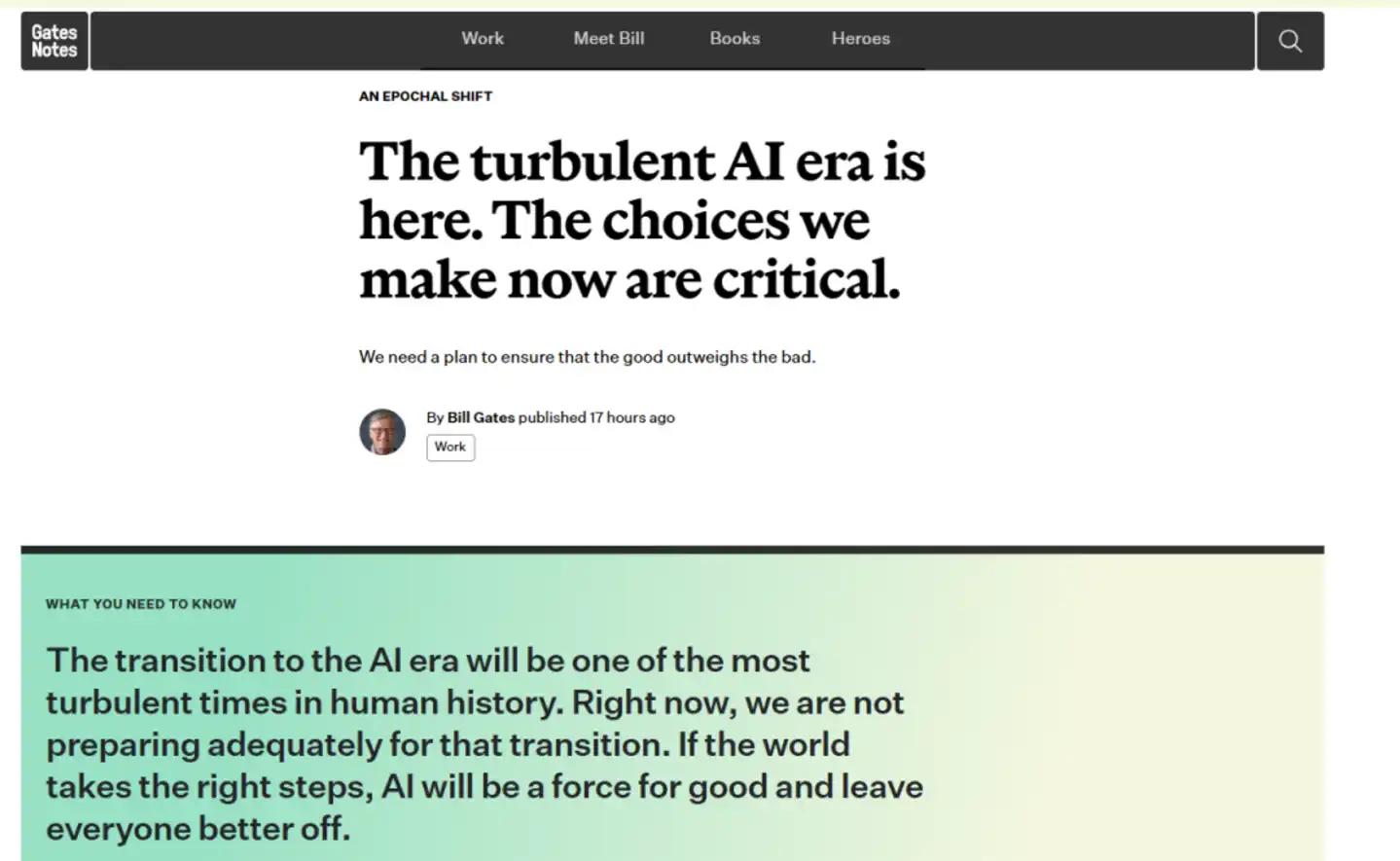
Core gist of the original article: AI could become the most powerful tool for equality, or a major source of inequality. Gates believes we need to start planning for this transition now.

This article is highly readable. Gates has not become an AI pessimist, nor does he deny AI's long-term value. He still believes AI will drive significant progress in fields like healthcare, education, agriculture, energy, and scientific research.

But his focus has changed.

In recent years, he talked more about what AI could ultimately create. This time, he spends considerable space discussing another question:

What will happen on the path from today to that future?

If the entire article were condensed into one sentence, it would probably be:

AI's long-term benefits could be enormous. But the 'transition period' between now and that future could become one of the most dramatic social transformations in human history. And we have barely established institutions for it.

Gates still believes in AI's long-term value. What worries him now is: how we get through the next decade or so in the middle.

He writes directly in the original text: "Unfortunately, we are not preparing for it now."

First Level: Gates believes this time cannot be simply compared to the Industrial Revolution

This is a point I consider very important and easily missed by news headlines.

Faced with the question 'Will AI take jobs?' in the past, a standard answer was: The steam engine eliminated some jobs but created new ones; the internet did the same, so AI will ultimately create new jobs too.

Gates now expresses clear skepticism about this analogy. Previous technologies primarily replaced physical labor or specific capabilities. New jobs ultimately still required human cognition.

The special thing about AI is: it is itself replacing cognitive labor.

The default cycle of the past two hundred years

Old jobs disappear → New jobs appear → Humans transition to them

Gates directly mentions law, customer service, healthcare, software, and manufacturing in the original text, later listing jobs like sales, software engineering, paralegal, loan approval, data analysis, and patient triage.

His assessment is: New jobs will still emerge, but without appropriate policies, the number of future positions may be far fewer than today's.

This assessment considers a deeper issue than the usual 'AI taking jobs'. For the past two hundred years, we assumed technological progress would ultimately create more, more complex jobs that also required human cognition.

But what if what's being scaled and made cheaper is 'cognitive capability' itself? The validity of this historical experience then becomes uncertain.

The biggest impact of AI on employment might not be a sudden wave of mass unemployment. A more likely change is that the same company, the same business, will need far fewer people in the future.

One person plus a few Agents can complete work that previously required a small team.

Jobs won't vanish overnight, but new job creation will slow, teams will thin out, and companies will become increasingly unwilling to pay the previous price for 'cognitive labor that can be done by AI'.

Second Level: The risk is no longer a post-AGI problem, it's happening now

Another important context for Gates's shift in stance this time.

He explained to MIT Technology Review why he is speaking out now specifically.

He believes several previously discussed 'danger thresholds' are actually starting to be crossed, including: biological capabilities, cyber attack capabilities, psychological and social influence, job market disruption, and AI controllability.

Especially Coding. Advances in Claude Code, long context, and Agentic Coding made him realize AI is crossing more than just a programming capability threshold.

An Agent capable of writing code at scale could also become a powerful tool for cyber attacks.

The stronger AI's capabilities, the better defenders become at finding vulnerabilities and patching systems. But the cost for attackers to find vulnerabilities and launch attacks using the same capabilities is also falling.

Gates also mentions this issue in the original text. The new capabilities attackers are gaining are rapidly increasing, while defenders cannot patch all weaknesses simultaneously.

Capabilities are crossing lines, governance remains stuck in the discussion stage.

Third Level: His biggest worry isn't just unemployment, but 'low-cost intelligent substitution'

There's one line from the MIT interview I find even more intriguing than the main text:

For well-defined jobs, AI will be cheaper and will do them better.

The examples he gives are very ordinary: telemarketing, customer service, finance departments, month-end closing, discount judgment, etc. A large number of white-collar jobs with clear processes, defined rules, and describable digitally will increasingly be easily done by low-cost AI.

The most crucial word here might not be 'substitution', but: cheaper.

The reality likely won't be a sudden switch where AI = 1, human = 0. It might be a department that previously needed 10 people now only needing 6.

The information processing required for entry-level positions is first handled mostly by Agents. A person's work hours used to dictate the speed of business expansion; now software can process vast numbers of tasks in parallel.

The core of the change is the marginal cost of labor and intelligence.

Following this line of thought further, Gates proposes an idea rarely heard from him: For some jobs, even if AI can do them, society may still want to leave them to people.

Fourth Level: A very interesting new concept – Human Reserved

Can be translated as: 'Human Reserved Domains.' Gates uses a vivid analogy: nature reserves.

Of course, roads and buildings could be built in nature reserves. We choose not to because the cost of losing them is too high. Human Reserved follows similar logic: even if AI can do it, we still decide to have humans do it.

This idea comes from his father's later years.

Gates's father had Alzheimer's disease. In his final years, a group of caregivers looked after him around the clock. Sometimes, his father could no longer express that he was hungry, but the caregivers could still understand him.

Gates writes there is something 'irreplaceably human' in this kind of care. Education and mental health might adopt a 'human + AI' approach, with humans bearing final responsibility and AI extending human capabilities.

Another example in healthcare: Technically, a robot could certainly tell a person 'You have an incurable disease.' Gates believes it should not.

The meaning of 'human work' in the future may no longer be determined solely by efficiency.

Fifth Level: Therefore, taxes and social security must be redesigned

If AI and robots continuously reduce labor demand, existing systems will encounter a very practical problem.

The current tax base

People work → Companies pay wages → Wages are taxed

If more and more work becomes: AI / robots work → Companies gain productivity benefits, the original tax base could be affected.

Therefore, Gates again raises the idea of a robot tax, and states it very directly:

"I believe we should tax AI tokens and robots."

"I believe we should tax AI tokens and robots."

When a company hires a person, it must pay payroll tax based on the salary. Purchasing a robot can often be immediately written off as a business expense.

Gates believes the current tax system actually incentivizes companies to replace humans with machines faster.

Taxation could, on one hand, slightly slow the pace at which companies move away from human labor, and on the other hand, raise funds for retraining and a stronger social safety net.

This touches on the flip side of the issue I previously considered when writing 'The Bill for AI Won't Just Be Paid by Tech Companies'.

If these investments ultimately do create huge productivity gains, who will the gains flow to?

Sixth Level: AI could simultaneously become 'the greatest equalizer' and 'the worst source of injustice'

This is the overarching thesis of the article.

"AI will either be the greatest equalizer ever invented, or the worst source of injustice."

AI will either be the greatest tool for equality ever invented by humanity, or the most severe source of injustice.

If the marginal cost of AI healthcare, AI education, AI agriculture, and AI research is low enough, capabilities previously available only to affluent regions have the opportunity to reach more ordinary people.

The same technology could also amplify existing disparities.

AI ownership is concentrated in a few companies.

Capital captures the main productivity gains.

The value of ordinary people's labor declines.

Affluent regions gain AI benefits first.

Low-income groups bear the brunt of job impacts first.

So the question is no longer just: 'Can AI create wealth?', but also: 'Who ultimately gets the wealth AI creates?'

Finally, the three categories of action he suggests

First, establish a new AI transition governance system.

Existing government agencies were not designed for a technology that spans employment, national security, education, healthcare, taxation, energy, finance, and cybersecurity.

Second, proactively manage job market impacts.

Including strengthening the social safety net, vocational retraining, adjusting tax systems, and unconventional solutions like Human Reserved.

Third, international coordination is needed; the US and China cannot be absent.

Cybersecurity, biological risks, and model proliferation all cross borders. Gates explicitly writes that a certain degree of cooperation between the US and China is needed.

The most hotly debated view in this article is his prediction about the future

Gates is discussing an AI transition period problem:

The endpoint of AI may be abundance, but there is no automatically smooth path between the 'abundant society' and the present.

An abundant society is at least a decade away. The entire transition process could last the next 10–20 years.

Sam Altman, Dario Amodei, and others often describe where AI can ultimately push productivity. Gates is discussing another period this time:

What exactly will happen between now and that abundant society?

This question is more realistic for ordinary people than 'When will AGI arrive?': Companies stop hiring so many new people. A department starts using Agents to do the work of several. Certain professional services become very cheap.

New productivity gains flow more to those who own the models, compute, and capital. But tax, education, social security, and employment systems still operate in the old way.

These changes don't need to wait for AGI to appear; some have already begun. The hardest part of AI may not just be making models powerful enough.

Once technology enters society, there is a slower, harder problem:

Do we have the capacity to make society adapt to it?

  • References:Bill Gates / Gates Notes; MIT Technology Review Interview; Anthropic Claude Code materials.


Tiền kỹ thuật số thịnh hành

Câu hỏi Liên quan

QAccording to Bill Gates, what is the main concern regarding AI's future development?

AAccording to Bill Gates, the main concern is not AI's ultimate potential but the "transition period" leading up to that future. This period could be one of the most dramatic social transformations in human history, and he believes we are largely unprepared for the institutional changes required to manage issues like employment disruption and inequality during this time.

QWhy does Bill Gates argue that the AI transition is not a simple repeat of the Industrial Revolution?

ABill Gates argues that past technological revolutions, like those driven by steam engines or the internet, primarily replaced physical labor or specific tasks, eventually creating new jobs that still required human cognition. AI is different because it is replacing cognitive labor itself, the very foundation upon which new jobs have historically been created. This calls into question whether the historical pattern of 'old jobs disappear → new jobs appear' will hold true.

QWhat is the concept of "Human Reserved" that Bill Gates introduces?

A"Human Reserved" refers to certain jobs or domains that society should purposefully reserve for humans, even if AI becomes technically capable of performing them. Gates uses the analogy of a nature preserve. Examples include certain aspects of caregiving (like for his father with Alzheimer's), education, and delivering serious medical news. The idea is that the human element in these roles provides an irreplaceable value that should be protected for social, not just efficiency, reasons.

QWhat specific policy recommendation does Bill Gates make to address potential economic disruptions from AI?

ABill Gates recommends implementing a "robot tax" or a tax on AI tokens. He argues that current tax systems, which tax human labor through payroll taxes but often allow immediate write-offs for capital investments in robots/AI, incentivize the rapid replacement of human workers. Taxing AI and robots could slow this transition and generate revenue to fund retraining programs and strengthen social safety nets for those affected by job displacement.

QWhat are the two potential, opposing outcomes that Bill Gates sees for AI's impact on society?

ABill Gates states that AI will either become "the greatest equalizer ever invented" or "the worst source of injustice." It could be an equalizer by drastically lowering the cost of access to high-quality services like healthcare and education, making them available to more people globally. Conversely, it could exacerbate inequality if the ownership and productivity gains from AI are concentrated among a few companies and capital owners, while the labor value of the majority declines and lower-income groups bear the brunt of job losses.

Nội dung Liên quan

Dù bitcoin gần đây tăng giá, một nhà phân tích vẫn thận trọng: 'Tôi vẫn chưa thấy điều tôi muốn'

Dù Bitcoin phục hồi gần đây làm dấy lên kỳ vọng tăng giá, nhà sáng lập Alphractal João Wedson tỏ ra thận trọng, cho rằng dữ liệu blockchain cho thấy một bức tranh khác. Ông nhấn mạnh chỉ số MVRV Z-Score, công cụ đo lường hành vi nhà đầu tư và giá trị thị trường thực hiện. Wedson so sánh cấu trúc thị trường hiện tại với chu kỳ 2017-2018, khi chỉ số này tạo ba đỉnh trước khi Bitcoin chạm đỉnh lịch sử, sau đó hình thành đáy và dẫn đến một đợt giảm mạnh khác vào cuối 2018. Trong chu kỳ 2024-2025, MVRV Z-Score cũng đã tạo ba đỉnh riêng biệt, dù mức độ nhiệt huyết thấp hơn. Sau đợt giảm gần đây, chỉ số này hình thành đáy tương tự năm 2018 nhưng đã tăng trở lại. Điểm rủi ro chính, theo Wedson, là chỉ số này chưa giảm xuống vùng âm - vùng thường liên quan đến các đáy chu kỳ chính của Bitcoin. Ông đặt câu hỏi liệu giá Bitcoin có đi theo chỉ số này nếu nó giảm sâu không. Dựa trên dữ liệu blockchain, ông cho rằng chưa đủ tín hiệu để khẳng định đợt giảm hiện tại là đáy cuối cùng. Để đáp ứng các điều kiện ông theo dõi, Bitcoin có thể cần giảm ít nhất xuống 53.000 USD hoặc thấp hơn. Wedson nhấn mạnh đây không phải lời khuyên đầu tư, mà là phân tích dữ liệu, đồng thời lưu ý rằng các chỉ số on-chain cho thấy rủi ro giảm giá chưa hoàn toàn biến mất, chứ không khẳng định Bitcoin đã chạm đáy.

cryptonews.ru26 phút trước

Dù bitcoin gần đây tăng giá, một nhà phân tích vẫn thận trọng: 'Tôi vẫn chưa thấy điều tôi muốn'

cryptonews.ru26 phút trước

Anthropic nhắm đến "chip đào tạo"? Bị phanh phui từng muốn mua lại công ty chip AI MatX với giá 70 tỷ USD

Công ty trí tuệ nhân tạo (AI) Anthropic từng thảo luận mua lại startup chip AI MatX với giá khoảng 70 tỷ USD, nhưng thương vụ này cuối cùng không tiến triển và hai bên chuyển hướng sang đàm phán hợp tác tiềm năng. Động thái này cho thấy tham vọng tự phát triển chip, đặc biệt là chip cho quá trình huấn luyện mô hình, của Anthropic nhằm tìm kiếm năng lực tính toán nhanh hơn và rẻ hơn cho Claude. MatX, thành lập năm 2023 bởi các cựu kỹ sư Google, tập trung thiết kế chip phục vụ huấn luyện mô hình ngôn ngữ lớn (LLM). Việc Anthropic tiếp cận MatX cho thấy họ có thể hướng tới phát triển chip huấn luyện nội bộ, khác với hướng tiếp cận ban đầu nhấn mạnh chip suy luận (inference) của OpenAI. Để thúc đẩy kế hoạch chip tự thiết kế, Anthropic đang tích cực tuyển dụng nhân tài ngành bán dẫn, gần đây đã mời cựu lãnh đạo chủ chốt của dự án TPU Google là Amir Salek và cả cựu kỹ sư chip của OpenAI. Công ty cũng đang gặp gỡ nhiều startup chip AI khác để nghiên cứu các kiến trúc khác nhau. Tuy nhiên, Anthropic được cho là vẫn sẽ duy trì chiến lược đa dạng nhà cung cấp chip, tiếp tục hợp tác với các đối tác như Nvidia và Google, bên cạnh nỗ lực tự nghiên cứu. Việc tự phát triển chip là một dự án tốn kém và phức tạp, do đó việc xem xét mua lại một công ty chip có kinh nghiệm như MatX là cách tiếp cận hấp dẫn để tăng tốc lộ trình và có khả năng giảm chi phí lâu dài.

marsbit1 giờ trước

Anthropic nhắm đến "chip đào tạo"? Bị phanh phui từng muốn mua lại công ty chip AI MatX với giá 70 tỷ USD

marsbit1 giờ trước

Chủ tịch Fed Kevin Warsh “bồ câu diều hâu”, Goldman Sachs vẫn không tin “Fed tăng lãi suất vào tháng 9”, JPMorgan cho rằng “vẫn cần xem số liệu việc làm và CPI tháng 8”

Chủ tịch Fed Kevin Warsh đã có bài phát biểu mang tính diều hâu tại Jackson Hole, nhấn mạnh lạm phát là "mối quan tâm hàng đầu" và cho rằng xu hướng cơ bản chưa được cải thiện thực chất. Ông tuyên bố mục tiêu ổn định giá 2% là cố định và lãi suất ngắn hạn là công cụ chính để ứng phó. Thị trường phản ứng mạnh, lợi suất trái phiếu Kho bạc kỳ hạn 2 năm tăng và xác suất Fed tăng lãi suất vào tháng 9 tăng lên trên 50%. Tuy nhiên, các nhà kinh tế tại Ngân hàng JP Morgan và Goldman Sachs vẫn chưa thay đổi dự báo cơ bản của họ. JP Morgan duy trì dự báo tăng lãi suất vào tháng 12, cho rằng dữ liệu việc làm và CPI tháng 8 sắp công bố mới là yếu tố then chốt cho quyết định vào tháng 9. Goldman Sachs dự báo lạm phát cốt lõi tháng 8 tăng khoảng 0.2% và cho rằng FOMc khả năng cao sẽ giữ nguyên lãi suất, trừ khi dữ liệu CPI và PPI mạnh hơn dự kiến một cách bất ngờ. Warsh đánh giá nền kinh tế Mỹ "ấn tượng", chi tiêu tiêu dùng vẫn lành mạnh và đầu tư của doanh nghiệp tăng trưởng nhanh, với hơn một nửa mức tăng trong năm nay đến từ các khoản đầu tư liên quan đến AI. Ông cũng nhận định điều kiện tài chính hiện tại "khó có thể được mô tả là thắt chặt".

marsbit1 giờ trước

Chủ tịch Fed Kevin Warsh “bồ câu diều hâu”, Goldman Sachs vẫn không tin “Fed tăng lãi suất vào tháng 9”, JPMorgan cho rằng “vẫn cần xem số liệu việc làm và CPI tháng 8”

marsbit1 giờ trước

Tuần san Biên Tập Viên Chọn Lọc Weekly Editor's Picks (0822-0828)

Tóm tắt tuyển chọn biên tập hàng tuần (22-28/08): **Bối cảnh vĩ mô:** Phố Wall dự đoán Bộ Tài chính Mỹ có thể thay đổi cách thức phát hành trái phiếu, tập trung vào tín phiếu ngắn hạn và mở rộng mua lại để giảm áp lực lợi suất dài hạn. Vàng tăng vọt lên trên 4600 USD, với động lực từ ngân hàng trung ương, ETF và quyền chọn. **Đầu tư & Khởi nghiệp:** Arthur Hayes dự đoán ETH lên 30.000 USD, cho rằng tiền mã hóa là "van xả" cho chính sách tiền tệ. Cổ phiếu tiền mã hóa như MSTR, COIN tăng mạnh. Thị trường altcoin phục hồi, tổng vốn hóa vượt 1 nghìn tỷ USD. Các dự án như Circle (USDC), Hyperliquid (HYPE), Ethena (ENA) có động thái tích cực về cơ chế mua lại token. **AI & Lưu trữ:** Doanh thu NVIDIA sắp chạm 100 tỷ USD, với nhu cầu AI mở rộng từ các hãng lớn sang doanh nghiệp. SK Hynix công bố kế hoạch mua lại cổ phiếu 40 nghìn tỷ Won sau đợt điều chỉnh. **CeFi & DeFi:** Các dự án DeFi có thu nhập cao như UNI, AAVE được chú ý. Galaxy Digital ra mắt dịch vụ cho vay thế chấp bằng BTC, ETH, SOL. **Cơ hội Airdrop & Meme:** Tiếp tục các cơ hội tương tác trên PerpDEX. Thị trường meme sôi động với tin đồn quanh Trump. **Ethereum:** BitMine đang mua tích lũy ETH, có thể nắm giữ 5% tổng cung. Tom Lee (Fundstrat) nhận định điều này không có rủi ro quản trị và kỳ vọng ETH lên 10.000 USD. **Tin tức nổi bật tuần:** BTC trở lại 80.000 USD. Dự luật tiền mã hóa Clarity có thể được thông qua. Grayscale đẩy mạnh chuyển đổi trust ZEC, TAO thành ETF. Nhiều vụ lừa đảo và tranh chấp pháp lý trong ngành.

marsbit1 giờ trước

Tuần san Biên Tập Viên Chọn Lọc Weekly Editor's Picks (0822-0828)

marsbit1 giờ trước

Giám đốc Strive: Hiểu lại bánh xe giá của Bitcoin

Bài viết của Joe Burnett, Phó Chủ tịch Chiến lược Bitcoin tại Strive, phân tích sự phát triển của Bitcoin thông qua lăng kính "bánh xe giá". Ông lập luận rằng mô hình quy luật lũy thừa (power law) hiện tại, cho thấy lợi nhuận giảm dần khi Bitcoin trưởng thành, chỉ là Giai đoạn 2. Sự trưởng thành này dẫn đến biến động giảm, cải thiện tỷ lệ Sharpe và biến Bitcoin thành tài sản thế chấp hấp dẫn hơn. Biến động thấp hơn cho phép các nhà đầu tư hiện có phân bổ vốn nhiều hơn và quan trọng là mở rộng quy mô tín dụng có thể được hỗ trợ bởi Bitcoin. Khi rủi ro tín dụng giảm, hệ thống tài chính có thể cung cấp nhiều khoản vay hơn với chi phí thấp hơn (ví dụ: thông qua cho vay thế chấp, trái phiếu). Điều này tạo ra một vòng lặp tự củng cố: giá tăng làm tăng giá trị tài sản thế chấp, giải phóng không gian vay nhiều hơn để mua thêm Bitcoin, lại đẩy giá lên. Burnett so sánh điều này với Giai đoạn 3 trong đường cong mỏi kim loại, nơi một vết nứt tăng tốc đột ngột trước khi gãy. Ở đây, "vết nứt" là sự mở rộng tín dụng bằng USD, "vật liệu" là hệ thống tín dụng USD, và "sự gãy" là thời điểm giá Bitcoin tăng tốc vượt khỏi đường quy luật lũy thừa, do vòng xoáy kết hợp giữa vốn tự có và tín dụng mới đua nhau tranh giành nguồn cung Bitcoin cố định.

marsbit1 giờ trước

Giám đốc Strive: Hiểu lại bánh xe giá của Bitcoin

marsbit1 giờ trước

Giao dịch

Giao ngay

Bài viết Nổi bật

Làm thế nào để Mua BILL

Chào mừng bạn đến với HTX.com! Chúng tôi đã làm cho mua Billions Network (BILL) trở nên đơn giản và thuận tiện. Làm theo hướng dẫn từng bước của chúng tôi để bắt đầu hành trình tiền kỹ thuật số của bạn.Bước 1: Tạo Tài khoản HTX của BạnSử dụng email hoặc số điện thoại của bạn để đăng ký tài khoản miễn phí trên HTX. Trải nghiệm hành trình đăng ký không rắc rối và mở khóa tất cả tính năng. Nhận Tài khoản của tôiBước 2: Truy cập Mua Crypto và Chọn Phương thức Thanh toán của BạnThẻ Tín dụng/Ghi nợ: Sử dụng Visa hoặc Mastercard của bạn để mua Billions Network (BILL) ngay lập tức.Số dư: Sử dụng tiền từ số dư tài khoản HTX của bạn để giao dịch liền mạch.Bên thứ ba: Chúng tôi đã thêm những phương thức thanh toán phổ biến như Google Pay và Apple Pay để nâng cao sự tiện lợi.P2P: Giao dịch trực tiếp với người dùng khác trên HTX.Thị trường mua bán phi tập trung (OTC): Chúng tôi cung cấp những dịch vụ được thiết kế riêng và tỷ giá hối đoái cạnh tranh cho nhà giao dịch.Bước 3: Lưu trữ Billions Network (BILL) của BạnSau khi mua Billions Network (BILL), lưu trữ trong tài khoản HTX của bạn. Ngoài ra, bạn có thể gửi đi nơi khác qua chuyển khoản blockchain hoặc sử dụng để giao dịch những tiền kỹ thuật số khác.Bước 4: Giao dịch Billions Network (BILL)Giao dịch Billions Network (BILL) dễ dàng trên thị trường giao ngay của HTX. Chỉ cần truy cập vào tài khoản của bạn, chọn cặp giao dịch, thực hiện giao dịch và theo dõi trong thời gian thực. Chúng tôi cung cấp trải nghiệm thân thiện với người dùng cho cả người mới bắt đầu và người giao dịch dày dạn kinh nghiệm.

Tổng lượt xem 748Xuất bản vào 2026.05.07Cập nhật vào 2026.06.02

Làm thế nào để Mua BILL

Thảo luận

Chào mừng đến với Cộng đồng HTX. Tại đây, bạn có thể được thông báo về những phát triển nền tảng mới nhất và có quyền truy cập vào thông tin chuyên sâu về thị trường. Ý kiến ​​của người dùng về giá của BILL (BILL) được trình bày dưới đây.

活动图片