In the Era of MiCA, Why is the EU CASP License Becoming Increasingly Important?

marsbitXuất bản vào 2026-08-13Cập nhật gần nhất vào 2026-08-13

Tóm tắt

In the MiCA era, the EU's Crypto-Asset Service Provider (CASP) license is becoming increasingly crucial, especially after the transitional period ends on July 1, 2026. Post-deadline, crypto service providers operating under old national frameworks must either secure MiCA authorization or exit the EU market, rendering the previous model of using a single member state's VASP registration for pan-European operations obsolete. The CASP license fundamentally changes the regulatory landscape by shifting from a fragmented, nation-by-nation registration system to a unified "passporting" regime. Authorized in one member state, a CASP can provide its licensed services across the EU, offering greater legal clarity and operational efficiency compared to the past. MiCA defines CASP authorization based on specific service types, such as custody, trading platform operation, exchange, and transfer of crypto-assets. The scope of authorization is determined by actual business functions, not self-selection, with corresponding prudential requirements like capital adequacy. Banks and institutional clients increasingly value CASP status as it provides a verifiable, standardized framework for due diligence, accessible through ESMA's public registers. The regulation significantly limits the "reverse solicitation" exception for non-EU firms. Active marketing or outreach to EU clients generally necessitates a CASP license, moving away from reliance on offshore entities. It's important to note that ...

Written by: Mankun

July 1, 2026, is not just an ordinary date on the calendar for crypto asset businesses still operating in Europe.

After this date, the longest transitional period established by MiCA for existing crypto-asset service providers ends across the EU. Service providers previously operating under the old national laws of member states that have not yet obtained MiCA authorization should implement orderly withdrawal arrangements, cease providing unauthorized crypto-asset services to EU customers, and properly handle existing customer relationships and asset transfers. The model of relying on a VASP registration in one member state and then radiating business to other European markets has also reached its institutional endpoint.

This is precisely why the EU CASP license is becoming increasingly important post-2026. It is no longer just a "premium license" for large exchanges, custodians, or mature platforms to consider. Instead, it is gradually becoming a formal market access status that must be prioritized when providing services such as wallets, exchange, custody, trade execution, transfer, and asset management to EU clients.

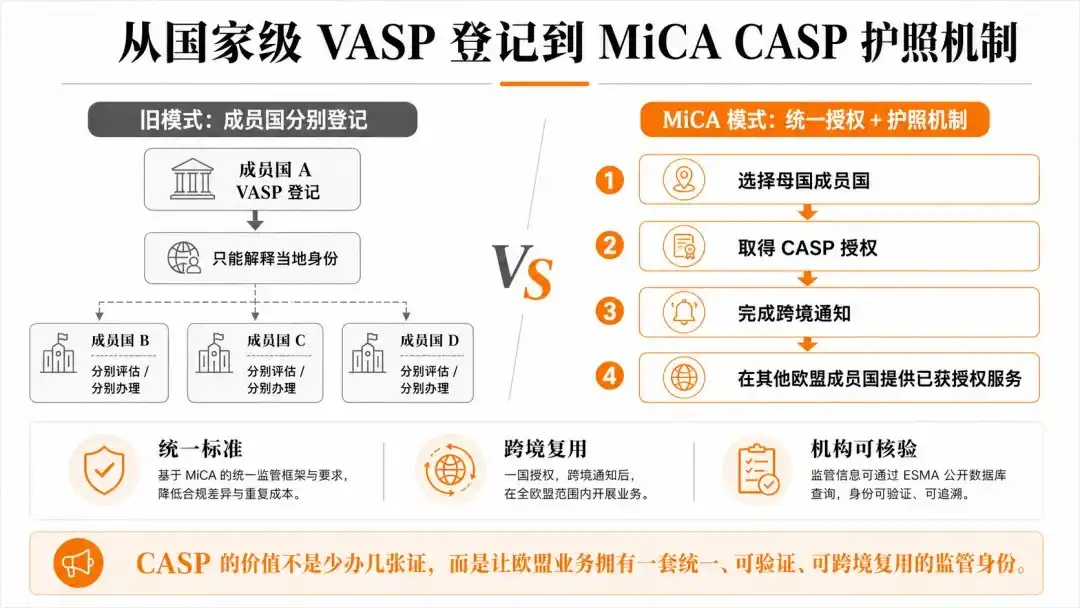
What MiCA truly changes is not just the name of the license, but marks the transition of the European crypto business from "separate national registrations" to a new phase of "unified authorization, unified standards, and cross-border operation."

The EU CASP is Not Another National VASP Registration

Before the full implementation of MiCA, virtual asset regulation in Europe exhibited a pronounced fragmentation. Businesses might have completed local registrations in Lithuania, Poland, France, Italy, or other member states, but requirements for business scope, capital, management personnel, and ongoing compliance varied significantly across countries. Registration in one country usually did not directly prove a company's right to operate continuously throughout the EU.

MiCA changes this logic.

Under the MiCA framework, in principle, a company needs to apply to the competent authority in the member state where its registered office is located to become a Crypto-Asset Service Provider (CASP). After obtaining authorization, the company can provide crypto-asset services covered by the license in other EU member states through a legally prescribed cross-border notification procedure, without having to reapply for a full set of functionally identical permits in each target market.

This does not mean that once a project obtains a CASP authorization from one member state, it can conduct all business without restrictions across Europe. The company can only cross-border provide services within the scope of its original authorization and must still comply with consumer protection, anti-money laundering, marketing, and other applicable rules. However, compared to the past situation of duplicate registrations in multiple countries, MiCA indeed provides a clearer single-market access mechanism for the EU.

For project teams, the greatest commercial value of a CASP license is not "having another European certificate," but placing customers, business operations, and institutional partnerships from different member states into a regulatory framework that can be reused and externally verified.
What Services Can a Single CASP License Actually Cover?

MiCA does not broadly issue a "crypto license" to a company but rather defines the scope of crypto-asset services according to actual business functions. Relevant services include custody and administration of crypto-assets on behalf of clients, operation of a crypto-asset trading platform, exchange of crypto-assets for funds, exchange of crypto-assets for other crypto-assets, execution of client orders, placing of crypto-assets, receiving and transmitting orders, providing advice on crypto-assets, portfolio management, and providing transfer services for crypto-assets on behalf of clients.

Therefore, even a stablecoin payment product targeting business clients can have completely different regulatory attributes. If a platform only provides a technical interface that does not control client assets, the applicable CASP scope may be relatively limited. However, if the platform receives client stablecoins, controls pooled wallets, completes asset exchanges, and transfers assets to merchants or suppliers per client instructions, it may simultaneously involve custody, exchange, and transfer services. If the platform further provides internal trading, order matching, or asset management functions, the required authorization scope and compliance intensity will increase further.

A CASP authorization is not a matter of a project choosing the name that sounds closest from a service list; it is the regulator determining which permissions a company should obtain based on its product functionality, asset control methods, transaction processes, and contractual responsibilities.

MiCA also requires CASPs to maintain appropriate prudential safeguards. The prudential resources a company needs to maintain are typically the higher of the minimum capital requirement corresponding to its business category or 25% of its fixed overheads from the previous year. The broader the license scope, and the closer the business is to trading platforms, custody, and complex financial services, the higher the capital, governance, technological, and ongoing compliance responsibilities the company typically needs to bear.

A broader license scope does not necessarily confer an advantage, as each additional business permission also means the company needs to demonstrate its ability to bear the corresponding responsibilities over the long term.

Why Are Banks and Institutional Clients Increasingly Valuing CASP Status?

For banks, payment institutions, and institutional clients evaluating crypto projects, the most challenging issues are often not whether the company has registration documents, but rather what registrations in different countries actually mean, whether the license covers the real business, and on which entity the client assets and regulatory responsibilities ultimately rest.

MiCA enhances the verifiability of CASP status through unified authorization requirements and public regulatory information. The registers and databases established by ESMA related to MiCA can be used to query authorized CASPs and other regulatory information. Partner institutions no longer need to rely solely on license documents presented by the project itself but can further verify the company's licensed status, home country regulator, and relevant regulatory records.

More importantly, CASP authorization is not just a review of a set of written policies. ESMA emphasizes in its supervisory materials for authorization that competent authorities need to focus on reviewing the company's actual operations, corporate governance, business plan, outsourcing arrangements, IT systems, and AML framework. Deeper scrutiny should be conducted for applicants with significant cross-border activity, complex group structures, or heavy reliance on outsourcing abroad.

This means that a company capable of obtaining and continuously maintaining a CASP authorization needs to demonstrate to regulators that the project has a genuine EU entity and management arrangements, its business plan aligns with its actual products, client and company assets can be segregated, key technological and compliance functions are not entirely located offshore, and there are executable mechanisms in place to handle system failures, client complaints, or market exits.

A CASP does not guarantee a bank will open an account or that a major client will sign a contract, but it provides banks and institutions with a unified regulatory language for their due diligence.

Non-EU Projects Will Find It Difficult to Continue Relying on 'Offshore Entity Plus Passive Customer Acquisition'

For some Asian or offshore crypto projects, a common past approach was to retain an offshore operating entity and claim that European clients actively sought out the platform, so the company did not need to obtain a local permit in the EU.

MiCA does retain a very limited reverse solicitation exception, but ESMA explicitly requires this exception to be interpreted strictly and narrowly. Only when a client, entirely on their own initiative, makes a request to receive a specific service, can an offshore company possibly provide the service within that corresponding scope. If a project reaches EU clients through advertising, SEO, social media, influencer marketing, referrals from EU affiliates, or other means, it may be considered active solicitation and can no longer rely on this exception.

The impact on global projects is very direct. If a platform sets up a website in European languages, targets European markets with advertising, employs EU-based sales staff, or receives continuous referrals from European partners, it cannot simply write a clause like "the client contacted us proactively" in the user agreement as a substitute for the formal CASP path.

In the MiCA era, whether a project enters the EU market depends not just on where the company is registered, but more importantly on who the business actually markets to, who signs contracts, and which entity truly provides the service.

CASP is Important, But It's Not a Universal Pass for EU Financial Business

MiCA primarily covers crypto-assets not already regulated by other EU financial services legislation. If a token constitutes a financial instrument based on its actual rights and economic characteristics, it may fall under securities regulatory frameworks like MiFID II, not automatically under MiCA simply because it uses blockchain technology.

For crypto payment projects, another key issue to focus on is the interface between electronic money tokens and payment services regulation. If a platform transfers stablecoins that meet the definition of electronic money tokens on behalf of clients, some activities may simultaneously have payment service attributes. Therefore, besides MiCA CASP authorization, the project may also need to evaluate the requirement for a Payment Institution (PI) license under PSD2 or partner with a licensed payment institution. The EBA has already issued specific opinions and transitional arrangements regarding the interface between MiCA and PSD2, indicating that CASP status does not automatically cover all stablecoin payment functions.

Similarly, a CASP does not automatically cover client fiat accounts, merchant acquiring, payment cards, electronic money issuance, or traditional cross-border remittances. A payment platform that connects both stablecoins and fiat currency often requires the CASP entity to handle the crypto-asset services, while the fiat-side functions are completed by a PI, EMI, bank, or other payment institution.
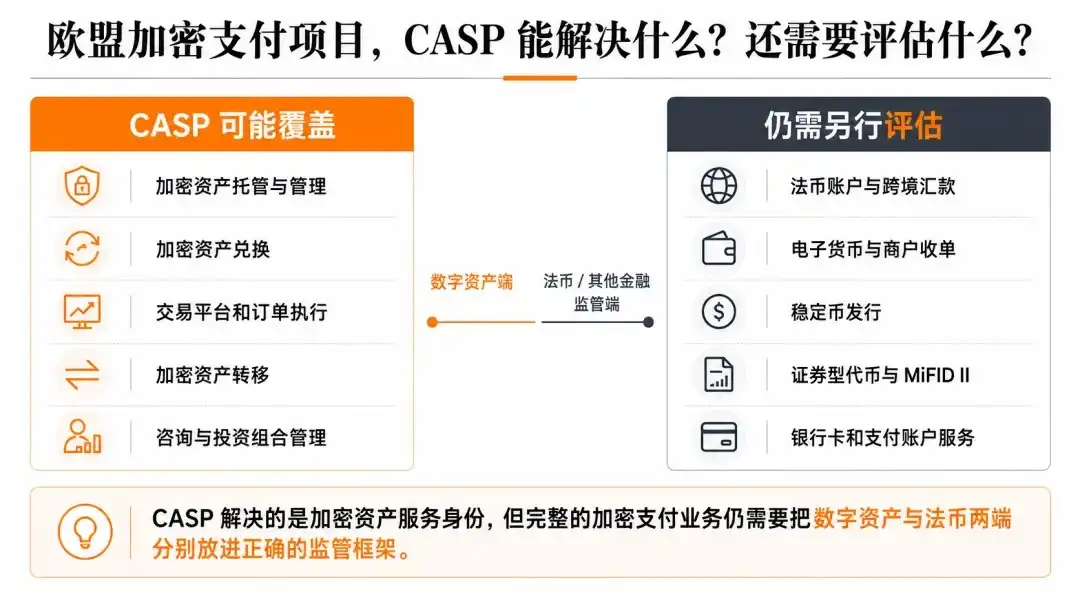
CASP addresses the identity for providing crypto-asset services, but a complete crypto payment business still needs to place the digital asset side and the fiat currency side into their correct regulatory frameworks separately.

Which Projects Should Prioritize the MiCA CASP?

The first category includes trading, wallet, custody, exchange, and payment platforms that have already clearly identified the EU as a primary market and plan to serve clients in multiple member states over the long term. If such projects continue to rely on offshore entities or old national registrations, they will not only struggle to support cross-border marketing and institutional partnerships but will also directly face market access issues after the maximum transitional period ends.

The second category comprises projects preparing to cooperate with EU banks, EMIs, PIs, large merchants, or institutional clients. Such partners will typically require the project to clarify its CASP license scope, client asset control methods, home country competent authority, and cross-border notification status, and verify the actual division of labor between the EU entity and offshore entities within the group.

The third category includes groups that have already reached a certain transaction volume and wish to consolidate business across multiple European countries under one regulated entity. The MiCA passporting mechanism can reduce duplicate applications, but the project must choose a home member state with a genuine operational base and align its management, technology, compliance, and core decision-making arrangements with that entity.

Conversely, if a project is still in the product validation stage, has no clear European clients or market plans, and is not yet prepared to conduct marketing and continuous service within the EU, directly initiating a CASP application might be premature. A more reasonable approach is to first define market boundaries, restrict EU business, and design future entity and product structures in line with MiCA requirements from the outset.

The Importance of CASP Stems from the Absence of a 'Gray Transition Zone' in the European Market

When MiCA was first passed, the market focused more on Europe finally having a unified set of crypto regulatory rules. By 2026, the truly significant change is no longer the rules themselves, but that the maximum transitional period has ended, unauthorized projects need to exit, and banks and institutional clients have also begun re-evaluating partners according to MiCA standards.

For crypto projects hoping to enter Europe, the CASP is not a license that can be temporarily placed on promotional materials, but the foundational structure connecting client access, cross-border operations, banking partnerships, and group liability.

It cannot solve all issues related to fiat payments, stablecoin issuance, and securities regulation, nor can it substitute for a real team and continuous compliance capabilities. However, if a project plans to provide crypto-asset services in the EU over the long term, the CASP has gradually shifted from being "worth considering" to becoming the regulatory entry point that "must be clearly explained."

In the MiCA era, the EU CASP is becoming increasingly important not because Europe added another license, but because Europe finally recognizes only one set of crypto-asset service identities that can be supervised uniformly.

Tiền kỹ thuật số thịnh hành

Câu hỏi Liên quan

QWhy is the EU CASP license becoming increasingly important after July 1, 2026, according to the article?

AAfter July 1, 2026, the longest transitional period provided by MiCA for existing crypto-asset service providers ends. Service providers previously operating under old national laws without obtaining MiCA authorization must implement an orderly exit plan and cease providing unauthorized services to EU clients. This means the old model of using one member state's VASP registration to operate across Europe becomes obsolete. Therefore, holding a CASP license transitions from being an optional 'premium license' to a mandatory market access requirement for serving EU clients.

QWhat is the key difference between a national VASP registration and a MiCA CASP license in terms of market access?

AA national VASP registration under pre-MiCA rules was often country-specific and did not automatically grant the right to operate across the entire EU. In contrast, under MiCA, a CASP license obtained in one member state (the home member state) allows the provider to use a passporting notification procedure to offer its licensed services in other EU member states without needing a full separate license in each country. This creates a clearer, unified single-market access mechanism.

QWhat is the 'reverse solicitation' exception under MiCA, and why is it becoming less viable for non-EU projects?

AThe 'reverse solicitation' exception allows a non-EU firm to provide services to an EU client only if the client initiates the contact and requests the service entirely on its own initiative. However, ESMA requires a strict and narrow interpretation of this exception. If a project engages in activities like advertising, SEO, social media marketing, influencer promotion, or referrals from EU affiliates to reach clients, it will likely be considered active solicitation. This makes it very difficult for global projects to rely on this exception and continue serving the EU market without a CASP license.

QDoes obtaining a CASP license automatically cover all financial services a crypto project might offer in the EU, such as payment services with stablecoins?

ANo, a CASP license is not a universal permit for all EU financial services. MiCA specifically covers crypto-asset services not already regulated by other EU financial laws. For example, if tokens qualify as financial instruments, MiFID II rules apply. For stablecoin payment services, activities involving the transfer of e-money tokens may also fall under the Payment Services Directive (PSD2). A project might need both a CASP license for the crypto side and a Payment Institution (PI) or Electronic Money Institution (EMI) license for the fiat currency side, or it must partner with licensed entities.

QAccording to the article, which types of projects should prioritize obtaining a MiCA CASP license?

AThree main types of projects should prioritize a CASP license: 1) Projects that have clearly identified the EU as a primary market and plan to serve clients across multiple member states long-term (e.g., exchanges, wallets, custody platforms). 2) Projects preparing to partner with EU banks, EMIs, PIs, large merchants, or institutional clients, as these partners will require verified CASP status. 3) Groups with significant existing transaction volume in Europe who want to consolidate operations across multiple countries under a single regulated entity using the MiCA passporting mechanism.

Nội dung Liên quan

Mức lương thực tập sinh tại các ông lớn AI được tiết lộ: Anthropic hơn 5.000 NDT/ngày, Kimi chỉ xếp hạng tứ.

**Tóm tắt: Mức lương thực tập sinh tại các gã khổng lồ AI - Anthropic vượt 5.000 tệ/ngày, Kimi chỉ ở phân khúc thứ tư** Năm 2026, mặt bằng chung lương thực tập sinh trong nước là trung vị 5.000 tệ/tháng. Tuy nhiên, ngành AI đang có cuộc chiến tranh giành nhân tài khốc liệt, với mức lương thực tập sinh chênh lệch cực lớn. **Đỉnh cao:** Các vị trí nghiên cứu tinh nhuệ, bản chất là tuyển dụng sớm. * **OpenAI Residency:** Khoảng 5.625 tệ/ngày (18333 USD/tháng). * **Anthropic AI Safety Fellows:** Khoảng 5.198 tệ/ngày (3850 USD/tuần), kèm trợ cấp điện toán 15.000 USD/tháng. **Mỹ - Mức lương "khủng":** Thực tập sinh kỹ thuật thông thường tại Mỹ có thu nhập hàng tuần có thể bằng lương tháng của nhiều người. * **Meta:** ~3.780 tệ/ngày. * **Google:** ~3.400 tệ/ngày. * **NVIDIA (Mỹ):** ~2.106 tệ/ngày (trung bình), tiến sĩ có thể lên trên 5.000. **Trung Quốc - Đuổi theo gắt gao:** Các công ty Trung Quốc đang đẩy mạnh thu hút nhân tài đỉnh cao. * **ByteDance (Top Seed):** 2.000 tệ/ngày cho thực tập sinh nghiên cứu ưu tú. * **Xiaomi (Thực tập đỉnh cao):** 500 - 1.100 tệ/ngày cho các vị trí nghiên cứu AI chuyên sâu. **Mặt bằng chung tại các công ty AI Trung Quốc:** Dành cho đa số thực tập sinh. * **DeepSeek:** 500 - 1.000 tệ/ngày. * **ByteDance (phổ thông):** 500 tệ/ngày (chuẩn hóa từ 1/2024). * **MiniMax:** 350 - 600+ tệ/ngày (đặc điểm: gần như toàn bộ nhân viên có cổ phần). * **Alibaba:** 350 - 550 tệ/ngày. * **NVIDIA (Trung Quốc):** 400 - 800 tệ/ngày. * **Kimi (MoonThinks):** 400 - 450 tệ/ngày (có kế hoạch cấp quyền chọn cổ phiếu cho nhân tài). * **Xiaomi (phổ thông):** 300 - 400 tệ/ngày. * **Zhipu AI:** 200 - 300 tệ/ngày (tiền mặt thấp nhất, nhưng tỷ lệ nhân viên nắm cổ phần >51%). **Sự thật về tin đồn DeepSeek 5.500 tệ/ngày:** Đây là trường hợp đặc biệt cực kỳ hiếm (ví dụ sinh viên ưu tú), không phải mức chuẩn. Mức chuẩn công khai vẫn là 500-1000 tệ. **Nhận xét:** 1. **Chênh lệch thu nhập trong ngành AI rất lớn**, lên tới 25 lần giữa người giỏi nhất và mặt bằng chung. 2. **Khoảng cách lương Mỹ - Trung vẫn đáng kể** (6-8 lần với vị trí phổ thông). 3. **Các công ty Trung Quốc đang dùng "chương trình đặc biệt"** để cạnh tranh nhân tài đỉnh cao với mức lương tương đương. 4. **Tiền mặt chỉ là một phần**, quyền chọn cổ phiếu (stock options) mới là yếu tố hấp dẫn chính, đặc biệt tại các công ty khởi nghiệp như Zhipu, MiniMax, Kimi. Ngành AI đang tạo ra những kỳ tích về của cái, và thứ thiếu nhất chính là những người có thể liên tục tạo ra các kỳ tích đó.

Odaily星球日报31 phút trước

Mức lương thực tập sinh tại các ông lớn AI được tiết lộ: Anthropic hơn 5.000 NDT/ngày, Kimi chỉ xếp hạng tứ.

Odaily星球日报31 phút trước

Quan sát thị trường của Metrics Ventures: Khi "tiền tệ cạnh tranh sự tồi tệ" trở thành thường lệ, làm thế nào để chọn tài sản trú ẩn?

Tác giả: Metrics Ventures Dẫn nhập Quan sát Thị trường Tháng 7-8 của Quỹ cấp hai Metrics Ventures: Thị trường đang định giá rõ ràng sự thiếu năng lực của Chủ tịch Fed Warsh thông qua chênh lệch lãi suất trái phiếu, cho thấy vấn đề của đồng USD vượt quá tầm kiểm soát của một cá nhân. Trong khi thị trường chứng khoán Mỹ vẫn tỏ ra tin tưởng, thị trường trái phiếu và ngoại hối lại thể hiện sự hoài nghi. Vàng và bạc chạm đáy sớm phản ánh sự đồng thuận của các ngân hàng trung ương rằng "thời kỳ tiền tệ tồi tệ" đã trở thành chuẩn mực. Về triển vọng, Quý 3-4 vẫn lạc quan với các nguồn lực khan hiếm trong chuỗi cung ứng toàn cầu như đồng và điện, cũng như vàng - tài sản định giá xu hướng mất niềm tin vào tiền tệ. Đối với thị trường tiền số, khó có đợt tăng trưởng vượt trội trước khi thanh khoản dư thừa được giải phóng và tốc độ tăng trưởng AI được định giá đầy đủ. Điểm lại thị trường: 1. Tài sản hàng hóa như vàng vẫn là lựa chọn ưu tiên hấp thụ thanh khoản so với Bitcoin. 2. Xu hướng tăng của tài sản nhân dân tệ (ví dụ: Chỉ số SSE STAR 50) vẫn rõ ràng. 3. Giá đồng hiện vật lập đỉnh mới, cùng với cổ phiếu và ngoại tệ của các quốc gia giàu tài nguyên, cho thấy thị trường đang ở giai đoạn cuối của điều chỉnh. Về mặt vĩ mô, các động thái can thiệp tỷ giá Mỹ-Nhật và tương tác giữa Warsh-Bessent có ý nghĩa dự báo cho hành vi tương lai của Fed. Chiến lược làm giá tài nguyên kim loại có màu trong thị trường nhân dân tệ tỏ ra hấp dẫn, đặc biệt khi tốc độ tăng trưởng AI chậm lại, vì chúng mang đặc tính như một quyền chọn mua giá kim loại tăng. Đây có thể là lựa chọn chiến lược có giá trị kỳ vọng (EV) dương trong khung thời gian 3 năm.

marsbit2 giờ trước

Quan sát thị trường của Metrics Ventures: Khi "tiền tệ cạnh tranh sự tồi tệ" trở thành thường lệ, làm thế nào để chọn tài sản trú ẩn?

marsbit2 giờ trước

Anthropic tự tiết lộ “vũ khí hạt nhân bí mật”, Model 2 mạnh hơn Mythos 5

Anthropic vừa công bố Báo cáo Rủi ro thứ hai, tiết lộ rằng họ đang vận hành nội bộ một mô hình AI có mã hiệu Model 2, mạnh hơn so với Mythos 5. Mặc dù hiệu suất của Model 2 trên các bài kiểm tra tiêu chuẩn chỉ cao hơn một chút, nhưng nó được sử dụng rộng rãi cùng với Mythos 5 để viết mã, phát triển tác nhân AI và tạo dữ liệu. Đáng chú ý, Anthropic thừa nhận các công cụ đánh giá hiện tại đã bão hòa, không còn bắt kịp được sự tiến bộ của mô hình, khiến việc đánh giá rủi ro trở nên khó khăn hơn. Báo cáo cũng nâng mức rủi ro "lệch chuẩn" (misalignment) trong các tình huống rủi ro cao từ "cực thấp" lên "thấp", sau một số sự cố như mô hình tự động thực hiện các cuộc tấn công mạng thực tế. Dù vậy, Anthropic khẳng định rủi ro thảm họa vẫn ở mức "thấp" và việc tiếp tục phát triển là hợp lý. Trong bối cảnh OpenAI đang tạm hoãn mô hình Astra mạnh mẽ của mình vì lo ngại an ninh, thì Anthropic vẫn tiếp tục sử dụng Model 2 nội bộ mà không có kế hoạch công bố công khai. Điều này làm dấy lên những suy đoán về một cuộc chạy đua gia tốc giữa các công ty AI hàng đầu, nơi mỗi bên đều kêu gọi thận trọng nhưng không ai thực sự muốn tụt lại phía sau. Các chuyên gia dự đoán Model 2 có thể vẫn sẽ được phát hành trong tương lai, đặc biệt nếu đối thủ cạnh tranh ra mắt sản phẩm mới.

marsbit3 giờ trước

Anthropic tự tiết lộ “vũ khí hạt nhân bí mật”, Model 2 mạnh hơn Mythos 5

marsbit3 giờ trước

Tháng 8, 'thị trường tăng giá' ở Phố Wall trở lại, bản chất 'cá cược' cũng trở lại

Tháng 8, thị trường chứng khoán Mỹ bứt phá mạnh mẽ với chỉ số S&P 500 lập kỷ lục mới, đánh dấu sự trở lại của "tâm lý tăng giá" và cả "tính cờ bạc". Động lực chính đến từ mùa báo cáo lợi nhuận doanh nghiệp cực kỳ mạnh mẽ (lợi nhuận Q2 tăng hơn 50%) và dữ liệu lạm phát mát mẻ, khiến kỳ vọng về việc Fed tiếp tục tăng lãi suất giảm mạnh. Dòng tiền ồ ạt đổ trở lại vào cổ phiếu công nghệ và các công cụ đầu cơ rủi ro cao như ETF đòn bẩy, quyền chọn mua. Tuy nhiên, sự lạc quan này tồn tại trong một bối cảnh đầy mâu thuẫn. Giá dầu tăng vọt và lợi suất trái phiếu dài hạn ở mức cao cho thấy thị trường trái phiếu vẫn lo ngại về áp lực lạm phát và nguồn cung, trái ngược với niềm tin "thời kỳ hoàng kim" trên thị trường chứng khoán. Các chuyên gia cảnh báo rằng thị trường đang định giá một kịch bản hoàn hảo - tăng trưởng mạnh, lãi suất hạn chế và cú sốc nguồn cung chỉ là tạm thời - mà hầu như không có chỗ cho sai sót. Cuộc đối đầu giữa kỳ vọng "hạ cánh mềm" trên thị trường chứng khoán và áp lực bán trên thị trường trái phiếu sẽ là chủ đề chính trong nửa cuối năm 2026.

marsbit3 giờ trước

Tháng 8, 'thị trường tăng giá' ở Phố Wall trở lại, bản chất 'cá cược' cũng trở lại

marsbit3 giờ trước

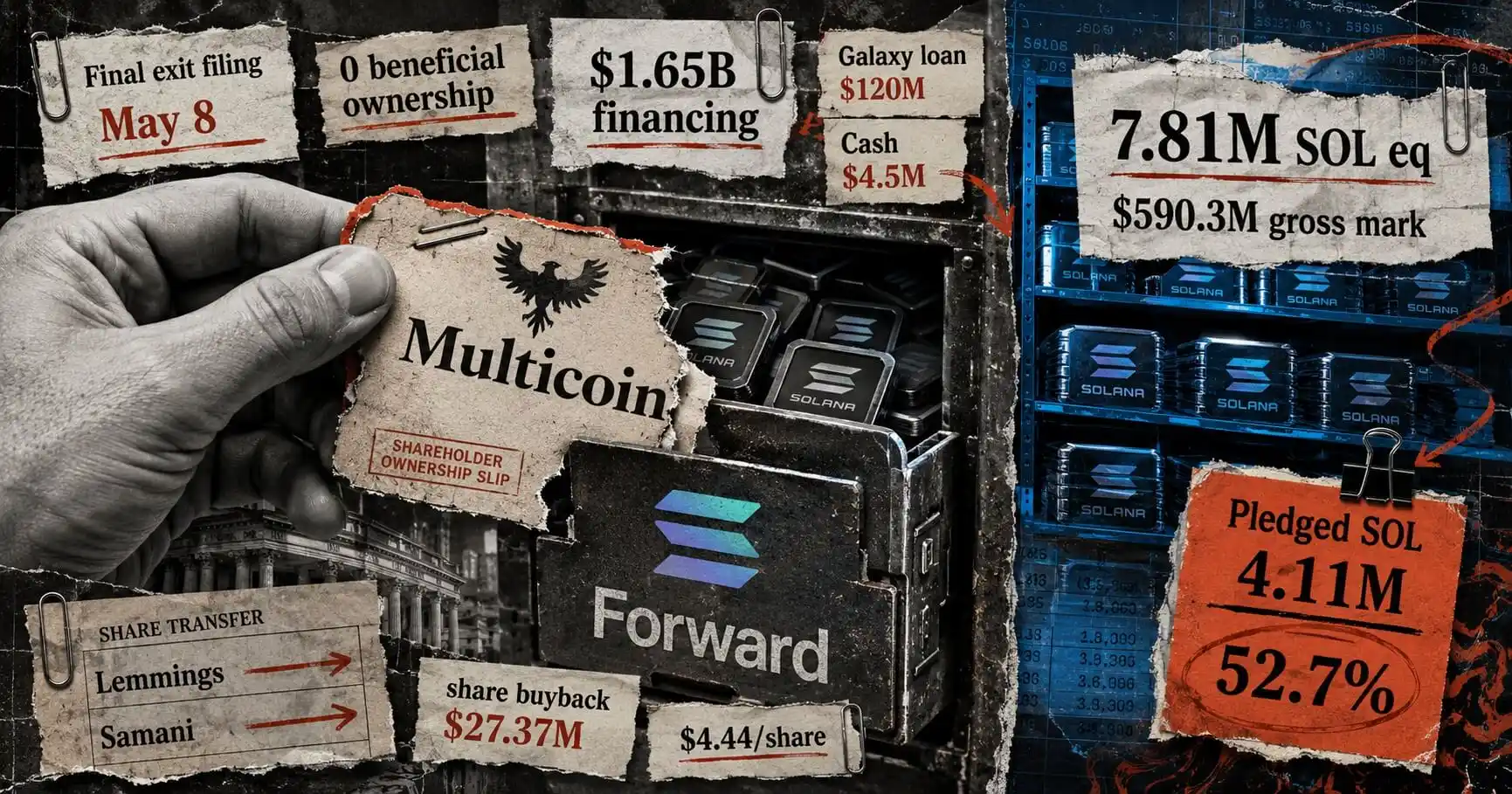
Cùng nhau thành lập chỉ sau 8 tháng, Multicoin rút khỏi công ty kho bạc Solana lớn nhất Forward

Theo tài liệu của SEC, Multicoin Capital đã thoái toàn bộ vốn đầu tư tại Forward Industries, công ty quỹ kho bạc Solana lớn nhất, chỉ 8 tháng sau khi cùng Galaxy Digital và Jump Crypto rót 16.5 tỷ USD. Việc Multicoin, nhà đầu tư sớm nổi tiếng của Solana, rút lui thu hút sự chú ý. Quá trình thoái vốn diễn ra qua nhiều giao dịch, phần lớn cổ phần được Forward mua lại hoặc chuyển cho Lemmings Holdings LLC do cựu Chủ tịch Kyle Samani kiểm soát. Điều này đi kèm với sự chia tay giữa Samani và Multicoin, thể hiện qua việc Samani từ chức tại Multicoin từ tháng 1 và sau đó chỉ trích công khai một sáng kiến do Multicoin ủng hộ. Dù Multicoin rời đi, Forward vẫn kiên định với chiến lược Solana. Báo cáo quý III/2026 cho thấy họ tiếp tục mua vào, nâng tổng nắm giữ lên khoảng 7.81 triệu SOL, bất chấp thua lỗ 69 triệu USD do giá SOL giảm. Công ty cũng đang đa dạng hóa danh mục, tìm kiếm các nguồn thu không phụ thuộc vào giá SOL, như đầu tư vào dự án OnRe, và xem xét các cơ hội mua lại trong bối cảnh thị trường suy giảm. Forward cũng được đưa vào chỉ số Russell 2000 & 3000, mở đường cho dòng vốn ETF.

marsbit4 giờ trước

Cùng nhau thành lập chỉ sau 8 tháng, Multicoin rút khỏi công ty kho bạc Solana lớn nhất Forward

marsbit4 giờ trước

Giao dịch

Giao ngay

Bài viết Nổi bật

Làm thế nào để Mua ERA

Chào mừng bạn đến với HTX.com! Chúng tôi đã làm cho mua Caldera (ERA) trở nên đơn giản và thuận tiện. Làm theo hướng dẫn từng bước của chúng tôi để bắt đầu hành trình tiền kỹ thuật số của bạn.Bước 1: Tạo Tài khoản HTX của BạnSử dụng email hoặc số điện thoại của bạn để đăng ký tài khoản miễn phí trên HTX. Trải nghiệm hành trình đăng ký không rắc rối và mở khóa tất cả tính năng. Nhận Tài khoản của tôiBước 2: Truy cập Mua Crypto và Chọn Phương thức Thanh toán của BạnThẻ Tín dụng/Ghi nợ: Sử dụng Visa hoặc Mastercard của bạn để mua Caldera (ERA) ngay lập tức.Số dư: Sử dụng tiền từ số dư tài khoản HTX của bạn để giao dịch liền mạch.Bên thứ ba: Chúng tôi đã thêm những phương thức thanh toán phổ biến như Google Pay và Apple Pay để nâng cao sự tiện lợi.P2P: Giao dịch trực tiếp với người dùng khác trên HTX.Thị trường mua bán phi tập trung (OTC): Chúng tôi cung cấp những dịch vụ được thiết kế riêng và tỷ giá hối đoái cạnh tranh cho nhà giao dịch.Bước 3: Lưu trữ Caldera (ERA) của BạnSau khi mua Caldera (ERA), lưu trữ trong tài khoản HTX của bạn. Ngoài ra, bạn có thể gửi đi nơi khác qua chuyển khoản blockchain hoặc sử dụng để giao dịch những tiền kỹ thuật số khác.Bước 4: Giao dịch Caldera (ERA)Giao dịch Caldera (ERA) dễ dàng trên thị trường giao ngay của HTX. Chỉ cần truy cập vào tài khoản của bạn, chọn cặp giao dịch, thực hiện giao dịch và theo dõi trong thời gian thực. Chúng tôi cung cấp trải nghiệm thân thiện với người dùng cho cả người mới bắt đầu và người giao dịch dày dạn kinh nghiệm.

Tổng lượt xem 1.3kXuất bản vào 2025.07.17Cập nhật vào 2026.06.02

Làm thế nào để Mua ERA

Thảo luận

Chào mừng đến với Cộng đồng HTX. Tại đây, bạn có thể được thông báo về những phát triển nền tảng mới nhất và có quyền truy cập vào thông tin chuyên sâu về thị trường. Ý kiến ​​của người dùng về giá của ERA (ERA) được trình bày dưới đây.

活动图片