LeCun Continuously Endorses, New Work VISReg Tackles the Core Challenge of 'Representation Collapse' in JEPA World Models

marsbitXuất bản vào 2026-07-28Cập nhật gần nhất vào 2026-07-28

Tóm tắt

"VISReg: A New Self-Supervised Learning Method Tackles Representation Collapse in JEPA World Models" Yann LeCun has highlighted the new self-supervised learning (SSL) work VISReg (Variance-Invariance-Sketching Regularization), which addresses the core challenge of "representation collapse" in JEPA-based world models. SSL often collapses, mapping different inputs to similar vectors, losing discriminative power. While methods like VICReg and SIGReg attempted to regularize the representation distribution, they suffered from issues like vanishing gradients during collapse or coupled scale and shape optimization. VISReg overcomes these by decoupling the regularization into independent "scale" and "shape" objectives. It uses a variance term to prevent amplitude collapse (providing constant gradient even during collapse) and a sliced Wasserstein distance (SWD) based sketching target with stop-gradient to align the distribution shape to an isotropic Gaussian, without interfering with scale. This approach, requiring only ~15 lines of PyTorch core code, offers linear computational complexity and scales efficiently across multiple GPUs. Evaluated across 15 datasets (in-domain, out-of-distribution/OOD, dense prediction), VISReg outperforms 7 mainstream SSL methods (MoCoV3, DINO, iBOT, I-JEPA, MAE, data2vec) without relying on heuristic tricks like EMA or stop-gradient. Key results include: superior average OOD accuracy; matching DINOv2's OOD performance using only ~1/10 of the data (I...

The foundation of JEPA world models is Self-Supervised Learning (SSL), advocated by Yann LeCun since 2017.

SSL can learn general representations from massive amounts of data without manual annotation, but it commonly faces a core challenge—representation collapse: the model tends to map different inputs to the same or very few vectors, seemingly completing training without actually learning discriminative representations.

To suppress collapse, mainstream methods mostly rely on a series of heuristic techniques (EMA, teacher-student networks, stop-gradient, freezing layers, etc.). These techniques make training fragile, difficult to tune, and also weaken the method's interpretability and scalability.

Another approach is to directly constrain the representation distribution through regularization terms.

VICReg, proposed by LeCun's team, decomposes the learning objective into three terms: variance, invariance, and covariance, using covariance to constrain correlations between dimensions; but covariance only captures second-order statistics, unable to distinguish between two representations with "the same mean and variance, but drastically different distribution shapes."

Subsequently proposed SIGReg, based on the Cramér–Wold theorem, aligns the entire embedding distribution to a standard Gaussian using sketching techniques, thereby constraining the complete distribution shape.

However, SIGReg still has two key flaws:

  • Gradient Vanishing upon Collapse: When representations start to collapse, SIGReg's gradient decays accordingly—the more severe the collapse, the weaker the correction signal, making it difficult for the model to recover on its own;
  • Coupling of Scale and Shape: It does not separate the two independent attributes of "magnitude (scale)" and "distribution morphology (shape)". They interfere with each other during optimization, leading to poor adaptability on long-tailed, low-quality, low-rank data.

In other words, when the model most needs gradient signals to escape the collapsed state, SIGReg's gradient tends to vanish.

This is precisely the core problem that VISReg aims to solve.

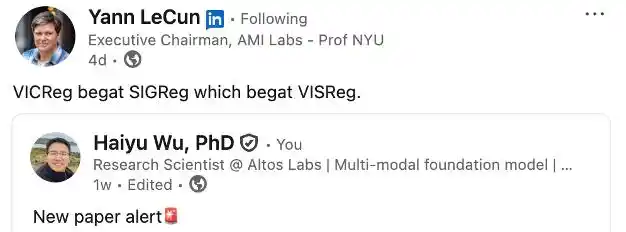
Recently, the new SSL work VISReg (Variance-Invariance-Sketching Regularization) has been continuously endorsed and highly recognized by Turing Award winner Yann LeCun—he commented on the repost, "VICReg begat SIGReg which begat VISReg," succinctly outlining the technical lineage of this regularization route.
To gain such recognition from LeCun, what makes VISReg so strong?

The answer lies in the fact that it precisely targets the core challenge of JEPA world models that LeCun has long bet on—representation collapse.

Paper Link: https://arxiv.org/abs/2606.02572

Code / Pre-trained Weights: https://github.com/HaiyuWu/visreg

Project Page: https://haiyuwu.github.io/visreg/

VISReg decouples the collapse-preventing regularization term into two independent objectives: "scale" and "shape." Without relying on any heuristic training tricks or massive data, it outperforms 7 mainstream SSL methods on a comprehensive evaluation across 15 datasets; using only about 1/10 of the training data, it matches DINOv2 on out-of-distribution (OOD) benchmarks.
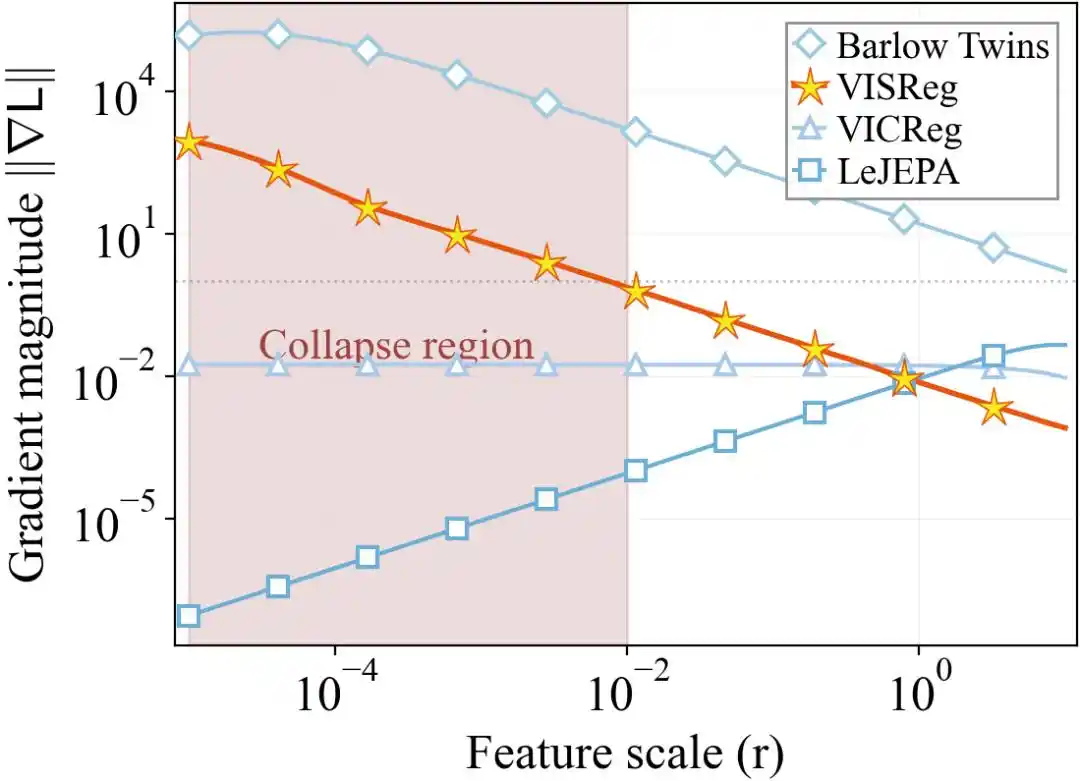
Figure 2: Simulation of gradient magnitude ‖∇L‖ for different regularization methods at various stages of representation collapse. VISReg maintains strong gradients even in collapsed states, while SIGReg's gradient almost vanishes.

Core Method

VISReg combines the strengths of VICReg and SIGReg: it retains VICReg's variance term to control scale, while replacing the covariance term with a sketching objective based on Sliced Wasserstein Distance (SWD) to control shape, and completely decouples the two via stop-gradient. The entire regularization objective consists of three parts.

1. Scale Regularization

The first part constrains the variance of each dimension to prevent amplitude collapse:
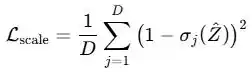
Its key property is: when the model collapses, the gradient of this term approaches a constant, ensuring the model can recover stably—this exactly compensates for SIGReg's gradient vanishing flaw.

2. Shape Regularization

The second part first normalizes to eliminate scale influence, then constrains shape separately. The crucial step is normalization with "stop-gradient" (sg):
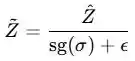
Here, stop-gradient is applied to the standard deviation σ, ensuring that optimizing the shape loss does not conversely alter the scale—this is the mechanism enabling true decoupling and non-interference between the "scale" and "shape" objectives.

After normalization, the geometric shape of the distribution is aligned to an isotropic Gaussian using the Sliced Wasserstein Distance:
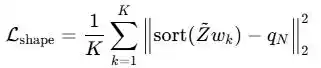
where

is the standard Gaussian quantile, and

is the random projection direction (i.e., "slice / sketching").

The theoretical basis is the Cramér–Wold theorem (Lemma 3.1 in the paper): two distributions are equal if and only if all their one-dimensional projections along directions on the unit sphere are equal. Therefore, by slicing the high-dimensional representation along sufficiently many random one-dimensional directions and aligning each to a Gaussian, we equivalently align the entire distribution in the high-dimensional space—this allows us to characterize the complete distribution shape using cheap one-dimensional sorting operations, rather than just second-order statistics.

3. Combined Objective

The third part is a centering loss that pulls the batch mean μ towards the origin:
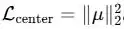
The three regularization terms are combined with weights:

The predictive loss follows the invariance objective of JEPA / LeJEPA—aligning embeddings from each view (global + local, total V views)

to the mean of the global view

:
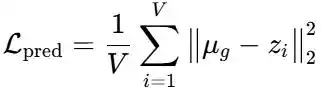
Finally, a single hyperparameter λ balances prediction and regularization, yielding the full objective:

Comparison with VICReg: VICReg also decouples regularization into variance + covariance, but covariance only captures second-order statistics; VISReg uses a sketching objective based on Sliced Wasserstein to fully characterize the distribution shape while retaining the variance term for scale control—preserving VICReg's flexibility while gaining distribution-level rigor.

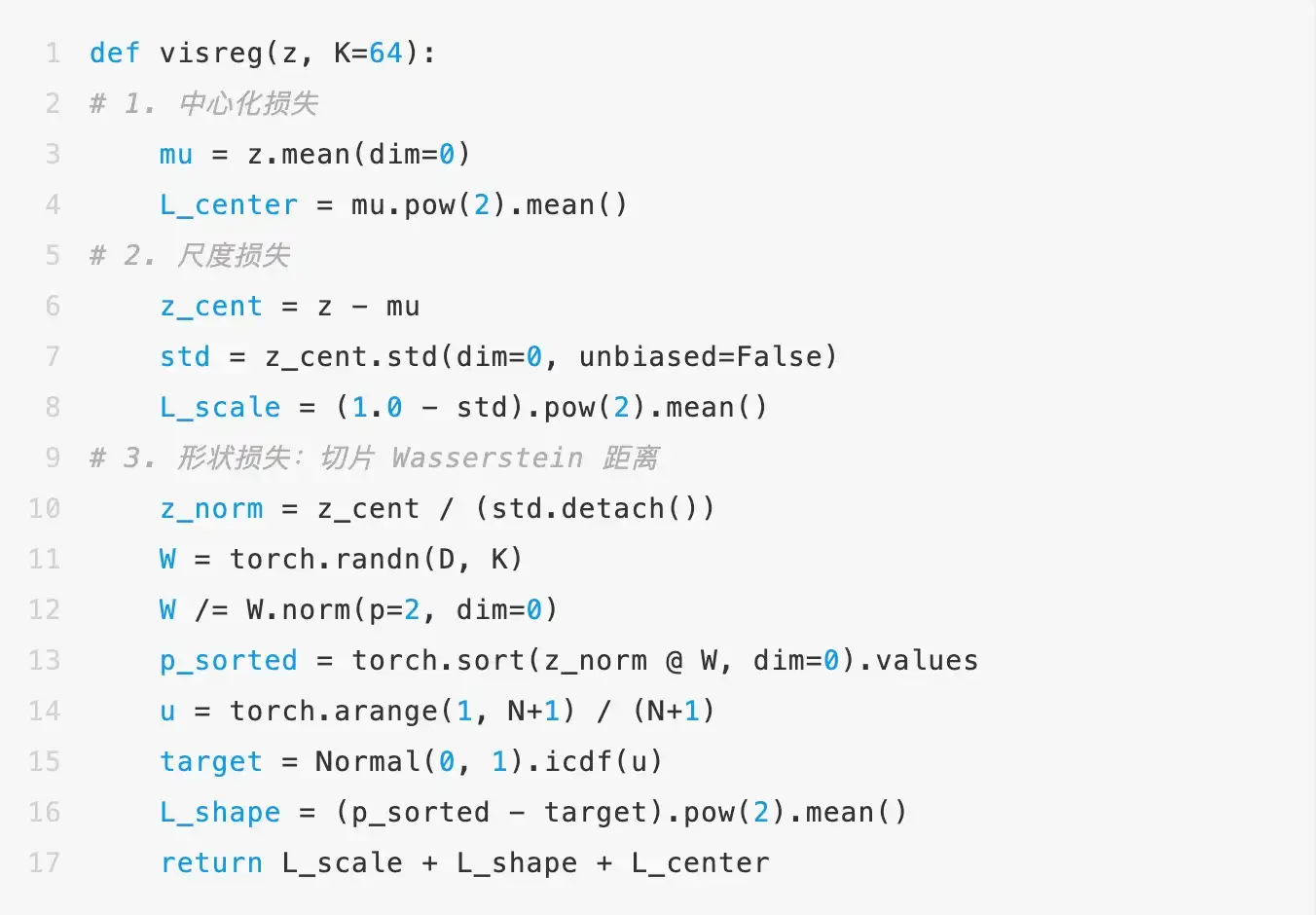
Requires Only About 15 Lines of PyTorch Code

This regularization objective is very lightweight to implement; the core logic takes only about 15 lines:
Computational Complexity and Scalability

In terms of computation and scalability, VISReg also has advantages. The computational complexity of its regularization part is
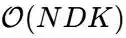
(N is batch size, D is dimension, K is number of slices), which is linear for all scaling factors; in contrast, VICReg's covariance term is
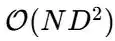
, scaling quadratically with dimension.

Under the same batch size, VISReg's runtime speed and GPU memory usage on a single H100 GPU are superior to SIGReg.

More importantly, the K random slices can be distributed across multiple GPUs: each of M GPUs generates K/M slices, achieving an effect equivalent to a single GPU generating all K slices.

In experiments, when the number of slices per GPU was insufficient, switching to 8 GPUs, each with 128 slices (total 1024), reduced the accuracy gap with "single GPU 1024 slices" from about 2.4% to 0.22%. This means that K can remain constant when scaling up training, adding almost no per-GPU burden.
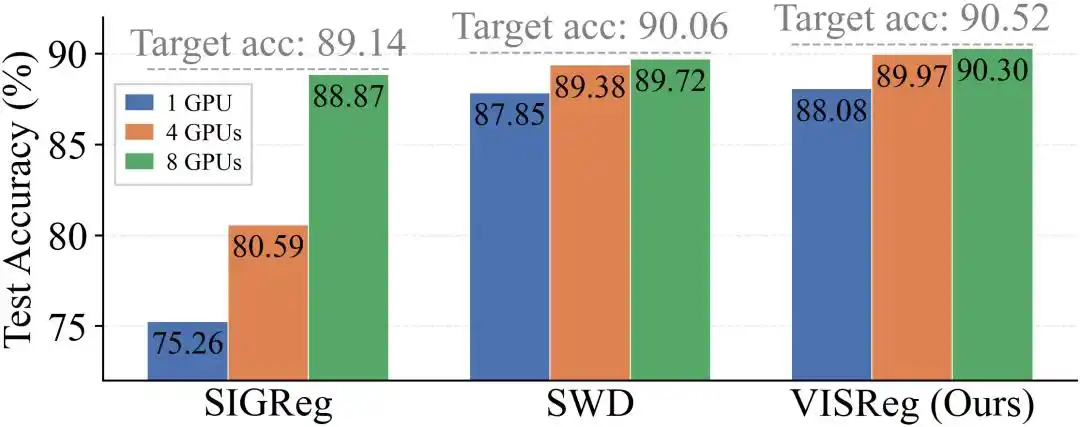
Figure: Change in linear probing accuracy when increasing GPU count with fixed K and D. When K is insufficient (K = 1⁄4D), using 8 times the number of GPUs can raise accuracy to the level of K = 2D—making it possible to keep K constant during large-scale training.

Experimental Results

Back to the question in the title—where exactly is VISReg strong? The research team compared VISReg with 7 mainstream SSL methods—MoCoV3, DINO, iBOT, I-JEPA, MAE, data2vec—on 15 datasets (8 in-domain + 6 out-of-distribution + ADE20K dense prediction), covering domains such as astronomy, medical, remote sensing, texture, flowers, etc. The answer manifests across multiple dimensions from recognition to segmentation and generation.

1. In-Domain Linear Probing

To ensure a fair comparison, experiments are divided into two groups based on whether heuristic techniques are used. In the group not using any heuristic techniques, VISReg leads: ViT-B/16 achieves in-domain linear probing accuracy of 75.7%, higher than MAE (75.1%); ViT-L/14 further improves to 77.0%, higher than LeJEPA (75.6%). Compared to iBOT and DINO which use heuristic techniques, VISReg is only slightly lower on conventional datasets, but surpasses all methods on the texture dataset DTD—indicating its cross-domain generalization ability stems from the method itself, not stacking manual tricks.

2. Out-of-Distribution (OOD) Generalization: Comprehensive Superiority

OOD generalization is a stricter test than in-domain accuracy: methods relying on heuristics are often finely tuned on the ImageNet in-domain but may not transfer well to significantly different new distributions. The team evaluated on 6 OOD datasets covering medical (ChestXRay, RetinaMNIST, OrganAMNIST), astronomy (Galaxy10), remote sensing (AID), texture (DTD), which are completely unrelated to the ImageNet training domain. Results show VISReg achieved the best average OOD accuracy across all methods and all backbone sizes, even surpassing some methods using heuristic techniques with larger backbones.
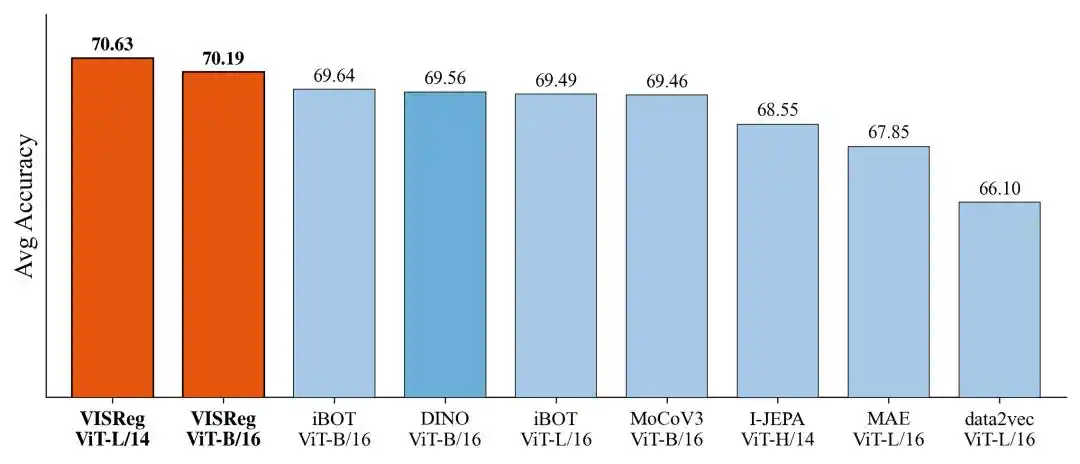
Figure 4: Average OOD linear probing accuracy. VISReg comprehensively outperforms iBOT, DINO, MoCoV3, I-JEPA, MAE, data2vec, etc.

As shown in Figure 4, ViT-B/16 VISReg average OOD accuracy is 70.19%, ViT-L/14 is 70.63%, significantly higher than MAE (67.85%), and better than MoCoV3 (69.46%), DINO (69.56%), I-JEPA (68.55%), etc.

3. Data Efficiency: Matching DINOv2 with 1/10 the Data

After pre-training VISReg (ViT-L/14) on ImageNet-22K (~14 million images), its average accuracy on 6 OOD datasets reaches 72.94%, essentially on par with DINOv2 (72.93%) trained on 10x larger scale LVD-142M (142 million images). In other words, VISReg achieves comparable performance using about 1/10 of the data. (As a control, VISReg with ViT-L/14 pre-trained only on ImageNet-1K has an average accuracy of 70.63%.) This indicates its learned representations have strong generality.
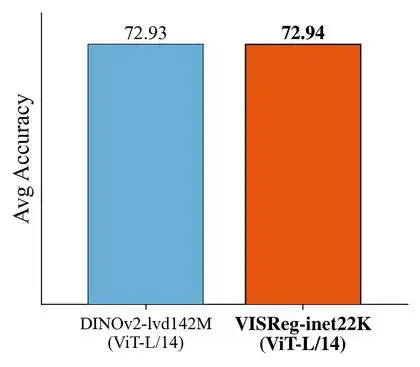
Figure 5: VISReg pre-trained on ImageNet-22K matches DINOv2 trained on 10x more data (LVD-142M) on OOD benchmarks.

4. Transfer Fine-tuning: Comprehensively Surpassing DINO

Although VISReg's linear probing accuracy on some in-domain datasets is slightly lower than DINO, after fine-tuning, it surpasses both DINO and supervised pre-training on all five tested datasets—CIFAR-10, CIFAR-100, Flowers, ImageNet-1K, Galaxy10—indicating its representation distribution is more uniform, less redundant, and more transferable.
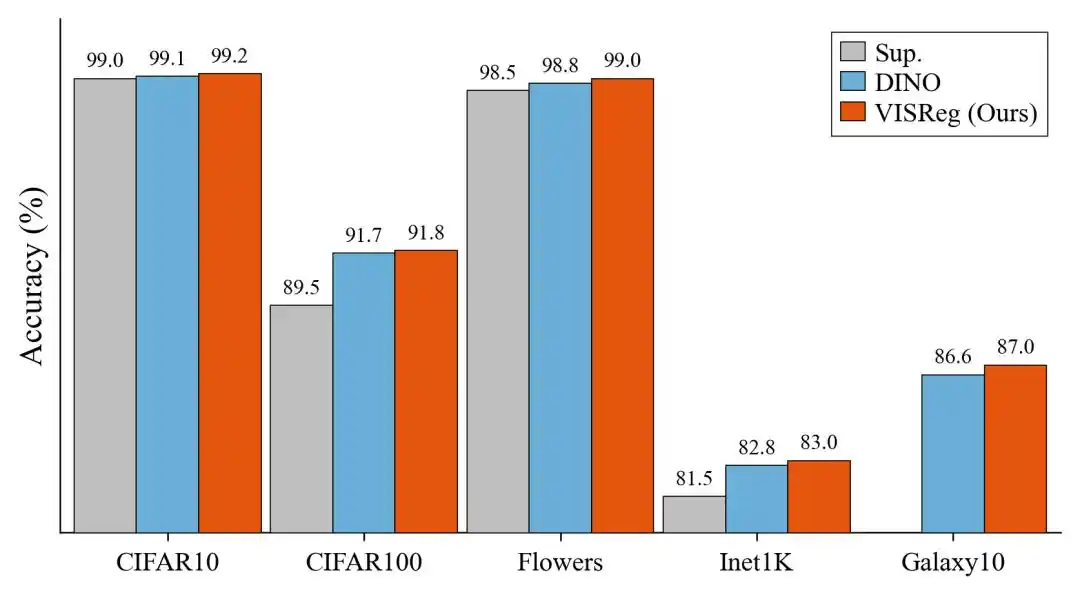
Figure: Transfer learning comparison. After fine-tuning, VISReg outperforms DINO and supervised pre-training on all tested datasets (CIFAR-10, CIFAR-100, Flowers, ImageNet-1K, Galaxy10).

5. Dense Prediction and Generation Guidance

VISReg's advantages are not limited to classification. On ADE20K linear semantic segmentation (ViT-B/16), its mIoU is 30.16, higher than DINO (29.40) and MAE (23.60), second only to MoCoV3 (31.69); this result is competitive without using any heuristic tricks. The paper also acknowledges that there is still a gap with the best methods in dense prediction, a focus for future optimization.
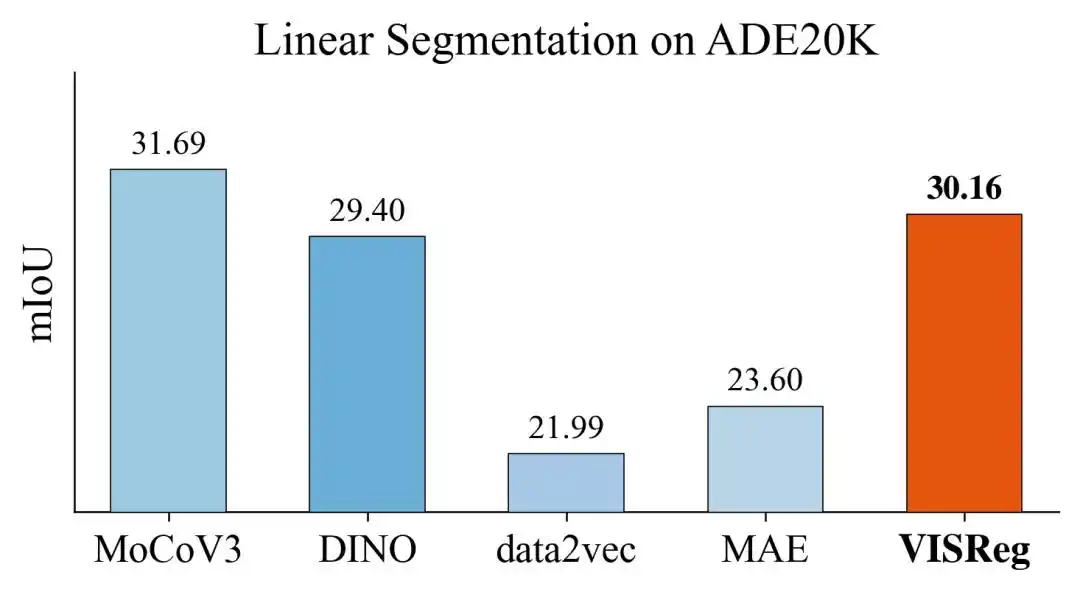
Figure 7: Linear semantic segmentation on ADE20K. Without any heuristic tricks, VISReg achieves competitive mIoU, second only to MoCoV3.

In generation guidance (SiT-B/2, iREPA framework, 100k training steps), generation guided by VISReg features outperforms DINO on three out of four metrics: gFID 40.36 (DINO 41.15), Precision 51.38 (DINO 50.51), Recall 61.26 (DINO 60.70), IS essentially tied (33.48 vs 33.47). This shows VISReg's learned representations are also superior as generation guidance signals.
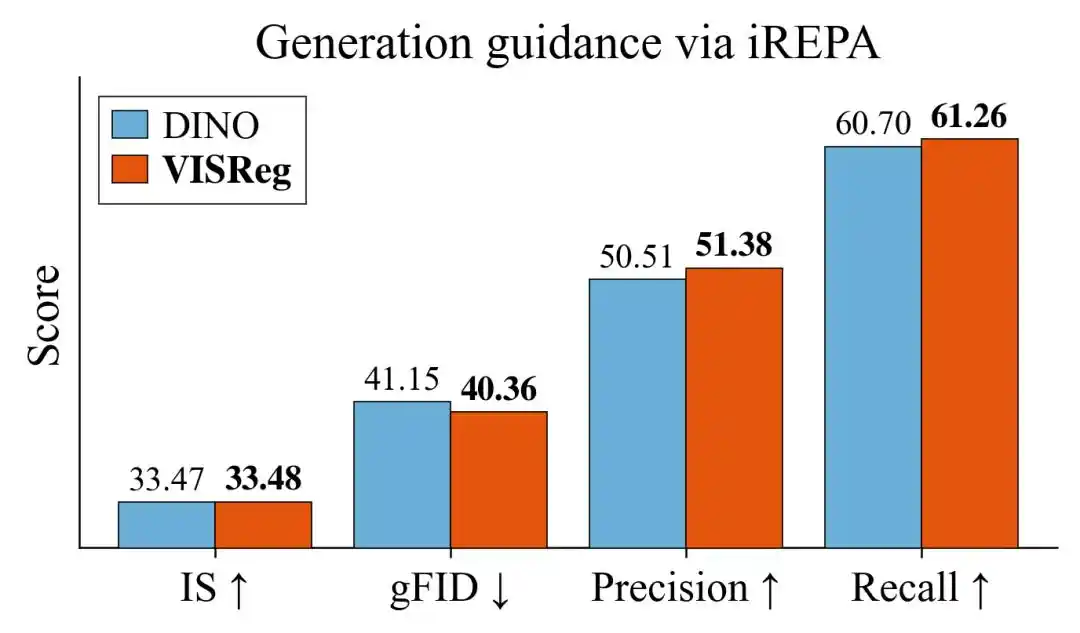
Figure 8: Image generation guided by VISReg vs. DINO features using SiT-B/2. VISReg provides better guidance on most metrics (lower gFID, higher Precision and Recall).

6. Robustness on Low-Quality Data

On low-quality datasets such as long-tail distribution (ImageNet-LT) and low-rank (Galaxy10), VISReg can stably prevent collapse and learn meaningful representations, while DINO fails directly without fine-tuned hyperparameters.
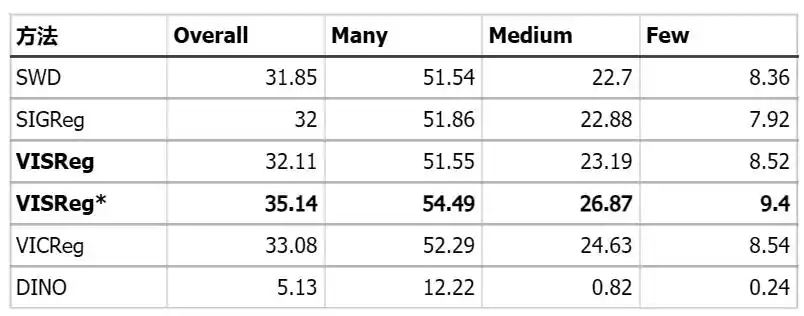
Table 1: Linear probing accuracy on ImageNet-LT

Table 2: In-domain linear probing accuracy on Galaxy10

Conclusion

VISReg demonstrates that by decoupling representation regularization into two independent components, "scale" and "shape," one can obtain an SSL method that is more stable, efficient, and has stronger generalization than existing methods.

Without using any training heuristic tricks, it achieves leading or near-leading results across multiple dimensions including image recognition, segmentation, and generation guidance, and matches DINOv2's OOD performance with about 1/10 of the data. This provides a new regularization-based solution to the long-standing representation collapse problem in JEPA world models.

References:

https://arxiv.org/abs/2606.02572

This article is from the WeChat public account "Xin Zhi Yuan," author: LRST

Tiền kỹ thuật số thịnh hành

Câu hỏi Liên quan

QWhat is the core problem that VISReg aims to solve in self-supervised learning?

AVISReg aims to solve the core problem of representation collapse in self-supervised learning, where a model maps different inputs to the same or very few vectors, failing to learn discriminative representations.

QHow does VISReg fundamentally differ from its predecessor SIGReg in handling representation collapse?

AVISReg differs from SIGReg by decoupling the regularization into two independent targets: 'scale' and 'shape'. Crucially, it maintains a strong gradient signal even when the model is collapsing, whereas SIGReg suffers from vanishing gradients in such states, making recovery difficult.

QWhat are the three main components of the VISReg regularization objective?

AThe three main components are: 1) Scale Regularization (variance term to prevent magnitude collapse), 2) Shape Regularization (using Sliced Wasserstein Distance after stop-gradient normalization to align the distribution shape to an isotropic Gaussian), and 3) A centering loss that pulls the batch mean towards the origin.

QWhat key advantage in data efficiency does VISReg demonstrate compared to DINOv2 according to the experimental results?

AAccording to the experimental results, VISReg achieves comparable performance to DINOv2 on out-of-distribution benchmarks using only about 1/10th of the training data. Specifically, VISReg trained on ImageNet-22K (~14M images) matched the average OOD performance of DINOv2 trained on LVD-142M (~142M images).

QIn which evaluation scenarios did VISReg outperform DINO after fine-tuning?

AAfter fine-tuning, VISReg outperformed DINO and supervised pre-training across all five tested datasets: CIFAR-10, CIFAR-100, Flowers, ImageNet-1K, and Galaxy10.

Nội dung Liên quan

Bất Ngờ, Google Earth Gấp Rút Rút Lại Tính Năng Tạo Ảnh Nano Banana 2!

Google Earth vừa triển khai tính năng tạo ảnh mới "Nano Banana 2" cho phép người dùng chỉnh sửa cảnh quan thực tế bằng lời nhắc văn bản. Tuy nhiên, chỉ sau một ngày, tính năng này đã bị thu hồi khẩn cấp sau khi cộng đồng mạng "nghịch ngợm" tạo ra những hình ảnh như tượng đài lịch sử Mỹ biến thành phế tích tận thế hay thành phố bị zombie xâm chiếm. Công nghệ mới này sử dụng "ràng buộc không gian địa lý", kết hợp ảnh vệ tinh, dữ liệu độ cao 3D và kiến thức thực tế để tạo ra hình ảnh phù hợp với địa hình thật. Nó hứa hẹn ứng dụng trong giáo dục (tái hiện lịch sử), bất động sản (trực quan hóa dự án) và khám phá. Mặc dù tạo ra hình ảnh chất lượng cao với văn bản chính xác, thời gian xử lý lên tới 2 phút và không khả dụng trong chế độ Street View. Việc tích hợp này đánh dấu chiến lược riêng của Google: tận dụng kho dữ liệu bản đồ độc quyền để tạo ra công cụ AI "hiện thực" dựa trên tọa độ thực, thay vì chỉ cạnh tranh về khả năng nghệ thuật. Tính năng hiện đã được tái triển khai với các biện pháp bảo vệ được tăng cường.

marsbit39 phút trước

Bất Ngờ, Google Earth Gấp Rút Rút Lại Tính Năng Tạo Ảnh Nano Banana 2!

marsbit39 phút trước

Altman thừa nhận: Đã đánh giá quá cao việc AI cướp việc làm! Jensen Huang: Luận điểm mất việc hoàn toàn bị hiểu ngược

OpenAI CEO Sam Altman thừa nhận đã đánh giá quá cao tốc độ AI thay thế các vị trí văn phòng cơ bản, cho rằng "ngày tận thế việc làm" khó xảy ra. Trong một podcast, ông nói mọi người "không thực sự muốn một CEO AI" vì cần một con người cụ thể chịu trách nhiệm cho quyết định. CEO NVIDIA Jensen Huang cũng tuyên bố quan điểm "AI hủy hoại việc làm" là hoàn toàn sai lầm. Ông phân biệt giữa "công việc" và "nhiệm vụ": AI có thể đảm nhận một số nhiệm vụ, nhưng không thay thế toàn bộ công việc đòi hỏi giao tiếp, phán đoán, phối hợp và chịu trách nhiệm. Nghiên cứu từ Đại học Maryland và LinkUp cho thấy, tính đến quý 4/2025, nhu cầu tuyển dụng tổng thể ở Mỹ không bị ảnh hưởng tiêu cực bởi AI. Tỷ lệ vị trí dành cho sinh viên mới tốt nghiệp thậm chí tăng từ 11,7% (cuối 2022) lên 12,6% (cuối 2025). Tuy nhiên, những nhiệm vụ tiêu chuẩn hóa, vốn là bước đệm quan trọng để người mới tích lũy kinh nghiệm, lại đang bị AI tiếp quản nhanh chóng, khiến lối vào thị trường lao động trở nên hẹp hơn. Bài học chung là giá trị công việc của con người đang dịch chuyển lên các khía cạnh như chịu trách nhiệm, xây dựng niềm tin và ra quyết định cuối cùng - những điều AI chưa thể thay thế. Thay vì lo lắng AI sẽ cướp việc, câu hỏi quan trọng hơn là xác định phần việc nào trong công việc của mình đòi hỏi trách nhiệm và sự tin cậy mà chỉ con người mới có thể đáp ứng.

marsbit45 phút trước

Altman thừa nhận: Đã đánh giá quá cao việc AI cướp việc làm! Jensen Huang: Luận điểm mất việc hoàn toàn bị hiểu ngược

marsbit45 phút trước

Fed Có Bước Chuyển Lớn? Tin Tức: Walsh Cân Nhắc Giảm Tần Suất Họp Lãi Suất, Phá Vỡ Thông Lệ 40 Năm

Chủ tịch Fed Jerome Powell đang xem xét cắt giảm số lượng cuộc họp định kỳ hàng năm của Ủy ban Thị trường Mở Liên bang (FOMC), một động thái được cho là thay đổi lớn nhất trong cách vận hành của ngân hàng trung ương này trong nhiều thập kỷ. Theo nguồn tin từ New York Times, đề xuất này được đưa ra trong cuộc họp tuần này và kế hoạch mới có thể được quyết định trước cuộc họp tháng 9, dù các thay đổi cụ thể có thể được thực hiện muộn hơn. Việc cắt giảm tần suất họp, hiện là 8 lần/năm theo thông lệ có từ năm 1981 dưới thời Chủ tịch Paul Volcker, sẽ làm giảm cơ hội bỏ phiếu về lãi suất. Điều này có thể làm suy yếu khả năng phản ứng của Fed trước những biến động về lạm phát và thị trường lao động, đồng thời giảm kênh thông tin cho thị trường, đảo ngược xu hướng tăng cường minh bạch thông tin trong nhiều thập kỷ qua của Fed. Theo luật Ngân hàng năm 1935, FOMC chỉ bắt buộc phải họp ít nhất bốn lần mỗi năm. Điều này cho thấy đề xuất cắt giảm là khả thi về mặt pháp lý. Tuy nhiên, chính Chủ tịch Powell trước đây từng cho rằng bốn cuộc họp là "không đủ", tạo nên một mâu thuẫn nhất định với hướng thảo luận hiện nay. Đề xuất này nằm trong kế hoạch cải tổ thể chế rộng lớn hơn của ông Powell kể từ khi nhậm chức vào tháng 5, bao gồm việc rút ngắn thông cáo chính sách và xem xét giảm các cuộc họp báo sau họp FOMC. Nếu được thông qua, thay đổi về tần suất họp dự kiến sẽ tác động sâu sắc đến dòng thông tin thị trường, tính linh hoạt trong chính sách và cách thức giao tiếp của ngân hàng trung ương.

marsbit1 giờ trước

Fed Có Bước Chuyển Lớn? Tin Tức: Walsh Cân Nhắc Giảm Tần Suất Họp Lãi Suất, Phá Vỡ Thông Lệ 40 Năm

marsbit1 giờ trước

Tuyển Chọn Biên Tập Hàng Tuần Weekly Editor's Picks(0725-0731)

Dòng thông tin quá nhanh, các bài phân tích sâu dễ bị lu mờ bởi tin nóng. Mục "Lựa chọn Biên tập viên Hàng tuần" chắt lọc những nội dung có giá trị từ biển thông tin, giúp bạn lọc nhiễu, giữ lại những hiểu biết sâu sắc. **Bối cảnh vĩ mô:** Cuộc họp Fed đầy bất ổn nhất trong những năm gần đây, giữa lúc dữ liệu lạm phát, việc làm yếu và giá dầu giảm tạo không gian chờ đợi, nhưng áp lực lạm phát và các phát biểu diều hâu vẫn khiến thị trường cảnh giác với rủi ro tăng lãi suất. **Đầu tư & Khởi nghiệp:** Các chuyên gia thảo luận về giá trị dài hạn của tiền mã hóa, nhấn mạnh tầm quan trọng của việc nắm vững bản chất tài sản và kiên trì vượt qua chu kỳ. Thị trường chứng khoán toàn cầu, đặc biệt là cổ phiếu công nghệ, đang ngày càng có đặc điểm giống thị trường tiền mã hóa: câu chuyện áp đảo định giá, đòn bẩy khuếch đại cảm xúc. Các nền tảng như Hyperliquid và Polymarket gặp khó khăn khi mở rộng sang lĩnh vực mới. Nhiều giao thức kiếm được doanh thu đáng kể nhưng giá token không tăng, do áp lực bán từ token đã mở khóa và các yếu tố khác. **AI & Bộ nhớ:** CDS của Nvidia tăng mạnh, cho thấy thị trường tín dụng đang định giá rủi ro từ việc mở rộng cơ sở hạ tầng AI. Ngành công nghiệp chip Trung Quốc đang tác động đến logic định giá bộ nhớ toàn cầu. Sự sụt giảm của cổ phiếu bộ nhớ phản ánh khoảng cách giữa cơ bản và kỳ vọng, với thị trường định giá trước nguy cơ dư cung tiềm tăng vào năm 2027. Mặc dù SK Hynix có quý kinh doanh tốt, nhưng thị trường vẫn tập trung vào việc định giá lại không gian tăng trưởng trong tương lai. **Chính sách & Stablecoin:** Đạo luật Clarity vẫn gặp trở ngại ở "vạch một thước" cuối cùng do bất đồng về các điều khoản đạo đức và cạnh tranh thời gian biểu quốc hội. Nếu không được thông qua, tác động đến thị trường tiền mã hóa có thể hạn chế, nhưng sẽ gây khó khăn cho các nỗ lực lập pháp trong tương lai. **CeFi & DeFi:** TradeXYZ thể hiện khả năng định giá chính xác với cổ phiếu A-shares. Động lực tăng giá ngắn hạn của ONDO có liên quan đến các sản phẩm hợp đồng chứng khoán được token hóa. **Ethereum & Mở rộng:** Lido đang lên kế hoạch di chuyển 8 triệu ETH sang kiến trúc trình xác thực mới sau bản nâng cấp Pectra, nhằm quản lý vốn hiệu quả hơn, mặc dù có thể tạm thời làm giảm phần thưởng. **An ninh:** Vụ phá sản của Poolin nhấn mạnh rủi ro khi giữ tài sản trong ví nền tảng thay vì các giải pháp giám sát chuyên nghiệp. **Điểm tin nóng trong tuần:** Fed giữ nguyên lãi suất; MiCA chính thức có hiệu lực tại châu Âu; Quỹ hưu trí Hàn Quốc mua ròng cổ phiếu KOSPI; Trường Tân Khoa học Kỹ thuật lập nhiều kỷ lục khi lên sàn; Sam Altman tuyên bố OpenAI sẽ "làm thế giới kinh ngạc" trong 12 tháng tới; Samsung và SK Hynix sắp ký thỏa thuận chip AI lớn với các đại gia công nghệ Mỹ; Vốn hóa Apple vượt 5 nghìn tỷ USD; SpaceX giảm 20% so với giá phát hành.

marsbit1 giờ trước

Tuyển Chọn Biên Tập Hàng Tuần Weekly Editor's Picks(0725-0731)

marsbit1 giờ trước

Đầu tư ít không phải là lá bài miễn tử của Apple

Bài viết phân tích tình hình tài chính và chiến lược AI của Apple trong bối cảnh cạnh tranh công nghệ. Mặc dù bị chỉ trích vì chậm trễ trong phát triển AI so với các gã khổng lồ như Meta, Google, Microsoft (vốn đang chi tiêu khổng lồ cho AI), Apple lại được thị trường đánh giá cao nhờ sự kiềm chế trong chi tiêu vốn, giúp dòng tiền hoạt động mạnh mẽ. Gần đây, cổ phiếu Apple tăng mạnh, đưa vốn hóa lên trên 5 nghìn tỷ USD. Báo cáo tài chính quý III năm tài chính 2026 (quý II năm 2026) của Apple cho thấy doanh thu và lợi nhuận kỷ lục, chủ yếu nhờ iPhone và Mac tăng trưởng mạnh (21.7% và 28.7%). Tuy nhiên, dự báo tăng trưởng quý tiếp theo thấp hơn kỳ vọng, dẫn đến giá cổ phiếu giảm mạnh sau giờ giao dịch. Nguyên nhân chính là áp lực từ chuỗi cung ứng, đặc biệt là chip và bộ nhớ, do nhu cầu AI toàn cầu tăng vọt làm tăng chi phí và hạn chế nguồn cung. Điều này buộc Apple phải tăng giá sản phẩm và tích trữ hàng tồn kho. Dù tránh được cuộc đua chi tiêu AI lớn, Apple vẫn bị ảnh hưởng gián tiếp. Trong khi các đối thủ tăng chi tiêu vốn (capex) cho AI, Apple lại tăng mạnh chi phí nghiên cứu & phát triển (R&D) lên 32.5%, nhưng kết quả cụ thể về AI còn hạn chế. Đây là báo cáo cuối cùng của CEO Tim Cook trước khi ông nghỉ hưu vào tháng 9.

marsbit2 giờ trước

Đầu tư ít không phải là lá bài miễn tử của Apple

marsbit2 giờ trước

Giao dịch

Giao ngay

Bài viết Nổi bật

Làm thế nào để Mua CORE

Chào mừng bạn đến với HTX.com! Chúng tôi đã làm cho mua CORE (CORE) trở nên đơn giản và thuận tiện. Làm theo hướng dẫn từng bước của chúng tôi để bắt đầu hành trình tiền kỹ thuật số của bạn.Bước 1: Tạo Tài khoản HTX của BạnSử dụng email hoặc số điện thoại của bạn để đăng ký tài khoản miễn phí trên HTX. Trải nghiệm hành trình đăng ký không rắc rối và mở khóa tất cả tính năng. Nhận Tài khoản của tôiBước 2: Truy cập Mua Crypto và Chọn Phương thức Thanh toán của BạnThẻ Tín dụng/Ghi nợ: Sử dụng Visa hoặc Mastercard của bạn để mua CORE (CORE) ngay lập tức.Số dư: Sử dụng tiền từ số dư tài khoản HTX của bạn để giao dịch liền mạch.Bên thứ ba: Chúng tôi đã thêm những phương thức thanh toán phổ biến như Google Pay và Apple Pay để nâng cao sự tiện lợi.P2P: Giao dịch trực tiếp với người dùng khác trên HTX.Thị trường mua bán phi tập trung (OTC): Chúng tôi cung cấp những dịch vụ được thiết kế riêng và tỷ giá hối đoái cạnh tranh cho nhà giao dịch.Bước 3: Lưu trữ CORE (CORE) của BạnSau khi mua CORE (CORE), lưu trữ trong tài khoản HTX của bạn. Ngoài ra, bạn có thể gửi đi nơi khác qua chuyển khoản blockchain hoặc sử dụng để giao dịch những tiền kỹ thuật số khác.Bước 4: Giao dịch CORE (CORE)Giao dịch CORE (CORE) dễ dàng trên thị trường giao ngay của HTX. Chỉ cần truy cập vào tài khoản của bạn, chọn cặp giao dịch, thực hiện giao dịch và theo dõi trong thời gian thực. Chúng tôi cung cấp trải nghiệm thân thiện với người dùng cho cả người mới bắt đầu và người giao dịch dày dạn kinh nghiệm.

Tổng lượt xem 512Xuất bản vào 2024.12.13Cập nhật vào 2026.06.02

Làm thế nào để Mua CORE

Thảo luận

Chào mừng đến với Cộng đồng HTX. Tại đây, bạn có thể được thông báo về những phát triển nền tảng mới nhất và có quyền truy cập vào thông tin chuyên sâu về thị trường. Ý kiến ​​của người dùng về giá của CORE (CORE) được trình bày dưới đây.

活动图片













