Data Review: How Much Profit Did Prediction Markets Reap from a Single World Cup?

Odaily星球日报Xuất bản vào 2026-07-27Cập nhật gần nhất vào 2026-07-27

Tóm tắt

**How Much Did the 2026 World Cup Boost Prediction Markets? A Data Review.** The 2026 World Cup provided a major, temporary boost to leading prediction markets, according to an analysis of Kalshi, Polymarket, and predict.fun. During the tournament, total nominal trading volume reached $543.38 billion on Kalshi, $209.88 billion on Polymarket, and $10.92 billion on predict.fun. While Kalshi maintained an overall lead, Polymarket narrowed the gap significantly in World Cup-specific markets. All platforms saw daily trading volumes roughly double or more during the event compared to pre-tournament levels, but activity largely retreated to baseline shortly after the final. Fee revenue also surged. Kalshi's weekly fees peaked at over $100 million in the fourth week, totaling $473.2 million for the tournament. Polymarket's weekly fees stabilized around $20 million, totaling $111.4 million. Predict.fun saw its weekly fee income rise from a pre-tournament $159k to a peak of $755k, with a six-week total of $3.48 million. Post-tournament, daily fee income declined for all three. Analysis of Total Value Locked (TVL) showed Polymarket's deposits remained flat around $4.4-$4.8 billion during the World Cup and later fell, suggesting the event spurred high-frequency trading but not long-term capital commitment. In contrast, predict.fun's TVL saw a clear inflow during the tournament's knockout stages, rising to a peak near $25 million before easing. The data confirms that mega-sports even...

Original | Odaily Planet Daily (@OdailyChina)

Author | Asher (@Asher_ 0210)

The 2026 World Cup has concluded, and prediction markets are undergoing a phased review.

Over the past six weeks, many users engaged in trading predictions on match outcomes, qualification scenarios, and championship winners, adding a layer of real-time interaction to viewing. Now that the tournament is over, Odaily Planet Daily will review the performance of leading prediction market platforms Kalshi, Polymarket, and predict.fun before, during, and after the World Cup from three dimensions: trading volume, fee revenue, and TVL.

World Cup Drove Prediction Market Trading Volume to New Highs, But the Momentum Didn't Last

Kalshi Maintains Lead, Polymarket Narrows Gap, predict.fun Breaks Through with World Cup

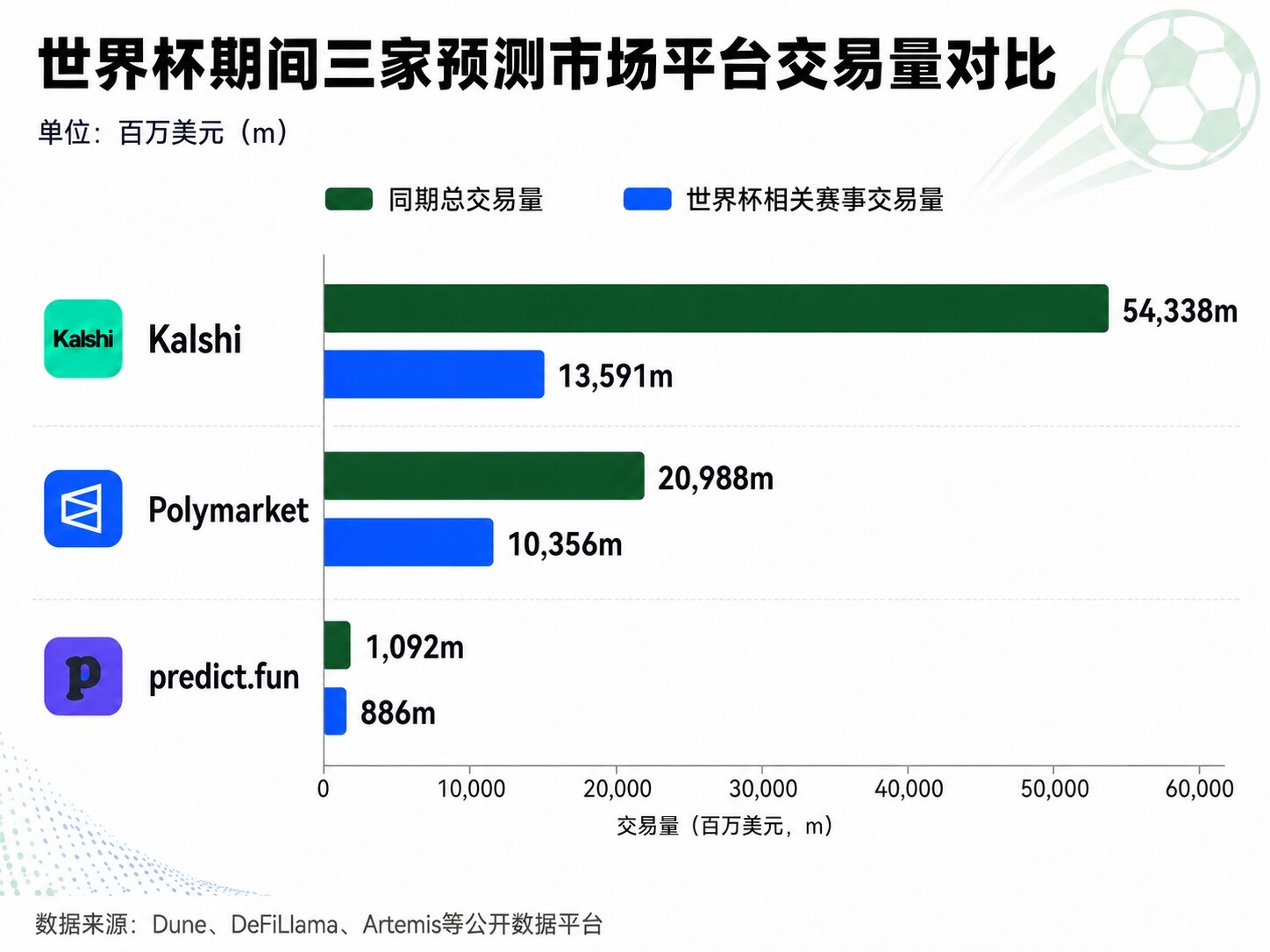
Looking at total platform trading volume during the World Cup period, Kalshi still maintains a clear lead. During the same period, Kalshi's total trading volume reached $54.338 billion, while Polymarket's was $20.988 billion, the former being about 2.6 times the latter. However, considering only World Cup-related events, the gap between the two narrows significantly. Kalshi's related trading volume was $13.591 billion, while Polymarket reached $10.356 billion, the former being only about 1.3 times the latter.(Note: Trading volume discussed in this article is nominal trading volume.)

In the past, Polymarket's representative markets were more concentrated in US elections, cryptocurrency, and geopolitical events. The World Cup further elevated the importance of sports markets on the platform, shifting them from a supplementary category to a core trading segment. Kalshi's advantage lies in its more dispersed trading structure; besides the World Cup, other sports events, politics, and macro markets continue to contribute trading volume, providing more scenarios to sustain activity after the tournament ends.

predict.fun's total platform trading volume during the World Cup reached $1.092 billion, with World Cup-related markets contributing $886 million. Although the overall scale still shows a clear gap compared to Kalshi and Polymarket, for a platform launched just over half a year ago, achieving nearly $900 million in trading volume from this World Cup has made predict.fun one of the most prominent new platforms benefiting from this round of tournament gains.
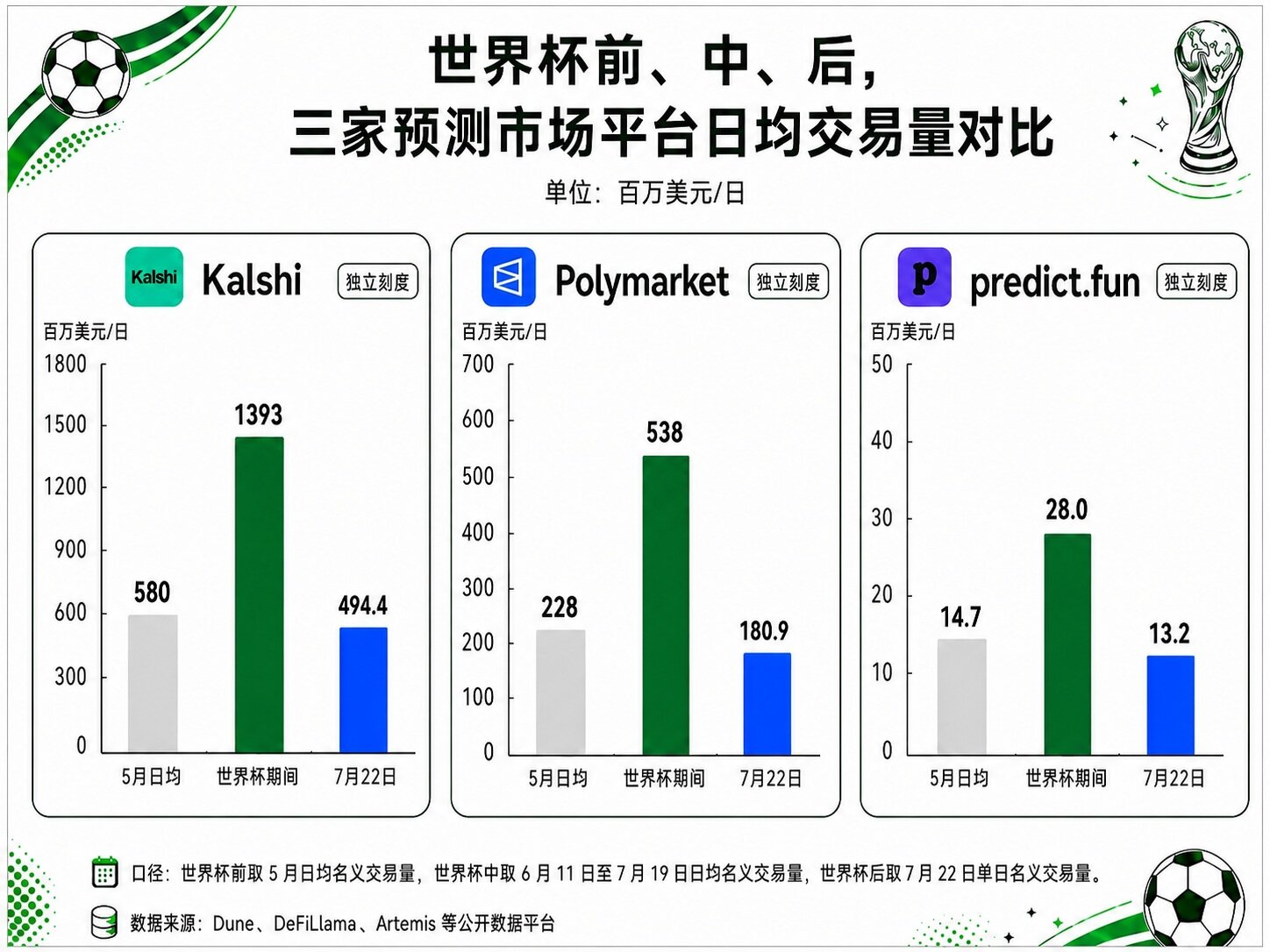
Changes in Average Daily Trading Volume for the Three Prediction Market Platforms Before, During, and After the World Cup

Kalshi's increase in trading volume during the World Cup was the most significant. Its average daily nominal trading volume in May was $580 million, rising to $1.393 billion during the tournament, an increase of about 140%. By July 22nd, trading volume fell back to $494.4 million, already below the May average daily level.

Polymarket's change magnitude was similar to Kalshi's. Its average daily nominal trading volume in May was $228 million, rising to $538 million during the World Cup, an increase of about 136%. By July 22nd, trading volume dropped to $180.9 million, also below pre-tournament levels.

predict.fun had a lower base, but the boost from the World Cup was still clear. Its average daily nominal trading volume in May was $14.7 million, rising to $28 million during the tournament, nearly doubling. By July 22nd, trading volume was $13.2 million, basically returning to pre-tournament levels.

Taking just one day's trading volume after the World Cup for comparison, the growth brought by the World Cup appears more like a concentrated release of event traffic, rather than elevating the platform's daily trading volume to a permanently higher level. Whether it can rise again in the future depends on whether other sports events and non-sports markets can capture the trading demand left after the World Cup.
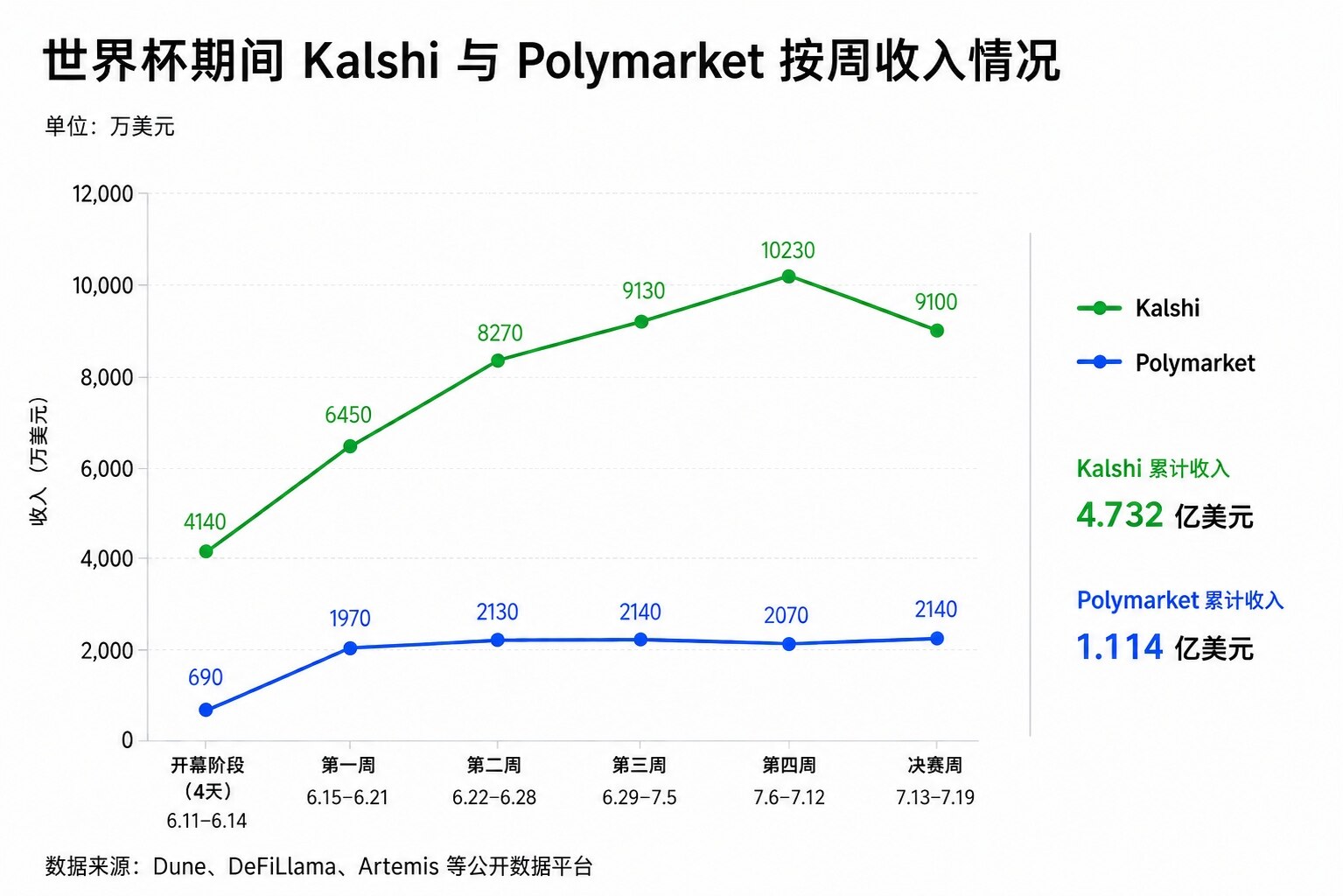
How Much Fee Revenue Did the World Cup Generate for the Three Prediction Market Platforms?

Kalshi's Fee Revenue Rose Continuously as the Tournament Progressed, Exceeding $100 Million in a Single Week in Week 4

Kalshi's fee revenue curve showed a strong overall upward trend. Revenue for the opening four-day period was $41.4 million, rising to $64.5 million in the first week, further increasing to $82.7 million in the second week, reaching $91.3 million in the third week, and rising another step in the fourth week with single-week revenue reaching $102.3 million, the highest point during the entire World Cup period. The final week saw a slight drop to $91 million. Throughout the World Cup, Kalshi's cumulative fee revenue reached $473.2 million.

The World Cup's impact on Kalshi not only brought initial attention at the start but, more importantly, sustained trading heat into the latter stages of the tournament. Single-week revenue exceeding $100 million also means Kalshi not only benefited from World Cup gains in trading volume but also successfully converted this wave of traffic into platform revenue at the monetization level.

Polymarket's Fee Revenue Was More Stable, But Didn't See Accelerated Volume Growth Like Kalshi in the Latter Stages

Polymarket's fee revenue trend was noticeably flatter. Revenue for the opening four-day period was $6.9 million, rising to $19.7 million in the first week. Subsequent weeks two, three, four, and the final week were $21.3 million, $21.4 million, $20.7 million, and $21.4 million respectively. Throughout the World Cup, Polymarket's cumulative fee revenue reached $111.4 million.

Starting from the first week, Polymarket's weekly fee revenue remained largely stable around $20 million. The World Cup did elevate Polymarket's fee revenue to a higher level, but from the second week onward, the platform did not continue to amplify gains as the tournament progressed like Kalshi did, instead operating within a relatively stable range.
predict.fun's Fee Revenue Gradually Increased as the Tournament Progressed, Cumulative $3.481 Million Over Six Settlement Weeks

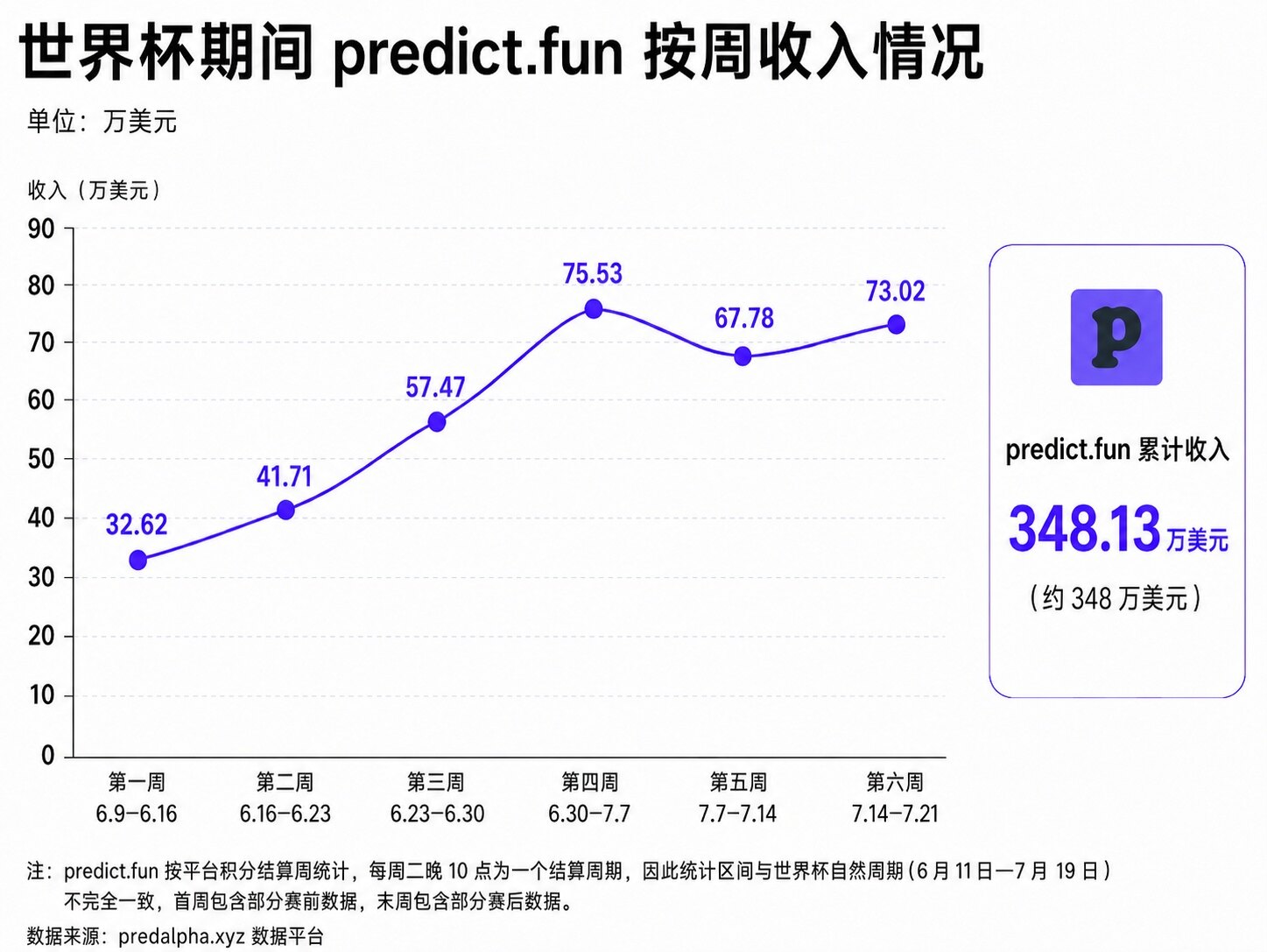
predict.fun's fee revenue is counted by platform settlement weeks, switching cycles every Tuesday at 10 PM, so it does not perfectly align with the natural World Cup schedule from June 11th to July 19th. The first settlement week was June 9th to June 16th, including two days of pre-tournament data; the last settlement week was July 14th to July 21st, also incorporating two days of post-tournament data.

Looking at the revenue trend, predict.fun's fee revenue for the first settlement week was $326.2 thousand. It then increased for three consecutive weeks, reaching $755.3 thousand from June 30th to July 7th, setting the single-week high during the World Cup period. The subsequent two weeks recorded $677.8 thousand and $730.2 thousand respectively. Although not setting new highs, these were still significantly higher than early in the tournament. The cumulative fee revenue for the six settlement weeks during the World Cup reached $3.4813 million.

The settlement week before the World Cup, June 2nd to June 9th, predict.fun's fee revenue was only $159.4 thousand. Entering the World Cup period, revenue for the first week rose to $326.2 thousand, an increase of about 105%. Subsequently, most settlement weeks further increased to over $500 thousand. Even though the first and last periods included some pre- and post-tournament data, the World Cup's boost to predict.fun's fee revenue remained significant.
After the World Cup, Fee Revenue Generally Declined Across Platforms, with Kalshi Experiencing the Smallest Drop

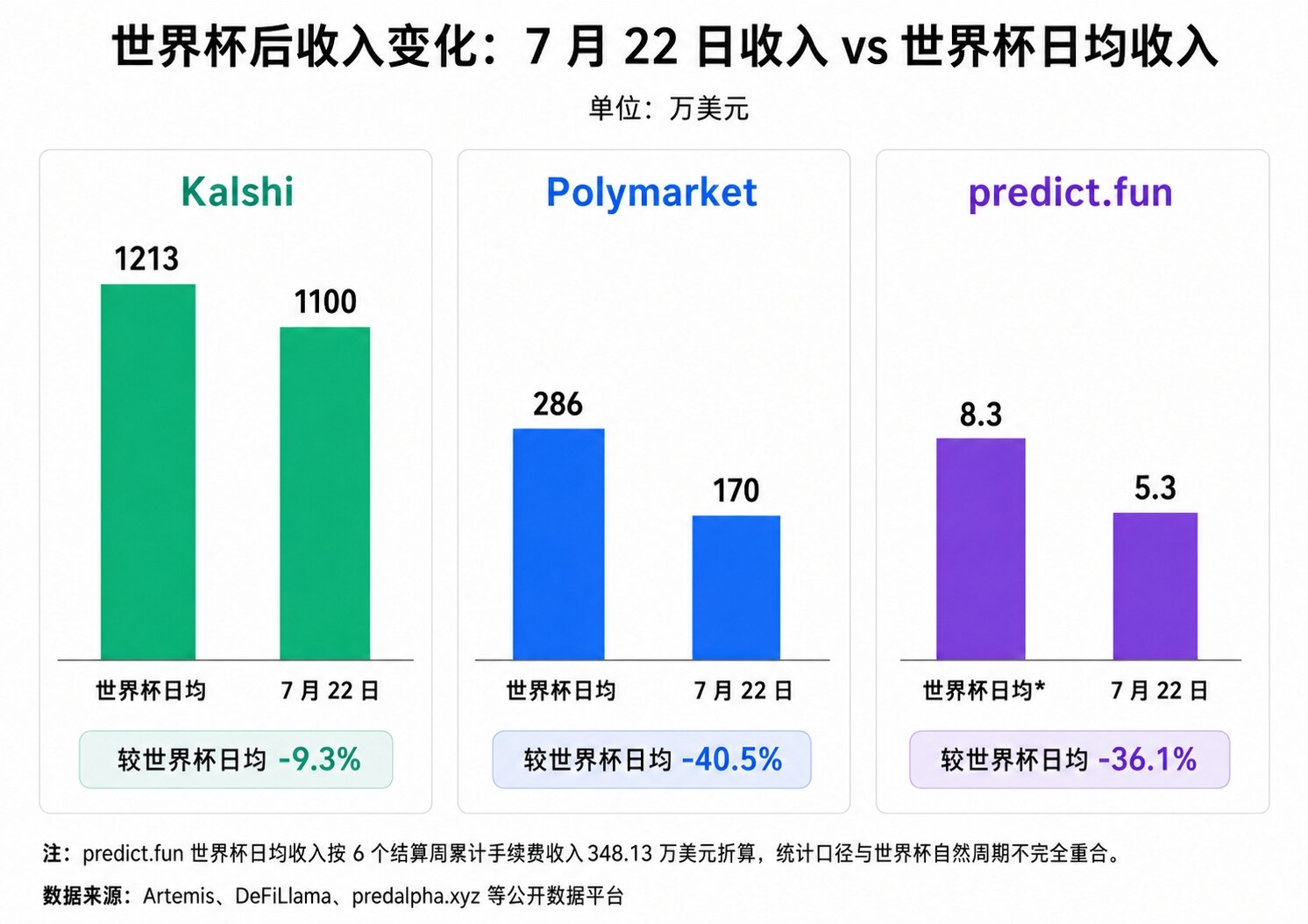
Kalshi's average daily fee revenue during the World Cup was $12.13 million, dropping to $11 million on July 22nd, a decrease of 9.3%. Among the three platforms, Kalshi's post-tournament decline was the smallest. Although fee revenue fell from the peak levels during the tournament, it remained close to the World Cup daily average.

Polymarket's drop was more pronounced. Its average daily fee revenue during the World Cup was $2.86 million, dropping to $1.7 million on July 22nd, a decrease of 40.5%. The revenue increment the World Cup brought to Polymarket was relatively concentrated, and as the tournament ended, this increment quickly dissipated.

predict.fun's average daily fee revenue during the World Cup was approximately $83 thousand, dropping to $53 thousand on July 22nd, a decrease of 36.1%, similar in magnitude to Polymarket's decline. Although the statistical method differs slightly from the first two, the post-tournament trend is clear. The World Cup also provided a significant boost to predict.fun's fee revenue, which similarly receded relatively quickly after the event.
World Cup Didn't Elevate Polymarket's TVL, While predict.fun Saw Capital Inflow in the Latter Stages

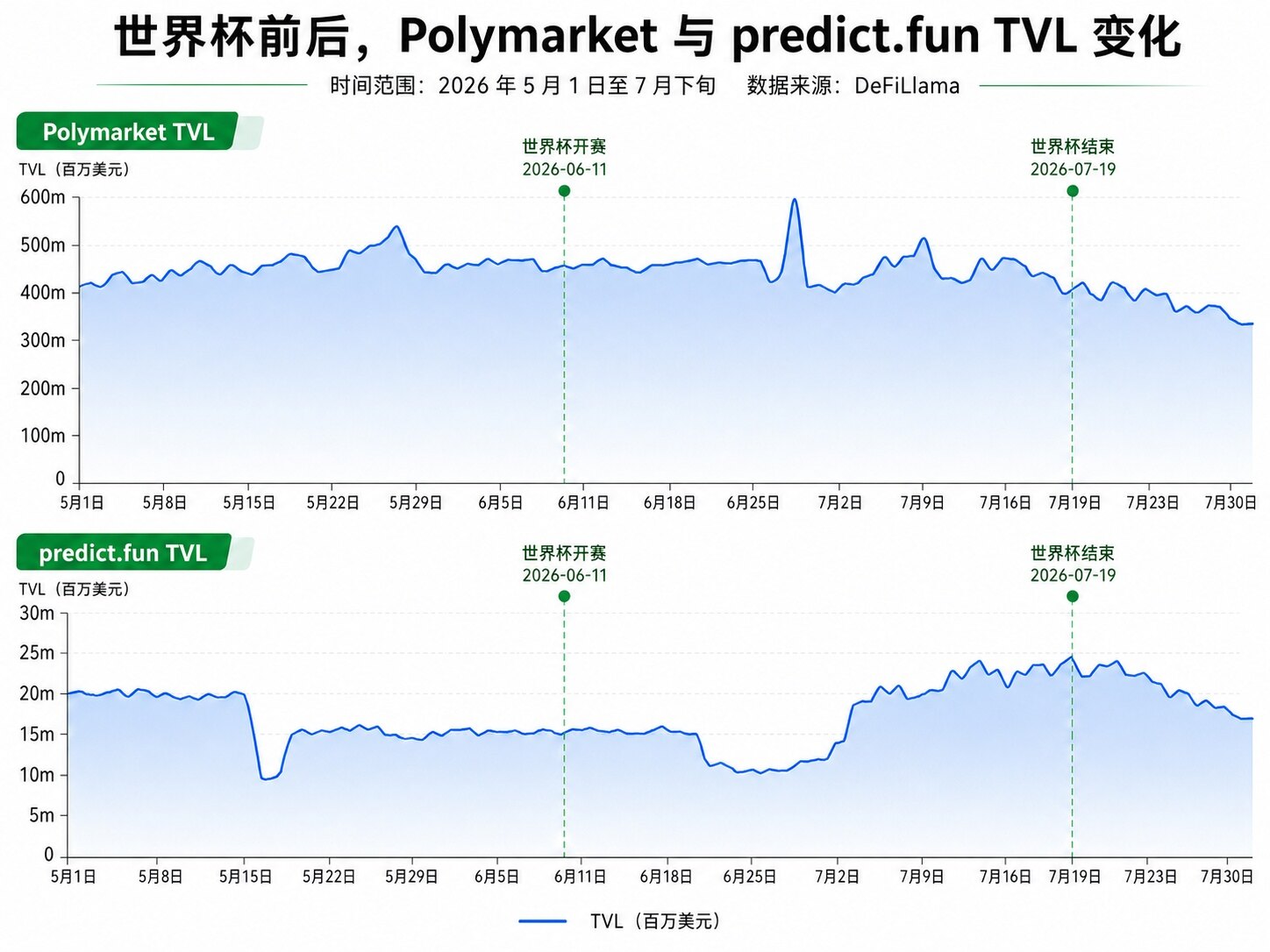
Polymarket's TVL did not rise in sync with trading volume during the World Cup. In early May, the platform's TVL was around $410 million, and for most of the subsequent period, it remained in the range of $440 million to $480 million. After the World Cup began, TVL continued to fluctuate mainly around this level. Although it briefly spiked in late June and early July, it did not form a sustained upward trend.

After mid-July, TVL began to decline noticeably, dropping to around $400 million by the end of the World Cup, and has since fallen further to about $340 million. While trading volume significantly expanded during the tournament, the platform's settled capital did not correspondingly convert into long-term retained funds, indicating that the World Cup brought more high-frequency trading demand rather than simultaneously translating into persistent capital.

predict.fun's trend was more phased. In early May, its TVL was around $20 million. By mid-May, it had dropped to about $10 million, then maintained around $15 million until mid-June. At the start of the World Cup, TVL did not immediately rise. It wasn't until early July that it began to rebound quickly, reaching the $20-25 million range during the latter half of the tournament and hitting a phase high around the end of the World Cup.

After the tournament, TVL gradually declined, currently at about $17 million, but still higher than the low point in late June. Compared to Polymarket, predict.fun's capital changes were more closely linked to the World Cup's progress, especially with more noticeable capital inflows during the knockout stages.

(Note: As Kalshi's TVL data is not available on-chain, this section only discusses Polymarket and predict.fun.)
Summary

The World Cup indeed brought substantial trading volume and fee revenue to prediction markets, but post-tournament data also shows that this growth did not naturally continue. The average daily trading volume and fee revenue for all three platforms declined after the event, and Polymarket's TVL continued to fall. Mega-events can concentrate and amplify trading demand in the short term but may not directly elevate a platform's long-term activity level.

However, the World Cup benefits are not confined to short-term data alone. It at least validated that sports events can provide prediction markets with continuous, high-frequency, short-cycle trading scenarios and helped more users develop the habit of repeated trading across consecutive matches.

The World Cup has ended, but the competition around user retention, market supply, and normalized trading is just beginning.


Tiền kỹ thuật số thịnh hành

Câu hỏi Liên quan

QAccording to the article, which prediction market platform achieved the highest total nominal trading volume during the 2026 World Cup?

AKalshi achieved the highest total nominal trading volume during the 2026 World Cup, reaching $54.338 billion.

QWhat was the key difference between Kalshi's and Polymarket's fee income trends during the World Cup, as highlighted in the article?

AKalshi's fee income showed a strong upward trend throughout the tournament, peaking at over $100 million in a single week. In contrast, Polymarket's fee income was more stable, leveling off after an initial rise and not showing the same accelerated growth in the latter stages of the tournament.

QThe article mentions that the post-tournament transaction volume data indicates the World Cup growth did not 'naturally extend'. Which platform's data is used to illustrate a significant drop in daily fee income after the event?

APolymarket is used to illustrate a significant post-tournament drop. Its daily fee income fell from $2.86 million during the tournament to $1.7 million on July 22nd, a drop of 40.5%. Predict.fun also saw a 36.1% drop in daily fee income.

QHow did the Total Value Locked (TVL) on predict.fun change during the World Cup, according to the article's analysis?

APredict.fun's TVL showed a delayed but clear correlation with the World Cup. It did not rise immediately at the start but began a rapid increase in early July, peaking between $20-25 million during the tournament's knockout stages (the latter half). After the event, it gradually declined but remained above its pre-tournament lows.

QWhat positive long-term effect did the article suggest the World Cup had on the prediction market space, beyond just short-term data?

AThe article suggested that the World Cup validated that major sports events can provide high-frequency, short-cycle trading scenarios for prediction markets. It also helped more users develop a habit of repeated trading across consecutive matches, which is beneficial for the industry's long-term growth.

Nội dung Liên quan

Vật liệu bị kiểm soát ngầm nhất trong ngành bán dẫn, tăng giá vài lần không ai để ý, vừa bị Trung Quốc cấm

Khí heli, nguyên tố phổ biến thứ hai trong vũ trụ, lại cực kỳ khan hiếm trên Trái Đất và không thể tổng hợp nhân tạo. Nó chỉ có thể được chiết xuất từ khí tự nhiên với hàm lượng cực thấp, và một khi thoát ra ngoài, nó sẽ bay vào không gian vĩnh viễn. Dù vậy, heli là nguyên liệu thô không thể thay thế trong quy trình sản xuất chip tiên tiến nhất hiện nay, với yêu cầu độ tinh khiết lên đến 99,9999%. Nó được sử dụng trong khắc plasma, kiểm tra rò rỉ, kiểm soát nhiệt độ bệ đỡ máy quang khắc và nhiều công đoạn quan trọng khác tại các nhà máy bán dẫn. Không có nó, nhiều hoạt động sản xuất chip sẽ dừng lại. Tuy nhiên, heli là vật liệu ít được chú ý nhất trong chuỗi cung ứng bán dẫn. Giá của nó đã tăng gấp đôi mà hầu như không được đưa tin. Ngày 10 tháng 7, Trung Quốc đã đột ngột cấm xuất khẩu khí heli, một động thái hầu như không gây tiếng vang trên truyền thông. Nhưng đằng sau đó là một cơn khủng hoảng thiếu hụt toàn cầu nghiêm trọng: trung tâm sản xuất heli lớn nhất thế giới ở Qatar bị tấn công bằng tên lửa vào tháng 3, phá hủy năng lực xuất khẩu và cần 3-5 năm để sửa chữa; khoảng 200 bình chứa heli lỏng bị mắc kẹt ở Trung Đông; giá heli toàn cầu tăng gấp đôi. Ba quốc gia kiểm soát 85% nguồn cung heli toàn cầu là Mỹ, Qatar và Nga. Qatar (chiếm 1/3) đã ngừng sản xuất, Mỹ đã bán kho dự trữ chiến lược liên bang, và Nga áp dụng chế độ cấp phép đặc biệt cho xuất khẩu từ tháng 4/2026. Ngành công nghiệp chip đang lo ngại về tình trạng thiếu hụt kéo dài, có thể buộc phải cắt giảm sản xuất, ưu tiên chip AI và HBM. Trung Quốc là nước phụ thuộc nhiều vào nhập khẩu heli (84,4%), chủ yếu từ Qatar và Nga. Động thái cấm xuất khẩu được coi là để đảm bảo nguồn cung trong nước. Điều đáng chú ý là dù thiếu tài nguyên, Trung Quốc đã phát triển công nghệ sản xuất heli nội địa bằng cách tận dụng khí thải từ các nhà máy LNG, đạt độ tinh khiết 6N9 vào năm 2025. Tuy sản lượng còn nhỏ (tự cung dưới 20%), nhưng đây là bước tiến quan trọng. Cuộc khủng hoảng heli toàn cầu được dự báo sẽ còn kéo dài, buộc các quốc gia phải xem xét lại tầm quan trọng chiến lược của nguồn tài nguyên dễ bay hơi này.

marsbit25 phút trước

Vật liệu bị kiểm soát ngầm nhất trong ngành bán dẫn, tăng giá vài lần không ai để ý, vừa bị Trung Quốc cấm

marsbit25 phút trước

Nhà đầu tư giai đoạn đầu của Unitree đặt cược vào một công ty Brain-Computer Interface

"Wabo Technology, một công ty khởi nghiệp về giao diện não-máy (BCI) có trụ sở tại Thành Đô, vừa hoàn thành vòng đầu tư thiên thần với sự tham gia của các quỹ Vertex Ventures (thuộc Temasek), Hongtai Fund, Chengdu Future Industry Fund và Huifengda Capital. Vertex Ventures, nhà đầu tư ban đầu vào Unitree, cũng nằm trong số những người ủng hộ. Được thành lập vào cuối năm 2025 bởi Zhang Xingzhi, một Tiến sĩ từ Đại học Thanh Hoa, Wabo Technology tập trung vào phát triển "mô hình ý định thần kinh của con người", một hệ thống giải mã và biểu diễn tín hiệu thần kinh. Cách tiếp cận này nhằm mục đích giúp AI hiểu được ý định thực sự của con người trước khi hành động, ví dụ như phân biệt giữa việc định uống nước hay đặt cốc xuống, thông qua việc kết hợp dữ liệu EEG, EMG, hành vi và ngữ cảnh. Công ty có kế hoạch thiết lập trụ sở song phương tại Thành Đô (tập trung vào phần cứng và sản xuất) và Thượng Hải (tập trung vào R&D và mô hình tiên tiến). Wabo cũng đang hợp tác với Đại học Thiên Tân trong các thử nghiệm BCI ngoài không gian, một lĩnh vực thu hút sự quan tâm của các nhà đầu tư vào lĩnh vực hàng không vũ trụ thương mại. Ngành công nghiệp BCI ở Trung Quốc đang chứng kiến sự bùng nổ đầu tư, với hơn 45 tỷ nhân dân tệ được huy động chỉ trong 5 tháng đầu năm 2026. Zhang Xingzhi dự đoán rằng ngành sẽ chứng kiến sự hợp nhất trong vòng ba năm tới, và chỉ những công ty có thể thiết lập vòng lặp khép kín hiệu quả giữa dữ liệu, mô hình và ứng dụng thực tế mới tồn tại được. Tầm nhìn dài hạn của Wabo là biến những hình ảnh khoa học viễn tưởng, như trong phim 'Avatar', thành hiện thực bằng cách cho phép ý định của con người điều khiển trực tiếp nhiều loại thiết bị và robot khác nhau."

marsbit39 phút trước

Nhà đầu tư giai đoạn đầu của Unitree đặt cược vào một công ty Brain-Computer Interface

marsbit39 phút trước

Công nghệ Trường Tín: Cổ phiếu chu kỳ đứng trên đỉnh chu kỳ

Bài báo phân tích Changxin Technology (CXMT) - doanh nghiệp DRAM Trung Quốc đạt vốn hóa 3,28 nghìn tỷ nhân dân tệ, tăng 465% trong ngày đầu niêm yết (7/2026). Từ chỗ lỗ 16,3 tỷ năm 2023, công ty dự kiến lãi 50-57 tỷ trong nửa đầu 2026, chủ yếu nhờ chu kỳ tăng giá DRAM. Nguyên nhân bùng nổ là sự thiếu hụt nguồn cung DRAM thông dụng khi các hãng lớn (Samsung, SK Hynix, Micron) chuyển hướng sản xuất sang HBM (bộ nhớ băng thông cao) phục vụ AI. Tuy nhiên, chu kỳ ngành DRAM (3-4 năm/lần) bắt nguồn từ đặc điểm: sản phẩm tiêu chuẩn hóa cao và thời gian xây dựng nhà máy kéo dài (2-3 năm), dẫn đến việc mở rộng sản xuất dễ gây dư thừa. Làn sóng đầu tư mới đang diễn ra mạnh mẽ, với tổng chi tiêu vốn của các hãng lớn gần 70 tỷ USD. Dự báo giá DRAM sẽ tăng chậm lại vào nửa cuối 2026 và có thể đảo chiều vào khoảng năm 2028 khi năng lực sản xuất mới đi vào hoạt động. Thách thức then chốt của CXMT là đẩy nhanh tiến độ phát triển HBM - thị trường sinh lời cao nhất hiện nay - để có khả năng vượt chu kỳ. Bài viết kết luận CXMT là một công ty tốt, đột phá trong việc tự chủ bán dẫn, nhưng đồng thời cũng là một cổ phiếu chu kỳ điển hình. Lợi nhuận hiện tại phản ánh đỉnh chu kỳ. Nhà đầu tư cần tỉnh táo nhìn nhận cả hai góc độ: câu chuyện tăng trưởng dài hạn (thay thế nhập khẩu, AI) và rủi ro điều chỉnh khi chu kỳ đảo chiều.

marsbit45 phút trước

Công nghệ Trường Tín: Cổ phiếu chu kỳ đứng trên đỉnh chu kỳ

marsbit45 phút trước

Tại sao quý kiếm tiền nhất lịch sử SK Hynix vẫn 'dưới kỳ vọng'?

SK Hynix vừa công bố báo cáo tài chính quý II năm 2026 với mức lợi nhuận kỷ lục: doanh thu 79,32 nghìn tỷ Won (tăng 257%), lợi nhuận hoạt động 60,54 nghìn tỷ Won (tăng 557%) và biên lợi nhuận hoạt động đạt 76%. Tuy nhiên, hai chỉ số này đều thấp hơn một chút so với kỳ vọng của thị trường (84 và 64 nghìn tỷ Won), dẫn đến biến động mạnh của cổ phiếu. Nguyên nhân chính là do cơ cấu lợi nhuận thay đổi: tỷ trọng cao của sản phẩm HBM (theo hợp đồng dài hạn) hạn chế khả năng hưởng lợi từ giá giao ngay tăng mạnh, trong khi tốc độ tăng giá DRAM và NAND thông thường đã chậm lại. Dù vậy, triển vọng từ SK Hynix vẫn lạc quan. Công ty dự báo nhu cầu DRAM toàn cầu năm 2026 tăng trung bình 20%, NAND tăng khoảng 15-19%, và khẳng định chưa thấy dấu hiệu đầu tư AI chậm lại. Họ đã ký kết nhiều hợp đồng cung ứng dài hạn (LTA) với các khách hàng lớn để ổn định doanh thu. Về sản phẩm, HBM4 đã bắt đầu giao hàng và sẽ tăng sản lượng vào nửa cuối năm, HBM4E đã gửi mẫu cho khách hàng chính. Kế hoạch chi tiêu vốn (CapEx) cho năm 2026 vẫn được duy trì ở mức cao (trên 40 nghìn tỷ Won), cho thấy sự tin tưởng vào nhu cầu AI dài hạn. Thị trường hiện đang trong cuộc giằng co giữa phe tin tưởng vào chu kỳ mở rộng hạ tầng AI và phe lo ngại định giá đã phản ánh hết triển vọng tăng trưởng. SK Hynix, với tư cách là doanh nghiệp dẫn đầu, đang chịu áp lực phải liên tục vượt kỳ vọng để thúc đẩy cổ phiếu.

Odaily星球日报1 giờ trước

Tại sao quý kiếm tiền nhất lịch sử SK Hynix vẫn 'dưới kỳ vọng'?

Odaily星球日报1 giờ trước

Giao dịch

Giao ngay

Bài viết Nổi bật

Làm thế nào để Mua DATA

Chào mừng bạn đến với HTX.com! Chúng tôi đã làm cho mua DATA Network (DATA) trở nên đơn giản và thuận tiện. Làm theo hướng dẫn từng bước của chúng tôi để bắt đầu hành trình tiền kỹ thuật số của bạn.Bước 1: Tạo Tài khoản HTX của BạnSử dụng email hoặc số điện thoại của bạn để đăng ký tài khoản miễn phí trên HTX. Trải nghiệm hành trình đăng ký không rắc rối và mở khóa tất cả tính năng. Nhận Tài khoản của tôiBước 2: Truy cập Mua Crypto và Chọn Phương thức Thanh toán của BạnThẻ Tín dụng/Ghi nợ: Sử dụng Visa hoặc Mastercard của bạn để mua DATA Network (DATA) ngay lập tức.Số dư: Sử dụng tiền từ số dư tài khoản HTX của bạn để giao dịch liền mạch.Bên thứ ba: Chúng tôi đã thêm những phương thức thanh toán phổ biến như Google Pay và Apple Pay để nâng cao sự tiện lợi.P2P: Giao dịch trực tiếp với người dùng khác trên HTX.Thị trường mua bán phi tập trung (OTC): Chúng tôi cung cấp những dịch vụ được thiết kế riêng và tỷ giá hối đoái cạnh tranh cho nhà giao dịch.Bước 3: Lưu trữ DATA Network (DATA) của BạnSau khi mua DATA Network (DATA), lưu trữ trong tài khoản HTX của bạn. Ngoài ra, bạn có thể gửi đi nơi khác qua chuyển khoản blockchain hoặc sử dụng để giao dịch những tiền kỹ thuật số khác.Bước 4: Giao dịch DATA Network (DATA)Giao dịch DATA Network (DATA) dễ dàng trên thị trường giao ngay của HTX. Chỉ cần truy cập vào tài khoản của bạn, chọn cặp giao dịch, thực hiện giao dịch và theo dõi trong thời gian thực. Chúng tôi cung cấp trải nghiệm thân thiện với người dùng cho cả người mới bắt đầu và người giao dịch dày dạn kinh nghiệm.

Tổng lượt xem 216Xuất bản vào 2026.07.01Cập nhật vào 2026.07.01

Làm thế nào để Mua DATA

Thảo luận

Chào mừng đến với Cộng đồng HTX. Tại đây, bạn có thể được thông báo về những phát triển nền tảng mới nhất và có quyền truy cập vào thông tin chuyên sâu về thị trường. Ý kiến ​​của người dùng về giá của DATA (DATA) được trình bày dưới đây.

活动图片