How Did the Target Price of 116 Yuan and a Market Cap of 7.9 Trillion for CXMT Come About?

链捕手Xuất bản vào 2026-07-27Cập nhật gần nhất vào 2026-07-27

Tóm tắt

Nomura's inaugural coverage report on ChangXin Memory Technologies (CXMT) gives a 'Buy' rating with a highly aggressive target price of 116 RMB, implying a 1239.5% upside from the IPO price of 8.66 RMB. The valuation is derived by applying a 20x P/E multiple to projected 2028 EPS of 5.79 RMB. The 20x multiple combines Micron's historical valuation with a premium for Chinese A-shares. The report's financial forecasts are exceptionally bullish. It projects revenue to soar from 62B RMB in 2025 to 773B RMB in 2028, with net profit surging to 393B RMB. A key, and arguably unsustainable, assumption is gross margin expanding to over 90% by 2028, driven almost entirely by price increases with minimal cost growth. This optimism is rooted in a forecast that global DRAM demand will grow over 7x from 2026 to 2030 (CAGR >60%), fueled by agentic AI. Nomura argues that supply growth (30-40% CAGR) will lag far behind demand, creating a persistent shortage. Bottlenecks in cleanroom space, equipment, materials, and skilled engineers will constrain rapid industry expansion. For CXMT, Nomura expects capacity to reach 550k wafers/month by 2028. The company's bit output is forecast to grow 40-45% annually, allowing its global market share to rise from ~10% to ~18%. While CXMT's technology lags leaders by about five years, limiting its wafer ASP, it benefits from supportive domestic procurement policies. Key risks include the cyclicality of memory pricing, with the 90% margin assumption represen...

Author: Fourth Dimension's Dream

Today, Nomura issued its first coverage report on ChangXin Memory Technologies (CXMT), with a Buy rating and a target price of 116 yuan. The report's cover page also notes the offering price of 8.66 yuan and an implied upside potential of +1239.5%. As of now, this is the highest target price I have seen from a foreign institution for CXMT, making it arguably the most aggressive valuation report currently on the market.

I. How Was the 116 Yuan Figure Calculated?

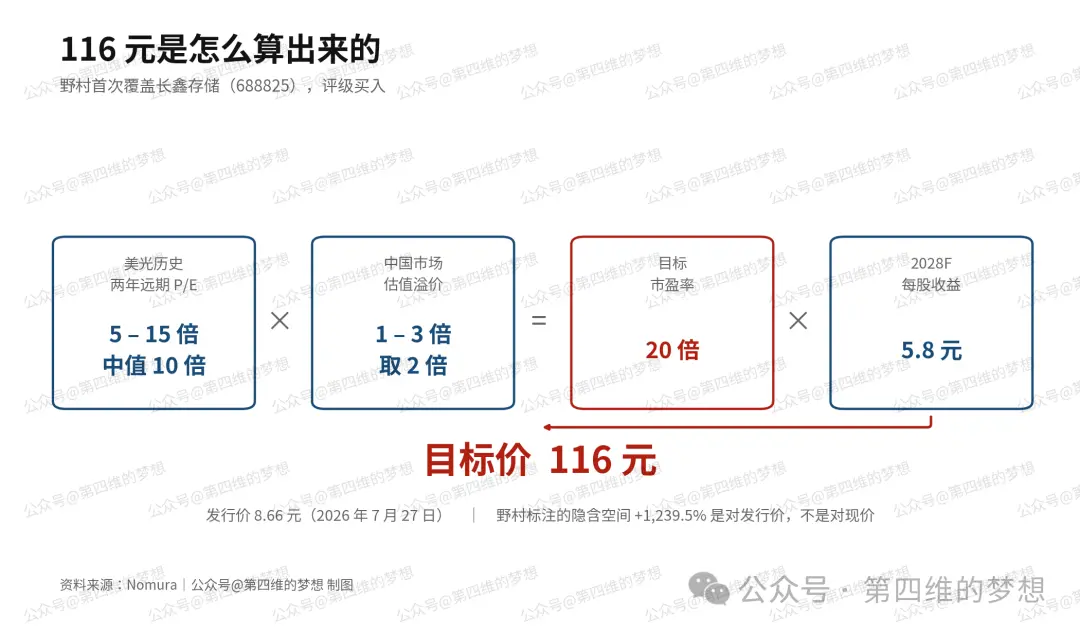
Valuing 20 times the projected 2028 earnings per share of 5.8 yuan results in a target price of 116 yuan.

The key is the anchor of 20 times. Nomura's derivation is a two-step process. First, selecting Micron as the benchmark. Nomura believes Micron is CXMT's closest competitor, and Micron's two-year forward price-to-earnings ratio (P/E) has historically fluctuated roughly between 5x and 15x over the past five years, with a median of 10x. Second, adding a valuation premium for the Chinese market. Nomura used a comparison sample: ACM Research Shanghai versus its US-listed parent company ACM Research. The same business trades at a P/E ratio in the A-share market that is consistently 1 to 3 times that of its US counterpart. Based on this, Nomura assumes CXMT will also trade at 1 to 3 times Micron's valuation. This corresponds to a range of 10x to 30x, with a median of 20x.

Therefore, the figure of 116 yuan essentially equals Micron's historical median valuation multiplied by the Chinese market premium coefficient, multiplied by Nomura's own 2028 earnings forecast.
II. Nomura's Earnings Forecast: Aggressive, to Say the Least

Operating Revenue: 2025 actual 61.799 billion yuan, 2026 forecast 290.666 billion yuan, 2027 560.788 billion yuan, 2028 773.323 billion yuan.

Net Profit Attributable to Parent Company: 2025 actual 1.875 billion yuan, 2026 forecast 130.315 billion yuan, 2027 277.248 billion yuan, 2028 393.070 billion yuan.

Nomura thus projects a compound annual growth rate (CAGR) from 2026 to 2028 of 63% for revenue and 74% for net profit attributable to the parent. Diluted earnings per share would grow from 2.05 yuan in 2026 to 5.79 yuan in 2028.

Calculated based on the offering price of 8.66 yuan, the corresponding P/E ratios are 4.2x for 2026, 2.1x for 2027, and 1.5x for 2028. The 2028 price-to-book ratio (P/B) is 0.6x. This means if Nomura's model holds true, buyers at the IPO price would receive book equity value more than double their investment in three years. Return on equity (ROE) in 2026 is 84%. By the end of 2028, cash on hand is projected at 1,085.5 billion yuan, with net cash at 933.5 billion yuan.

One detail that can easily be missed must be added here. Nomura forecasts post-tax net profit for 2026 at 173.753 billion yuan, but 43.438 billion yuan is deducted for minority interests, leaving only 130.315 billion yuan attributable to the parent. CXMT's equity structure includes a substantial portion of minority interests, which Nomura's model consistently maintains at around 25%. When looking at CXMT's profit, one must look at the line for net profit attributable to the parent, otherwise it will be overestimated by a quarter.

Next is what the author would like to point out: the most aggressive assumption in Nomura's model lies in gross margin. CXMT's gross margin was 41.0% in 2025, while Nomura forecasts 83.7% for 2026, 89.2% for 2027, and 90.5% for 2028.

How can it reach 90%? Because in this table, operating costs are almost stagnant. Operating costs were 36.465 billion yuan in 2025, forecasted to be 47.451 billion yuan in 2026, and 73.560 billion yuan in 2028. Revenue grew from 61.799 billion yuan to 773.323 billion yuan over the same period.In three years, revenue multiplied by 12.5 times, while operating costs only doubled.

In other words, Nomura assumes that almost all of CXMT's increased revenue in these years comes from price increases rather than additional spending, and the increased prices almost entirely fall into profits. There are precedents for this in the memory industry's upcycle, where price elasticity indeed far exceeds cost elasticity. However, extrapolating this all the way to 2028 and a 90% gross margin treats the best part of the cycle as the new normal.

III. Demand Side: Nomura Says Memory Usage Will Increase More Than Sevenfold in the Next Five Years

Supporting the above table is Nomura's judgment on memory demand. Nomura's starting point is agentic AI. The report breaks down an intelligent agent task into eight stages: user request arrival, model weight loading, pre-fill, inference planning, tool calling, context integration, multi-step iteration, and response generation.

The key lies in the sixth and seventh steps. Each time an external tool is called, the returned result must be re-integrated into the context, and the model must reprocess the lengthened context, causing the KV cache to swell. The agent will repeatedly run the cycle of "inference – call tool – integrate," and with each cycle, the context grows longer. Nomura judges thatthe peak memory pressure appears during the seventh step of multi-step iteration, potentially approaching the capacity limits of HBM.

Nomura thus proposes a multiplicative structure: memory demand equals the product of user count, usage duration, task complexity, inference token consumption, and agent penetration rate. A multiplicative relationship means that even moderate growth in individual factors leads to exponential amplification of the total. Nomura's estimate is thatby 2030, the number of concurrently executable intelligent agent tasks globally will be 50 times higher than in 2026.

On the other hand, there is the non-negligible improvement in technological efficiency. Nomura specifically evaluated memory efficiency techniques: KV quantization, Grouped Query Attention (GQA), PagedAttention, prefix caching, Multi-Head Latent Attention (MLA), etc. These technologies can be multiplicative, theoretically compressing memory usage by 4 to 40 times. However, Nomura believesthe actual savings are unlikely to exceed 5 times. Because the largest single source of compression is the quantization of weights and KV, i.e., reducing from FP32/FP16 to INT8/INT4, which itself has a precision floor, while other methods are complementary.

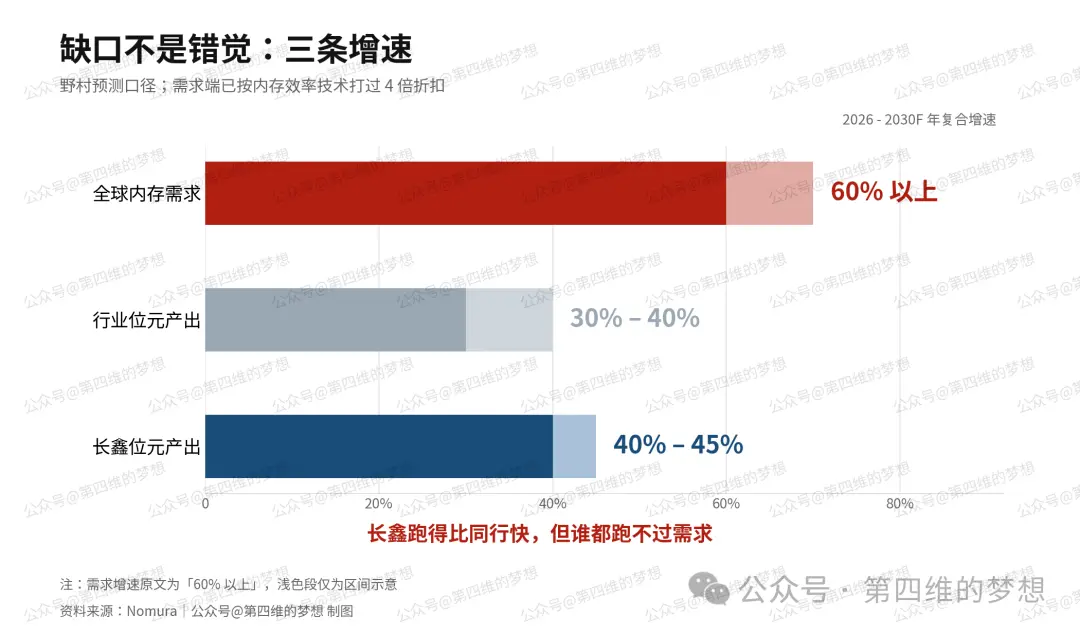
Offsetting both sides, Nomura concludes. Even after discounting for 4x efficiency gains,global memory usage from 2026 to 2030 will still grow more than 7 times, with a CAGR exceeding 60%, and this is calculated under the assumption of zero growth for non-AI applications.

Nomura also cites supporting evidence. Cloudflare's CEO publicly stated that for the first time in internet history, bot traffic has exceeded human traffic. Nomura follows up with a qualitative question: If AI no longer requires human instruction for each task and can run tasks continuously, where is the ceiling for demand? Nomura's answer is that the constraints would then be only three: whether humans are willing to authorize (security concerns), whether infrastructure is sufficient (power, chips, data centers, and most importantly, talent), and the capital expenditure limits of cloud providers and enterprises.

IV. Supply Side: Wanting to Catch Up, But Unable

What is the flip side of demand growing at over 60% CAGR? Nomura estimates that the global memory manufacturers' bit output CAGR will only be 30% to 40%, resulting in a persistent supply-demand gap.

Worse, this gap cannot be filled just by spending more money. Nomura points to bottlenecks: clean rooms, equipment, materials, and, most critically, people. Semiconductor capacity expansion is hitting these walls, with skilled engineers being the most difficult to create quickly.

Nomura also discusses mitigation measures, such as using NAND for offloading, with capacities over 100 times that of DRAM, at the cost of being slower, advancing High Bandwidth Flash (HBF). But Nomura also bluntly states that HBF is not yet ready for mass production, and large-scale replacement with NAND would only tighten NAND supply as well, offering limited relief for DRAM tightness. Nomura's original words: these schemes only slow the trend, not reverse it.

Addressing the market's biggest concern about a cyclical reversal due to frantic capacity expansion by manufacturers, Nomura offers a counterargument. Over the past 15 years, the DRAM industry's capital intensity (capex as % of revenue) mostly ranged between 25% and 45%. However, due to the explosive growth in market size driven by AI demand since September 2025,this ratio may drop to only about 15% in 2026. In other words, measured by historical standards, current industry investment is relatively low compared to market size, and the market can absorb far higher capital expenditure than current levels.

However, Nomura also mentions that as memory prices have surged since September 2025, both manufacturers and customers will gradually realize that stable prices are healthier. Long-term agreements (LTAs) are being signed. Starting in 2028, Nomura believes memory manufacturers will shift their focus from pushing prices to reasonable capacity expansion.

V. CXMT Itself: Capacity, Market Share, Yield, and Price

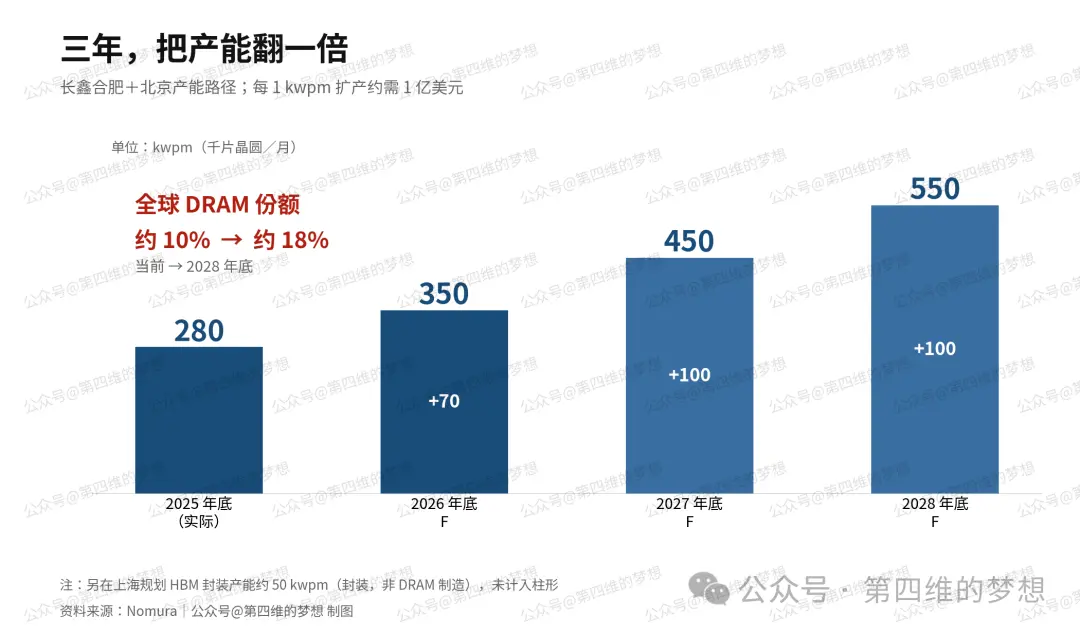
Returning to the company itself. The capacity roadmap Nomura provides is as follows: By the end of 2025, Hefei and Beijing combined have about 280 kwpm (thousand wafer starts per month). It increases to 350 kwpm by the end of 2026. Another 100 kwpm is added each in 2027 and 2028, reaching 550 kwpm by the end of 2028. Additionally, HBM packaging capacity is being built in Shanghai, with a potential scale of 50 kwpm. This part is for packaging, not DRAM manufacturing.

How much will expansion cost? Nomura's rule of thumb is thatroughly $100 million is needed per 1 kwpm of DRAM capacity. CXMT raised 57.9 billion yuan in its July 27th IPO on the STAR Market. If the over-allotment option (greenshoe) is fully exercised, the maximum could reach 66.6 billion yuan.

Assuming full capacity operation, Nomura calculates that CXMT's wafer shipment CAGR from 2026 to 2030 will be 20% to 25%. Additionally, with process node advancement every two years,bit output CAGR will be 40% to 45%.

Industry bit growth: 30% to 40%. CXMT growth: 40% to 45%. Demand growth: over 60%. CXMT runs faster than its peers, but still cannot keep up with demand. Therefore, Nomura's conclusion is thatCXMT will continuously take market share from global peers, while the entire industry remains short-supplied.
The market share target is to increase from the current approximately 10% to about 18% of the global DRAM market by the end of 2028. For reference, Nomura mentions Micron's share is above 20%, with a market capitalization of $960 billion as of July 20, 2026.
Technologically, Nomura estimates CXMT's mainstream process in 2026 is at the 1x-1y node (approximately 16-17nm), with DDR5 yield around 80% and DDR4 yield above 90%. From 2027 onward, it will advance to the 1z-1a node (approximately 10-15nm) and have HBM3 mass-production capability. The entire process does not use EUV, relying on DUV advancement.

Regarding HBM, Nomura mentions that CXMT has already sent HBM3 samples to a leading domestic ICT company and others, but certification takes time. HBM3e is still under development.

The pricing section is what the author finds most informative. Results from Nomura's channel checks with leading domestic mobile phone and PC/server manufacturers indicate that CXMT's quotations are lower than those of overseas leaders, but not by a large margin—about 0% to 20% lower. The main reason is the presence of policy factors supporting local procurement.

However, the cost gap is real. Nomura estimates that, due to being about five years behind overseas leaders in mainstream process technology, CXMT's number of good die per wafer is only a few hundred, while overseas leaders exceed a thousand. Therefore, CXMT's average selling price per wafer (wafer ASP) in 2026 is only about $14,000 to $15,000. As the process migrates from 16-17nm to 14-15nm from 2027 to 2028, increasing bits per wafer, Nomura expects this figure to rise to $21,000 to $25,000.

Another background figure. According to WSTS, China accounted for about 25% of the global DRAM market in 2025. However, Nomura estimates the global share of domestic manufacturers (including CXMT and others) in terms of output value is only about 10%. This means the self-sufficiency rate of domestic DRAM is only around 30%. This is the direct basis for Nomura's belief that CXMT still has significant market share to capture in the domestic market.

Customer-wise, over 85% of CXMT's revenue is completed via distributors. The concentration ratio of the top five customers was 68.08% in 2025. IPO materials disclose that end customers include Alibaba Cloud, ByteDance, Tencent, Lenovo, Xiaomi, Transsion, Honor, OPPO, and Vivo. In terms of product structure, LPDDR series accounted for 66.43% of revenue in 2025, while DDR series accounted for 31.87% (20.16% in 2023). The ramp-up of DDR5 server products is the main reason for this shift.

Nomura also mentions another point: CXMT is collaborating with GigaDevice on DRAM-on-logic wafer-on-wafer (WoW) stacking for edge AI scenarios like automotive smart cockpits, high-end mobile phones/PCs, and robotics. Nomura believes this technology will start gaining significant momentum from the end of 2027.

In the author's opinion, the assumption of a 90% gross margin mentioned earlier is clearly unsustainable. Extrapolating the cyclical peak directly as a long-term norm itself contradicts the operating patterns of the memory industry. Therefore, the correct way to interpret this is to not view the profit assumptions and target price therein as long-term benchmarks, but rather as an upper-limit calculation under conditions of extreme supply-demand tightness and simultaneously optimistic price and profitability.


Logic and Technology, We Are Still on the Journey!

Tiền kỹ thuật số thịnh hành

Câu hỏi Liên quan

QHow did Nomura arrive at the target price of 116 yuan for CXMT?

ANomura's target price of 116 yuan for ChangXin Memory Technologies (CXMT) was calculated by applying a 20x P/E multiple to their forecasted 2028 EPS of 5.8 yuan. This 20x multiple was derived by first establishing a base of 10x, which is the median two-year forward P/E of competitor Micron over the past five years. They then applied a 'China market premium' multiplier of 1x to 3x, based on the valuation differential between ACM Research's Shanghai-listed entity and its U.S.-listed parent, taking the midpoint of 20x.

QWhat are the most aggressive assumptions in Nomura's earnings forecast for CXMT?

AThe most aggressive assumptions in Nomura's forecast are related to gross margin and cost growth. They project CXMT's gross margin to rise from 41.0% in 2025 to 90.5% by 2028. This is based on the assumption that revenues will grow 12.5x by 2028 while cost of revenue only doubles. This effectively models a scenario where price increases contribute almost entirely to profit, extending the peak conditions of a memory upcycle indefinitely, which the article's author criticizes as unsustainable.

QWhat is Nomura's core argument for sustained strong DRAM demand growth through 2030?

ANomura's core argument centers on 'agentic AI'—AI agents that perform multi-step tasks autonomously. They model demand as a multiplicative function of user numbers, usage time, task complexity, token consumption, and agent penetration. Even after accounting for potential 4x efficiency gains from techniques like KV quantization, Nomura concludes that global DRAM bit consumption will still grow over 7x from 2026 to 2030, representing a CAGR exceeding 60%, assuming zero growth from non-AI applications.

QWhat are the key bottlenecks preventing the DRAM supply from catching up with demand, according to Nomura?

ANomura identifies several key bottlenecks limiting DRAM supply expansion: cleanroom capacity, semiconductor equipment, materials, and most critically, a shortage of skilled engineers. They argue that these are not constraints that can be quickly resolved with capital. Additionally, while solutions like using NAND (via HBM) exist, they are not yet ready for mass production and would only shift the supply shortage to another component.

QHow does Nomura justify CXMT gaining global market share despite aggressive industry-wide demand?

ANomura justifies CXMT's market share gains through a relative growth rate comparison. They estimate global DRAM bit supply growth at a 30-40% CAGR, while CXMT's bit output is projected to grow at a 40-45% CAGR, driven by a 20-25% increase in wafer shipments and a biennial process node migration. Since overall AI-driven demand is forecast to grow at >60% CAGR, the market can absorb both industry growth and CXMT's faster expansion. Thus, CXMT gains share from competitors while the entire industry remains in a supply deficit.

Nội dung Liên quan

Vật liệu bị kiểm soát ngầm nhất trong ngành bán dẫn, tăng giá vài lần không ai để ý, vừa bị Trung Quốc cấm

Khí heli, nguyên tố phổ biến thứ hai trong vũ trụ, lại cực kỳ khan hiếm trên Trái Đất và không thể tổng hợp nhân tạo. Nó chỉ có thể được chiết xuất từ khí tự nhiên với hàm lượng cực thấp, và một khi thoát ra ngoài, nó sẽ bay vào không gian vĩnh viễn. Dù vậy, heli là nguyên liệu thô không thể thay thế trong quy trình sản xuất chip tiên tiến nhất hiện nay, với yêu cầu độ tinh khiết lên đến 99,9999%. Nó được sử dụng trong khắc plasma, kiểm tra rò rỉ, kiểm soát nhiệt độ bệ đỡ máy quang khắc và nhiều công đoạn quan trọng khác tại các nhà máy bán dẫn. Không có nó, nhiều hoạt động sản xuất chip sẽ dừng lại. Tuy nhiên, heli là vật liệu ít được chú ý nhất trong chuỗi cung ứng bán dẫn. Giá của nó đã tăng gấp đôi mà hầu như không được đưa tin. Ngày 10 tháng 7, Trung Quốc đã đột ngột cấm xuất khẩu khí heli, một động thái hầu như không gây tiếng vang trên truyền thông. Nhưng đằng sau đó là một cơn khủng hoảng thiếu hụt toàn cầu nghiêm trọng: trung tâm sản xuất heli lớn nhất thế giới ở Qatar bị tấn công bằng tên lửa vào tháng 3, phá hủy năng lực xuất khẩu và cần 3-5 năm để sửa chữa; khoảng 200 bình chứa heli lỏng bị mắc kẹt ở Trung Đông; giá heli toàn cầu tăng gấp đôi. Ba quốc gia kiểm soát 85% nguồn cung heli toàn cầu là Mỹ, Qatar và Nga. Qatar (chiếm 1/3) đã ngừng sản xuất, Mỹ đã bán kho dự trữ chiến lược liên bang, và Nga áp dụng chế độ cấp phép đặc biệt cho xuất khẩu từ tháng 4/2026. Ngành công nghiệp chip đang lo ngại về tình trạng thiếu hụt kéo dài, có thể buộc phải cắt giảm sản xuất, ưu tiên chip AI và HBM. Trung Quốc là nước phụ thuộc nhiều vào nhập khẩu heli (84,4%), chủ yếu từ Qatar và Nga. Động thái cấm xuất khẩu được coi là để đảm bảo nguồn cung trong nước. Điều đáng chú ý là dù thiếu tài nguyên, Trung Quốc đã phát triển công nghệ sản xuất heli nội địa bằng cách tận dụng khí thải từ các nhà máy LNG, đạt độ tinh khiết 6N9 vào năm 2025. Tuy sản lượng còn nhỏ (tự cung dưới 20%), nhưng đây là bước tiến quan trọng. Cuộc khủng hoảng heli toàn cầu được dự báo sẽ còn kéo dài, buộc các quốc gia phải xem xét lại tầm quan trọng chiến lược của nguồn tài nguyên dễ bay hơi này.

marsbit19 phút trước

Vật liệu bị kiểm soát ngầm nhất trong ngành bán dẫn, tăng giá vài lần không ai để ý, vừa bị Trung Quốc cấm

marsbit19 phút trước

Nhà đầu tư giai đoạn đầu của Unitree đặt cược vào một công ty Brain-Computer Interface

"Wabo Technology, một công ty khởi nghiệp về giao diện não-máy (BCI) có trụ sở tại Thành Đô, vừa hoàn thành vòng đầu tư thiên thần với sự tham gia của các quỹ Vertex Ventures (thuộc Temasek), Hongtai Fund, Chengdu Future Industry Fund và Huifengda Capital. Vertex Ventures, nhà đầu tư ban đầu vào Unitree, cũng nằm trong số những người ủng hộ. Được thành lập vào cuối năm 2025 bởi Zhang Xingzhi, một Tiến sĩ từ Đại học Thanh Hoa, Wabo Technology tập trung vào phát triển "mô hình ý định thần kinh của con người", một hệ thống giải mã và biểu diễn tín hiệu thần kinh. Cách tiếp cận này nhằm mục đích giúp AI hiểu được ý định thực sự của con người trước khi hành động, ví dụ như phân biệt giữa việc định uống nước hay đặt cốc xuống, thông qua việc kết hợp dữ liệu EEG, EMG, hành vi và ngữ cảnh. Công ty có kế hoạch thiết lập trụ sở song phương tại Thành Đô (tập trung vào phần cứng và sản xuất) và Thượng Hải (tập trung vào R&D và mô hình tiên tiến). Wabo cũng đang hợp tác với Đại học Thiên Tân trong các thử nghiệm BCI ngoài không gian, một lĩnh vực thu hút sự quan tâm của các nhà đầu tư vào lĩnh vực hàng không vũ trụ thương mại. Ngành công nghiệp BCI ở Trung Quốc đang chứng kiến sự bùng nổ đầu tư, với hơn 45 tỷ nhân dân tệ được huy động chỉ trong 5 tháng đầu năm 2026. Zhang Xingzhi dự đoán rằng ngành sẽ chứng kiến sự hợp nhất trong vòng ba năm tới, và chỉ những công ty có thể thiết lập vòng lặp khép kín hiệu quả giữa dữ liệu, mô hình và ứng dụng thực tế mới tồn tại được. Tầm nhìn dài hạn của Wabo là biến những hình ảnh khoa học viễn tưởng, như trong phim 'Avatar', thành hiện thực bằng cách cho phép ý định của con người điều khiển trực tiếp nhiều loại thiết bị và robot khác nhau."

marsbit33 phút trước

Nhà đầu tư giai đoạn đầu của Unitree đặt cược vào một công ty Brain-Computer Interface

marsbit33 phút trước

Công nghệ Trường Tín: Cổ phiếu chu kỳ đứng trên đỉnh chu kỳ

Bài báo phân tích Changxin Technology (CXMT) - doanh nghiệp DRAM Trung Quốc đạt vốn hóa 3,28 nghìn tỷ nhân dân tệ, tăng 465% trong ngày đầu niêm yết (7/2026). Từ chỗ lỗ 16,3 tỷ năm 2023, công ty dự kiến lãi 50-57 tỷ trong nửa đầu 2026, chủ yếu nhờ chu kỳ tăng giá DRAM. Nguyên nhân bùng nổ là sự thiếu hụt nguồn cung DRAM thông dụng khi các hãng lớn (Samsung, SK Hynix, Micron) chuyển hướng sản xuất sang HBM (bộ nhớ băng thông cao) phục vụ AI. Tuy nhiên, chu kỳ ngành DRAM (3-4 năm/lần) bắt nguồn từ đặc điểm: sản phẩm tiêu chuẩn hóa cao và thời gian xây dựng nhà máy kéo dài (2-3 năm), dẫn đến việc mở rộng sản xuất dễ gây dư thừa. Làn sóng đầu tư mới đang diễn ra mạnh mẽ, với tổng chi tiêu vốn của các hãng lớn gần 70 tỷ USD. Dự báo giá DRAM sẽ tăng chậm lại vào nửa cuối 2026 và có thể đảo chiều vào khoảng năm 2028 khi năng lực sản xuất mới đi vào hoạt động. Thách thức then chốt của CXMT là đẩy nhanh tiến độ phát triển HBM - thị trường sinh lời cao nhất hiện nay - để có khả năng vượt chu kỳ. Bài viết kết luận CXMT là một công ty tốt, đột phá trong việc tự chủ bán dẫn, nhưng đồng thời cũng là một cổ phiếu chu kỳ điển hình. Lợi nhuận hiện tại phản ánh đỉnh chu kỳ. Nhà đầu tư cần tỉnh táo nhìn nhận cả hai góc độ: câu chuyện tăng trưởng dài hạn (thay thế nhập khẩu, AI) và rủi ro điều chỉnh khi chu kỳ đảo chiều.

marsbit39 phút trước

Công nghệ Trường Tín: Cổ phiếu chu kỳ đứng trên đỉnh chu kỳ

marsbit39 phút trước

Tại sao quý kiếm tiền nhất lịch sử SK Hynix vẫn 'dưới kỳ vọng'?

SK Hynix vừa công bố báo cáo tài chính quý II năm 2026 với mức lợi nhuận kỷ lục: doanh thu 79,32 nghìn tỷ Won (tăng 257%), lợi nhuận hoạt động 60,54 nghìn tỷ Won (tăng 557%) và biên lợi nhuận hoạt động đạt 76%. Tuy nhiên, hai chỉ số này đều thấp hơn một chút so với kỳ vọng của thị trường (84 và 64 nghìn tỷ Won), dẫn đến biến động mạnh của cổ phiếu. Nguyên nhân chính là do cơ cấu lợi nhuận thay đổi: tỷ trọng cao của sản phẩm HBM (theo hợp đồng dài hạn) hạn chế khả năng hưởng lợi từ giá giao ngay tăng mạnh, trong khi tốc độ tăng giá DRAM và NAND thông thường đã chậm lại. Dù vậy, triển vọng từ SK Hynix vẫn lạc quan. Công ty dự báo nhu cầu DRAM toàn cầu năm 2026 tăng trung bình 20%, NAND tăng khoảng 15-19%, và khẳng định chưa thấy dấu hiệu đầu tư AI chậm lại. Họ đã ký kết nhiều hợp đồng cung ứng dài hạn (LTA) với các khách hàng lớn để ổn định doanh thu. Về sản phẩm, HBM4 đã bắt đầu giao hàng và sẽ tăng sản lượng vào nửa cuối năm, HBM4E đã gửi mẫu cho khách hàng chính. Kế hoạch chi tiêu vốn (CapEx) cho năm 2026 vẫn được duy trì ở mức cao (trên 40 nghìn tỷ Won), cho thấy sự tin tưởng vào nhu cầu AI dài hạn. Thị trường hiện đang trong cuộc giằng co giữa phe tin tưởng vào chu kỳ mở rộng hạ tầng AI và phe lo ngại định giá đã phản ánh hết triển vọng tăng trưởng. SK Hynix, với tư cách là doanh nghiệp dẫn đầu, đang chịu áp lực phải liên tục vượt kỳ vọng để thúc đẩy cổ phiếu.

Odaily星球日报1 giờ trước

Tại sao quý kiếm tiền nhất lịch sử SK Hynix vẫn 'dưới kỳ vọng'?

Odaily星球日报1 giờ trước

Giao dịch

Giao ngay

Bài viết Nổi bật

Làm thế nào để Mua CAP

Chào mừng bạn đến với HTX.com! Chúng tôi đã làm cho mua Cap (CAP) trở nên đơn giản và thuận tiện. Làm theo hướng dẫn từng bước của chúng tôi để bắt đầu hành trình tiền kỹ thuật số của bạn.Bước 1: Tạo Tài khoản HTX của BạnSử dụng email hoặc số điện thoại của bạn để đăng ký tài khoản miễn phí trên HTX. Trải nghiệm hành trình đăng ký không rắc rối và mở khóa tất cả tính năng. Nhận Tài khoản của tôiBước 2: Truy cập Mua Crypto và Chọn Phương thức Thanh toán của BạnThẻ Tín dụng/Ghi nợ: Sử dụng Visa hoặc Mastercard của bạn để mua Cap (CAP) ngay lập tức.Số dư: Sử dụng tiền từ số dư tài khoản HTX của bạn để giao dịch liền mạch.Bên thứ ba: Chúng tôi đã thêm những phương thức thanh toán phổ biến như Google Pay và Apple Pay để nâng cao sự tiện lợi.P2P: Giao dịch trực tiếp với người dùng khác trên HTX.Thị trường mua bán phi tập trung (OTC): Chúng tôi cung cấp những dịch vụ được thiết kế riêng và tỷ giá hối đoái cạnh tranh cho nhà giao dịch.Bước 3: Lưu trữ Cap (CAP) của BạnSau khi mua Cap (CAP), lưu trữ trong tài khoản HTX của bạn. Ngoài ra, bạn có thể gửi đi nơi khác qua chuyển khoản blockchain hoặc sử dụng để giao dịch những tiền kỹ thuật số khác.Bước 4: Giao dịch Cap (CAP)Giao dịch Cap (CAP) dễ dàng trên thị trường giao ngay của HTX. Chỉ cần truy cập vào tài khoản của bạn, chọn cặp giao dịch, thực hiện giao dịch và theo dõi trong thời gian thực. Chúng tôi cung cấp trải nghiệm thân thiện với người dùng cho cả người mới bắt đầu và người giao dịch dày dạn kinh nghiệm.

Tổng lượt xem 258Xuất bản vào 2026.06.26Cập nhật vào 2026.06.26

Làm thế nào để Mua CAP

Thảo luận

Chào mừng đến với Cộng đồng HTX. Tại đây, bạn có thể được thông báo về những phát triển nền tảng mới nhất và có quyền truy cập vào thông tin chuyên sâu về thị trường. Ý kiến ​​của người dùng về giá của CAP (CAP) được trình bày dưới đây.

活动图片