JP Morgan Tokenized Fund Surges 250% in TVL in One Month, Institutional Funds Are Treating Ethereum as the Default Underlying Layer

marsbitXuất bản vào 2026-07-07Cập nhật gần nhất vào 2026-07-07

Tóm tắt

JPMorgan's tokenized money market fund, JLTXX, has seen its on-chain total value locked (TVL) surge approximately 250% in a month, reaching nearly $700 million from an initial $200 million since its launch seven weeks ago. The fund, which invests in short-term U.S. Treasuries and repos, operates exclusively on the public Ethereum mainnet, signaling growing institutional acceptance of Ethereum as a foundational layer for compliant financial products. A key driver of this growth is its inclusion as reserve assets for stablecoins like USDG, meeting requirements under U.S. stablecoin legislation. Simultaneously, despite a significant price decline—ETH has fallen over 50% from its 2025 high—institutional accumulation continues. BitMine Immersion Technologies, led by Tom Lee, purchased an additional $73 million worth of ETH last week, bringing its holdings to roughly 4.8% of Ethereum's circulating supply. The article highlights a divergence: while the tokenization of real-world assets and stablecoin reserves is driving long-term institutional adoption of Ethereum's infrastructure, short-term price action remains pressured by market sentiment and ETF outflows. This suggests that institutional on-chain activity, though a positive fundamental development, may not serve as a reliable signal for near-term price bottoms.

Author: Claude, Deep Tide TechFlow

Deep Tide Introduction: If you're still holding Ethereum, with its price more than halved this year, you might be wondering who's buying at these levels.

The answer is the most conservative money on Wall Street. JP Morgan's tokenized money market fund, JLTXX, has seen its on-chain size surge from $200 million to nearly $700 million in seven weeks, growing about 250% in one month, and it runs exclusively on Ethereum. In the same week, BitMine, led by Tom Lee, purchased another $73 million worth of ETH, bringing its total holdings to about 4.8% of Ethereum's circulating supply. The ETH price is falling, but institutions are accumulating; these two things are happening simultaneously.
JP Morgan has quietly turned a tokenized fund into one of the fastest-growing products in recent years.

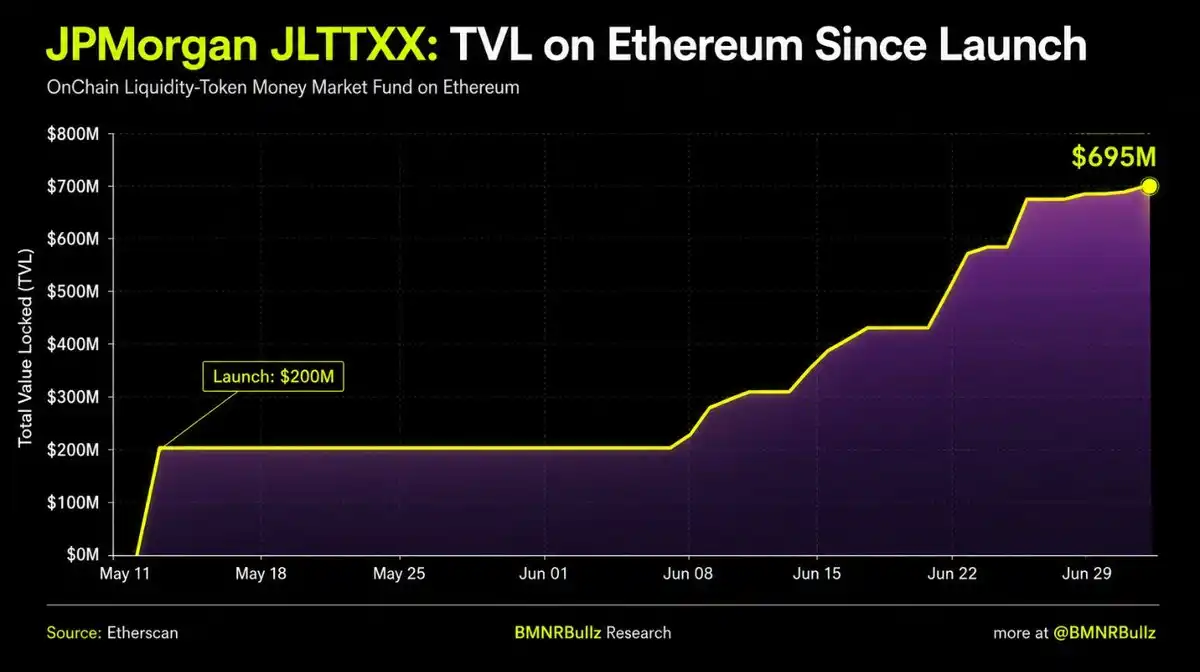
According to The Defiant, the on-chain management scale of JP Morgan's OnChain Liquidity Token Money Market Fund (ticker: JLTXX) grew by approximately 250% over the past month, based on data from blockchain analytics platform Token Terminal. This fund operates only on Ethereum.

From $200M to Nearly $700M in Seven Weeks, JP Morgan Seeded with Its Own Capital

JLTXX launched on May 13th. JP Morgan initially seeded it with $100 million of its own capital, and custodian Anchorage Digital also participated in the initial subscription. The on-chain total value locked (TVL) on the first day was about $200 million. According to a post by ethereuminsti on X, this number reached $695 million seven weeks later, a 248% increase, closely matching Token Terminal's ~250% figure.

The fund's investments are anything but aggressive, consisting entirely of short-term U.S. Treasury bills and overnight repurchase agreements fully collateralized by Treasuries or cash, identical to the safest assets in traditional money market funds. What's truly different is where it runs. JP Morgan has its own private settlement network called Kinexys, but JLTXX, like the bank's first tokenized fund MONY launched last December, chose the public Ethereum mainnet over its own chain. The fact that a bank with its own blockchain infrastructure places its product on a public chain is a signal in itself.

For ETH holders, the implication here is: Ethereum is gradually transforming from a speculative asset into an underlying ledger for compliant financial products in the eyes of institutions. This type of demand has little relation to short-term price fluctuations but will solidify into long-term network usage.

Stablecoin Reserve Needs Behind the Growth

The rapid growth of JLTXX is partly because it's being used as a reserve for stablecoins.

According to disclosures by a Dune analysis account, this fund has been added to the reserve asset pool for the USDG stablecoin, alongside BlackRock's BUIDL and Superstate's STBXX. This points to a growing demand: stablecoin issuers need on-chain Treasury exposure that complies with the rules of the GENIUS Act. The GENIUS Act, U.S. stablecoin legislation passed in 2025, specifies the conditions that stablecoin reserve assets must meet, and tokenized Treasury money market funds fit perfectly into this niche.

JP Morgan designed JLTXX to accept subscriptions both in cash and stablecoins, effectively positioning the fund at the intersection of regulated finance and crypto-native infrastructure. It's not alone in this race. BlackRock has filed documents with the SEC for two tokenized money market products, one of which involves tokenizing a share class of its existing $6.1 billion BlackRock US Treasury Fund on Ethereum. BlackRock's BUIDL is currently the world's largest tokenized fund, with assets under management surpassing $2.8 billion in early 2026 and spanning eight blockchains.

Observers can discern the direction from this: stablecoin reserves are a cake that is definitely growing, and institutions are almost unanimously choosing Ethereum as the foundational layer for that cake.

BitMine Buys Another $73M in a Week, Holdings Approach 5% of Circulating Supply

While traditional finance approaches Ethereum from the asset side, accumulation on-chain hasn't stopped.

According to a holdings update released on Monday by BitMine Immersion Technologies (NYSE: BMNR), the Ethereum treasury company chaired by Fundstrat's Tom Lee purchased 42,197 ETH over the past week, valued at approximately $73 million at the time. This purchase brings BitMine's total ETH holdings to 5,742,237, accounting for about 4.8% of Ethereum's circulating supply. BitMine's own accounts list its crypto and other asset total value at $11.1 billion, including its ETH position valued at $1,800 per ETH, 206 BTC, a $180 million stake in Beast Industries, a $71 million stake in Eightco Holdings, and $527 million in cash and marketable securities.
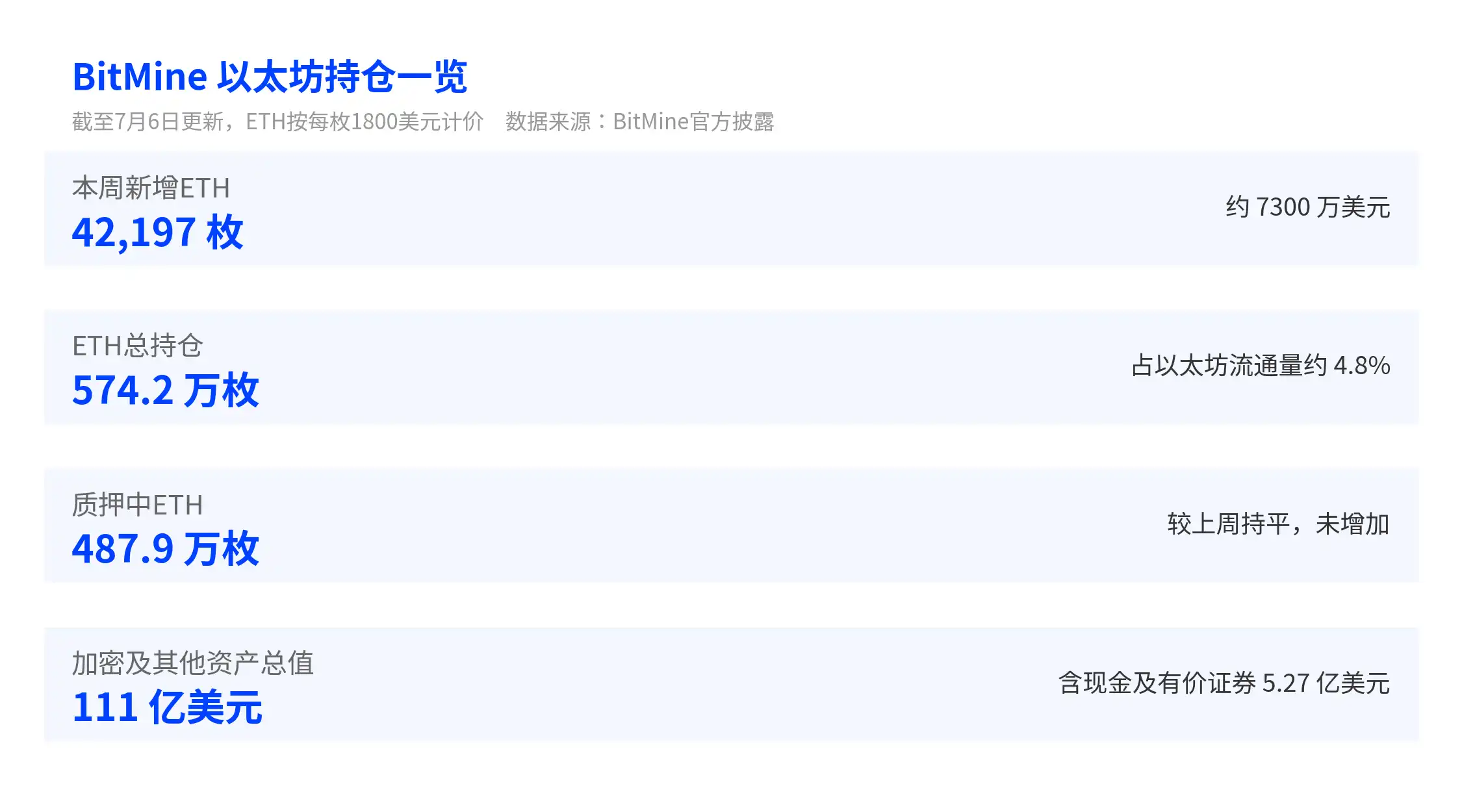
One detail worth noting for holders: BitMine's staked ETH amount remained flat at 4,879,157, meaning the newly acquired coins this week were not staked. The company's publicly stated goal is to control 5% of Ethereum's total supply, and its weekly accumulation is approaching that threshold.

A risk note is warranted here: BitMine's holding value is highly dependent on the coin price. Its accounts value ETH at $1,800, while as of July 6th, the spot ETH price was around $1,747, already below its valuation benchmark. In June this year, insiders also warned that the company faced a cash shortfall of about $30 million, which Tom Lee publicly denied as a financing crisis. For those following such treasury companies to go long on ETH, the double leverage of the company's stock price and the coin price is a double-edged sword.

Price Falls, Institutions Buy: How to Read This Divergence

Putting the two threads together paints a contradictory picture: institutions are accelerating their entry while the coin price is moving down.

Ethereum has had a tough year. According to multiple market data sources, ETH has fallen over 50% from its all-time high of around $4,900 in August 2025. It closed the first three quarters of 2026 with three consecutive quarterly declines, the first recorded three-quarter losing streak. Spot Ethereum ETFs also recorded net outflows in June. On-chain activity is declining too. According to Glassnode data, the 14-day moving average of active addresses dropped from about 795,000 in early February to about 420,000 in June, a decline of about 46%.

Therefore, the growth in JP Morgan's fund size and BitMine's holdings tells a different story from the secondary market price action. Institutions are buying into Ethereum's long-term position as a settlement layer and compliant asset infrastructure, betting on the stablecoin reserve and tokenized asset trend. The secondary market is selling based on short-term liquidity, sentiment, and ETF fund flows. These two narratives can diverge for a long time, and there's no certainty about which will materialize first.

For holders or potential entrants, the operational implication here is: institutional accumulation and the tokenization narrative are real, fundamental changes, but they do not constitute a short-term price floor. Historically, concentrated buying by large holders hasn't always been a clean buy signal; a local top followed the whale accumulation in February. It's valid to consider institutional entry as a long-term logic, but caution is advised when using it as a basis for timing a market bottom.

Tiền kỹ thuật số thịnh hành

Câu hỏi Liên quan

QWhat is the growth rate of JPMorgan Chase's tokenized fund JLTXX in terms of on-chain TVL over the past month, and on which blockchain does it operate?

AJPMorgan Chase's tokenized money market fund JLTXX has seen its on-chain Total Value Locked (TVL) increase by approximately 250% over the past month. It operates exclusively on the Ethereum blockchain.

QAccording to the article, what is the primary traditional asset composition of the JLTXX fund, and what new demand is driving its growth?

AThe JLTXX fund is invested in conservative, traditional assets such as short-term U.S. Treasury bills and overnight repurchase agreements fully collateralized by Treasuries or cash. Its growth is partly driven by its inclusion as a reserve asset for stablecoins, meeting the requirements of U.S. regulations like the GENIUS Act for on-chain Treasury exposure.

QHow much ETH did BitMine Immersion Technologies purchase in the week prior to the article's publication, and what is the company's stated long-term goal regarding Ethereum's supply?

ABitMine Immersion Technologies purchased 42,197 ETH (worth approximately $73 million at the time) in the week before the article's publication. The company's publicly stated goal is to control 5% of Ethereum's total supply.

QWhat contradictory market trends regarding Ethereum does the article highlight between institutional activity and price action?

AThe article highlights a contradiction where institutional activity is increasing (e.g., JPMorgan's growing tokenized fund and BitMine's accumulating ETH holdings), while Ethereum's price is declining significantly, having fallen over 50% from its 2025 highs. This suggests institutions are betting on Ethereum's long-term utility as a settlement layer, while short-term market prices are driven by different factors like sentiment and ETF flows.

QName one other major financial institution mentioned in the article that is also active in the tokenized fund space, and what is the name of its flagship product?

ABlackRock is another major financial institution active in the tokenized fund space mentioned in the article. Its flagship tokenized fund is called BUIDL, which was the world's largest tokenized fund with over $2.8 billion in assets under management as of early 2026.

Nội dung Liên quan

Đáy Đang Hình Thành

**Tóm tắt: Quá Trình Tạo Đáy Đang Diễn Ra** Thị trường Bitcoin đang cho thấy những dấu hiệu của giai đoạn cuối trong một thị trường gấu. Phân tích toàn diện từ ba lớp: vĩ mô, on-chain và off-chain, đều nhất quán với nhận định này. * **On-chain:** Giá đã giao dịch trong vùng giá trị sâu (deep value) trong khoảng 5 tháng, một dấu hiệu tích lũy kéo dài thường thấy trước khi tạo đáy. Tuy nhiên, áp lực bán từ các nhà đầu tư dài hạn đang chốt lỗ vẫn rất mạnh, đạt mức cao nhất kể từ tháng 12/2022, cho thấy sự phân phối nguồn cung vẫn tiếp diễn. Một sự giảm nhiệt bền vững của chỉ số này là điều kiện tiên quyết cho sự chuyển dịch sang xu hướng tăng. * **Off-chain:** Dòng tiền rút ra khỏi các ETF Bitcoin Mỹ đã giảm tốc so với đỉnh tháng Sáu nhưng vẫn âm tính trên cơ sở hàng tháng. Khối lượng giao dịch ETF duy trì ở mức thấp, chỉ bằng khoảng 20% so với đỉnh năm 2025, phản ánh sự thiếu vắng niềm tin mạnh mẽ từ các nhà đầu tư tổ chức. * **Phái sinh:** Vị thế trên thị trường phái sinh đã nghiêng về phe mua một cách thận trọng, với tỷ lệ put/call mở ở mức thấp nhất năm 2026. Tuy nhiên, cấu trúc quyền chọn vẫn cho thấy nhà giao dịch sẵn sàng trả phí cao để phòng ngừa rủi ro giảm giá, mặc dù mức phí này đang giảm dần. **Kết luận:** Các điều kiện cho một quá trình tạo đáy đang hình thành, với giai đoạn tích lũy kéo dài và vị thế phái sinh không quá bán. Tuy nhiên, thị trường vẫn thiếu các tín hiệu xác nhận quan trọng: áp lực chốt lỗ từ nhà đầu tư dài hạn cần giảm mạnh, dòng tiền ETF cần ổn định, và giá cần tái chiếm lại các mức trung bình thị trường then chốt. Cho đến khi những tín hiệu này xuất hiện, xác suất cho một sự chuyển đổi xu hướng bền vững vẫn chưa thể được đánh giá một cách tích cực.

insights.glassnode3 phút trước

Đáy Đang Hình Thành

insights.glassnode3 phút trước

Giải mã chu kỳ altcoin 2026: Vốn đang chuyển dịch khỏi các đồng vốn hóa lớn?

Luồng vốn luân chuyển không cho thấy dấu hiệu rõ ràng về một chu kỳ altcoin rộng khắp. Chu kỳ này có vẻ khác biệt, với dữ liệu on-chain chỉ ra rằng altcoin đang thể hiện kém nhất so với Bitcoin (BTC) trong lịch sử. Điều này cho thấy thanh khoản không lan tỏa khắp thị trường altcoin mà đang luân chuyển vào một số lĩnh vực được tin tưởng cao, trong khi hầu hết tài sản vẫn tụt hậu so với BTC. Khoảng 40% altcoin vẫn giao dịch dưới mức đỉnh mọi thời đại, dù tổng vốn hóa thị trường altcoin tăng 4% trong quý 3. Tỷ lệ ETH/BTC tăng trong thị trường biến động có thể là tín hiệu sớm cho một chu kỳ altcoin, nhưng hiệu suất yếu kém của altcoin so với Bitcoin đặt ra câu hỏi: Liệu chu kỳ này có khác biệt, khi thanh khoản chỉ chảy vào một vài tài sản chính? Các chuyên gia khuyên nhà đầu tư nên "chọn lọc". Các tài sản vốn hóa lớn như Ethereum (ETH) và Solana vẫn giao dịch thấp hơn nhiều so với đỉnh cũ. Trong khi đó, TVL trên Robinhood Chain tăng vọt >150% trong 24 giờ, cho thấy vốn đang đổ vào các câu chuyện đầu tư có độ tin cậy cao thay vì các altcoin vốn hóa lớn nói chung. Sức mạnh gần đây của ETH có thể chỉ là kỹ thuật, và áp lực lên các altcoin vốn hóa lớn có thể tiếp tục nếu thanh khoản vẫn chọn lọc.

ambcrypto9 phút trước

Giải mã chu kỳ altcoin 2026: Vốn đang chuyển dịch khỏi các đồng vốn hóa lớn?

ambcrypto9 phút trước

Ethereum và Bitcoin đối mặt với đợt siết nguồn cung lịch sử – 2 chỉ số này tiết lộ điều gì sắp xảy ra

Dù thị trường biến động nhiều tháng qua, nhưng các nhà nắm giữ Ethereum và Bitcoin vẫn thể hiện ít quan tâm đến việc chuyển coin trở lại các sàn giao dịch. Điều này phản ánh nhiều hơn là sự giảm nhiệt tình giao dịch của nhà đầu tư. Các khoản rút tiền liên tục tiếp tục làm giảm nguồn cung lưu động sẵn có trên thị trường. Số lượng Bitcoin trên các sàn đang ở mức thấp nhất kể từ năm 2017, trong khi số Ethereum (ETH) trên sàn cũng ở mức thấp kỷ lục kể từ năm 2015. Dòng chảy ròng âm liên tục cho thấy các tổ chức và nhà nắm giữ dài hạn đang ưa chuộng các mô hình tự lưu ký như ETF hoặc kho bạc công ty. Sự di chuyển này sẽ loại bỏ thêm coin khỏi áp lực bán tiềm năng, tạo ra sự khan hiếm và có thể khuếch đại biến động giá nếu nhu cầu phục hồi. Ở phía sau, các Nhà Nắm Giữ Dài Hạn Bitcoin đang ổn định hấp thụ nguồn cung lưu hành. Chỉ số Thay đổi Vị thế Ròng của Nhà Nắm Giữ Dài Hạn đã trở lại vùng tích cực, xác nhận sự chuyển dịch từ phân phối sang tích lũy. Nguồn cung do Nhà Nắm Giữ Dài Hạn nắm giữ đang tiến gần 15 triệu BTC, trong khi nguồn cung của Nhà Nắm Giữ Ngắn Hạn giảm xuống khoảng 16,75 triệu BTC. Hành vi này cho thấy Bitcoin đang chuyển từ những người tham gia ngắn hạn sang những người nắm giữ có niềm tin vững chắc hơn. Tóm lại, mặc dù nguồn cung trên sàn của cả Bitcoin và Ethereum đang thắt chặt, củng cố xu hướng tích lũy dài hạn, nhưng Bitcoin vẫn cần nhu cầu mua mạnh mẽ hơn để duy trì đà phục hồi bền vững giữa bối cảnh nguồn cung đang thu hẹp.

ambcrypto4 giờ trước

Ethereum và Bitcoin đối mặt với đợt siết nguồn cung lịch sử – 2 chỉ số này tiết lộ điều gì sắp xảy ra

ambcrypto4 giờ trước

AxBlade × AWS Hong Kong Summit Kết Thúc: Định Nghĩa Tính Chịu Trách Nhiệm cho Physical AI

AxBlade, lớp trách nhiệm giải trình cho AI tự trị, đã đồng tổ chức sự kiện bên lề độc quyền "Từ AI Tác nhân đến AI Vật lý: Điều gì sẽ được tài trợ sau Làn sóng Mô hình?" cùng với AWS Summit Hong Kong. Sự kiện chỉ dành cho khách mời, quy tụ hơn 100 nhà sáng lập, nhà nghiên cứu, lãnh đạo doanh nghiệp và nhà đầu tư để thảo luận về khoảng trống hạ tầng quan trọng giữa demo AI và triển khai thực tế. Các phiên thảo luận đi đến đồng thuận: nếu không có danh tính có thể xác minh, môi trường thực thi đáng tin cậy và hồ sơ hoạt động có thể chứng minh bằng mật mã, AI Vật lý không thể chuyển từ phòng thí nghiệm sang sản xuất. Các chủ đề bao gồm xu hướng đầu tư vào hạ tầng, các thách thức về trách nhiệm pháp lý, an toàn, quản trị và phần mềm trung gian kỹ thuật cần thiết để chuyển từ demo sang triển khai doanh nghiệp. Là lớp hạ tầng blockchain duy nhất được giới thiệu tại hội nghị, AxBlade trình bày giải pháp kết hợp Blockchain Layer 2, Danh tính AI (DID), Môi trường Thực thi Tin cậy (TEE) và Bằng chứng Không tiết lộ Thông tin về Hành vi (PoB) để giải quyết khoảng trống trách nhiệm giải trình, giúp các hệ thống tự trị có thể kiểm tra, truy xuất nguồn gốc và tuân thủ.

TheNewsCrypto4 giờ trước

AxBlade × AWS Hong Kong Summit Kết Thúc: Định Nghĩa Tính Chịu Trách Nhiệm cho Physical AI

TheNewsCrypto4 giờ trước

Giao dịch

Giao ngay

Bài viết Nổi bật

Làm thế nào để Mua LAYER

Chào mừng bạn đến với HTX.com! Chúng tôi đã làm cho mua Solayer (LAYER) trở nên đơn giản và thuận tiện. Làm theo hướng dẫn từng bước của chúng tôi để bắt đầu hành trình tiền kỹ thuật số của bạn.Bước 1: Tạo Tài khoản HTX của BạnSử dụng email hoặc số điện thoại của bạn để đăng ký tài khoản miễn phí trên HTX. Trải nghiệm hành trình đăng ký không rắc rối và mở khóa tất cả tính năng. Nhận Tài khoản của tôiBước 2: Truy cập Mua Crypto và Chọn Phương thức Thanh toán của BạnThẻ Tín dụng/Ghi nợ: Sử dụng Visa hoặc Mastercard của bạn để mua Solayer (LAYER) ngay lập tức.Số dư: Sử dụng tiền từ số dư tài khoản HTX của bạn để giao dịch liền mạch.Bên thứ ba: Chúng tôi đã thêm những phương thức thanh toán phổ biến như Google Pay và Apple Pay để nâng cao sự tiện lợi.P2P: Giao dịch trực tiếp với người dùng khác trên HTX.Thị trường mua bán phi tập trung (OTC): Chúng tôi cung cấp những dịch vụ được thiết kế riêng và tỷ giá hối đoái cạnh tranh cho nhà giao dịch.Bước 3: Lưu trữ Solayer (LAYER) của BạnSau khi mua Solayer (LAYER), lưu trữ trong tài khoản HTX của bạn. Ngoài ra, bạn có thể gửi đi nơi khác qua chuyển khoản blockchain hoặc sử dụng để giao dịch những tiền kỹ thuật số khác.Bước 4: Giao dịch Solayer (LAYER)Giao dịch Solayer (LAYER) dễ dàng trên thị trường giao ngay của HTX. Chỉ cần truy cập vào tài khoản của bạn, chọn cặp giao dịch, thực hiện giao dịch và theo dõi trong thời gian thực. Chúng tôi cung cấp trải nghiệm thân thiện với người dùng cho cả người mới bắt đầu và người giao dịch dày dạn kinh nghiệm.

Tổng lượt xem 511Xuất bản vào 2025.02.11Cập nhật vào 2026.06.02

Làm thế nào để Mua LAYER

Thảo luận

Chào mừng đến với Cộng đồng HTX. Tại đây, bạn có thể được thông báo về những phát triển nền tảng mới nhất và có quyền truy cập vào thông tin chuyên sâu về thị trường. Ý kiến ​​của người dùng về giá của LAYER (LAYER) được trình bày dưới đây.

活动图片