UK Crypto Regulation Enters Countdown: What Changes Are in the FCA's New Rules?

Foresight NewsXuất bản vào 2026-07-02Cập nhật gần nhất vào 2026-07-02

Tóm tắt

UK Crypto Regulation Enters Countdown: Key Changes in FCA's New Rules The UK Financial Conduct Authority (FCA) has published its final crypto asset regulatory policy, marking a shift from consultation to implementation. The new regime, set to fully expand from October 25, 2027, moves crypto businesses from registration to authorisation. A critical window from September 30, 2026, to February 28, 2027, allows existing firms to apply for transitional provisions, enabling them to continue operating while their authorisation is reviewed. Existing registrations will not automatically convert. The rules cover a broad range of activities including stablecoin issuance, custody, trading platform operation, arranging deals, staking, and lending. Authorised firms must meet new prudential capital requirements, with permanent minimum capital ranging from £750,000 for proprietary trading to £75,000 for arranging deals. They must also hold a basic liquid asset buffer for operational resilience. Market integrity rules now apply to trading platforms and intermediaries, covering areas like insider trading and requiring best execution checks against at least three UK-authorised venues. Custodians face enhanced client asset protection rules (CASS 17), focusing on ownership, reconciliation, and private key management. For stablecoins, issuers must provide full backing from issuance and allow redemption at par value within a T+1 timeframe. Reserve assets are categorised into core (e.g., demand...


Written by: KarenZ, Foresight News


A countdown clock is rewriting the UK crypto market.


If a platform helps users buy crypto, facilitates trading, custodies assets, or issues stablecoins in the UK, the core questions it faces next are straightforward: does its business fall under the FCA's new regulatory scope? Does it need to apply for authorization? Can it continue operating during the application review period?


At the end of June 2026, the UK Financial Conduct Authority (FCA) issued a set of crypto asset regulatory policy statements covering stablecoin issuance, custody, trading platforms, intermediaries, staking, lending, market abuse, disclosure, prudential capital, and the applicability of the FCA Handbook.


According to the FCA's Crypto Roadmap, this marks the transition of UK crypto regulation from years of consultation to the final rule-making stage.


From Registration to Authorization


The UK has previously regulated the crypto industry, but its scope was relatively limited. Since January 2020, crypto asset trading service providers and custodian wallet providers operating in the UK have needed to register with the FCA under anti-money laundering regulations; in 2023, financial promotion rules began to apply to crypto asset marketing.


This change goes further. The FCA stated that the UK Parliament passed the *Financial Services and Markets Act 2000 (Cryptoassets) Regulations 2026* on February 4, 2026, bringing a broader range of crypto asset activities into the FCA's regulatory perimeter for the first time. Under the new regime, the full scope of regulated activities will be extended from October 25, 2027.


This regime covers a significant number of entities. The relevant activities listed by the FCA include: issuing qualifying stablecoins, custodying crypto assets, operating qualifying crypto asset trading platforms, trading qualifying crypto assets (as principal or agent), arranging qualifying crypto asset trading services (including crypto lending), arranging qualifying crypto asset staking services, and more.


In other words, regarding crypto-specific regulation, the UK regulator is not targeting just one segment. Issuance, trading, matching, brokerage, custody, staking, lending—if an activity falls within the definitions of the new regime, it will likely need to enter the FCA's authorization system.


The Most Critical Window, Determining Whether Business Can Continue During Review


For crypto companies already operating in the UK market, the period from September 30, 2026, to February 28, 2027, is the most crucial to watch.


The FCA stated that if a firm wishes to rely on the *savings provisions*, which are transitional grandfathering clauses, the application window is planned to open on September 30, 2026, and close on February 28, 2027. Eligible companies that submit applications within this window can continue to carry out specified activities before the FCA makes its decision.


This is not a mere date reminder. It determines whether existing firms can continue operating while awaiting authorization review. Missing the window may cause a company to lose the protection to continue relevant business during the transition period.


The FCA also explicitly stated that existing registrations will not be automatically converted. Firms currently registered under the *Financial Services and Markets Act 2000 (FSMA)* or the *Money Laundering Regulations*, authorized under payment service or electronic money rules, or relying on FSMA s.21 approval for financial promotions—if their business falls within the scope of the new regulated crypto asset activities—will still need to obtain the corresponding authorization.


This will force many companies to re-evaluate their business boundaries. Models that were sufficient under anti-money laundering registration or financial promotion rules may no longer suffice under the new regime. Companies must first determine if they fall within the regulatory scope, then prepare authorization applications, capital arrangements, risk control systems, and client asset protection mechanisms.


Beyond Authorization: Capital and Risk Control Thresholds


Obtaining authorization is not the only challenge. This time, the FCA has broken down many compliance requirements that were previously easily relegated to slogans into more concrete rules.


Regarding prudential capital, PS26/12 sets out the permanent minimum capital requirements for different businesses. Firms trading qualifying crypto assets as principal: £750,000; issuing qualifying stablecoins: £350,000; custodying crypto assets, providing qualifying crypto asset staking services, operating qualifying crypto asset trading platforms: £150,000; trading as agent and arranging trades: £75,000.
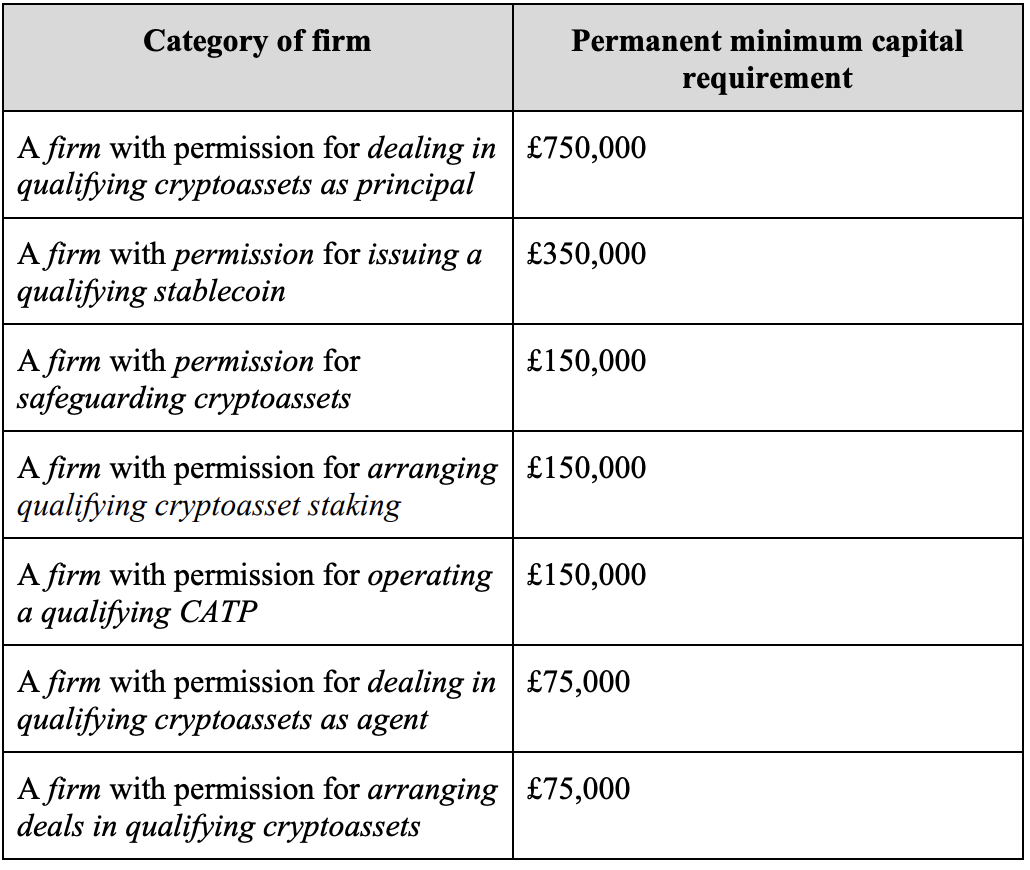


These figures may not seem high, but they are just the baseline. The FCA explained that a firm's minimum own funds requirement is the highest of three values: the permanent minimum capital requirement, the fixed overheads requirement, and the K-factor requirement. The permanent minimum capital is the baseline, while the K-factor is further calculated based on the scale of business activities and risk exposure. The FCA also emphasized that the permanent minimum capital is an authorization threshold; firms cannot obtain authorization first and then gradually meet the requirement in phases afterwards.


The FCA has also introduced a basic liquid asset requirement. Relevant firms must hold core liquid assets amounting to one-third of the fixed overheads requirement plus 1.6% of the total value of client guarantees. The purpose of this liquidity buffer is pragmatic: firms cannot meet capital requirements only on paper; they must also have sufficient liquid assets to support operations, orderly wind-down, or handling client-related obligations under stress scenarios.


Trading platforms and intermediaries also face more detailed market conduct rules. In its press release, the FCA stated that the new framework will introduce market integrity rules covering areas like insider trading and market manipulation; in the regime overview, the FCA also included trading platforms and intermediaries within the scope of activity rules in PS26/11, specifically mentioning requirements such as best execution and price checks across multiple execution venues. PS26/11 further stipulates that relevant firms need to establish client order handling procedures to ensure client orders are executed promptly, fairly, and expeditiously, and to reference prices from at least 3 reliable UK authorized execution venues for price checks where possible.


If there are fewer than 3 UK authorized venues where the order can be executed, existing available venues should be checked. The FCA simultaneously emphasized that this is not a mechanical price comparison for each trade, nor does it require orders to be executed only at the 3 venues checked. It requires firms to use reliable price sources to validate their execution policies and be able to demonstrate that the execution outcomes delivered to clients are at least as good as those that would have been achieved in comparable circumstances at these UK authorized venues.


The focus for custody businesses is client asset protection. In PS26/11, the FCA confirmed that CASS 17 protection requirements will apply to client crypto assets, with rule focuses including ownership, record keeping, asset reconciliation, and private key management. In short, platforms cannot merely state that "assets are transparent on-chain"; they must also prove they know which assets belong to which clients, whether their ledgers match on-chain assets, and that private key control will not be compromised due to internal processes or external attacks.


The FCA's cost-benefit analysis provides a more tangible figure: it estimates that custody protection rules could prevent approximately £60 million in consumer losses annually.


Lending and staking are also brought into a more detailed consumer protection framework. For crypto lending, the FCA retains core protection requirements for retail clients, including enhanced disclosure, client consent, appropriateness tests, record keeping, over-collateralization, and negative balance protection. Negative balance protection means that a retail client's losses in a crypto borrowing arrangement should not exceed the market value of the collateral they have specifically provided for that borrowing.


For staking services, the FCA retains requirements for disclosure, contract terms, client consent, and record keeping, but makes adjustments for automatic staking arrangements, allowing clients to consent to ongoing staking covering current and future holdings, provided relevant conditions are met and annual notifications are given.


Stablecoins Placed Beside Payment Ambitions


Stablecoins are a category of activity treated separately within this regulatory framework.


The FCA stated that qualifying stablecoins issued in the UK will be required to be fully backed and redeemable at par value, to support their use as "money-like instruments."


The core of PS26/10 is to require stablecoin issuers to establish an auditable mechanism around backing assets, redemption, disclosure, and asset protection. The FCA's final rules require UK stablecoin issuers to provide full backing for their stablecoins from the moment they are minted, including tokens held by the issuer itself; tokens that have been permanently destroyed no longer require backing asset coverage. The FCA's reasoning is direct: stablecoins are liquid, and if unsupported tokens enter the market, it could undermine confidence in their 1:1 peg.


Regarding redemption, the FCA requires UK stablecoin issuers to provide the right to redeem at par value and complete redemptions within a T+1 timeframe. However, the final rules adjust the starting point: T+1 no longer starts from the submission of a complete redemption request, but from when the issuer receives the stablecoins to be redeemed into its wallet. This allows AML/KYC checks to be completed before T+1, avoiding squeezing anti-money laundering reviews into the redemption timeline.


Regarding backing assets, the FCA divides stablecoin reserves into two tiers: core backing assets and expanded backing assets.


Core backing assets include demand deposits and short-term government debt instruments; expanded backing assets include longer-term government debt instruments, shares in public debt CNAV money market funds, and repo or reverse repo arrangements with government debt instruments as the underlying and a maturity not exceeding 7 days.


The FCA sets two liquidity requirements: First, issuers must meet the On-demand Deposit Requirement (ODDR), meaning they must hold at least 5% of the backing asset pool as demand deposits. Second, issuers must also meet the Core Backing Asset Requirement (CBAR), meaning they must hold an additional percentage of core backing assets, with the percentage being the higher of 5% and the highest single-day redemption ratio over the past 180 redemption days. Demand deposits used to meet the ODDR cannot also be used to meet the CBAR.


The focus of this design is to prevent issuers from allocating more to long-term or complex assets for yield, yet being unable to provide sufficient high-liquidity assets during concentrated user redemptions.


Beyond this, there is a larger regulatory division of labor. The FCA and the Bank of England issued a joint statement on the same day explaining the regulatory pathway for systemic stablecoin issuers. "General UK stablecoin issuers" are regulated by the FCA; if a UK stablecoin issuer is designated by HM Treasury as having "systemic importance," it may transition from sole FCA regulation to joint regulation by the FCA and the Bank of England.


PS26/10 also mentions that in the Bank of England's draft rules, the backing asset composition for systemic stablecoins may shift to a maximum of 70% UK sovereign debt with a remaining maturity of less than 6 months, and a minimum of 30% central bank deposits; individual stablecoins may also be subject to a provisional issuance cap of £40 billion and required to offer T+0 redemption.


This indicates that the UK does not view stablecoins solely as exchange-denominated tools. As long as they continue to approach payment and settlement scenarios, regulatory focus will expand from investment risk to reserve safety, redemption stability, and financial infrastructure reliability.


Summary


The FCA still cautions that the vast majority of crypto assets are highly speculative, and consumers may lose all their principal. The new rules do not eliminate such risks, nor do they endorse crypto assets. What they change is another matter: the UK is beginning to address crypto business using more comprehensive financial regulatory language.


Under the new framework, crypto-related companies must also demonstrate whether capital is sufficient, how client assets are protected, whether trade execution is fair, if stablecoins can be redeemed according to rules, and who is responsible if risks get out of control.


By October 25, 2027, when the countdown ends, those that truly remain will be the companies that can clearly articulate their business boundaries, client assets, capital buffers, and risk responsibilities.


Tiền kỹ thuật số thịnh hành

Câu hỏi Liên quan

QWhat is the most crucial application window for existing crypto firms under the new UK FCA regime, and what does it allow?

AThe most crucial window is from September 30, 2026, to February 28, 2027. Firms that submit their applications during this period and meet the conditions can rely on the 'savings provisions' (transitional arrangements). This allows them to continue their designated crypto-related activities while the FCA processes their application for authorization.

QWill a firm's existing registration with the FCA (e.g., for AML purposes) automatically convert into a full authorization under the new crypto regime?

ANo. Existing registrations under the Money Laundering Regulations, authorizations under the Payment Services or E-money rules, or financial promotions approvals will NOT automatically convert to authorization. Any firm whose activities fall within the scope of the new regulated crypto asset business must apply for and obtain the appropriate FCA authorization.

QWhat are the key new regulatory requirements for a crypto asset custodian under the FCA's final rules (PS26/11)?

AKey requirements for custodians under PS26/11 include: Client Asset (CASS 17) protection rules focused on client asset segregation, accurate record-keeping, regular reconciliation of holdings on and off-chain, and secure private key management. The rules aim to ensure firms can prove which assets belong to which client and that private keys are not at risk from internal failures or external attacks.

QHow does the FCA's new framework (PS26/10) structure the reserve assets for 'Qualifying Stablecoin' issuers?

AThe FCA structures stablecoin reserves into two tiers. 'Core backing assets' include demand deposits and short-term government debt instruments. 'Expanded backing assets' include longer-term government debt, CNAV money market fund shares, and short-term repos (≤7 days). Issuers must also meet specific liquidity buffers: a 5% On-demand Deposit Requirement (ODDR) and a Core Backing Asset Requirement (CBAR) based on peak redemption history.

QWhat is the potential regulatory path for a stablecoin issuer deemed 'systemically important' in the UK?

AA stablecoin issuer designated by HM Treasury as 'systemically important' would move from being regulated solely by the FCA to a dual-regulatory regime with joint supervision by the FCA and the Bank of England (BoE). The BoE's proposed rules for such issuers could include stricter reserve asset requirements (e.g., up to 70% in short-term UK sovereign debt and at least 30% in central bank deposits) and a potential T+0 redemption timeframe.

Nội dung Liên quan

Bitcoin có thể chưa hoàn tất giai đoạn đầu hàng – Tại sao mức đáy 50 nghìn USD vẫn có thể xảy ra

Sự tin tưởng trong một thị trường né tránh rủi ro thường là dấu ấn của sức mạnh dài hạn. Thiết lập hiện tại của Bitcoin phản ánh sự tin tưởng đó. Về mặt kỹ thuật, BTC đã ghi nhận ba quý thua lỗ liên tiếp, với mức giảm trung bình khoảng 20% mỗi quý. Đây là chuỗi thua lỗ ba quý đầu tiên kể từ thị trường gấu năm 2022, khiến hơn 50% nguồn cung lưu hành của Bitcoin rơi vào trạng thái "dưới nước" và tập trung sự chú ý vào các nhà đầu tư nắm giữ dài hạn. Điều đáng chú ý là các nhà nắm giữ dài hạn hiện kiểm soát 78% nguồn cung lưu hành và họ không bán ra trong đợt suy yếu này, thay vào đó đang tích lũy thêm. Tuy nhiên, lịch sử cho thấy Bitcoin thường chạm đáy khi nhóm này bắt đầu đầu hàng, một điều chưa xảy ra trong chu kỳ này. Bối cảnh vĩ mô đang thay đổi với kỳ vọng Cục Dự trữ Liên bang Mỹ có thể tiếp tục tăng lãi suất vào mùa thu, tạo ra điều kiện tài chính thắt chặt hơn. So sánh với các chu kỳ gấu trước (2018 và 2022), khi BTC chạm đáy sau chín tháng giảm điểm liên tiếp, chu kỳ hiện tại mới có bảy tháng. Nếu mô hình lịch sử lặp lại, giai đoạn đầu hàng của Bitcoin vẫn có thể còn tiếp diễn. Sự đầu hàng của các nhà nắm giữ dài hạn, kết hợp với bối cảnh vĩ mô bất ổn, có thể đánh dấu đợt thanh lọc cuối cùng, đẩy BTC về vùng 50.000 USD vào cuối quý 3 trước khi hình thành đáy thực sự.

ambcrypto1 giờ trước

Bitcoin có thể chưa hoàn tất giai đoạn đầu hàng – Tại sao mức đáy 50 nghìn USD vẫn có thể xảy ra

ambcrypto1 giờ trước

MSTR tiết lộ bán 3,588 Bitcoin, giá cổ phiếu lao dốc 5% trong ngày

Công ty Strategy, chủ sở hữu doanh nghiệp lớn nhất thế giới, đã công bố việc bán 3.588 Bitcoin trong khoảng thời gian từ 29/6 đến 5/7 để thu về khoảng 216 triệu USD, nhằm chi trả cổ tức cho các cổ phiếu ưu đãi. Đây là lần bán Bitcoin lớn nhất trong lịch sử công ty, đánh dấu sự thay đổi từ chiến lược "chỉ mua, không bán" trước đây sang việc sử dụng Bitcoin như một tài sản để quản lý thanh khoản. Động thái này diễn ra trong bối cảnh giá Bitcoin và cổ phiếu MSTR đều chịu áp lực giảm. Sau thông báo, giá cổ phiếu Strategy đã giảm hơn 5% trong phiên. Công ty trước đây từng tuyên bố "không bao giờ bán Bitcoin", nhưng đã có hai lần bán nhỏ vào tháng 5 và giờ là đợt bán lớn với quy mô gấp hàng trăm lần. Nguyên nhân chính đến từ áp lực tài chính. Strategy phải chi trả khoảng 1,5 tỷ USD cổ tức ưu đãi hàng năm, trong khi dòng tiền từ hoạt động phần mềm không đủ trang trải. Khi huy động vốn mới khó khăn, công ty buộc phải bán Bitcoin để duy trì hoạt động. Mô hình hiện tại của Strategy là tiếp tục mua Bitcoin khi điều kiện tài chính thuận lợi và bán một phần khi cần thanh khoản, tạo thành một vòng vận hành khép kín. Tính đến ngày 5/7, công ty vẫn nắm giữ 84.377 Bitcoin với giá vốn trung bình khoảng 75.700 USD.

华尔街日报6 giờ trước

MSTR tiết lộ bán 3,588 Bitcoin, giá cổ phiếu lao dốc 5% trong ngày

华尔街日报6 giờ trước

Donald Trump, Tổng thống Mỹ biết 'chơi' chứng khoán nhất

Donald Trump, tổng thống Mỹ giàu có nhất lịch sử, đã kiếm được 2,2 tỷ USD trong năm 2025, theo báo cáo tài chính công khai. Phần lớn thu nhập đến từ tiền điện tử (1,4 tỷ USD), đặc biệt là đồng meme $TRUMP và token WLFI của công ty World Liberty Financial do gia đình ông thành lập. Lĩnh vực bất động sản truyền thống mang về 575 triệu USD, với các khu nghỉ dưỡng và sân golf như Mar-a-Lago có doanh thu tăng mạnh nhờ sự hiện diện của ông. Trump cũng thực hiện hơn 22.000 giao dịch chứng khoán trong năm, với tần suất cao bất thường và thời điểm giao dịch trùng khớp với các sự kiện chính sách quan trọng, dấy lên lo ngại về xung đột lợi ích. Dù Nhà Trắng cho biết các giao dịch do đội ngũ chuyên nghiệp quản lý, việc Trump không sử dụng ủy thác mù (blind trust) như các tổng thống tiền nhiệm vẫn là điểm gây tranh cãi. Bài viết nhận định Trump đã biến vai trò tổng thống thành một "cỗ máy kinh doanh", khai thác triệt để ảnh hưởng chính trị để thu lợi nhuận cá nhân và gia đình, từ tiền điện tử, bất động sản đến chứng khoán. Điều này làm dấy lên cuộc tranh luận mới về ranh giới giữa quyền lực công và lợi ích tư trong chính trị Mỹ.

marsbit7 giờ trước

Donald Trump, Tổng thống Mỹ biết 'chơi' chứng khoán nhất

marsbit7 giờ trước

Giao dịch

Giao ngay

Bài viết Nổi bật

Làm thế nào để Mua CAP

Chào mừng bạn đến với HTX.com! Chúng tôi đã làm cho mua Cap (CAP) trở nên đơn giản và thuận tiện. Làm theo hướng dẫn từng bước của chúng tôi để bắt đầu hành trình tiền kỹ thuật số của bạn.Bước 1: Tạo Tài khoản HTX của BạnSử dụng email hoặc số điện thoại của bạn để đăng ký tài khoản miễn phí trên HTX. Trải nghiệm hành trình đăng ký không rắc rối và mở khóa tất cả tính năng. Nhận Tài khoản của tôiBước 2: Truy cập Mua Crypto và Chọn Phương thức Thanh toán của BạnThẻ Tín dụng/Ghi nợ: Sử dụng Visa hoặc Mastercard của bạn để mua Cap (CAP) ngay lập tức.Số dư: Sử dụng tiền từ số dư tài khoản HTX của bạn để giao dịch liền mạch.Bên thứ ba: Chúng tôi đã thêm những phương thức thanh toán phổ biến như Google Pay và Apple Pay để nâng cao sự tiện lợi.P2P: Giao dịch trực tiếp với người dùng khác trên HTX.Thị trường mua bán phi tập trung (OTC): Chúng tôi cung cấp những dịch vụ được thiết kế riêng và tỷ giá hối đoái cạnh tranh cho nhà giao dịch.Bước 3: Lưu trữ Cap (CAP) của BạnSau khi mua Cap (CAP), lưu trữ trong tài khoản HTX của bạn. Ngoài ra, bạn có thể gửi đi nơi khác qua chuyển khoản blockchain hoặc sử dụng để giao dịch những tiền kỹ thuật số khác.Bước 4: Giao dịch Cap (CAP)Giao dịch Cap (CAP) dễ dàng trên thị trường giao ngay của HTX. Chỉ cần truy cập vào tài khoản của bạn, chọn cặp giao dịch, thực hiện giao dịch và theo dõi trong thời gian thực. Chúng tôi cung cấp trải nghiệm thân thiện với người dùng cho cả người mới bắt đầu và người giao dịch dày dạn kinh nghiệm.

Tổng lượt xem 57Xuất bản vào 2026.06.26Cập nhật vào 2026.06.26

Làm thế nào để Mua CAP

Làm thế nào để Mua ANSEM

Chào mừng bạn đến với HTX.com! Chúng tôi đã làm cho mua The Black Bull (ANSEM) trở nên đơn giản và thuận tiện. Làm theo hướng dẫn từng bước của chúng tôi để bắt đầu hành trình tiền kỹ thuật số của bạn.Bước 1: Tạo Tài khoản HTX của BạnSử dụng email hoặc số điện thoại của bạn để đăng ký tài khoản miễn phí trên HTX. Trải nghiệm hành trình đăng ký không rắc rối và mở khóa tất cả tính năng. Nhận Tài khoản của tôiBước 2: Truy cập Mua Crypto và Chọn Phương thức Thanh toán của BạnThẻ Tín dụng/Ghi nợ: Sử dụng Visa hoặc Mastercard của bạn để mua The Black Bull (ANSEM) ngay lập tức.Số dư: Sử dụng tiền từ số dư tài khoản HTX của bạn để giao dịch liền mạch.Bên thứ ba: Chúng tôi đã thêm những phương thức thanh toán phổ biến như Google Pay và Apple Pay để nâng cao sự tiện lợi.P2P: Giao dịch trực tiếp với người dùng khác trên HTX.Thị trường mua bán phi tập trung (OTC): Chúng tôi cung cấp những dịch vụ được thiết kế riêng và tỷ giá hối đoái cạnh tranh cho nhà giao dịch.Bước 3: Lưu trữ The Black Bull (ANSEM) của BạnSau khi mua The Black Bull (ANSEM), lưu trữ trong tài khoản HTX của bạn. Ngoài ra, bạn có thể gửi đi nơi khác qua chuyển khoản blockchain hoặc sử dụng để giao dịch những tiền kỹ thuật số khác.Bước 4: Giao dịch The Black Bull (ANSEM)Giao dịch The Black Bull (ANSEM) dễ dàng trên thị trường giao ngay của HTX. Chỉ cần truy cập vào tài khoản của bạn, chọn cặp giao dịch, thực hiện giao dịch và theo dõi trong thời gian thực. Chúng tôi cung cấp trải nghiệm thân thiện với người dùng cho cả người mới bắt đầu và người giao dịch dày dạn kinh nghiệm.

Tổng lượt xem 35Xuất bản vào 2026.07.01Cập nhật vào 2026.07.01

Làm thế nào để Mua ANSEM

Làm thế nào để Mua DATA

Chào mừng bạn đến với HTX.com! Chúng tôi đã làm cho mua DATA Network (DATA) trở nên đơn giản và thuận tiện. Làm theo hướng dẫn từng bước của chúng tôi để bắt đầu hành trình tiền kỹ thuật số của bạn.Bước 1: Tạo Tài khoản HTX của BạnSử dụng email hoặc số điện thoại của bạn để đăng ký tài khoản miễn phí trên HTX. Trải nghiệm hành trình đăng ký không rắc rối và mở khóa tất cả tính năng. Nhận Tài khoản của tôiBước 2: Truy cập Mua Crypto và Chọn Phương thức Thanh toán của BạnThẻ Tín dụng/Ghi nợ: Sử dụng Visa hoặc Mastercard của bạn để mua DATA Network (DATA) ngay lập tức.Số dư: Sử dụng tiền từ số dư tài khoản HTX của bạn để giao dịch liền mạch.Bên thứ ba: Chúng tôi đã thêm những phương thức thanh toán phổ biến như Google Pay và Apple Pay để nâng cao sự tiện lợi.P2P: Giao dịch trực tiếp với người dùng khác trên HTX.Thị trường mua bán phi tập trung (OTC): Chúng tôi cung cấp những dịch vụ được thiết kế riêng và tỷ giá hối đoái cạnh tranh cho nhà giao dịch.Bước 3: Lưu trữ DATA Network (DATA) của BạnSau khi mua DATA Network (DATA), lưu trữ trong tài khoản HTX của bạn. Ngoài ra, bạn có thể gửi đi nơi khác qua chuyển khoản blockchain hoặc sử dụng để giao dịch những tiền kỹ thuật số khác.Bước 4: Giao dịch DATA Network (DATA)Giao dịch DATA Network (DATA) dễ dàng trên thị trường giao ngay của HTX. Chỉ cần truy cập vào tài khoản của bạn, chọn cặp giao dịch, thực hiện giao dịch và theo dõi trong thời gian thực. Chúng tôi cung cấp trải nghiệm thân thiện với người dùng cho cả người mới bắt đầu và người giao dịch dày dạn kinh nghiệm.

Tổng lượt xem 34Xuất bản vào 2026.07.01Cập nhật vào 2026.07.01

Làm thế nào để Mua DATA

Thảo luận

Chào mừng đến với Cộng đồng HTX. Tại đây, bạn có thể được thông báo về những phát triển nền tảng mới nhất và có quyền truy cập vào thông tin chuyên sâu về thị trường. Ý kiến ​​của người dùng về giá của M (M) được trình bày dưới đây.

活动图片