First Long-Horizon Doc2Repo Training Dataset: Code Agents Move Beyond Bug Fixing and Begin Creating Repositories

marsbitXuất bản vào 2026-06-25Cập nhật gần nhất vào 2026-06-25

Tóm tắt

With the advancement of LLM Code Agents, the research focus is shifting towards long-horizon, real-world tasks, moving beyond simple bug fixes to full repository generation. To address this, researchers from Renmin University of China introduced the DeNovoSWE dataset. This dataset focuses on long-term software engineering tasks, specifically the "document-to-repository" challenge—generating an entire, executable code repository from a task description. The DeNovoSWE construction method employs a Divide & Conquer approach. It breaks down target repositories into core capabilities and uses a multi-agent Draft-Critic-Repair workflow to automatically generate high-quality, evaluation-aligned task documents. The dataset also implements difficulty-aware filtering to balance quality and diversity. The result is a high-quality, anti-leakage dataset of 4,818 instances. Experiments show that models trained on DeNovoSWE achieve significant improvements in long-horizon repository generation. For instance, Qwen3-30B-A3B-Instruct's performance on the BeyondSWE-Doc2Repo benchmark increased from 5.8% to 47.2%, and on NL2RepoBench from 4.3% to 23.0%. Similar gains were observed with stronger backbones, demonstrating that dedicated long-horizon training data is crucial for advancing Code Agents from maintainers to architects capable of planning and building complete software projects from scratch.

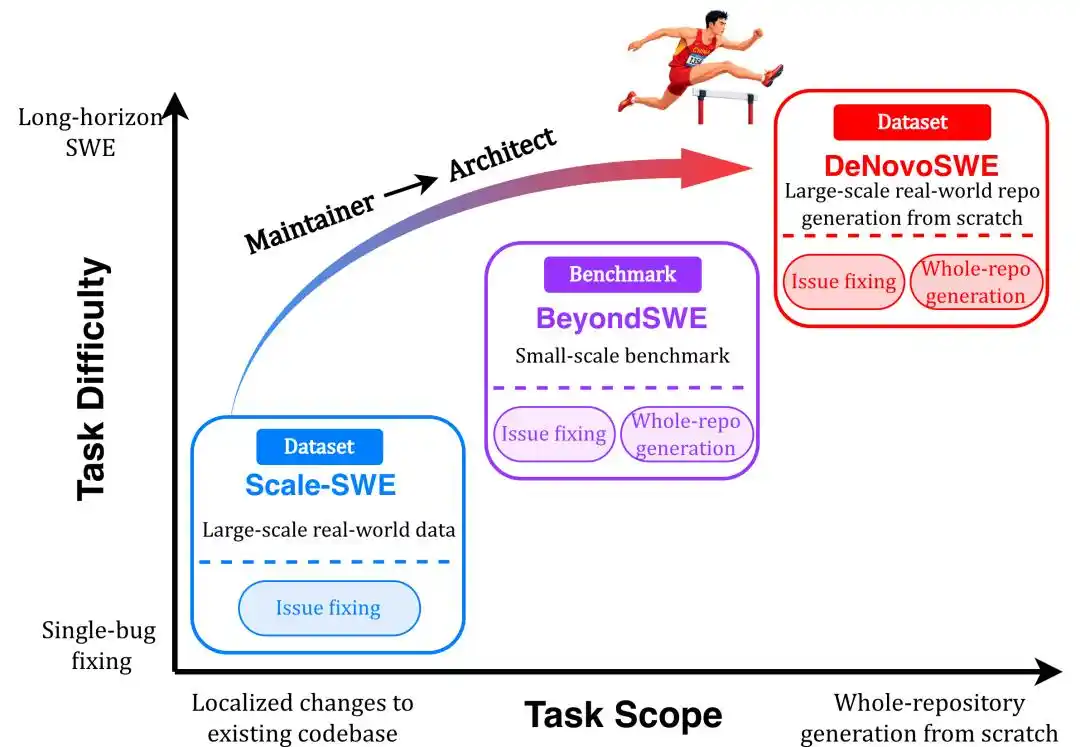
With the continuous improvement of LLM Code Agent capabilities, more and more researchers are realizing it's time to advance to the next stage of long-horizon tasks that are closer to real-world scenarios. Consequently, some benchmarks for evaluating long-horizon tasks have emerged, such as NL2RepoBench and BeyondSWE. The expected role of Code Agents is gradually shifting from repository maintainers to architects, capable of planning and completing long-horizon coding tasks for entire repositories.

Recently, the Gaoling School of Artificial Intelligence at Renmin University of China completed related research and officially released the DeNovoSWE dataset, focusing on long-horizon software engineering tasks, particularly repository-level code generation from scratch.
Paper link: https://arxiv.org/pdf/2606.10728

Repository link: https://github.com/AweAI-Team/DeNovoSWE

Data link: https://huggingface.co/collections/AweAI-Team/denovoswe

Through the mechanisms of Divide & Conquer and Critic & Repair, a high-quality dataset was constructed, successfully achieving scaling for long-horizon SWE tasks. This effort resulted in DeNovoSWE, an open-source, high-quality long-horizon SWE task dataset containing 4,818 real-world instances. This achievement provides large-scale data for training Code Agents' long-horizon capabilities, significantly enhancing their performance on such tasks.
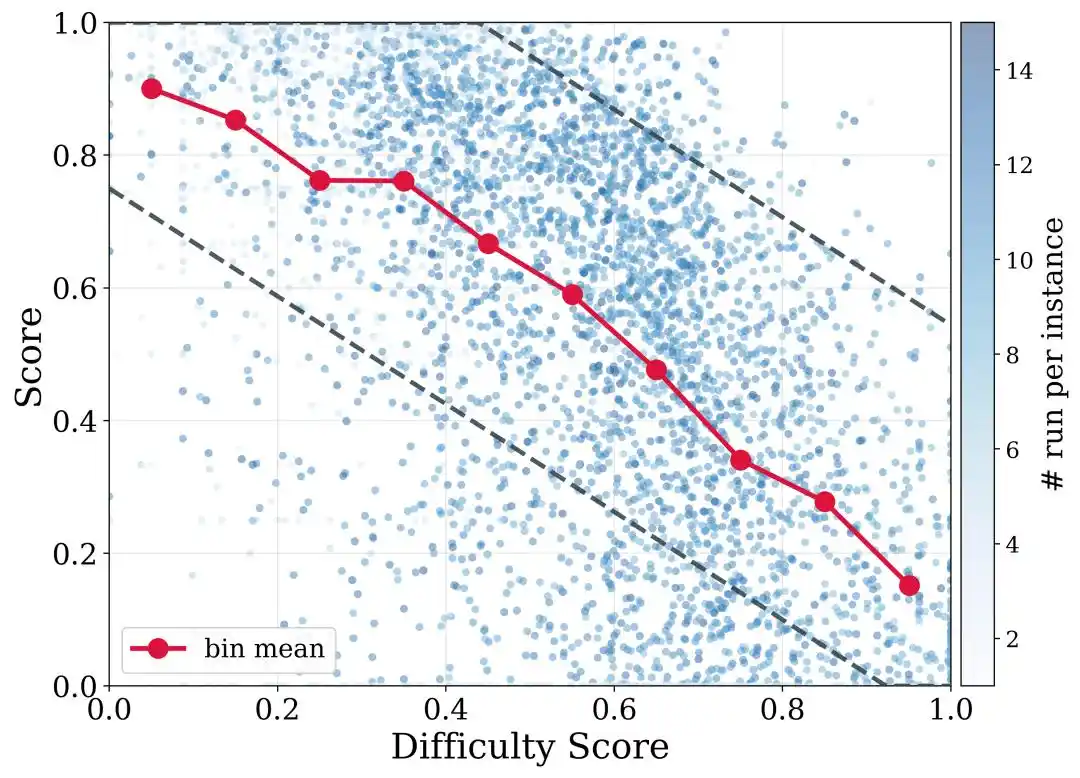
The paper also proposes methods based on difficulty score filtering, effectively alleviating the trade-off between the proportion of difficult problems and trajectory quality.
Experiments show that the Qwen3-30B-A3B-Instruct model trained on DeNovoSWE improved from 5.8% to 47.2% on BeyondSWE-Doc2Repo and from 4.3% to 23.0% on NL2RepoBench, demonstrating the significant boost in repository-level code generation capabilities brought by long-horizon data.

Rebuilding an Entire Repository from a Single Document

Over the past year, with the scaling of large-scale SWE data in works like Scale-SWE, code agents have rapidly progressed on real software engineering tasks like SWE-bench. But as models become increasingly adept at "fixing an issue" or "changing a few lines of buggy code," a more critical question arises: Do agents truly possess long-horizon software engineering capabilities? Judging from the performance of frontier models on BeyondSWE-Doc2Repo and NL2RepoBench, the results are not ideal.

Real-world software development often isn't about modifying a single function or adding a conditional statement. It involves understanding requirements, planning architecture, creating files, designing APIs, handling dependencies, connecting modules, and ultimately making the entire repository run successfully in tests.

In other words, the real challenge lies in long-horizon repository-level generation: starting from a task document and generating a complete, executable, and verifiable software repository. This is precisely the problem DeNovoSWE aims to solve.

High-Quality "Generate from Scratch" Task Documents

In document-to-repository generation, the document is not just a README, nor a simple API list. It is essentially the sole task entry point for the agent to rebuild the entire repository.

A high-quality task document needs to meet at least two core standards.

First, it must be well-organized.

Repository-level tasks are inherently complex, involving multiple modules, interfaces, configurations, data structures, and interaction flows. If the document merely piles up function descriptions, the agent can easily get lost in fragmented information. Therefore, the document should first provide a clear overview of the repository, then divide into chapters based on capabilities or workflows, ensuring each part corresponds to a clear functional boundary.

Second, it must be written from the perspective of reliable evaluation.

The document cannot be too sparse, otherwise the task becomes an underdefined problem, potentially requiring the model to guess aimlessly to pass evaluation. Nor can it be too detailed, as that would directly leak implementation details, making the task unchallenging.

A truly high-quality document should describe the key behaviors on which evaluation depends: including import paths, public APIs, inputs and outputs, default parameters, exception behaviors, configuration items, pattern strings, return fields, etc., while also outlining the general functionalities to be implemented. In other words, the document should be sufficient for the agent to reproduce testable behaviors, but it should not become a copy of the implementation code.

This is also the core idea of DeNovoSWE: making documents readable, implementable, and verifiable.

The DeNovoSWE Method

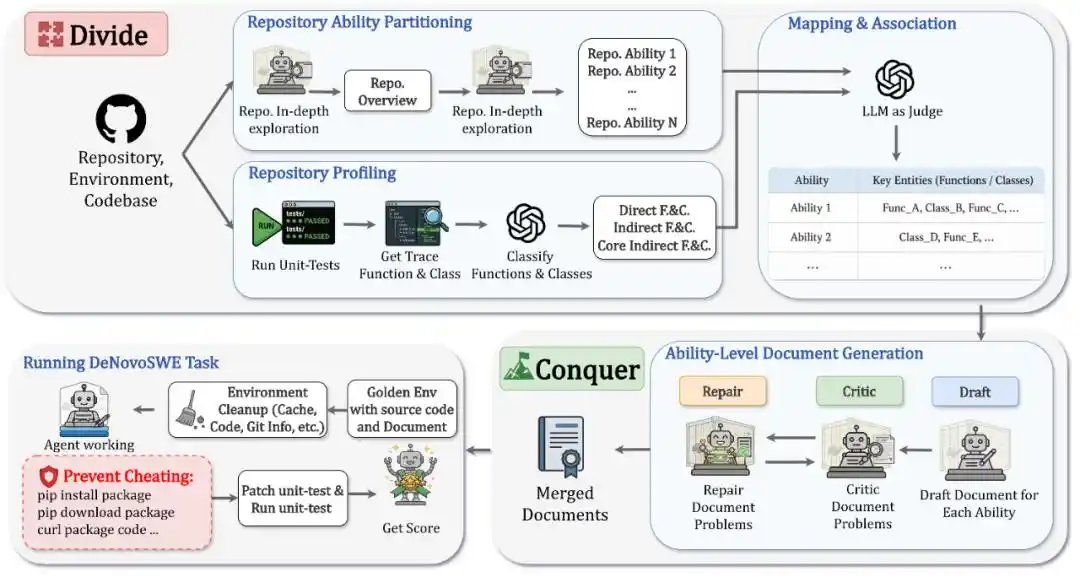
DeNovoSWE frames "generating a complete repository from a document" as a large-scale, verifiable long-horizon software engineering task. It does not rely on manually written documents but automatically constructs high-quality instances through a sandboxed multi-agent workflow. The entire method can be summarized in two steps: Divide and Conquer.

In the Divide stage, the system first analyzes the target repository, decomposing it into multiple repository capabilities.

Each capability corresponds to a core function or workflow within the repository, such as authentication and connection, data reading/writing, batch processing, export flows, etc. This way, the originally massive repository generation problem is split into several structurally clear document chapters.

Simultaneously, DeNovoSWE runs the original unit tests and collects execution traces to identify which functions, classes, and interfaces actually impact evaluation. This further distinguishes between direct components, core indirect components, and non-core indirect components: interfaces directly called by tests must be documented in detail; core indirect components that affect observable behaviors also need coverage; while non-core internal implementations can be left for the agent to handle freely.

In the Conquer stage, DeNovoSWE uses a Draft-Critic-Repair mechanism to generate documents for each capability one by one. The Draft agent writes an initial draft; the Critic agent checks for omissions of key APIs, behavioral contracts, or structural information; the Repair agent then fixes the document based on the feedback. This cycle iterates until each capability chapter is clear, complete, and aligned with evaluation.

Finally, the documents for different capabilities are merged into a single, comprehensive task document, serving as the sole basis for the agent to generate the repository from scratch.

Difficulty: Why is This a Long-Horizon Task?

The difficulty of DeNovoSWE tasks stems from a fundamental change: it's no longer issue-level fixing, but whole-repository generation.

In traditional SWE tasks, agents typically face an existing repository, needing only to locate a bug, modify local code, and pass tests.

In DeNovoSWE, the agent faces a cleaned environment: the original source code and tests are removed, git history is reset, and potential leakage channels like caches, site-packages residues, pip wheels, temporary compilation artifacts, etc., are also cleared. This means the agent must truly rely on the document to complete the entire repository rebuild. It needs to plan the project structure, create module files, define public interfaces, implement cross-file interactions, handle dependencies and configurations, and continuously fix errors across multiple rounds of editing and test feedback.

Any deviation in an API signature, return field, exception type, or default behavior can cause test failures. Errors can also accumulate over the long horizon: an early poorly designed module can affect multiple subsequent files and call chains.

To further address the difficulty variance across different repositories, DeNovoSWE also proposes difficulty-aware trajectory filtering. In simple terms, easy tasks should require a higher pass rate, while difficult tasks should not be entirely discarded just for failing to achieve a perfect score. DeNovoSWE sets different filtering thresholds for different difficulty intervals based on structural complexity and LLM difficulty assessment, thereby balancing quality and diversity.

This is particularly important for long-horizon tasks: the more complex the repository, the harder it is to pass all tests in one go. Yet, the trajectories from challenging repositories, even with low scores or partial success, still contain valuable long-horizon planning and implementation capabilities.
Experimental Results

DeNovoSWE ultimately constructed 4,818 high-quality document-to-repository task instances. It is an executable, evaluable, and trainable long-horizon software engineering environment.
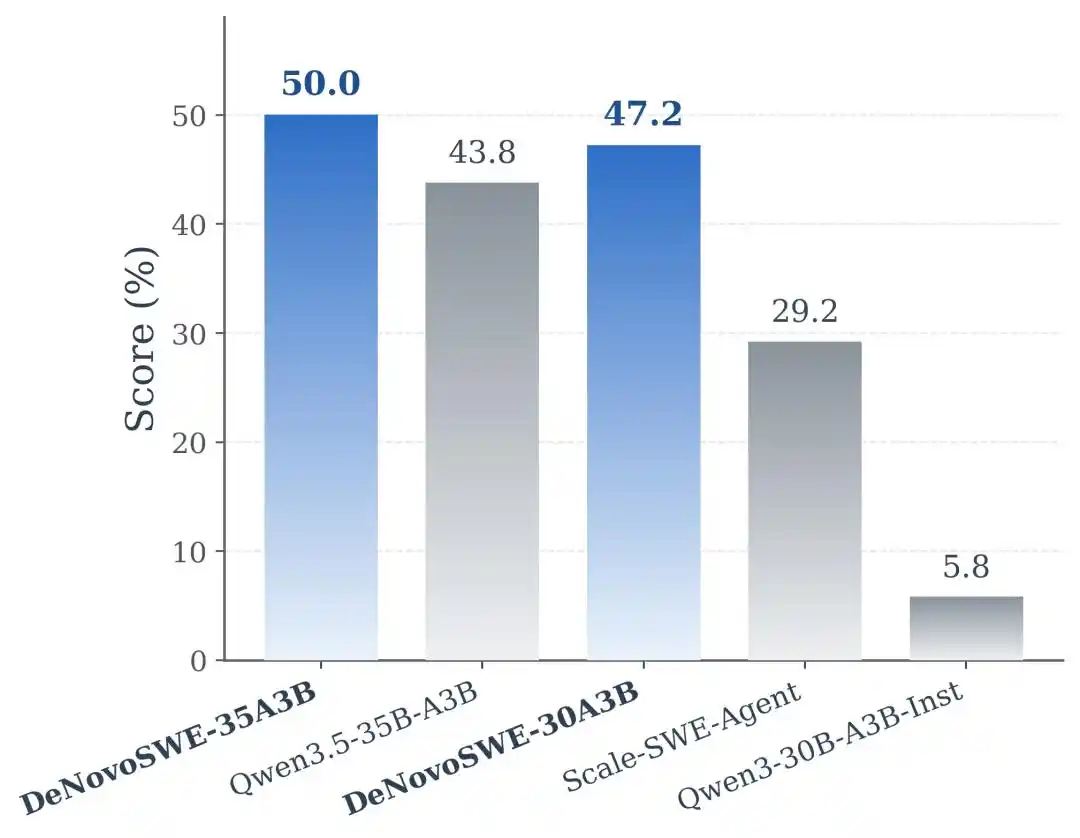
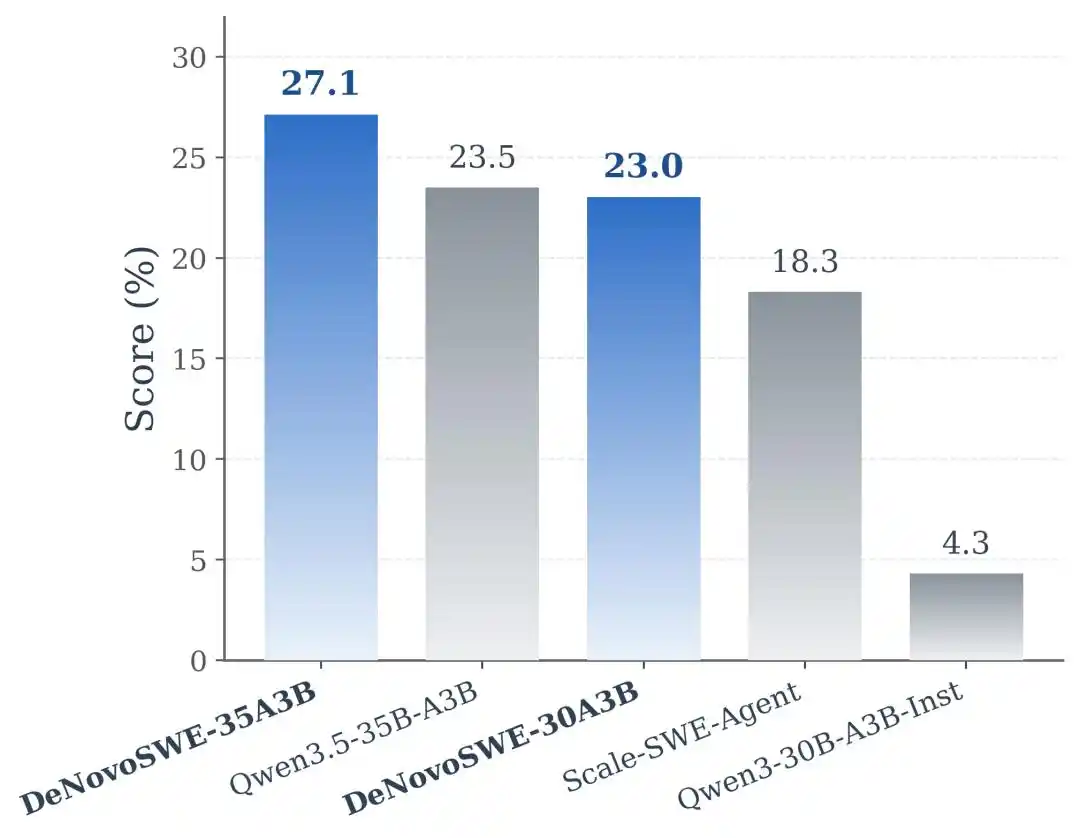
Experimental results show that DeNovoSWE brings significant improvements to models' long-horizon repository generation capabilities. For Qwen3-30B-A3B-Instruct, the original model scored only 5.8% on BeyondSWE-Doc2Repo and 4.3% on NL2RepoBench. Training with conventional issue-level SWE data like Scale-SWE-Agent improved these to 29.2% and 18.3%, indicating that general SWE data does have transfer effects. However, when the model was trained using DeNovoSWE, performance further increased to 47.2% and 23.0%.

This demonstrates that data oriented towards "fixing bugs" cannot fully replace data oriented towards "generating complete repositories" for long-horizon tasks. To truly teach agents repository-level engineering, specialized training environments built for long-horizon tasks are needed.

On the stronger Qwen3.5-35B-A3B backbone, DeNovoSWE similarly brought stable gains: BeyondSWE-Doc2Repo improved from 43.8% to 50.0%, and NL2RepoBench from 23.5% to 27.1%. This further indicates that the benefits of DeNovoSWE are not due to accidental adaptation to a specific model, but stem from the high-quality long-horizon data itself.

Conclusion

The next stage for code agents is not just about fixing individual issues faster, but about understanding documents, planning architecture, organizing modules, implementing interfaces, and ultimately generating a complete, runnable software repository.

DeNovoSWE systematically frames this goal into a trainable, verifiable, and scalable dataset. It answers a key question: What kind of data can truly train agents with long-horizon software engineering capabilities?

The answer is not more fragmented code, nor simpler problems, but high-quality, structured, evaluation-aligned, anti-leakage, full-repository generation tasks.

Starting from a single document, rebuild the entire repository. This is the threshold that long-horizon code agents need to cross.

Reference: https://arxiv.org/pdf/2606.10728

This article is from the WeChat public account "AI Era," edited by LRST.

Tiền kỹ thuật số thịnh hành

Câu hỏi Liên quan

QWhat is the main contribution of the research from Renmin University of China's Gaoling School of Artificial Intelligence?

AThe research introduces and releases the DeNovoSWE dataset, which is the first long-horizon Doc2Repo training set focused on repository-level code generation from scratch in software engineering tasks.

QHow does the DeNovoSWE dataset address the challenge of long-horizon software engineering tasks?

AIt uses a sandboxed multi-agent workflow based on 'Divide & Conquer' and 'Draft-Critic-Repair' mechanisms to automatically construct high-quality task documents, ensuring they are well-organized and evaluation-aligned for whole-repository generation.

QWhat were the performance improvements observed after training a model on the DeNovoSWE dataset?

AThe Qwen3-30B-A3B-Instruct model showed significant improvement, increasing its performance on BeyondSWE-Doc2Repo from 5.8% to 47.2% and on NL2RepoBench from 4.3% to 23.0%.

QWhat are the two core standards mentioned for a high-quality task document in document-to-repository generation?

AFirst, the document must be well-organized, providing a clear overview and structured chapters. Second, it must be evaluation-aligned, describing key behaviors for verification without leaking implementation details.

QWhat is the purpose of the difficulty-aware trajectory filtering mechanism in DeNovoSWE?

AIt sets different filtering thresholds for tasks of varying difficulty levels to balance quality and diversity, ensuring that valuable but partially successful trajectories from complex repositories are not discarded.

Nội dung Liên quan

Sau ba quý liên tiếp suy giảm, thị trường tiền điện tử có thể đón cửa sổ ổn định trong quý III?

Thị trường tiền mã hóa vừa trải qua quý tồi tệ nhất kể từ năm 2022, với vốn hóa giảm 12.6% xuống 2.1 nghìn tỷ USD, khối lượng giao dịch sụt giảm và dòng tiền rút mạnh khỏi các quỹ ETF Bitcoin. Bitcoin và Ethereum lần lượt giảm 14.2% và 25.4% trong quý, đánh dấu sự đảo ngược so với mối tương quan trước đây với các tài sản rủi ro như Nasdaq. Dòng vốn ETF chứng khoán Mỹ ghi nhận dòng ròng rút khoảng 46.7 tỷ USD trong quý II, báo hiệu áp lực bán. Tuy nhiên, dấu hiệu tích cực ban đầu xuất hiện khi các nhà đầu tư dài hạn bắt đầu tích lũy trở lại và dòng ETF có đợt thu hút ngắn hạn. Toàn bộ thị trường hiện tập trung vào cuộc họp của Cục Dự trữ Liên bang Mỹ (FOMC) vào cuối tháng 7. Các tín hiệu chính sách tiền tệ sẽ quyết định xu hướng: tín hiệu ôn hòa có thể đẩy Bitcoin lên vùng 68,000-84,000 USD, trong khi lập trường cứng rắn có thể kéo giá về vùng 50,000-56,000 USD. Tiến trình pháp lý của Đạo luật CLARITY gần như đình trệ, làm giảm kỳ vọng và gia tăng phí rủi ro cho toàn ngành. Trong bối cảnh ảm đạm, hai lĩnh vực nổi bật là thị trường dự đoán (tăng trưởng 48.7%) và bộ sưu tập kỹ thuật số được mã hóa (tăng ~143%), cho thấy sự chuyển dịch nhu cầu thực tế. Nhìn chung, thị trường thiếu động lực cho một đợt tăng trưởng mạnh dựa trên tâm lý. Các quyết định giao dịch trong quý III sẽ chủ yếu xoay quanh diễn biến giá, lựa chọn chính sách và kỳ vọng lãi suất.

marsbit13 giờ trước

Sau ba quý liên tiếp suy giảm, thị trường tiền điện tử có thể đón cửa sổ ổn định trong quý III?

marsbit13 giờ trước

Giao Dịch SpaceX, Đã Mở Khóa: SPCXON Được Giao Dịch Trên WEEX

SpaceX đã thực hiện đợt IPO lớn nhất lịch sử vào tháng 6/2026, nhưng nhiều nhà giao dịch không thể tiếp cận do các rào cản như hạn chế môi giới và khu vực. Sàn giao dịch tiền điện tử WEEX đã giới thiệu SPCXON/USDT, một công cụ token hóa cho phép tiếp cận biến động giá của SpaceX thông qua tài khoản crypto được quyết toán bằng USDT, mà không cần môi giới Mỹ hay tài khoản ngân hàng. Sản phẩm này, xây dựng trên nền tảng cổ phiếu token hóa của Ondo, dành cho các nhà giao dịch bên ngoài Hoa Kỳ. Trường hợp đầu tư dựa trên đà tăng doanh thu Starlink và các cột mốc Starship, trong khi các yếu tố cần thận trọng bao gồm định giá cao, lượng cổ phiếu lưu hành công chúng ít và sự kiện mở khóa cổ phiếu nội bộ sắp tới. Lưu ý quan trọng: SPCXON cung cấp mức tiếp xúc với hiệu quả kinh tế, không phải quyền sở hữu cổ phiếu trực tiếp, và có thể giao dịch ở mức cao hơn hoặc thấp hơn giá trị tài sản ròng. WEEX tích hợp SPCXON cùng các sản phẩm TradFi token hóa khác như MicroStrategy (MSTRON) và Micron (MUON) vào một tài khoản thống nhất, cho phép luân chuyển giữa crypto và cổ phiếu dễ dàng. Sàn cũng đang chạy chiến dịch TradFi Trading Challenge với quỹ thưởng $50,000.

TheNewsCrypto13 giờ trước

Giao Dịch SpaceX, Đã Mở Khóa: SPCXON Được Giao Dịch Trên WEEX

TheNewsCrypto13 giờ trước

BIT Trading Hours: BTC Vẫn Chịu Áp Lực Từ Đường MA 200 Tuần, Bị Từ Chối Có Thể Tái Khởi Động Đợt Giảm, Ngành Lưu Trữ và Bán Dẫn Tăng Mạnh Đêm Qua Bắt Đầu Giảm Trong Khung Giờ Giao Dịch Ban Đêm

Bitcoin (BTC) hiện giao dịch quanh mức $66,000, đối mặt với vùng kháng cự mạnh gần $68,000 - nơi tập trung nhiều lệnh mua trước đó có thể chốt lời. Về mặt kỹ thuật, BTC đang nằm giữa đường trung bình động 200 tuần (MA ~$63,333) và đường trung bình động hàm mũ 200 tuần (EMA ~$68,328). Việc không thể vượt qua mức $68,000 có thể kéo giá về kiểm tra lại vùng hỗ trợ $63,000. Thị trường hiện có tính thanh khoản thấp và được xem là đang trong đợt phục hồi nhẹ. Trên thị trường chứng khoán Mỹ, các chỉ số tương lai giảm nhẹ. Nhóm cổ phiếu bán dẫn và lưu trữ, vốn tăng mạnh vào đêm trước, đã điều chỉnh giảm trong phiên giao dịch ngoài giờ. Tuy nhiên, Super Micro Computer (SMCI) tăng mạnh sau báo cáo doanh thu và đơn đặt hàng tích cực. Dầu thô tăng (trên $91) và lợi suất trái phiếu kho bạc Mỹ tăng cao tiếp tục gây áp lực lên thị trường cổ phiếu và làm dấy lên lo ngại lạm phát. Tại châu Á, thị trường Hàn Quốc phục hồi nhẹ cùng với cổ phiếu công nghệ, trong khi Nhật Bản thận trọng do đồng Yên yếu kỷ lục. Các sự kiện quan trọng sắp tới bao gồm báo cáo thu nhập từ các gã khổng lồ công nghệ như Alphabet, Tesla, IBM; sự kiện AI của AMD; và cuộc họp chính sách tiền tệ của Ngân hàng Trung ương châu Âu.

marsbit13 giờ trước

BIT Trading Hours: BTC Vẫn Chịu Áp Lực Từ Đường MA 200 Tuần, Bị Từ Chối Có Thể Tái Khởi Động Đợt Giảm, Ngành Lưu Trữ và Bán Dẫn Tăng Mạnh Đêm Qua Bắt Đầu Giảm Trong Khung Giờ Giao Dịch Ban Đêm

marsbit13 giờ trước

Chủ tịch CFTC cũ, Chủ tịch Circle Tarbert: Một mặt khuyên bạn chủ nghĩa dài hạn, mặt kia tự mình thoái vốn 30 triệu USD

Tác giả: Zen, PANews Trước tình cảnh cổ phiếu Circle (CRCL) giảm 70% so với đỉnh và bị hạ xếp hạng, Chủ tịch Heath Tarbert - cựu Chủ tịch CFTC - trong một cuộc phỏng vấn ngày 14/7 đã kêu gọi các nhà đầu tư kiên nhẫn và tập trung vào tầm nhìn dài hạn của công ty. Tuy nhiên, hành động của ông lại trái ngược hoàn toàn. Kể từ khi Circle IPO, Tarbert đã không ngừng bán cổ phiếu CRCL thông qua kế hoạch giao dịch 10b5-1 được lập trước, thu về tổng cộng khoảng 30 triệu USD. Ông chưa từng mua lại cổ phiếu trên thị trường mở, ngay cả khi giá cổ phiếu lao dốc. Bài viết nêu bật sự mâu thuẫn giữa lời nói "chủ nghĩa dài hạn" và hành động "thoái vốn" mạnh tay của Tarbert. Sự nghiệp của ông được mô tả là điển hình của "cánh cửa xoay" chính trị-thương mại Mỹ: từ các vị trí cấp cao tại Bộ Tài chính và CFTC, ông nghỉ hưu chỉ 27 ngày trước khi gia nhập Citadel Securities - một nhà tạo lập thị trường lớn - vào thời điểm công ty này đang đối mặt với cuộc điều tra của Quốc hội sau sự kiện GameStop. Sau đó, ông chuyển sang Circle, nơi ông được cho là đã sử dụng kinh nghiệm và quan hệ quản lý để giúp công ty vượt qua các rào cản pháp lý và niêm yết thành công. Bài báo đặt câu hỏi liệu Tarbert có thực sự tin vào tương lai dài hạn của Circle hay không, khi mà ông liên tục chốt lời trong khi lại khuyên các cổ đông nhỏ lẻ giữ vị thế. Nó gợi ý rằng mô hình của ông là tận dụng tối đa kiến thức về chu kỳ chính sách và cơ hội thị trường để biến các nguồn lực và uy tín tích lũy được thành lợi thế nghề nghiệp và tài chính cá nhân, trong khi rủi ro dài hạn được chuyển sang cho các nhà đầu tư tin tưởng vào những tường thuật công khai của ông.

marsbit14 giờ trước

Chủ tịch CFTC cũ, Chủ tịch Circle Tarbert: Một mặt khuyên bạn chủ nghĩa dài hạn, mặt kia tự mình thoái vốn 30 triệu USD

marsbit14 giờ trước

Gate Research: Làn sóng "phố Wall hóa" trong các sản phẩm tài chính tiền điện tử - Cạnh tranh hay Hội tụ?

Gate Research Institute: Sự hòa hợp hay cạnh tranh trong làn sóng "phố Wall hóa" các sản phẩm tài chính tiền mã hóa? Từ tầm nhìn ban đầu về một hệ thống tài chính phi tập trung, loại bỏ trung gian của Bitcoin, thị trường tiền mã hóa đang chứng kiến sự hội tụ mạnh mẽ với tài chính truyền thống (TradFi). Các quỹ ETF Bitcoin, tài sản thế giới thực được mã hóa (RWA) và trái phiếu chính phủ trên chuỗi cho thấy các tổ chức như BlackRock, Fidelity đang đưa tài sản mã hóa vào hệ thống phát hành, định giá, lưu ký và phân phối truyền thống. Tuy nhiên, đây không phải là một trò chơi tổng bằng không. Xu hướng này thể hiện sự bổ sung lẫn nhau: TradFi cung cấp khung pháp lý, mạng lưới phân phối rộng và sự tin cậy, trong khi Crypto mang lại tính mở, thanh khoản toàn cầu 24/7 và khả năng thanh toán lập trình được. Hai hướng đi tiêu biểu minh chứng cho sự hội tụ hai chiều: các sàn giao dịch tiền mã hóa (CEX) như Gate mở rộng sang giao dịch cổ phiếu thực, ETF thông qua cơ sở hạ tầng môi giới truyền thống; trong khi các công ty môi giới truyền thống như Robinhood tích hợp tài sản mã hóa và phát triển tài sản mã hóa (như cổ phiếu mã hóa) để thu hút người dùng. Mục tiêu chung của cả hai hướng là tranh giành "tài khoản tài chính tổng hợp" thế hệ tiếp theo - một điểm vào duy nhất nơi người dùng có thể giao dịch đa dạng tài sản từ cổ phiếu, tiền mã hóa đến RWA. Sự tăng trưởng mạnh mẽ của thị trường RWA, đặc biệt là cổ phiếu mã hóa, bất chấp xu hướng thị trường giảm, cho thấy đây là một xu hướng cấu trúc thực sự. Kết luận, "phố Wall hóa" không có nghĩa là thị trường tiền mã hóa bị TradFi thôn tính. Thay vào đó, đây là một sự chuyển đổi hai chiều, nơi cả hai hệ thống đang cùng nhau định hình lại thị trường vốn thành một cấu trúc hỗn hợp hiệu quả và toàn cầu hơn, với trải nghiệm người dùng liền mạch cho nhiều loại tài sản khác nhau.

marsbit14 giờ trước

Gate Research: Làn sóng "phố Wall hóa" trong các sản phẩm tài chính tiền điện tử - Cạnh tranh hay Hội tụ?

marsbit14 giờ trước

Giao dịch

Giao ngay

Bài viết Nổi bật

Làm thế nào để Mua RE

Chào mừng bạn đến với HTX.com! Chúng tôi đã làm cho mua Re (RE) trở nên đơn giản và thuận tiện. Làm theo hướng dẫn từng bước của chúng tôi để bắt đầu hành trình tiền kỹ thuật số của bạn.Bước 1: Tạo Tài khoản HTX của BạnSử dụng email hoặc số điện thoại của bạn để đăng ký tài khoản miễn phí trên HTX. Trải nghiệm hành trình đăng ký không rắc rối và mở khóa tất cả tính năng. Nhận Tài khoản của tôiBước 2: Truy cập Mua Crypto và Chọn Phương thức Thanh toán của BạnThẻ Tín dụng/Ghi nợ: Sử dụng Visa hoặc Mastercard của bạn để mua Re (RE) ngay lập tức.Số dư: Sử dụng tiền từ số dư tài khoản HTX của bạn để giao dịch liền mạch.Bên thứ ba: Chúng tôi đã thêm những phương thức thanh toán phổ biến như Google Pay và Apple Pay để nâng cao sự tiện lợi.P2P: Giao dịch trực tiếp với người dùng khác trên HTX.Thị trường mua bán phi tập trung (OTC): Chúng tôi cung cấp những dịch vụ được thiết kế riêng và tỷ giá hối đoái cạnh tranh cho nhà giao dịch.Bước 3: Lưu trữ Re (RE) của BạnSau khi mua Re (RE), lưu trữ trong tài khoản HTX của bạn. Ngoài ra, bạn có thể gửi đi nơi khác qua chuyển khoản blockchain hoặc sử dụng để giao dịch những tiền kỹ thuật số khác.Bước 4: Giao dịch Re (RE)Giao dịch Re (RE) dễ dàng trên thị trường giao ngay của HTX. Chỉ cần truy cập vào tài khoản của bạn, chọn cặp giao dịch, thực hiện giao dịch và theo dõi trong thời gian thực. Chúng tôi cung cấp trải nghiệm thân thiện với người dùng cho cả người mới bắt đầu và người giao dịch dày dạn kinh nghiệm.

Tổng lượt xem 220Xuất bản vào 2026.06.18Cập nhật vào 2026.06.29

Làm thế nào để Mua RE

Thảo luận

Chào mừng đến với Cộng đồng HTX. Tại đây, bạn có thể được thông báo về những phát triển nền tảng mới nhất và có quyền truy cập vào thông tin chuyên sâu về thị trường. Ý kiến ​​của người dùng về giá của RE (RE) được trình bày dưới đây.

活动图片













