Ethereum's Next Stop Glamsterdam: The Core Upgrades You Must Know

Foresight NewsXuất bản vào 2026-06-23Cập nhật gần nhất vào 2026-06-23

Tóm tắt

The Glamsterdam upgrade, scheduled for late 2026, is a major Ethereum hard fork combining the Amsterdam execution layer and Glasgow consensus layer updates. Its primary goal is not simply increasing throughput but restructuring Ethereum's block production, validation, and resource pricing to enable future scaling. Key technical changes include **EIP-7732 (ePBS)**, which formally enshrines proposer-builder separation into the protocol. This decouples consensus and execution tasks, extending the execution payload propagation window to ~9 seconds. This provides more time for node verification, allowing for safer increases in block capacity (Gas limit) in the future. Another core component is **EIP-7928 (Block-Level Access Lists - BAL)**. It mandates a list of all state accessed within a block, moving this feature from an optional transaction-level (EIP-2930) to a mandatory block-level requirement. This explicit access list enables client optimizations like parallel disk reads and state root computations, paving the way for parallel execution. To manage long-term state growth, **EIP-8037** increases the cost of creating new state (e.g., accounts, storage slots), separating the pricing of permanent database bloat from temporary computation. This allows execution capacity to scale more aggressively without causing state size to explode proportionally. The planned upgrade bundle includes around 10 EIPs categorized into: 1) Core protocol restructuring (ePBS, BAL), 2) Resource pri...


Author: KarenZ, Foresight News


The Glamsterdam upgrade for Ethereum is most easily misunderstood as yet another purely technical iteration to increase throughput. A more accurate description is: it is reorganizing Ethereum's block proposal process, validation process, resource pricing methods, and more, laying the groundwork for higher gas limits, larger blob capacities, and future parallel execution.


As of June 23, 2026, ethereum.org labels Glamsterdam as an upgrade planned for the second half of 2026. The name Glamsterdam comes from the combination of the execution layer upgrade "Amsterdam" and the consensus layer upgrade "Gloas." The official roadmap places it after Fusaka in December 2025 and before Hegotá, clearly listing two main features: enshrined proposer-builder separation (ePBS) and block-level access lists (BAL).


Who Proposes, Who Builds: ePBS Codifies Block Creation Roles into the Protocol


Today's Ethereum block production is like a very tight shift change: someone is responsible for proposing a block, someone else for building the transaction content, with dependencies on off-protocol infrastructure like MEV-Boost and third-party relays.


This system has been running for years, but it places some trust relationships off-protocol and also forces validators to handle consensus, execution, data availability, and other tasks within a very short time window.


One of Glamsterdam's headline changes, EIP-7732, or ePBS (Enshrined Proposer-Builder Separation), codifies the division of labor between proposers and builders into the protocol.


Simply put, the proposer is responsible for selecting the consensus block, and the builder is responsible for preparing the transaction content inside it. A builder cannot just make verbal promises; it must first "post a bond" within the protocol: specify exactly which execution payload it will deliver and how much it is willing to pay the proposer. Subsequently, a Payload Timeliness Committee (PTC) will check whether it delivers on time.


The key to this change is not just reducing reliance on third-party relays but also buying time for block propagation and validation.


Today, validators need to handle both consensus and execution simultaneously within a very short critical window; ePBS separates these two tasks, allowing the execution payload to be revealed and verified later. According to the design of EIP-7732, the propagation window for the execution payload—the available time for data to spread through the network and be received by nodes—can be extended from about 2 seconds to about 9 seconds. With a longer window, Ethereum can more safely handle larger payloads when increasing block capacity, reducing the risk of missed votes or reorgs due to nodes not having enough time to download, verify, and vote.


This change may not be directly perceptible to ordinary users, but it is crucial for Ethereum scaling. A longer propagation and validation window means the network can more securely handle larger loads. CoinDesk reported on June 16, 2026, citing Ethereum Foundation DevOps engineer Parithosh Jayanthi, that Glamsterdam could be one of the biggest forks since the Merge, changing many assumptions about Ethereum and preparing for larger-scale scaling in the future.


BAL and Repricing: Scaling Isn't Just About Stepping on the Gas, It's Also About Managing the Database


Another core change in Glamsterdam is EIP-7928, Block-Level Access Lists.


It can be understood as providing each block with an "access record": which accounts and which storage locations were touched during the block's execution, and what the related state became after execution, are all recorded. This way, nodes no longer process blocks completely like opening a blind box; they can know earlier which data needs to be read and which computations can be advanced in parallel.


The earlier EIP-2930 introduced transaction-level access lists, but they were optional and saw limited practical use. The change with EIP-7928 is that it elevates access lists to the block level: the block header contains a "fingerprint" (hash) of this list, while the execution payload stores the complete list. Nodes executing the block will verify whether the access records written in the list actually match the block's execution process; if they don't match, the block is invalid.


Why is this important? Today, when Ethereum executes transactions, many data accesses are only known when that specific step is reached. Nodes don't know if a batch of transactions will read/write the same account or storage slot simultaneously, making it hard to confidently process them in parallel. BAL explicitly writes out the access trajectory during block execution, allowing clients to perform parallel disk reads, parallel transaction validation, parallel state root computation, and also update the state in some scenarios without fully replaying transactions. It's not a direct button to lower user fees but opens up engineering space for client-side parallelization.


But Glamsterdam's scaling logic isn't just about "widening the road." It also needs to manage the long-term bloat of Ethereum's database. EIP-8037 increases state creation costs and introduces a cost per state byte (CPSB). State can be understood as the database content that Ethereum must preserve long-term, such as new accounts, new contracts, and new storage slots. Transactions end after execution, but state remains in the ledger that all nodes must maintain; if state grows too fast, running a node becomes increasingly expensive, and decentralization is gradually eroded.


The background numbers provided by EIP-8037 are straightforward: As of January 2026, a Geth node database dedicated to state is about 390 GiB; after the mainnet gas limit increased from 30 million to 60 million, daily new state growth rose from about 105 MiB to about 326 MiB, translating to an annual growth of about 116 GiB. Extrapolating proportionally under a 200 million gas limit, state growth could reach about 387 GiB per year and exceed the 650 GiB performance degradation threshold in less than a year.


Therefore, what EIP-8037 aims to do is separate the pricing of "temporary computation" from "permanently occupying the database." Creating new state will be more expensive because it imposes not a one-time computation cost on the network but a long-term storage burden.


Vitalik Buterin also mentioned, while explaining the Glamsterdam scaling roadmap, that Glamsterdam will separate state creation costs from execution and calldata costs: the goal is to allow execution capacity to expand more significantly while preventing state size from膨胀 at the same rate.


Looking at them together, BAL makes it easier for nodes to process blocks in parallel, addressing "running faster"; state creation repricing makes operations that long-term occupy the database pay a higher cost, addressing "don't let the ledger get fatter and fatter." Glamsterdam's scaling isn't simply raising the gas limit; it's asking a more realistic question: can Ethereum accommodate more transactions while preventing block propagation, transaction validation, and state storage pressures from spiraling out of control.


The Glamsterdam EIP List Takes Shape: Which Are Set, Which Are Still Waiting?


As of June 23, 2026, according to tracking content on Forkcast regarding Ethereum upgrades, Ethereum developers are currently testing the Glamsterdam upgrade in devnets environments, with deployment scheduled for Sepolia on August 3 and for the mainnet on September 16 (specific deployment dates are subject to change).
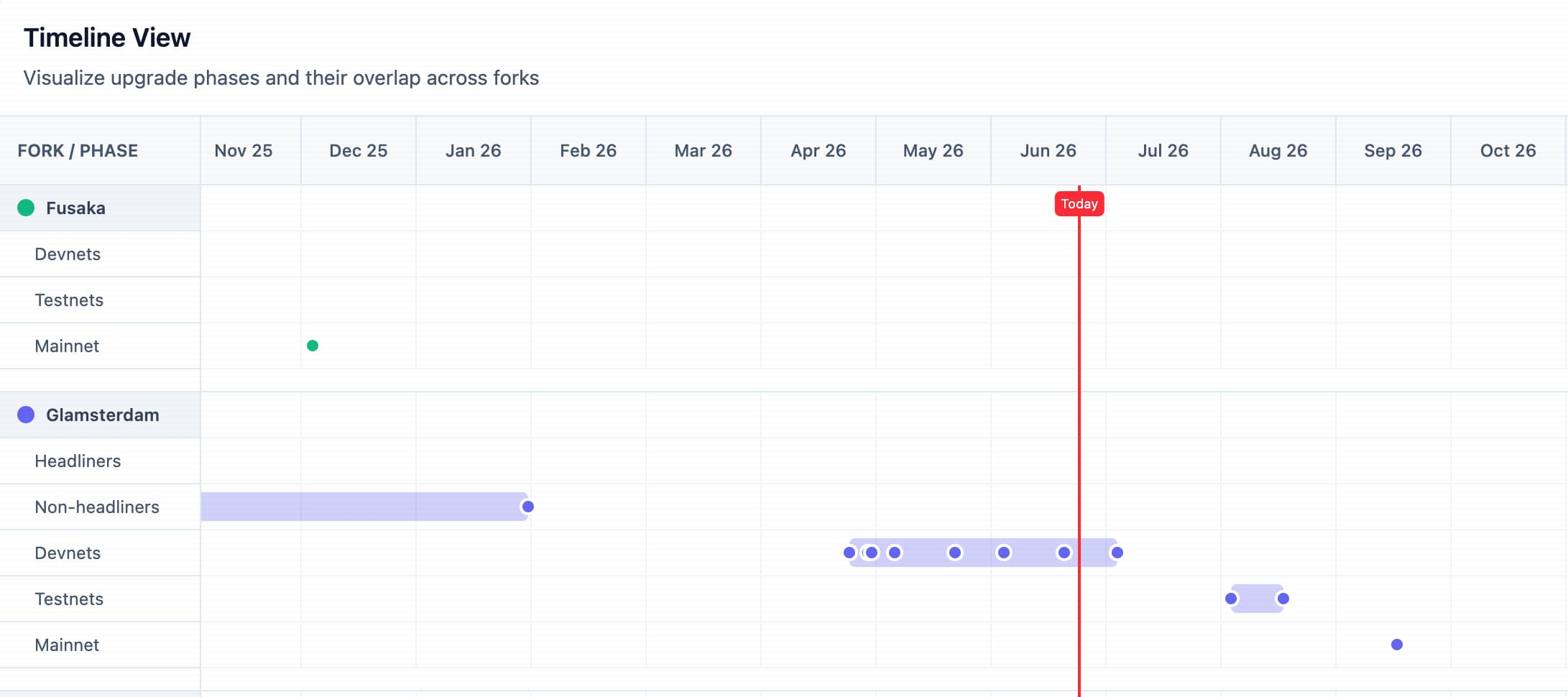


Currently, 10 EIPs are planned for inclusion in the Glamsterdam list:


  • EIP-7708 (ETH transfers will also trigger logs, facilitating indexing and tracking of native ETH transfers)
  • EIP-7732 (ePBS, codifying proposer-builder separation into the protocol, reducing reliance on off-protocol relays)
  • EIP-7778 (Removes block gas accounting related to gas refunds, simplifying block gas calculation)
  • EIP-7843 (Adds SLOTNUM opcode, allowing contracts to read the current slot number)
  • EIP-7928 (Block-level access lists BAL, recording accounts and storage locations accessed during block execution, paving the way for parallel verification)
  • EIP-7954 (Increases the maximum contract size limit, allowing larger contract bytecode)
  • EIP-7976 (Increases calldata floor cost, adjusting the minimum cost for calldata)
  • EIP-7981 (Increases access list cost, recalibrating gas pricing for access lists)
  • EIP-8024 (Backward-compatible SWAPN, DUPN, EXCHANGE opcodes, enhancing EVM stack operation capabilities)
  • EIP-8037 (Increases state creation gas cost,抑制 state database过快膨胀)


These EIPs can be roughly categorized into several groups: The first is the restructuring of block proposal and validation processes, with EIP-7732 and EIP-7928 at the core; the second is resource pricing adjustments, including EIP-7778, EIP-7976, EIP-7981, and EIP-8037; the third is EVM and developer experience changes, including EIP-7708, EIP-7843, EIP-7954, and EIP-8024.


In other words, Glamsterdam isn't changing just one feature point; it's simultaneously upgrading block creation roles, parallel validation, gas pricing, and EVM usability.


Another batch of EIPs remains on the "Considered for Inclusion" list:


  • EIP-2780 (Splits transaction intrinsic gas by resource)
  • EIP-7610 (Contract creation reverts when using a non-empty storage account)
  • EIP-7688 (Future-compatible consensus layer data structure)
  • EIP-7904 (Computational gas cost analysis, potentially to be removed from Glamsterdam)
  • EIP-7975 (eth/70, partial block receipt lists)
  • EIP-7997 (Deterministic factory contracts)
  • EIP-8038 (State access gas cost updates)
  • EIP-8045 (Excludes slashed validators from continuing to propose blocks)
  • EIP-8061 (Increases exit and merge churn)
  • EIP-8070 (eth/72, Sparse Blobpool)
  • EIP-8080 (Allows exits to use the consolidation queue)
  • EIP-8136 (Cell-level deltas for data column broadcasts)
  • EIP-8159 (eth/71, block access list exchange)
  • EIP-8246 (Removes SELFDESTRUCT burn)
  • EIP-8282 (Builder Execution Requests, provides dedicated registration and exit requests for ePBS builders)


Additionally, Forkcast currently lists EIP-8254 (Limits the number of deposit requests per execution layer block to 8192) on the "Proposed for Inclusion" list.


From a staker's perspective, EIP-8061 and EIP-8080 on the considered list are particularly noteworthy. For stakers, this could mean improved exit liquidity. Figment stated in an article on May 5, 2026, that institutional stakers should pay most attention to ePBS, EIP-8061, and EIP-8080, estimating that under the ~38.9 million ETH staked规模 as of April 2026, EIP-8061 could increase the exit churn limit from 256 ETH/epoch to ~1187 ETH/epoch, while EIP-8080 allows regular exits to utilize spare capacity in the merge queue. Figment also cautions that all pre-mainnet numbers should be considered speculative.
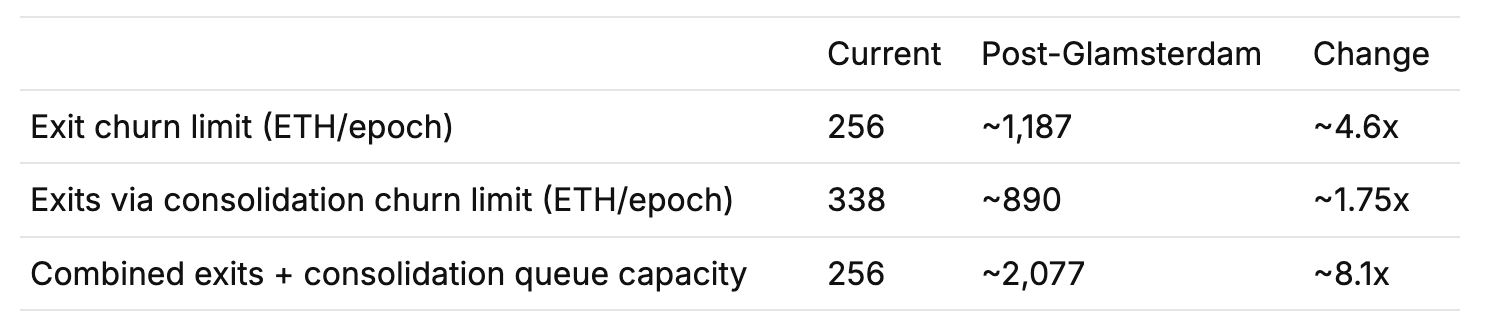

Source: Figment


The Protocol is Upgrading, and Foundation Members Are Also Changing


The technical preparation for Glamsterdam coincides almost simultaneously with personnel changes in the Ethereum Foundation's Protocol cluster. An Ethereum Foundation blog post on May 11, 2026, stated that Glamsterdam had reached several milestones: a 200 million gas limit floor had been established as a credible post-Glamsterdam target, ePBS was running stably on multi-client Glamsterdam devnets, and EIP-8037 was finalized.


The same article announced a leadership transition for the Protocol cluster: Will Corcoran, Kev Wedderburn, and Fredrik would become the new Protocol cluster coordinators. Original coordinators Barnabé Monnot and Tim Beiko left the Ethereum Foundation, and Alex Stokes is on leave.


The Foundation's description of the分工 for the three new coordinators is: Will Corcoran has cross-team coordination experience; Kev Wedderburn leads the zkEVM team; Fredrik leads the Protocol Security and Trillion Dollar Security project.


These changes didn't stop at the protocol team. On June 18, 2026, Hsiao-Wei Wang posted that after a leave of absence, they had decided to resign from their positions as Co-Executive Director and Board Member of the Ethereum Foundation.


Former Ethereum Foundation researcher Dankrad Feist stated on June 19, 2026, that those leaving the EF are believers in CROPS (Censorship & Capture Resistance, Open Source, Privacy, Security), that the issue isn't with strategy but with management, and called this wave of talent outflow slightly bearish for Ethereum. Miden co-founder Azeem interpreted it from the opposite direction, believing the EF struggles to change itself, and that the talent outflow might lead to the formation of new organizations better able to execute the Ethereum roadmap, ultimately a net positive for the ecosystem long-term.


The narrative from within the Ethereum Foundation sounds more like setting boundaries. Ethereum Foundation Interim Co-Executive Director Bastian Aue (Aerugo) responded that reasons for EF members leaving include strategic disagreements, role fit, normal institutional turnover, or personal choice, that the EF wouldn't discuss individual personnel matters on social media, but stated that those leaving should have a dignified way to depart.


The Ethereum Foundation later provided a clearer organizational narrative via an official Twitter thread: realizing Ethereum's potential requires a coalition of multiple organizations, and over the past year, several organizations have jointly enhanced the ecosystem's resilience and capabilities. Examples listed by the EF include: ethlabs announced on June 23 (a non-profit R&D lab focused on the next stage of Ethereum and ETH adoption), the Eth Apps Guild launched in April 2026 (focused on real adoption of Ethereum-native apps, especially in emerging markets), the Ethereum Economic Zone launched in 2026 (aiming to reduce ecosystem fragmentation through synchronous composability and zero-knowledge real-time proofs), and Argot established in 2025 (an autonomous collective of engineers and researchers maintaining Solidity and open-source compiler tools).


This official thread makes the recent changes at the Ethereum Foundation easier to understand: the Foundation isn't simply pushing people and projects out, nor is it abandoning central coordination; rather, it might be distributing the Ethereum roadmap across more organizations to shoulder together.


Summary


Therefore, Glamsterdam shouldn't be seen merely as a set of EIPs. It is a significant engineering reorganization by Ethereum before achieving higher throughput: who builds blocks, who proposes them, who validates them, which data must be stored long-term, and which resources should be more expensive are all being re-examined.


The keywords for the technical route are ePBS, BAL, and the beginning of multi-dimensional gas; the keywords for the organizational route are more pragmatic: can the Ethereum Foundation maintain its coordinating power, and can new organizations outside the Foundation turn this coordinating power into sustained delivery.


References:
https://forkcast.org/upgrade/glamsterdam/
https://ethereum.org/roadmap/glamsterdam/
https://blog.ethereum.org/2026/05/11/protocol-update-may-26
https://x.com/VitalikButerin/status/2027403360484430122


Tiền kỹ thuật số thịnh hành

Câu hỏi Liên quan

QWhat is the core purpose of the Glamsterdam upgrade for Ethereum?

AThe Glamsterdam upgrade is not simply about increasing throughput. Its core purpose is to restructure key processes like block production, validation, and resource pricing to pave the way for higher gas limits, larger blob capacity, and future parallel transaction execution. It aims to handle more transactions while preventing uncontrolled growth in block propagation time, verification pressure, and state storage size.

QWhat is ePBS (EIP-7732) and why is it significant in Glamsterdam?

AePBS (Enshrined Proposer-Builder Separation) formally encodes the division of labor between block proposers and block builders into the Ethereum protocol. Proposers choose consensus blocks, while builders prepare the transaction content. Builders must provide collateral and their execution payload, which is verified by a Payload Timeliness Committee (PTC). This reduces reliance on external relays like MEV-Boost and crucially extends the execution payload propagation window from ~2 seconds to ~9 seconds. This longer window allows for safer processing of larger block capacities without increasing the risk of missed votes or reorgs.

QHow does the Block-Level Access List (BAL, EIP-7928) facilitate future scaling?

AThe Block-Level Access List (BAL) attaches a detailed 'access record' to each block, listing every account and storage slot touched during execution and their resulting states. This allows nodes to know in advance which data needs to be read, enabling parallel disk reads, parallel transaction verification, and parallel state root calculations. By making data access patterns explicit, BAL creates an engineering foundation for parallel execution, allowing the network to process blocks faster and more efficiently, which is critical for handling higher transaction loads.

QWhy is EIP-8037 (increasing state creation cost) necessary alongside capacity increases?

AEIP-8037 is necessary to decouple the cost of 'permanent database occupancy' (state growth) from the cost of 'temporary computation'. State (like new accounts and contracts) persists indefinitely on all nodes, leading to database bloat and increased hardware costs that threaten decentralization. With projections showing state growth could exceed performance thresholds under higher gas limits, EIP-8037 significantly raises the gas cost for creating new state. This allows execution capacity (transactions per block) to increase more aggressively while preventing the state database from expanding at an unsustainable rate.

QWhat are the potential implications of the recent Ethereum Foundation personnel changes for the Glamsterdam upgrade and Ethereum's development?

AThe recent changes, including the departure of key figures and the promotion of new protocol cluster coordinators, have sparked debate. Some see it as a potential 'brain drain' that could slow progress. However, the Ethereum Foundation's official narrative frames it as part of a strategic shift towards a 'coalition of organizations' (like ethlabs, Eth Apps Guild, Ethereum Economic Zone, and Argot) sharing the responsibility for executing Ethereum's roadmap. The implication is that the Foundation aims to distribute coordination and development efforts more broadly across the ecosystem, which could enhance resilience and execution capacity in the long term, albeit with potential short-term transition challenges.

Nội dung Liên quan

Ripple Đẩy Mạnh Mở Rộng Tuân Thủ Toàn Cầu Trước Khi Thảo Luận Đạo Luật Rõ Ràng Ở Mỹ

Ripple đang tích cực mở rộng hoạt động tuân thủ quy định toàn cầu bằng cách xin cấp phép bổ sung tại Singapore và châu Âu, nhằm phát triển các sản phẩm thể chế dựa trên tiện ích. Động thái này diễn ra trong bối cảnh sắp tranh luận về Đạo luật Rõ ràng tại Mỹ, nhưng trọng tâm cần tách biệt với các diễn biến từ vụ kiện SEC. Đối với trader, câu chuyện này quan trọng vì nó phản ánh xu hướng phát triển hạ tầng và tiện ích, có khả năng ảnh hưởng đến dòng vốn, thanh khoản và tâm lý thị trường tiền điện tử rộng hơn, đặc biệt trong bối cảnh thị trường còn chịu tác động mạnh từ dòng ETF và sự luân chuyển vốn. Điều cần lưu ý là tránh diễn giải quá mức một tín hiệu đơn lẻ. Thông tin về giấy phép là một chỉ báo về định vị và sự tự tin của Ripple trong các thị trường được quản lý, chứ không phải một bảo đảm cho biến động giá. Cần theo dõi các dữ liệu tiếp theo như số liệu on-chain, lệnh mở (open interest) và dòng vốn để xác nhận liệu đây có phải một chủ đề bền vững hay chỉ là biến động ngắn hạn.

bitcoinist16 phút trước

Ripple Đẩy Mạnh Mở Rộng Tuân Thủ Toàn Cầu Trước Khi Thảo Luận Đạo Luật Rõ Ràng Ở Mỹ

bitcoinist16 phút trước

Giá XRP sẽ diễn biến thế nào trong tháng 7 năm 2026?

Giá XRP đã giảm xuống mức thấp nhất kể từ tháng 11/2024, chạm ngưỡng 1,009 USD vào ngày 26/6, gần sát mức tâm lý quan trọng 1 USD. Mặc dù dòng tiền vào quỹ ETF spot XRP vẫn tích cực, giúp thắt chặt nguồn cung, nhưng điều này có thể chưa đủ để đảo ngược xu hướng trong điều kiện thị trường chung đang yếu. Biểu đồ 1 ngày cho thấy XRP đang trong một xu hướng giảm dài hạn kể từ tháng 7/2025, với việc phá vỡ đáy trước đó ở 1,61 USD vào tháng 2. Mặc dù đã có một đợt phục hồi ngắn lên khoảng 1,3 USD vào giữa tháng 6, nhưng lực bán sau đó đã đẩy giá về quanh mức 1,05 USD. Dữ liệu phái sinh chỉ ra rằng thị trường đang ổn định và ít biến động, với Open Interest ổn định quanh 400 triệu XRP và tỷ lở Turnover khoảng 0,71. Điều này cho thấy hoạt động đầu cơ ngắn hạn đã chậm lại. Tuy nhiên, các nhà giao dịch cần cảnh giác với bất kỳ sự gia tăng đột biến nào trong các chỉ số này, vì chúng có thể báo hiệu biến động tăng cao. Phân tích kỹ thuật trên biểu đồ 4 giờ dự báo khả năng cao XRP sẽ tiếp tục giảm, hướng tới các mục tiêu mở rộng ở 0,975 USD và 0,854 USD. Do đó, khả năng giá XRP giảm xuống dưới ngưỡng 1 USD trong tháng 7 là rất lớn, với đà giảm có thể đẩy giá về mức 0,85 USD.

ambcrypto20 phút trước

Giá XRP sẽ diễn biến thế nào trong tháng 7 năm 2026?

ambcrypto20 phút trước

BNB Chain Tuyên Bố Dẫn Đầu Solana Về Khối Lượng Giao Dịch Cổ Phiếu Mã Hóa

BNB Chain tuyên bố đã vượt qua Solana về khối lượng giao dịch cổ phiếu được mã hóa (tokenized stocks), đạt 5,2 tỷ USD. Cột mốc này giúp BNB Chain củng cố vị thế trong lĩnh vực tài sản thế giới thực (RWA) - một trong những xu hướng tăng trưởng cạnh tranh nhất của crypto, nhằm kết nối tài chính truyền thống với blockchain. Khối lượng được thúc đẩy bởi các giao thức như Ondo, xStocks và bStocks, cho thấy một hệ sinh thái sản phẩm đang phát triển trên BNB Chain, không chỉ là một đợt phát hành token đơn lẻ. Trong khi đó, Solana vẫn mạnh ở các khía cạnh khác như hoạt động bán lẻ, meme coin và tốc độ DeFi. Sự kiện này có ý nghĩa quan trọng đối với BNB Chain, giúp mạng lưới mở rộng hình ảnh vượt ra ngoài các hoạt động giao dịch liên quan đến sàn tập trung, hướng tới một điểm nhấn thể chế hơn. Thách thức chính là tính bền vững: khối lượng giao dịch ổn định, thanh khoản sâu và nhiều tài sản được mã hóa hơn sẽ quyết định vị thế lâu dài của BNB Chain trong lĩnh vực RWA. Cuộc cạnh tranh về tài sản được mã hóa giữa các blockchain như Ethereum, Solana và BNB Chain đang trở nên thực tế hơn bao giờ hết.

bitcoinist1 giờ trước

BNB Chain Tuyên Bố Dẫn Đầu Solana Về Khối Lượng Giao Dịch Cổ Phiếu Mã Hóa

bitcoinist1 giờ trước

Giao dịch

Giao ngay

Bài viết Nổi bật

AGENT S là gì

Agent S: Tương Lai của Tương Tác Tự Động trong Web3 Giới thiệu Trong bối cảnh không ngừng phát triển của Web3 và tiền điện tử, các đổi mới đang liên tục định nghĩa lại cách mà cá nhân tương tác với các nền tảng kỹ thuật số. Một dự án tiên phong như vậy, Agent S, hứa hẹn sẽ cách mạng hóa tương tác giữa con người và máy tính thông qua khung tác nhân mở của nó. Bằng cách mở đường cho các tương tác tự động, Agent S nhằm đơn giản hóa các nhiệm vụ phức tạp, cung cấp các ứng dụng chuyển đổi trong trí tuệ nhân tạo (AI). Cuộc khám phá chi tiết này sẽ đi sâu vào những phức tạp của dự án, các tính năng độc đáo của nó và những tác động đối với lĩnh vực tiền điện tử. Agent S là gì? Agent S đứng vững như một khung tác nhân mở đột phá, được thiết kế đặc biệt để giải quyết ba thách thức cơ bản trong việc tự động hóa các nhiệm vụ máy tính: Thu thập Kiến thức Cụ thể theo Miền: Khung này học một cách thông minh từ nhiều nguồn kiến thức bên ngoài và kinh nghiệm nội bộ. Cách tiếp cận kép này giúp nó xây dựng một kho lưu trữ phong phú về kiến thức cụ thể theo miền, nâng cao hiệu suất của nó trong việc thực hiện nhiệm vụ. Lập Kế Hoạch Qua Các Tầm Nhìn Nhiệm Vụ Dài Hạn: Agent S sử dụng lập kế hoạch phân cấp tăng cường kinh nghiệm, một cách tiếp cận chiến lược giúp phân chia và thực hiện các nhiệm vụ phức tạp một cách hiệu quả. Tính năng này nâng cao đáng kể khả năng quản lý nhiều nhiệm vụ con một cách hiệu quả và hiệu suất. Xử Lý Các Giao Diện Động, Không Đều: Dự án giới thiệu Giao Diện Tác Nhân-Máy Tính (ACI), một giải pháp đổi mới giúp nâng cao tương tác giữa các tác nhân và người dùng. Sử dụng các Mô Hình Ngôn Ngữ Lớn Đa Phương Thức (MLLMs), Agent S có thể điều hướng và thao tác các giao diện người dùng đồ họa đa dạng một cách liền mạch. Thông qua những tính năng tiên phong này, Agent S cung cấp một khung vững chắc giải quyết các phức tạp liên quan đến việc tự động hóa tương tác giữa con người với máy móc, mở ra nhiều ứng dụng trong AI và hơn thế nữa. Ai là Người Tạo ra Agent S? Mặc dù khái niệm về Agent S là hoàn toàn đổi mới, thông tin cụ thể về người sáng lập vẫn còn mơ hồ. Người sáng lập hiện vẫn chưa được biết đến, điều này làm nổi bật giai đoạn sơ khai của dự án hoặc sự lựa chọn chiến lược để giữ kín các thành viên sáng lập. Bất chấp sự ẩn danh, sự chú ý vẫn tập trung vào khả năng và tiềm năng của khung này. Ai là Các Nhà Đầu Tư của Agent S? Vì Agent S còn tương đối mới trong hệ sinh thái mã hóa, thông tin chi tiết về các nhà đầu tư và những người tài trợ tài chính của nó không được ghi chép rõ ràng. Sự thiếu vắng thông tin công khai về các nền tảng đầu tư hoặc tổ chức hỗ trợ dự án dấy lên câu hỏi về cấu trúc tài trợ và lộ trình phát triển của nó. Hiểu biết về sự hỗ trợ là rất quan trọng để đánh giá tính bền vững và tác động tiềm năng của dự án. Agent S Hoạt Động Như Thế Nào? Tại cốt lõi của Agent S là công nghệ tiên tiến cho phép nó hoạt động hiệu quả trong nhiều bối cảnh khác nhau. Mô hình hoạt động của nó được xây dựng xung quanh một số tính năng chính: Tương Tác Giống Như Con Người: Khung này cung cấp lập kế hoạch AI tiên tiến, cố gắng làm cho các tương tác với máy tính trở nên trực quan hơn. Bằng cách bắt chước hành vi của con người trong việc thực hiện nhiệm vụ, nó hứa hẹn nâng cao trải nghiệm người dùng. Ký Ức Tường Thuật: Được sử dụng để tận dụng các trải nghiệm cấp cao, Agent S sử dụng ký ức tường thuật để theo dõi lịch sử nhiệm vụ, từ đó nâng cao quy trình ra quyết định của nó. Ký Ức Tình Huống: Tính năng này cung cấp cho người dùng hướng dẫn từng bước, cho phép khung này cung cấp hỗ trợ theo ngữ cảnh khi các nhiệm vụ diễn ra. Hỗ Trợ OpenACI: Với khả năng chạy cục bộ, Agent S cho phép người dùng duy trì quyền kiểm soát đối với các tương tác và quy trình làm việc của họ, phù hợp với tinh thần phi tập trung của Web3. Tích Hợp Dễ Dàng với Các API Bên Ngoài: Tính linh hoạt và khả năng tương thích với nhiều nền tảng AI khác nhau đảm bảo rằng Agent S có thể hòa nhập liền mạch vào các hệ sinh thái công nghệ hiện có, làm cho nó trở thành lựa chọn hấp dẫn cho các nhà phát triển và tổ chức. Những chức năng này cùng nhau góp phần vào vị trí độc đáo của Agent S trong không gian tiền điện tử, khi nó tự động hóa các nhiệm vụ phức tạp, nhiều bước với sự can thiệp tối thiểu của con người. Khi dự án phát triển, các ứng dụng tiềm năng của nó trong Web3 có thể định nghĩa lại cách mà các tương tác kỹ thuật số diễn ra. Thời Gian Phát Triển của Agent S Sự phát triển và các cột mốc của Agent S có thể được tóm tắt trong một dòng thời gian nêu bật các sự kiện quan trọng của nó: 27 tháng 9, 2024: Khái niệm về Agent S được ra mắt trong một bài nghiên cứu toàn diện mang tên “Một Khung Tác Nhân Mở Sử Dụng Máy Tính Như Một Con Người,” trình bày nền tảng cho dự án. 10 tháng 10, 2024: Bài nghiên cứu được công bố công khai trên arXiv, cung cấp một cái nhìn sâu sắc về khung và đánh giá hiệu suất của nó dựa trên tiêu chuẩn OSWorld. 12 tháng 10, 2024: Một video trình bày được phát hành, cung cấp cái nhìn trực quan về khả năng và tính năng của Agent S, thu hút thêm sự quan tâm từ người dùng và nhà đầu tư tiềm năng. Những dấu mốc trong dòng thời gian không chỉ minh họa sự tiến bộ của Agent S mà còn chỉ ra cam kết của nó đối với sự minh bạch và sự tham gia của cộng đồng. Những Điểm Chính Về Agent S Khi khung Agent S tiếp tục phát triển, một số thuộc tính chính nổi bật, nhấn mạnh tính đổi mới và tiềm năng của nó: Khung Đổi Mới: Được thiết kế để cung cấp cách sử dụng máy tính trực quan giống như tương tác của con người, Agent S mang đến một cách tiếp cận mới cho việc tự động hóa nhiệm vụ. Tương Tác Tự Động: Khả năng tương tác tự động với máy tính thông qua GUI đánh dấu một bước tiến tới các giải pháp tính toán thông minh và hiệu quả hơn. Tự Động Hóa Nhiệm Vụ Phức Tạp: Với phương pháp mạnh mẽ của nó, nó có thể tự động hóa các nhiệm vụ phức tạp, nhiều bước, làm cho các quy trình nhanh hơn và ít sai sót hơn. Cải Tiến Liên Tục: Các cơ chế học tập cho phép Agent S cải thiện từ các trải nghiệm trước đó, liên tục nâng cao hiệu suất và hiệu quả của nó. Tính Linh Hoạt: Khả năng thích ứng của nó trên các môi trường hoạt động khác nhau như OSWorld và WindowsAgentArena đảm bảo rằng nó có thể phục vụ một loạt các ứng dụng rộng rãi. Khi Agent S định vị mình trong bối cảnh Web3 và tiền điện tử, tiềm năng của nó để nâng cao khả năng tương tác và tự động hóa quy trình đánh dấu một bước tiến quan trọng trong công nghệ AI. Thông qua khung đổi mới của mình, Agent S minh họa cho tương lai của các tương tác kỹ thuật số, hứa hẹn một trải nghiệm liền mạch và hiệu quả hơn cho người dùng trên nhiều ngành công nghiệp khác nhau. Kết luận Agent S đại diện cho một bước nhảy vọt táo bạo trong sự kết hợp giữa AI và Web3, với khả năng định nghĩa lại cách chúng ta tương tác với công nghệ. Mặc dù vẫn còn ở giai đoạn đầu, những khả năng cho ứng dụng của nó là rộng lớn và hấp dẫn. Thông qua khung toàn diện của mình giải quyết các thách thức quan trọng, Agent S nhằm đưa các tương tác tự động lên hàng đầu trong trải nghiệm kỹ thuật số. Khi chúng ta tiến sâu hơn vào các lĩnh vực tiền điện tử và phi tập trung, các dự án như Agent S chắc chắn sẽ đóng một vai trò quan trọng trong việc định hình tương lai của công nghệ và sự hợp tác giữa con người với máy tính.

Tổng lượt xem 902Xuất bản vào 2025.01.14Cập nhật vào 2025.01.14

AGENT S là gì

Làm thế nào để Mua S

Chào mừng bạn đến với HTX.com! Chúng tôi đã làm cho mua Sonic (S) trở nên đơn giản và thuận tiện. Làm theo hướng dẫn từng bước của chúng tôi để bắt đầu hành trình tiền kỹ thuật số của bạn.Bước 1: Tạo Tài khoản HTX của BạnSử dụng email hoặc số điện thoại của bạn để đăng ký tài khoản miễn phí trên HTX. Trải nghiệm hành trình đăng ký không rắc rối và mở khóa tất cả tính năng. Nhận Tài khoản của tôiBước 2: Truy cập Mua Crypto và Chọn Phương thức Thanh toán của BạnThẻ Tín dụng/Ghi nợ: Sử dụng Visa hoặc Mastercard của bạn để mua Sonic (S) ngay lập tức.Số dư: Sử dụng tiền từ số dư tài khoản HTX của bạn để giao dịch liền mạch.Bên thứ ba: Chúng tôi đã thêm những phương thức thanh toán phổ biến như Google Pay và Apple Pay để nâng cao sự tiện lợi.P2P: Giao dịch trực tiếp với người dùng khác trên HTX.Thị trường mua bán phi tập trung (OTC): Chúng tôi cung cấp những dịch vụ được thiết kế riêng và tỷ giá hối đoái cạnh tranh cho nhà giao dịch.Bước 3: Lưu trữ Sonic (S) của BạnSau khi mua Sonic (S), lưu trữ trong tài khoản HTX của bạn. Ngoài ra, bạn có thể gửi đi nơi khác qua chuyển khoản blockchain hoặc sử dụng để giao dịch những tiền kỹ thuật số khác.Bước 4: Giao dịch Sonic (S)Giao dịch Sonic (S) dễ dàng trên thị trường giao ngay của HTX. Chỉ cần truy cập vào tài khoản của bạn, chọn cặp giao dịch, thực hiện giao dịch và theo dõi trong thời gian thực. Chúng tôi cung cấp trải nghiệm thân thiện với người dùng cho cả người mới bắt đầu và người giao dịch dày dạn kinh nghiệm.

Tổng lượt xem 1.7kXuất bản vào 2025.01.15Cập nhật vào 2026.06.02

Làm thế nào để Mua S

Thảo luận

Chào mừng đến với Cộng đồng HTX. Tại đây, bạn có thể được thông báo về những phát triển nền tảng mới nhất và có quyền truy cập vào thông tin chuyên sâu về thị trường. Ý kiến ​​của người dùng về giá của S (S) được trình bày dưới đây.

活动图片