Critical Game Week: BTC Retracement Confirmation vs. HYPE Support Battle | Guest Analysis

marsbitXuất bản vào 2026-06-22Cập nhật gần nhất vào 2026-06-22

Tóm tắt

This weekly analysis outlines a critical juncture for BTC and HYPE markets, focusing on key price level confirmations. **BTC Analysis:** BTC is at a pivotal point after a five-wave rally from the June 5th low of $59,100. The price has broken below a short-term rising channel's lower boundary, with the current move seen as a pullback to test this breakdown. Failure to reclaim this level could lead to a retest of the $59,000-$60,000 support zone. The core scenario hinges on this channel retest outcome. * **Key Levels:** Resistance at $64,500-$65,000 (channel boundary) and $69,500-$70,500. Support at $59,000-$60,000 and $55,000. * **Strategy:** A core bearish stance is maintained (20% short from last week), with short-term plans for tactical trades. Three detailed contingency plans (A/B/C) are provided for short positions on resistance tests or breakdowns, emphasizing strict stop-loss discipline. **HYPE Analysis:** HYPE shows strong momentum but is currently in a corrective phase after hitting a new high of $76.94. The price is retesting the crucial $64-$66 support area. * **Key Levels:** Resistance near $77 and $80-$82. Support at $64-$66 and $52-$54. * **Strategy:** The short-term approach is "buy on dips, avoid chasing rallies." A long position is considered only if clear stabilization signals appear at the $64-$66 or deeper $52-$54 support zones, with tight risk controls. **General Risk Management:** A standardized trailing stop-loss protocol is emphasized: set in...

This week, the market enters a critical phase of contention.

At the macro level, marginal changes in Federal Reserve policy expectations continue to dictate the pricing rhythm of risk assets. In the crypto market, after the previous period of consolidation, the divergence between bulls and bears is intensifying around key price levels.

This weekly review maintains the consistent framework: based on multi-timeframe structural analysis and combined with quantitative model signals, it assesses the market outlook for BTC and HYPE this week and formulates specific short- to medium-term trading plans.

It is crucial to note that all content herein represents personal technical analysis records, serving solely as a reference framework and review basis for my own trading decisions, and does not constitute any form of investment advice. The market is always more complex than predictions. Strict adherence to risk control and stop-loss discipline remains the top priority.

Summary of Core Trading Views for This Week:

  • BTC Hourly Timeframe Structure Analysis (Detailed in Part 1)
  • BTC Weekly Outlook & Medium/Short-Term Trading Strategies (Detailed in Part 2)
  • HYPE Hourly Timeframe Structure Analysis (Detailed in Part 3)
  • HYPE Weekly Outlook & Short-Term Trading Strategy (Detailed in Part 4)

Market Verification of Last Week's Trading Strategies & Core Views:

  • BTC Market Outlook Verification: Last week, strictly following trading discipline, we promptly established an approximately 20% short position when market entry opportunities emerged. The medium-term trading plan outlined in the weekly review article was executed.

I. In-depth Analysis of Bitcoin's Hourly Timeframe Structure

Bitcoin _4-Hour K-line Chart
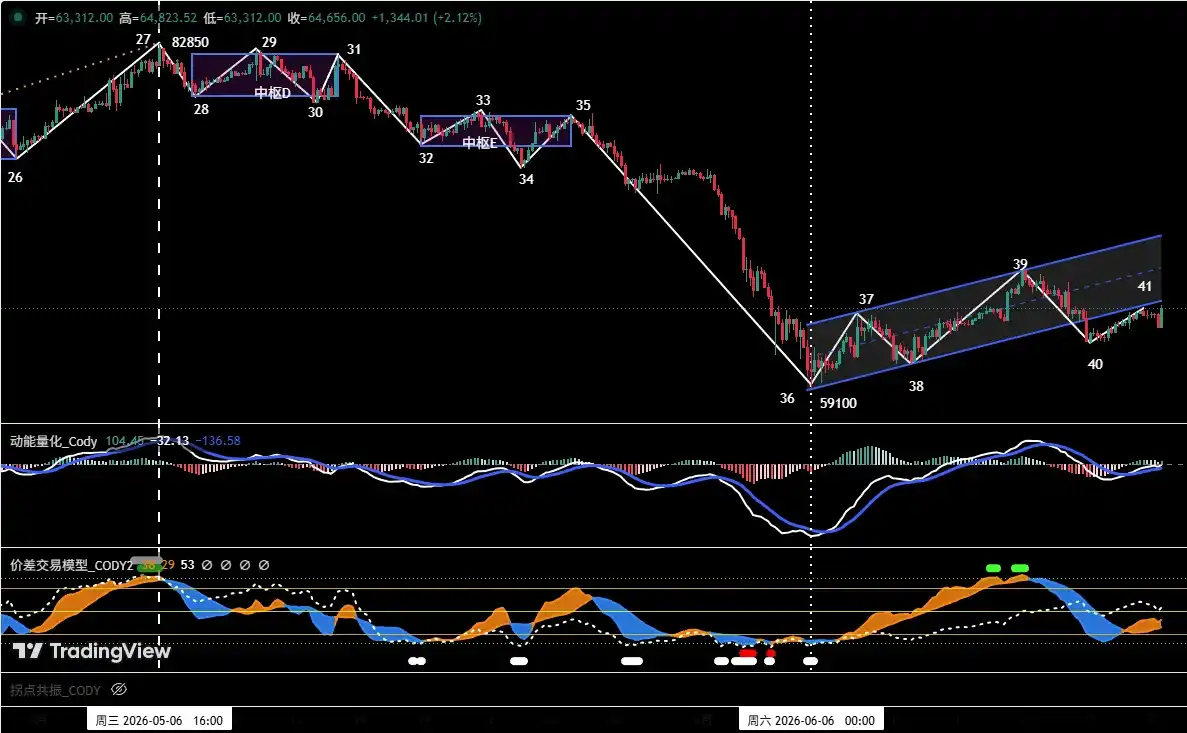
Figure 1

1 As shown in (Figure 1): From a 4-hour structural perspective, the price rebound initiated from the June 5th low of $59,100 can be subdivided into a five-wave structure, corresponding sequentially to segments 36-37, 37-38, 38-39, 39-40, and 40-41.

2 The overall trend presents a short-term rising channel pattern (blue channel in the chart): its upper bound is formed by connecting the two rebound highs at (point 37) and (point 39), while the lower bound is established by connecting the two correction lows at (point 36) and (point 38). The chart shows that the price has already breached the channel's lower bound at (point 40). The current (40-41) rebound segment can be viewed as a retracement confirmation phase for the breakdown below the channel's lower bound. If (point 41) fails to decisively reclaim a position above the channel's lower bound, the probability of the price revisiting the previous low support around $59,100 will significantly increase.

II. Bitcoin Weekly Outlook and Trading Strategies

1. BTC Weekly Market Outlook:

Core View for the Week: Focus on the outcome of the price's retracement confirmation of the short-term channel's lower bound.

  • If it holds firmly above, the price may continue its rebound along the short-term rising channel, potentially challenging the core resistance zone of $69,500~$70,500.
  • If it fails to hold, the market may retest the core support zone of $59,000~$60,000.

2. Core Resistance Levels:

  • First Resistance Zone: $64,500~$65,000 area (near the short-term rising channel's lower bound)
  • Second Resistance Zone: $69,500~$70,500 area (previous high-volume congestion zone)

3. Core Support Levels:

  • First Support Level: $59,000~$60,000 area (previous significant support level)
  • Second Support Level: Around $55,000 (previous significant support level)

4. Trading Strategies for This Week (Excluding Unexpected News Impact)

1 Medium-Term Strategy:

Bitcoin _ Daily K-line Chart (Position Monitoring Model)
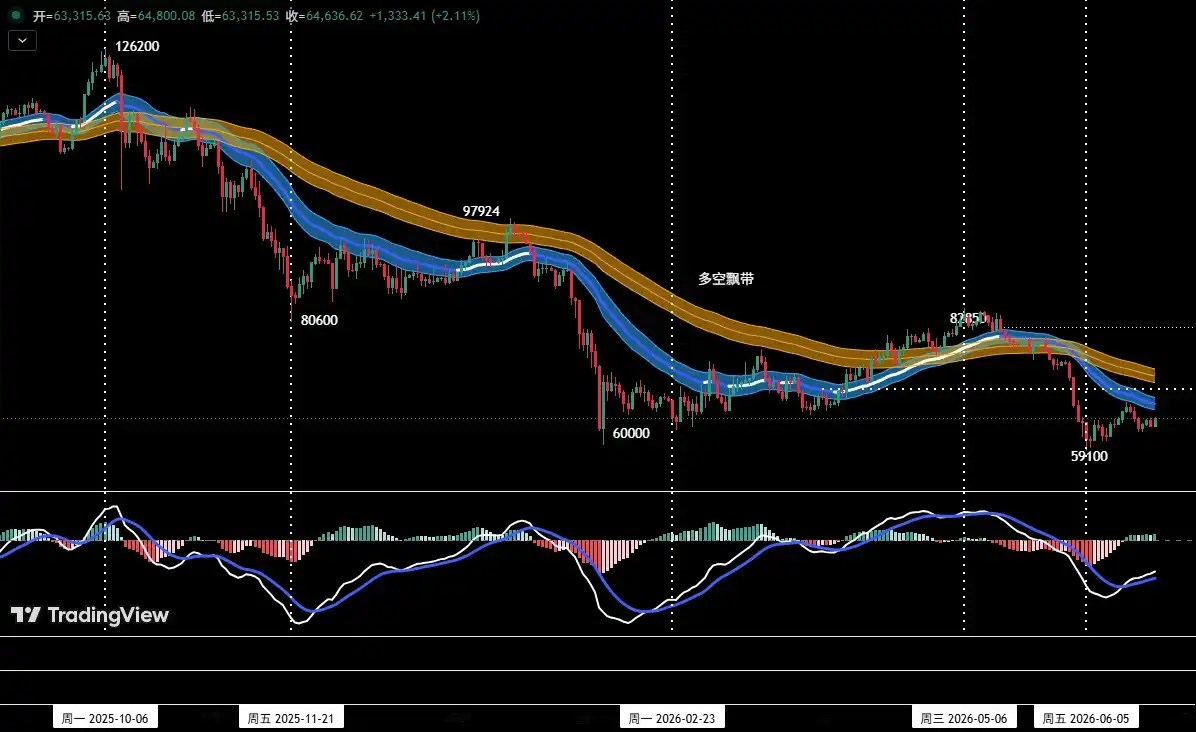
Figure 2

Position Monitoring Model: As shown in (Figure 2), the current price has decisively broken below the "Bull-Bear Channel," confirming a shift in market structure to a bear-dominated regime. Following the pre-set plan last week, we entered a short position around $64,500, with the initial medium-term position controlled at approximately 20% of total capital. Subsequent actions will adhere to stop-loss discipline, awaiting the next opportunity to add to the position.

2 Short-Term Strategy: Utilize 30% of capital, set stop-loss points, and seek "spread" trading opportunities based on support and resistance levels (using 30-minute/60-minute cycles).

3 To dynamically respond to the market's complex evolution in short-term operations, we have pre-formulated three specific contingency plans: A, B, and C.

Plan A: Tentative Positioning in Resistance Zone

  • Entry: If the price rallies to the $64,500~$65,000 zone showing signs of exhaustion, combined with a quantitative model top signal, an initial short position of around 15% can be established.
  • Risk Control: Set an initial stop-loss.
  • Exit: When the correction approaches significant support levels and aligns with model signals, gradually close positions to take profits.

Plan B: Adding to Position in Strong Resistance Zone

  • Addition: If the price breaks above the $65,000 resistance and continues to rally to the $69,500~$70,500 zone showing pressure signs, combined with a quantitative model top signal, increase the short position to within 30%.
  • Risk Control: Set an initial stop-loss.
  • Exit: When the correction approaches significant support levels and aligns with model signals, gradually close positions to take profits.

Plan C: Following the Break Below Support to Add Shorts

  • Addition: If the price decisively breaks below the $65,000 support, continues its decline, and loses the $59,000~$60,000 support zone, consider adding to the short position (within 30%) when price shows weakness during a retracement confirmation.
  • Risk Control: Set an initial stop-loss.
  • Exit: When the decline reaches significant support levels and aligns with model signals, gradually close positions to take profits.

III. HYPE Hourly Timeframe Structure Analysis

HYPE_4-Hour K-line Chart
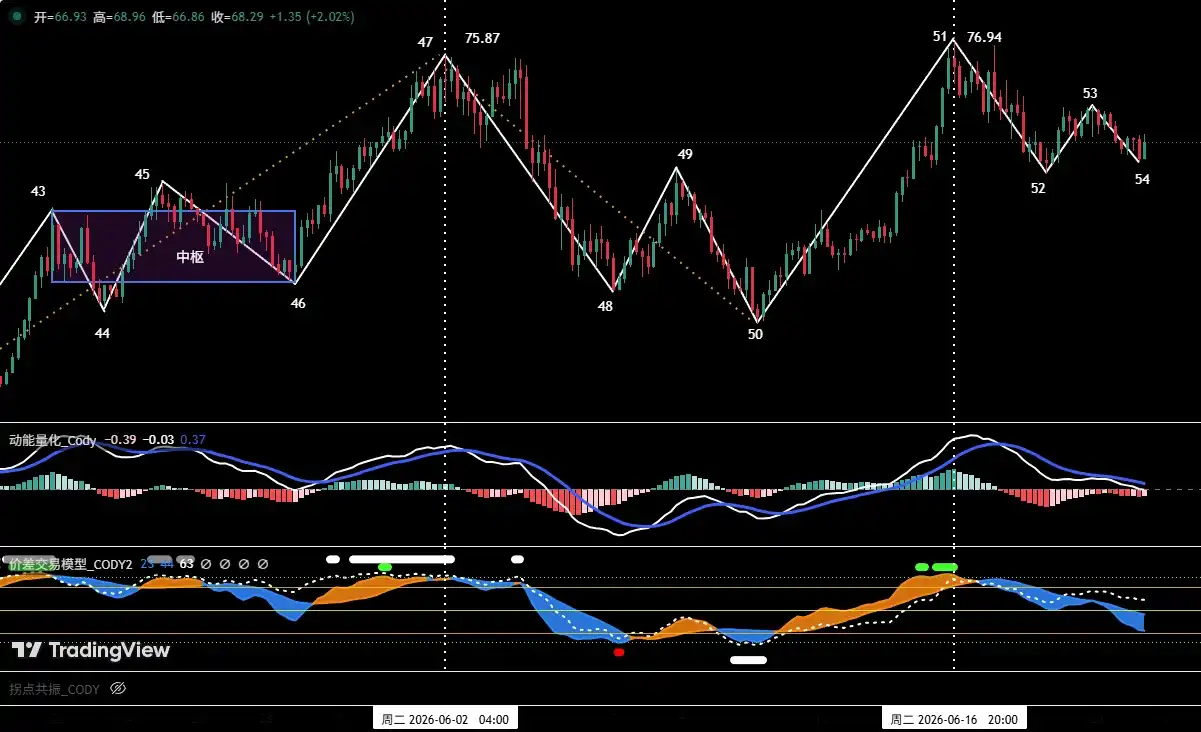
Figure 3

1 As shown in (Figure 3), on the 4-hour timeframe, HYPE initiated a correction from the June 2nd high of $75.87 (point 47), finding support near $52.62 (point 50) on June 10th, a correction lasting about 9 trading days. Subsequently, the market began a strong upward wave (segment 50-51), breaking the previous high within 6 trading days to reach a new high of $76.94 since the January rally, indicating that bullish momentum remains strong.

2 The decline from the new high presents a clear three-wave corrective structure (51-52, 52-53, 53-54). The price has currently retraced back to the critical support zone of $64~$66.

  • Bullish Scenario: If the price finds effective support in this zone, the uptrend from (point 50) is likely to continue, with subsequent prices challenging new highs.
  • Bearish Scenario: If this level is lost, the correction period will extend, and the price may retest the core support band of $52~$54, which marks the starting point of the previous uptrend.

IV. HYPE Weekly Outlook and Short-Term Trading Strategy

1. HYPE Weekly Market Outlook:

1 Core Resistance Levels:

  • First Resistance Level: Around $77
  • Second Resistance Zone: $80~$82 area

2 Core Support Levels:

  • First Support Level: $64~$66 area
  • Second Support Level: $52~$54 area

Core View for HYPE This Week:

  • Observe the outcome of the battle between bulls and bears over the $64~$66 zone.

2. HYPE Short-Term Trading Strategy for This Week (Long on Support)

This week's short-term HYPE trading should adhere to the strategy of "buying the dip, avoiding chasing rallies."

Short-Term Strategy: Testing Longs on Support Zone Stabilization

When the HYPE price retests and finds support, showing signs of stabilization in the $64~$66 key support zone or the deeper $52~$54 zone, and this aligns with bottom signals triggered by the two models, consider a light long position trial. Position size must be controlled below 30%, and strict stop-loss discipline must be maintained.

V. Special Notes:

  1. Upon Entry: Immediately set the initial stop-loss.
  2. Upon Reaching 1% Profit: Move the stop-loss to the entry price (break-even point), ensuring capital safety.
  3. Upon Reaching 2% Profit: Move the stop-loss to the position of 1% profit.
  4. Continuous Tracking: Thereafter, for every additional 1% profit gained, move the stop-loss up by 1%, dynamically protecting and locking in profits.

Financial markets change rapidly. All market analysis and trading strategies require dynamic adjustment. All views, analytical models, and operational strategies mentioned in this article are derived from personal technical analysis, intended solely for personal trading log purposes, and do not constitute any investment advice or operational basis. Markets involve risk, investment requires caution. Please do not make decisions based solely on this content.


Tiền kỹ thuật số thịnh hành

Câu hỏi Liên quan

QWhat is the key technical situation for Bitcoin according to the analysis?

AThe key technical situation for Bitcoin is its current position in a short-term rising channel on the 4-hour chart. The price has already broken below the channel's lower rail at point 40. The current move (40-41) is seen as a retest to confirm this break. If point 41 fails to hold above the lower rail, the probability of a retest of the previous low at $59,100 increases significantly.

QWhat are the two main scenarios for HYPE this week based on its price action?

AFor HYPE, there are two main scenarios based on its price action around the key support zone of $64-$66. In the bullish scenario, if the price finds effective support in this zone, the uptrend from point 50 is expected to continue, potentially challenging new highs. In the bearish scenario, if this support is decisively broken, the correction will likely extend, and the price may test the more critical support band of $52-$54.

QWhat is the core medium-term trading strategy for Bitcoin, and what action was already taken?

AThe core medium-term strategy for Bitcoin is bearish, as the price has broken below the 'Bull-Bear Channel' on the daily chart, confirming a market structure shift to bearish dominance. Following the plan, a short position of approximately 20% of total capital was established near $64,500 last week. The strategy involves holding this initial position while waiting for potential opportunities to add to it.

QAccording to the analysis, what is the primary short-term trading approach recommended for HYPE?

AThe primary short-term trading approach for HYPE is to 'buy on dips and avoid chasing rallies.' The specific strategy is to attempt long positions on support levels. When the price retests and shows signs of stabilization in the key support zones of $64-$66 or $52-$54, and this is confirmed by bottom signals from the analysis models, a light long position (under 30% of capital) can be considered, with strict adherence to stop-loss discipline.

QWhat are the three contingency plans (A, B, C) outlined for Bitcoin's short-term trading?

AThe three contingency plans for Bitcoin's short-term trading are: Plan A (Resistance Zone Test): Initiate a ~15% short position if the price shows signs of stalling in the $64,500-$65,000 resistance zone with a model top signal. Plan B (Strong Resistance Zone): Increase the short position to under 30% if the price rallies further and faces pressure in the $69,500-$70,500 zone with a model top signal. Plan C (Breakdown Follow-through): Add to the short position (to under 30%) if the price decisively breaks below $65,000 and then $59,000-$60,000 support, showing weakness on any retest.

Nội dung Liên quan

Vua ‘Bơm Thổi’ Arthur Hayes Lại Ra Tay, Lần Này Mục Tiêu Là Deribit

Arthur Hayes, đồng sáng lập BitMEX, đã mua khoảng 6,16 triệu đồng tiền SYN thông qua nền tảng OTC Flowdesk với giá trị giao dịch 2,2 triệu USD, giá mua trung bình khoảng 0,3573 USD. Sau đó, ông tuyên bố trên X rằng SYN là một trong những khoản đầu tư có tính bất đối xứng cao nhất mà ông thấy kể từ HYPE và cho rằng đã đến lúc các sàn giao dịch quyền chọn phi tập trung (DEX) thách thức Deribit, với Hypercall là đối thủ. Synapse Protocol, ban đầu là một mạng lưới chuyển tin nhắn xuyên chuỗi và thanh khoản đa năng, đã phát triển Hypercall – một giao thức giao dịch quyền chọn trên chuỗi triển khai trên HyperEVM của hệ sinh thái Hyperliquid. Hypercall hướng tới trở thành một sàn giao dịch quyền chọn có thể giao dịch mọi tài sản, hỗ trợ các hợp đồng quy mô khác nhau, với rủi ro tối đa chỉ là phí quyền chọn đã trả và không có rủi ro thanh lý dây chuyền. Trong khi đó, Deribit, thành lập năm 2016, vẫn thống trị thị trường quyền chọn tiền mã hóa với thị phần khoảng 85% đối với quyền chọn BTC và ETH. Nền tảng này có tính thanh khoản sâu và các công cụ chuyên nghiệp, nhưng cũng tồn tại những hạn chế vốn có của mô hình tập trung như rủi ro lưu ký, yêu cầu KYC và sự không chắc chắn về mặt quy định. Hayes tin rằng nhu cầu về quyền chọn trên chuỗi đang tăng lên. Hypercall có lợi thế về tính phi tập trung, không cần cấp phép và minh bạch, nhưng vẫn ở giai đoạn Mainnet Alpha sớm và tính thanh khoản còn thấp so với Deribit. Do đó, nó có thể bổ sung và cạnh tranh khác biệt, đặc biệt trong lĩnh vực quyền chọn cho tài sản gốc DeFi và tài sản mới nổi, hơn là thay thế trực tiếp Deribit. Động thái này của Hayes diễn ra trong bối cảnh hồ sơ "kêu gọi đầu tư" gần đây của ông có sự phân hóa rõ rệt, bao gồm việc thanh lý rồi lại mua vào HYPE, cùng báo cáo nghiên cứu gây tranh cãi về CARDS dẫn đến biến động giá đáng kể, thu hút sự chỉ trích từ cộng đồng về việc tạo ra "thanh khoản thoát" cho người theo dõi.

marsbit1 phút trước

Vua ‘Bơm Thổi’ Arthur Hayes Lại Ra Tay, Lần Này Mục Tiêu Là Deribit

marsbit1 phút trước

AI cuốn phăng toàn cầu, Crypto + AI tại sao lại ảm đạm thế?

**Tóm tắt: Tại sao Crypto + AI lại ảm đạm khi AI đang bùng nổ toàn cầu?** Bối cảnh AI đang phát triển mạnh mẽ, nhưng lĩnh vực kết hợp Blockchain (Crypto) và AI lại chưa tạo được sức hút tương ứng. Phân tích từ góc độ nhu cầu, có thể thấy vấn đề chính nằm ở sự **lệch pha nghiêm trọng giữa cung và cầu** trong các phân khúc. Các dự án Blockchain+AI nhắm vào các điểm đau thực tế như: 1. **Điện toán phi tập trung & Lưu trữ phi tập trung:** Giải quyết độc quyền tài nguyên, chủ quyền dữ liệu. Tuy có logic hợp lý nhưng **thiếu ưu thế kỹ thuật áp đảo**, chưa đủ thuyết phục doanh nghiệp chuyển đổi từ các nhà cung cấp cloud truyền thống ổn định. 2. **Xác minh mô hình & Bảo vệ quyền riêng tư (ZKML):** Cung cấp tính minh bạch và kiểm toán. Tuy nhiên, đây chưa phải nhu cầu cấp thiết hiện tại của doanh nghiệp. Nhu cầu có thể sẽ **chậm hơn so với chính sách quản lý** (ví dụ: Luật AI của EU). 3. **Cơ sở hạ tầng cho Tác nhân AI (AI Agent):** Hướng tới nền kinh tế đa tác nhân tự trị. **Nhu cầu thị trường chưa chín muồi** vì doanh nghiệp hiện tập trung vào tự động hóa quy trình nội bộ, chưa sẵn sàng cho giai đoạn tác nhân hoạt động xuyên mạng. 4. **Thanh toán cho Tác nhân AI:** Là phân khúc **duy nhất** mà Blockchain có thể cạnh tranh trực tiếp ngang hàng với tài chính truyền thống, vì cả hai đều chưa giải quyết tốt các yêu cầu giao dịch tần suất cao, vi mô, thời gian thực. **Nguyên nhân cốt lõi:** Ngành công nghiệp AI truyền thống có nhu cầu rõ ràng: tăng hiệu suất, giảm chi phí ngắn hạn và độ ổn định tối đa. Trong khi đó, hầu hết các giải pháp Blockchain+AI lại tập trung vào các giá trị dài hạn như chủ quyền dữ liệu, tính minh bạch, phi tập trung - những yếu tố chưa phải là nút thắt cấp bách. Sự đánh đổi về hiệu suất và thiếu **case study thành công quy mô lớn** khiến tỷ lệ ROI không thuyết phục được các doanh nghiệp và vốn tổ chức. **Tương lai:** Sự kết hợp Blockchain và AI vẫn có giá trị lâu dài. Con đường phía trước phụ thuộc vào việc ngành này sẽ **chủ động thích ứng với tiêu chuẩn ngành AI hiện tại** để bù đắp điểm yếu hiệu suất ngắn hạn, hay **kiên trì với lộ trình hiện tại** để xây dựng cơ sở hạ tầng cho tương lai của AI. Kết quả cuối cùng phụ thuộc vào việc lộ trình nào phù hợp với nhu cầu thị trường thực tế trong tương lai.

Foresight News10 phút trước

AI cuốn phăng toàn cầu, Crypto + AI tại sao lại ảm đạm thế?

Foresight News10 phút trước

ETF Liên Tục Ròng Rút, Các Tổ Chức Đang Thoát Ra?

Trong 6 tuần qua, các quỹ ETF Bitcoin dạng vật chất ở Mỹ đã chứng kiến dòng tiền ròng rút ra khoảng 6 tỷ USD, đánh dấu đợt tháo chạy kéo dài nhất kể từ khi ra mắt vào năm 2024. Quỹ IBIT của BlackRock là nguồn chảy chính, riêng tuần gần nhất chiếm hơn 70% tổng lượng rút ra toàn ngành. Dữ liệu trên chuỗi cho thấy những người nắm giữ Bitcoin lâu dài (trên 155 ngày) vẫn không động đậy, nắm giữ ~83% lượng lưu thông. Áp lực bán chủ yếu đến từ các nhà đầu tư tổ chức thông qua tài khoản môi giới - những người đã dễ dàng vào lại cũng dễ dàng rút đi, tạo nên đợt "đầu hàng tập thể" đầu tiên sau khi Bitcoin được phố Wall chấp nhận. Lý do bán tháo có vẻ là điều chỉnh danh mục để giảm rủi ro trong bối cảnh lạm phát tăng, Cục Dự trữ Liên bang (Fed) có thể thắt chặt chính sách, và vốn đổ mạnh vào cơ sở hạ tầng AI hay các đợt IPO hấp dẫn. Bitcoin bị coi là tài sản rủi ro cao và bị bán tháo đầu tiên. Mặc dù tốc độ dòng tiền rút ra đã chậm lại đáng kể, từ 1.72 tỷ USD đầu tháng 6 xuống còn 226.8 triệu USD giữa tháng, vấn đề cấu trúc vẫn tồn tại: IBIT quá lớn nên chính việc rút tiền từ nó đã tạo ra áp lực bán. Thị trường giao ngay hiện phải tự chống đỡ mà không có sự hỗ trợ từ dòng tiền mua ETF, trong khi lượng mua mới và thanh khoản đều ở mức thấp. Tương lai thị trường phụ thuộc vào diễn biến sắp tới: Nếu dòng chảy từ IBIT chậm lại và Bitcoin phục hồi trên 60,000 USD, đây có thể chỉ là đợt điều chỉnh tích cực. Ngược lại, nếu IBIT tiếp tục rút mạnh và giá vỡ dưới 58,000 USD, điều đó cho thấy áp lực bán là lâu dài và thị trường phi ETF sẽ phải một mình hấp thụ cú sốc từ việc các tổ chức rút lui.

marsbit52 phút trước

ETF Liên Tục Ròng Rút, Các Tổ Chức Đang Thoát Ra?

marsbit52 phút trước

Dương Công Mộ Đạo, Ám Độ Trần Thương, Walsh Lót Đường Cho Việc 'Hạ Lãi Suất' Vào Tháng 9?

Tác giả Peter Tchir từ Academy Securities đưa ra quan điểm gây tranh cãi rằng Chủ tịch Fed Kevin Walsh đang sử dụng tư thế diều hâu như một bức màn khói. Mục tiêu thực sự có thể là chuẩn bị cho một lộ trình cắt giảm lãi suất vào tháng 9 và tháng 10, sát thời điểm bầu cử giữa kỳ. Lập luận dựa trên logic chính trị - kinh tế: chính quyền Trump luôn ưa chuộng lãi suất thấp. Walsh có thể đang đóng vai diều hâu để kiểm soát lợi suất trái phiếu dài hạn và bảo vệ vẻ ngoài độc lập của Fed, trước khi chuyển hướng sang nới lỏng với lý do "dựa vào dữ liệu". Tchir chỉ trích các thước đo lạm phát hiện tại như PCE là lỗi thời, đề xuất sử dụng các chỉ số thay thế như Chỉ số giá thuê mới (NTRR) của Fed Cleveland hoặc dữ liệu thời gian thực từ Truflation (hiện cho thấy lạm phát cốt lõi khoảng 1.45%). Ông cho rằng Fed có thể định nghĩa lại "gần 2%" thành "trong khoảng 2%", tạo không gian cho việc cắt giảm. Về lạm phát AI, ông lập luận rằng việc tăng giá của Apple cho thấy sức tiêu dùng mong manh, và lãi suất cao không thể kiềm chế đầu tư vào AI - vốn không nhạy cảm với lãi suất - nhưng lại làm tổn thương người đi vay thông thường. Khuyến nghị đầu tư: Tập trung vào lợi suất đầu kỳ (short-end), tăng tỷ trọng ngành năng lượng (đặc biệt hạt nhân), và thận trọng với định giá AI/trung tâm dữ liệu.

marsbit1 giờ trước

Dương Công Mộ Đạo, Ám Độ Trần Thương, Walsh Lót Đường Cho Việc 'Hạ Lãi Suất' Vào Tháng 9?

marsbit1 giờ trước

IBIT Ghi Nhận Dòng Tiền Ròng Rút 1.3 Tỷ USD Trong Một Tuần, ETF Bitcoin Lớn Nhất Đang Trở Thành Bức Tường Bán Áp Lực Mà Phe Mua Phải Vượt Qua

Bài viết phân tích về tình trạng ròng dòng tiền ra mạnh mẽ từ quỹ ETF Bitcoin trực tiếp lớn nhất của BlackRock, iShares Bitcoin Trust (IBIT), trong tuần giao dịch từ 22-26/6, với mức rút ròng lên tới 1,3 tỷ USD, chiếm gần 73% tổng dòng tiền ra từ toàn bộ nhóm ETF Bitcoin trực tiếp tại Mỹ. Điều này đánh dấu một sự thay đổi cấu trúc thị trường quan trọng: kênh tiếp cận hợp quy định chính từng thúc đẩy câu chuyện "nhu cầu thể chế" giờ đây có thể đang vận hành theo chiều ngược lại, trở thành một nguồn cung cấp áp lực bán tập trung. Áp lực tập trung vào IBIT, sản phẩm có quy mô lớn và tính thanh khoản cao nhất, khiến nó trở thành điểm thử nghiệm then chốt cho đà phục hồi của Bitcoin quanh ngưỡng 60.000 USD. Bài viết đặt ra hai kịch bản: Nếu dòng tiền ra từ IBIT chậm lại và Bitcoin giữ được vùng giá cao, đây có thể chỉ là đợt thanh lọc. Ngược lại, nếu IBIT tiếp tục dẫn đầu dòng tiền ra và Bitcoin không thể củng cố trên 60.000 USD, áp lực bán cấu trúc từ ETF có thể trở thành một rào cản lâu dài, buộc thị trường giao ngang phải hấp thụ lượng cung này mà không có sự hỗ trợ từ câu chuyện ETF trước đây. Các ngày giao dịch sắp tới sẽ có ý nghĩa quyết định trong việc xác định hướng đi tiếp theo của thị trường.

marsbit2 giờ trước

IBIT Ghi Nhận Dòng Tiền Ròng Rút 1.3 Tỷ USD Trong Một Tuần, ETF Bitcoin Lớn Nhất Đang Trở Thành Bức Tường Bán Áp Lực Mà Phe Mua Phải Vượt Qua

marsbit2 giờ trước

Giao dịch

Giao ngay

Bài viết Nổi bật

Làm thế nào để Mua HYPE

Chào mừng bạn đến với HTX.com! Chúng tôi đã làm cho mua Hyperliquid (HYPE) trở nên đơn giản và thuận tiện. Làm theo hướng dẫn từng bước của chúng tôi để bắt đầu hành trình tiền kỹ thuật số của bạn.Bước 1: Tạo Tài khoản HTX của BạnSử dụng email hoặc số điện thoại của bạn để đăng ký tài khoản miễn phí trên HTX. Trải nghiệm hành trình đăng ký không rắc rối và mở khóa tất cả tính năng. Nhận Tài khoản của tôiBước 2: Truy cập Mua Crypto và Chọn Phương thức Thanh toán của BạnThẻ Tín dụng/Ghi nợ: Sử dụng Visa hoặc Mastercard của bạn để mua Hyperliquid (HYPE) ngay lập tức.Số dư: Sử dụng tiền từ số dư tài khoản HTX của bạn để giao dịch liền mạch.Bên thứ ba: Chúng tôi đã thêm những phương thức thanh toán phổ biến như Google Pay và Apple Pay để nâng cao sự tiện lợi.P2P: Giao dịch trực tiếp với người dùng khác trên HTX.Thị trường mua bán phi tập trung (OTC): Chúng tôi cung cấp những dịch vụ được thiết kế riêng và tỷ giá hối đoái cạnh tranh cho nhà giao dịch.Bước 3: Lưu trữ Hyperliquid (HYPE) của BạnSau khi mua Hyperliquid (HYPE), lưu trữ trong tài khoản HTX của bạn. Ngoài ra, bạn có thể gửi đi nơi khác qua chuyển khoản blockchain hoặc sử dụng để giao dịch những tiền kỹ thuật số khác.Bước 4: Giao dịch Hyperliquid (HYPE)Giao dịch Hyperliquid (HYPE) dễ dàng trên thị trường giao ngay của HTX. Chỉ cần truy cập vào tài khoản của bạn, chọn cặp giao dịch, thực hiện giao dịch và theo dõi trong thời gian thực. Chúng tôi cung cấp trải nghiệm thân thiện với người dùng cho cả người mới bắt đầu và người giao dịch dày dạn kinh nghiệm.

Tổng lượt xem 446Xuất bản vào 2024.12.11Cập nhật vào 2026.06.02

Làm thế nào để Mua HYPE

Thảo luận

Chào mừng đến với Cộng đồng HTX. Tại đây, bạn có thể được thông báo về những phát triển nền tảng mới nhất và có quyền truy cập vào thông tin chuyên sâu về thị trường. Ý kiến ​​của người dùng về giá của HYPE (HYPE) được trình bày dưới đây.

活动图片