Japan's AI Dark Horse Emerges: How a 7B Small Model Challenges Fable and Mythos?

marsbitXuất bản vào 2026-06-22Cập nhật gần nhất vào 2026-06-22

Tóm tắt

In June 2026, Sakana AI's new model Fugu caused a stir in the AI community. Its Fugu Ultra variant achieved scores of 73.7 on SWE-Bench Pro and 82.1 on TerminalBench 2.1, surpassing GPT-5.5 and Claude Opus 4.8, and was claimed to be comparable to export-restricted models like Fable 5 and Mythos Preview. Remarkably, the core of this high-performance system is not a massive model, but a small 7B-parameter RL Conductor model. Fugu operates as a multi-agent orchestrator: the 7B model acts as a "foreman," dynamically analyzing user tasks and delegating subtasks to a pool of top-tier global models (e.g., GPT-5, Gemini 3.1 Pro). It then synthesizes and verifies their outputs. This architecture represents a paradigm shift from monolithic models to an expert-team approach. It enhances performance in complex, multi-step engineering tasks like code review and security testing by enabling cross-validation from specialized models, improving long-session stability and token efficiency. However, Fugu's strengths come with trade-offs: it faces inherent latency due to multiple API calls, relies heavily on underlying US model APIs (creating dependency risks), and its benchmark comparisons with Fable/Mythos are based on reported scores, not head-to-head testing. For Japan's AI ecosystem, which lacks the massive compute and data resources of the US or China, Fugu exemplifies an "asymmetric breakthrough" strategy. Instead of competing directly in parameter scale, it focuses on intelligent orche...

June 22, 2026 — The new model "Fugu" released by Sakana AI sent shockwaves through the AI community. In the rigorous SWE-Bench Pro and TerminalBench benchmark tests, Fugu Ultra scored 73.7 and 82.1 points respectively, surpassing GPT-5.5 and Claude Opus 4.8, and even claimed to be on par with the export-controlled Fable 5 and Mythos Preview. Surprisingly, the core of this system, which topped the charts in engineering and reasoning capabilities, is not a massive model with hundreds of billions of parameters, but a model with only 7B parameters. It doesn't do the work itself; instead, it acts as a "project manager," dynamically orchestrating top global large models. This counter-intuitive architecture not only shatters the myth of "parameters equal justice" but also reflects Japan's path to AI breakthroughs amidst constrained computing resources.

The 7B "Project Manager": The Counter-Intuitive Architecture of Fugu

To understand the peculiarities of Fugu, one must first look at its origins. Sakana AI was founded in Tokyo in 2023 by Llion Jones, a co-author of the Transformer paper, and former Google researcher David Ha. From its inception, the company carried the "nature-inspired" gene, dedicated to solving AI problems with evolutionary algorithms and natural swarm intelligence. In 2025, Sakana AI secured investments from giants like NVIDIA and Google, valuing the company at over $25 billion. However, despite backing from these giants, Japan still lacks the massive computing infrastructure and data pools found in China and the US. Under these resource constraints, Sakana AI did not choose to compete head-on with trillion-parameter models but instead took an "orchestration" route.

Fugu is officially positioned as "a multi-agent orchestration system acting as a single foundational model." In traditional AI architecture, a large model is a "monolithic beast." A user inputs a prompt, and the model calculates from the first neural network layer to the last, outputting the result. This mode is extremely efficient for simple problems but often leads to hallucinations or logical breakdowns when facing complex, multi-step engineering tasks.
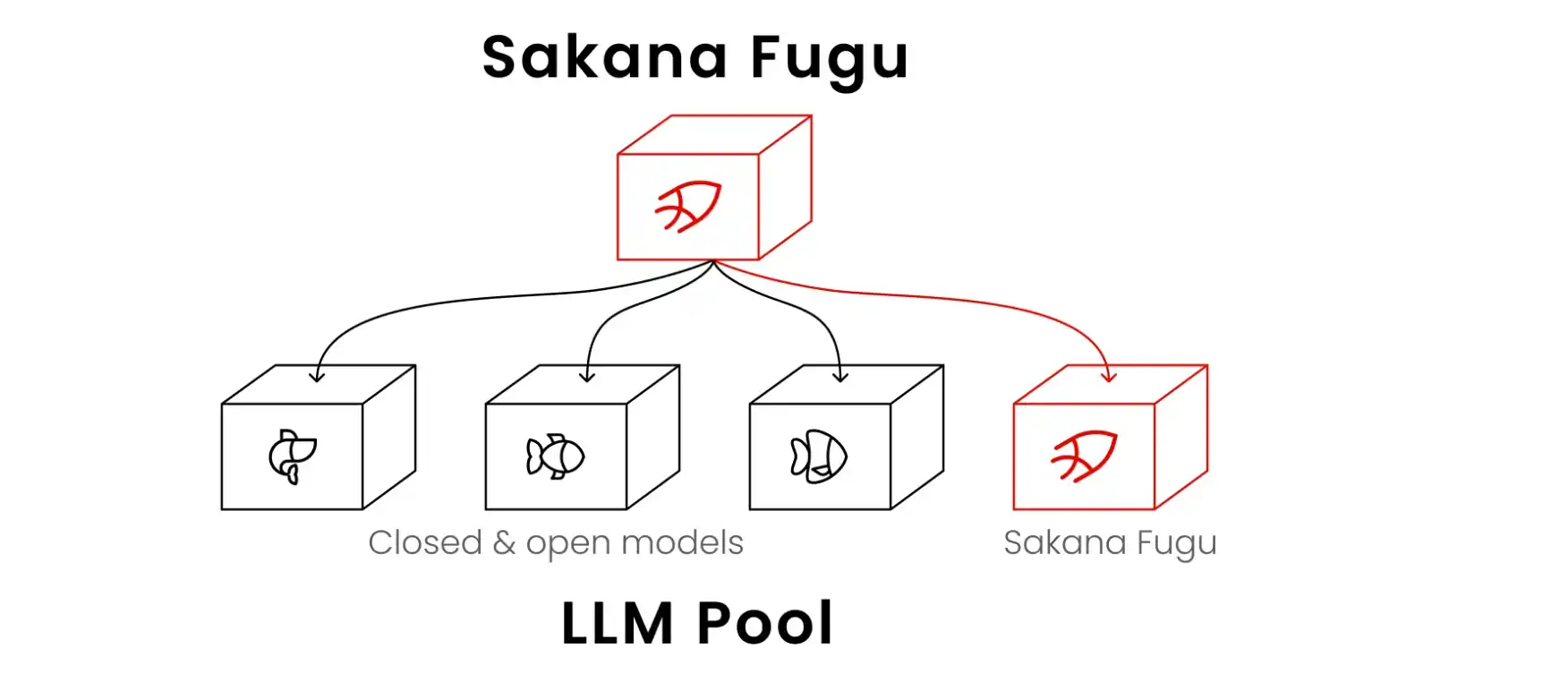
Fugu fundamentally changed this paradigm. Its core is a 7B-parameter model trained with reinforcement learning, called the RL Conductor. This 7B model does not directly generate the final answer; instead, it plays the role of a "project manager." When a user submits a task through a single OpenAI-compatible API, the RL Conductor dynamically analyzes the task type and then assigns subtasks to top global models in its agent pool, such as GPT-5, Gemini 3.1 Pro, or Claude Opus 4.8. It is responsible for scheduling, verifying, and synthesizing the outputs of these models, ultimately providing a result that has undergone multiple rounds of verification.

The theoretical underpinning for this architecture comes from two papers at ICLR 2026: "TRINITY: An Evolved LLM Coordinator" and "Learning to Orchestrate Agents in Natural Language with the Conductor." The papers detail how a small-parameter model can "conduct" large models through reinforcement learning. This changes the paradigm of "Test-time scaling." In the past, computing power was primarily used for deep inference within the model, making the model "struggle" for an answer. Now, computing power is used for external scheduling, verification, and synthesis. Traditional large models are monolithic all-rounders, while Fugu is a team of experts. The 7B RL Conductor proves that model parameter size is no longer the sole determinant of capability; knowing how to call tools and external agents can also lead to performance leaps.

The Truth Behind the Scores: Matching Fable and Surpassing GPT-5.5

The immediate reason for Fugu's sensation is its benchmark scores in rigorous tests. In the AI industry, benchmark scores are the hard currency for measuring model capabilities, but different benchmarks focus on entirely different aspects. The SWE-Bench Pro and TerminalBench 2.1 chosen by Sakana AI are both "tough nuts" biased towards real-world engineering environments.

SWE-Bench Pro focuses on software engineering capabilities, requiring models to locate and fix bugs in real codebases. According to data published in the Sakana AI console, Fugu Ultra scored 73.7 on SWE-Bench Pro. For comparison, Claude Opus 4.8 scored 69.2, GPT-5.5 scored 58.6, and Gemini 3.1 Pro scored 54.2. On TerminalBench 2.1, another test for system operation capabilities, Fugu Ultra scored 82.1, surpassing GPT-5.5's 78.2 and Opus 4.8's 74.6. These two tests not only examine a model's code generation ability but also its logical stability and tool-calling capability in multi-step, long-chain tasks. Fugu Ultra's lead means it experiences fewer mid-process crashes or deviations from goals when handling complex engineering problems compared to monolithic models.
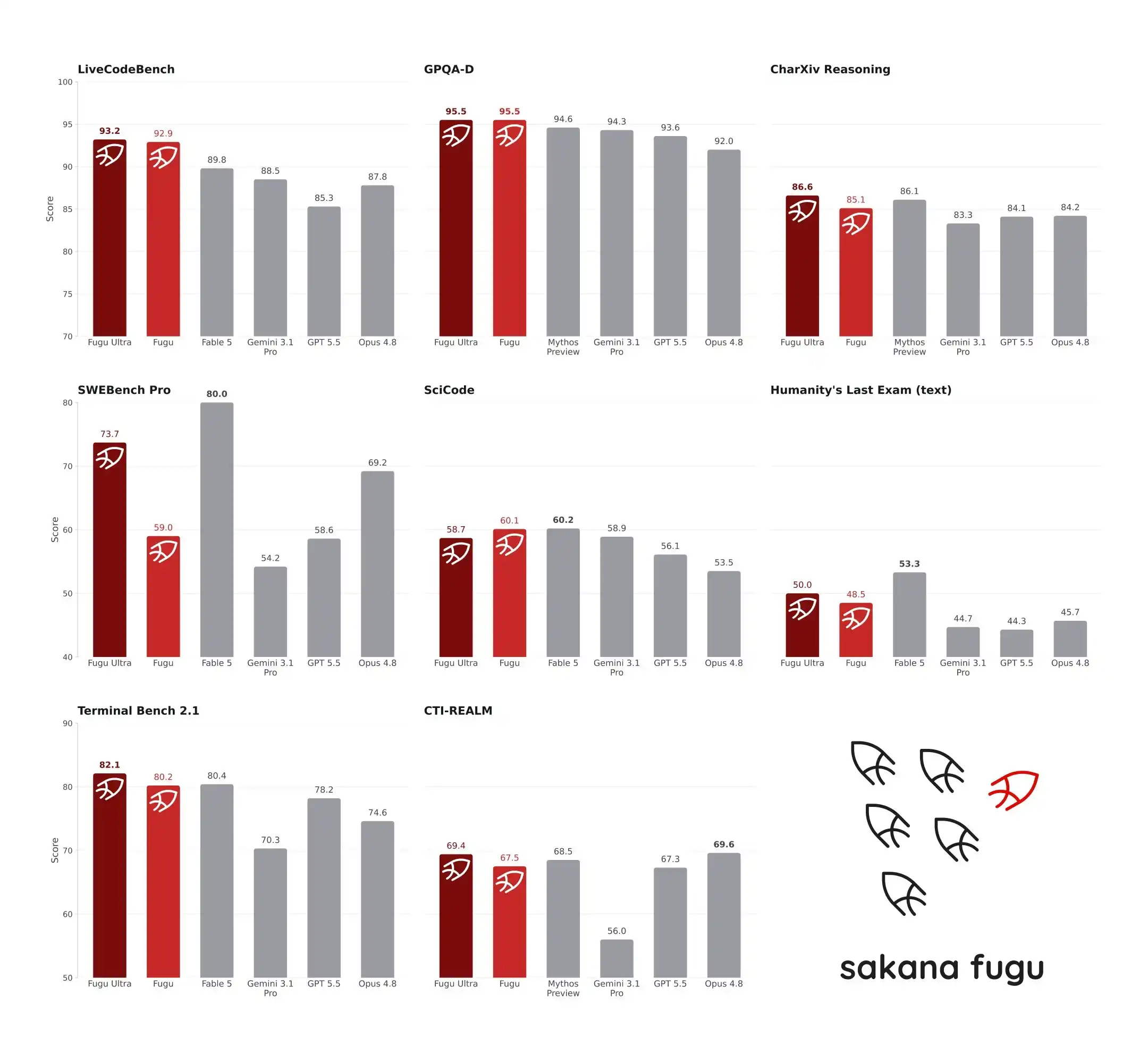
More attention was paid to the comparison between Fugu and Fable 5/Mythos Preview. Anthropic's Fable series and another frontier lab's Mythos series represent the pinnacle of current AI reasoning capabilities. However, due to export controls or incomplete public release, these two models are not part of Fugu's agent pool. Sakana AI officially claims that Fugu Ultra is "on par" with Fable 5 and Mythos Preview on engineering and science benchmarks. It must be clarified, however, that this comparison is not based on head-to-head testing in the same pool. Fugu's scores are based on actual runs of its own system, while Fable and Mythos data are based on report scores publicly released by their respective vendors.

This comparison methodology has sparked some controversy in the developer community. Some argue that test conditions across different systems and environments are difficult to align perfectly, making direct score comparisons unfair. However, other developers point out that referencing vendor-reported data is industry practice in the absence of a unified testing environment. Setting aside the controversy with Fable and Mythos, Fugu Ultra's surpassing of GPT-5.5 and Opus 4.8 on SWE-Bench Pro and TerminalBench 2.1 is a real, like-for-like comparison. This surpassing is not because Fugu's underlying model is smarter than GPT-5.5, but because the RL Conductor performs task decomposition and expert scheduling more precisely. In experiments requiring multiple rounds of reasoning and verification, such as AutoResearch, Rubik's Cube solving, and mechanical design, Fugu consistently showed advantages. This indicates that in handling "long, messy, multi-step" real-world workflows, the multi-agent orchestration architecture indeed offers more resilience than monolithic models.

Real Development Scenario Tests: Code Review and Long Session Stability

For developers and AI tool users, benchmark scores are only references. What truly determines a model's usefulness is its performance in real work scenarios. Fugu underwent beta testing with nearly 500 early users before release. Their feedback revealed Fugu's unique value in practical applications.

Code review is one of the most common AI scenarios for developers. Traditional monolithic models often only find superficial syntax errors or common logic bugs when reviewing code. In beta testing, some developers reported that Fugu demonstrated unusually detailed performance in code reviews, capable of uncovering deep architectural bugs, while other tools often found only a few surface-level issues. This difference stems from Fugu's architecture. Upon receiving a code review task, the RL Conductor can call models specializing in static analysis, logical reasoning, and security auditing respectively to conduct cross-validation on the same piece of code from multiple angles. This "expert consultation" model naturally uncovers more hidden problems than the "solo effort" of a single model.

Another frequently mentioned advantage is long-session stability. When building AI Agent products, one of developers' biggest headaches is the model's "persona drift" in long conversations. As the number of dialogue rounds increases, monolithic models often forget the initial setup or deviate in instruction following. After testing, some enterprise executives reported that Fugu's Persona in long conversations is exceptionally stable, with almost no drift. This is because the RL Conductor itself is not responsible for maintaining long-text memory; it only selects the most appropriate underlying model to generate a response in each dialogue round based on the current context. This architecture of "separation of control and generation" greatly improves Agent stability during long-running sessions.

In the field of cybersecurity, Fugu also demonstrated end-to-end practical capability. In tests, Fugu could independently complete the entire workflow from reconnaissance, XSS/SQLi vulnerability detection to authentication review, and generate a complete penetration test report, strictly adhering to instructions not to cross boundaries and damage systems. This level of completion for complex tasks relies on the RL Conductor's precise orchestration of security toolchains and the capabilities of different large models.

In addition, token efficiency is a major highlight of Fugu. Traditional large models often generate lengthy chains of thought, consuming a large number of tokens when dealing with complex problems. Fugu's RL Conductor avoids wasteful long CoT consumption through precise routing. Official data and early testing show it can significantly reduce waste of ineffective tokens. For developers billed by tokens, this means not only cost reduction but also improved response speed.

The Achilles' Heel of Underlying Dependency: The Cost of Multi-Agent Orchestration

Although Fugu shines in architecture and benchmark scores, as a tool for practical work, it is not without weaknesses. The multi-agent orchestration architecture, while bringing performance breakthroughs, also introduces significant risks and limitations.

The core issue is underlying dependency risk. Fugu's agent pool heavily relies on underlying APIs from US giants like GPT, Claude, and Gemini. Although the RL Conductor has dynamic routing capabilities and can switch to other models if one fails or is rate-limited, this only mitigates single-supplier risk. It does not and cannot detach from the entire US AI infrastructure ecosystem. If these underlying models collectively raise prices, impose large-scale rate limits, or change API terms, Fugu's cost structure and stability will be directly impacted. This "parasitic" mode, living atop others' infrastructure, has inherent fragility in commercialization and long-term stability.

Next is the trade-off between latency and cost structure. While the RL Conductor saves on ineffective token consumption through precise routing, multi-agent orchestration inevitably involves multiple API calls and inter-model communication. For real-time interaction scenarios requiring extremely low latency, such as real-time voice conversations or high-frequency trading assistance, Fugu Ultra's "deep thinking and scheduling" time may be longer than directly calling a monolithic model. In scenarios where response speed is paramount, Fugu's architectural advantage could become a drag on user experience.

Furthermore, controversies over fairness of comparison persist. As mentioned, Fugu claims parity with Fable and Mythos, but the latter two are not in its agent pool. In the developer community, some voices question whether comparisons based on vendor-reported data have practical reference value. After all, model performance can vary greatly across different task distributions, and simple aggregate score comparisons might mask specific strengths and weaknesses. For developers needing precise model capability assessments, the lack of head-to-head test data means they must remain cautious during selection.

Not Competing on Compute, but on Orchestration: Japan's Asymmetric Breakthrough in Large Models

Looking beyond the specific product review, Fugu's birth carries deeper implications for Japan's large model ecosystem. In the global AI arms race, Japan is in an awkward position. It lacks both the continuous influx of top-tier computing power and frontier algorithm accumulation of the US, and the massive data pools and fiercely competitive market environment of China. More critically, Japan also faces export control risks from US frontier models (like Fable/Mythos). Against this backdrop, Sakana AI's "evolutionary algorithm" and "multi-agent orchestration" route showcase the logic of "asymmetric breakthrough" for a resource-constrained nation.

Japan does have domestic large model players. NTT released tsuzumi, and institutions like ELYZA, Rinna, and LLM-jp are also working hard to train local language models. However, most follow the traditional "train from scratch" route, struggling to compete with top US and Chinese models in parameter scale and general capabilities. Sakana AI is the only Japanese lab with global frontier influence that champions an "asymmetric architecture."

Fugu's dynamic routing capability essentially helps Japanese companies and institutions establish "AI Sovereignty." Under limited computing resources, instead of spending huge sums to train a hundred-billion-parameter model that is inferior to GPT-5.5 in all aspects, it's better to train a clever 7B "project manager." This manager can flexibly connect to the world's best models based on task needs. If one day a US model faces export controls or supply cuts, the RL Conductor can quickly route tasks to other available models, even connecting to Japan's domestic specialized models. This architecture gives Japan a degree of autonomy and risk resilience in utilizing AI capabilities.

Observing the global AI tool ecosystem, OmniTools notes that large model capabilities are gradually leveling, and the main battleground of competition is shifting from mere parameter stacking to toolchains and landing scenarios. The emergence of Fugu precisely confirms this trend. It no longer pursues perfection in a single model but pursues optimality at the system level. This thinking holds significant reference value for nations and regions lacking advantages in compute and data.

Of course, this "asymmetric breakthrough" has its ceiling. As long as the core technology of underlying models remains in the hands of a few giants, the capability ceiling of orchestration systems will be limited by those underlying models. Fugu proves a 7B model can be an excellent conductor, but it cannot magically create capabilities that the underlying models lack. For Japan's large models to truly achieve a breakthrough, beyond architectural innovation in orchestration, continued investment in underlying computing power, core algorithms, and high-quality data is still necessary. Fugu is an ingenious system-level innovation, but it's not a panacea. For developers and enterprise users, Fugu provides a highly competitive new option in complex engineering scenarios. However, when using it, one must also be clear-eyed about its underlying dependency vulnerabilities and the latency-cost trade-offs.


Tiền kỹ thuật số thịnh hành

Câu hỏi Liên quan

QWhat is the core innovation and role of the 7B-parameter model in Sakana AI's Fugu system?

AThe core innovation is a 7B-parameter model called the RL Conductor, which acts as a 'foreman' or intelligent orchestrator. It does not directly generate final answers but dynamically analyzes user tasks and dispatches subtasks to a pool of top-tier global foundation models like GPT-5 or Claude Opus. It is responsible for scheduling, verifying, and synthesizing these models' outputs.

QOn which two benchmark tests did Fugu Ultra outperform models like GPT-5.5 and Claude Opus 4.8, and what do these tests evaluate?

AFugu Ultra outperformed competitors on SWE-Bench Pro and TerminalBench 2.1. SWE-Bench Pro evaluates software engineering capabilities, specifically locating and fixing bugs in real codebases. TerminalBench 2.1 tests system operation capabilities, focusing on multi-step tasks in real-world engineering environments.

QAccording to the article, what are two key practical advantages of Fugu's architecture reported by early beta testers?

ATwo key practical advantages are: 1) Superior code review capabilities, where Fugu's multi-agent 'expert consultation' approach finds deeper architectural bugs compared to single models. 2) Exceptional long-session stability, where the RL Conductor's 'control-generation separation' architecture prevents persona drift over long conversations by selecting the best model for each turn based on context.

QWhat are the main weaknesses or risks associated with Fugu's multi-agent orchestration architecture?

AThe main weaknesses are: 1) Underlying dependency risk, as Fugu's agent pool relies on APIs from major US AI providers, making it vulnerable to collective price changes, rate limits, or policy shifts. 2) Latency trade-offs, where the orchestration process involving multiple API calls can introduce higher latency unsuitable for real-time interaction scenarios.

QHow does the Fugu system represent a 'non-symmetric breakthrough' strategy for Japan's AI industry, according to the article?

AIt represents a 'non-symmetric breakthrough' by circumventing Japan's limitations in compute power and data. Instead of expensively training a massive general-purpose model that can't compete with US/China leaders, Japan focused on training a smart, small 'foreman' model (the RL Conductor) that orchestrates the world's best models. This grants a degree of AI sovereignty and risk resilience, allowing flexible routing if certain US models become unavailable, though ultimate capability is still bounded by the underlying models.

Nội dung Liên quan

Dwarkesh Patel: Thế hệ AI tiếp theo có thể được tạo ra từ công việc thực tế

Bài viết trình bày phân tích của Dwarkesh Patel về hướng phát triển tiếp theo của AI, vượt ra ngoài khuôn khổ "Huấn luyện Củng cố với Phần thưởng có thể Xác minh" (RLVR) hiện tại. Ông chỉ ra rằng RLVR thành công trong các lĩnh vực như viết mã, toán học vì chúng có tính "có thể mài mòn" cao - dễ dàng nhân bản, thiết lập lại và kiểm tra song song. Tuy nhiên, nhiều nhiệm vụ thế giới thực như khởi nghiệp, vận động tranh cử hay nghiên cứu khoa học lại thiếu các thuộc tính này, khiến việc huấn luyện trở nên khó khăn. Điểm mấu chốt mà Patel đưa ra là sự cần thiết phải chuyển từ mô hình chỉ huấn luyện trước khi triển khai sang khả năng học tập liên tục từ kinh nghiệm triển khai thực tế. Ông cho rằng kiến thức giá trị nhất thường nảy sinh từ tương tác thực, lỗi thực và bối cảnh cụ thể, nhưng hiện tại việc học ngữ cảnh (in-context learning) của các mô hình lớn chỉ là tạm thời và không lưu lại trọng số. Bài viết đề xuất hai hướng tiếp cận chính cho mô hình học tập tiếp theo: 1. **Tự chưng cất theo chính sách (OPSD):** Nén kiến thức mà một mô hình đã học được trong một phiên làm việc dài (như một "nhân viên kỳ cựu") trở lại trọng số của mô hình cơ sở. 2. **Mơ mộng (Dreaming):** Mô hình tự xây dựng môi trường mô phỏng dựa trên quan sát thế giới thực để luyện tập và thử nghiệm chiến lược, sau đó nén kinh nghiệm thu được. Tầm nhìn cuối cùng là một quy trình huấn luyện mới: AI đầu tiên đạt được năng lực cơ bản thông qua RLVR, sau đó được triển khai để thực hiện công việc thực. Kinh nghiệm tích lũy từ các nhiệm vụ thực này, thông qua các cơ chế như OPSD, sẽ liên tục được tinh chỉnh trở lại mô hình, biến mỗi lần tương tác của người dùng thành cơ hội học tập. Tương lai của AI có thể phụ thuộc vào dữ liệu huấn luyện do chính nó tạo ra từ kinh nghiệm thực tế, hơn là chỉ từ dữ liệu có sẵn trên internet hay các nhiệm vụ được xây dựng sẵn trong phòng thí nghiệm.

marsbit27 phút trước

Dwarkesh Patel: Thế hệ AI tiếp theo có thể được tạo ra từ công việc thực tế

marsbit27 phút trước

Những đồng tiền thắng và thua tuần này trên thị trường Crypto – VELVET, BEAT, WLD, XLM

Thị trường tiền mã hóa tiếp tục chịu áp lực trong tuần với Bitcoin và Ethereum thể hiện hiệu suất yếu. Trong khi các đồng tiền lớn vật lộn, vốn đã chảy vào một số altcoin vốn hóa nhỏ, tạo ra đà tăng mạnh. **Người thắng tuần:** - **Velvet [VELVET]** dẫn đầu với mức tăng 235%, tiến gần mức đỉnh mọi thời đại 1,80 USD. Chỉ số RSI cho thấy quá mua, nhưng động lực vẫn tích cực. - **DeXe [DEXE]** tăng 60%, lấy lại mức 22 USD lần đầu tiên từ cuối năm 2021, cho thấy sự tiếp tục của xu hướng tăng. - **Audiera [BEAT]** tăng 45% sau khi giảm mạnh tuần trước, cho thấy sự phục hồi mạnh mẽ. **Người thua tuần:** - **MemeCore [M]** lao dốc 70% sau báo cáo thao túng nội gián, nhưng có dấu hiệu ổn định quanh 0,65 USD. - **Worldcoin [WLD]** giảm 26%, điều chỉnh sau đà tăng nhiều tuần và đang kiểm tra vùng hỗ trợ. - **Stellar [XLM]** giảm 18,5%, với áp lực bán kéo dài và nguy cơ điều chỉnh sâu hơn. Nhìn chung, tuần này chứng kiến sự biến động mạnh với sự luân chuyển vốn rõ rệt. Các nhà đầu tư được khuyến cáo tiếp tục thận trọng và nghiên cứu kỹ lưỡng.

ambcrypto2 giờ trước

Những đồng tiền thắng và thua tuần này trên thị trường Crypto – VELVET, BEAT, WLD, XLM

ambcrypto2 giờ trước

Giao dịch

Giao ngay

Bài viết Nổi bật

AGENT S là gì

Agent S: Tương Lai của Tương Tác Tự Động trong Web3 Giới thiệu Trong bối cảnh không ngừng phát triển của Web3 và tiền điện tử, các đổi mới đang liên tục định nghĩa lại cách mà cá nhân tương tác với các nền tảng kỹ thuật số. Một dự án tiên phong như vậy, Agent S, hứa hẹn sẽ cách mạng hóa tương tác giữa con người và máy tính thông qua khung tác nhân mở của nó. Bằng cách mở đường cho các tương tác tự động, Agent S nhằm đơn giản hóa các nhiệm vụ phức tạp, cung cấp các ứng dụng chuyển đổi trong trí tuệ nhân tạo (AI). Cuộc khám phá chi tiết này sẽ đi sâu vào những phức tạp của dự án, các tính năng độc đáo của nó và những tác động đối với lĩnh vực tiền điện tử. Agent S là gì? Agent S đứng vững như một khung tác nhân mở đột phá, được thiết kế đặc biệt để giải quyết ba thách thức cơ bản trong việc tự động hóa các nhiệm vụ máy tính: Thu thập Kiến thức Cụ thể theo Miền: Khung này học một cách thông minh từ nhiều nguồn kiến thức bên ngoài và kinh nghiệm nội bộ. Cách tiếp cận kép này giúp nó xây dựng một kho lưu trữ phong phú về kiến thức cụ thể theo miền, nâng cao hiệu suất của nó trong việc thực hiện nhiệm vụ. Lập Kế Hoạch Qua Các Tầm Nhìn Nhiệm Vụ Dài Hạn: Agent S sử dụng lập kế hoạch phân cấp tăng cường kinh nghiệm, một cách tiếp cận chiến lược giúp phân chia và thực hiện các nhiệm vụ phức tạp một cách hiệu quả. Tính năng này nâng cao đáng kể khả năng quản lý nhiều nhiệm vụ con một cách hiệu quả và hiệu suất. Xử Lý Các Giao Diện Động, Không Đều: Dự án giới thiệu Giao Diện Tác Nhân-Máy Tính (ACI), một giải pháp đổi mới giúp nâng cao tương tác giữa các tác nhân và người dùng. Sử dụng các Mô Hình Ngôn Ngữ Lớn Đa Phương Thức (MLLMs), Agent S có thể điều hướng và thao tác các giao diện người dùng đồ họa đa dạng một cách liền mạch. Thông qua những tính năng tiên phong này, Agent S cung cấp một khung vững chắc giải quyết các phức tạp liên quan đến việc tự động hóa tương tác giữa con người với máy móc, mở ra nhiều ứng dụng trong AI và hơn thế nữa. Ai là Người Tạo ra Agent S? Mặc dù khái niệm về Agent S là hoàn toàn đổi mới, thông tin cụ thể về người sáng lập vẫn còn mơ hồ. Người sáng lập hiện vẫn chưa được biết đến, điều này làm nổi bật giai đoạn sơ khai của dự án hoặc sự lựa chọn chiến lược để giữ kín các thành viên sáng lập. Bất chấp sự ẩn danh, sự chú ý vẫn tập trung vào khả năng và tiềm năng của khung này. Ai là Các Nhà Đầu Tư của Agent S? Vì Agent S còn tương đối mới trong hệ sinh thái mã hóa, thông tin chi tiết về các nhà đầu tư và những người tài trợ tài chính của nó không được ghi chép rõ ràng. Sự thiếu vắng thông tin công khai về các nền tảng đầu tư hoặc tổ chức hỗ trợ dự án dấy lên câu hỏi về cấu trúc tài trợ và lộ trình phát triển của nó. Hiểu biết về sự hỗ trợ là rất quan trọng để đánh giá tính bền vững và tác động tiềm năng của dự án. Agent S Hoạt Động Như Thế Nào? Tại cốt lõi của Agent S là công nghệ tiên tiến cho phép nó hoạt động hiệu quả trong nhiều bối cảnh khác nhau. Mô hình hoạt động của nó được xây dựng xung quanh một số tính năng chính: Tương Tác Giống Như Con Người: Khung này cung cấp lập kế hoạch AI tiên tiến, cố gắng làm cho các tương tác với máy tính trở nên trực quan hơn. Bằng cách bắt chước hành vi của con người trong việc thực hiện nhiệm vụ, nó hứa hẹn nâng cao trải nghiệm người dùng. Ký Ức Tường Thuật: Được sử dụng để tận dụng các trải nghiệm cấp cao, Agent S sử dụng ký ức tường thuật để theo dõi lịch sử nhiệm vụ, từ đó nâng cao quy trình ra quyết định của nó. Ký Ức Tình Huống: Tính năng này cung cấp cho người dùng hướng dẫn từng bước, cho phép khung này cung cấp hỗ trợ theo ngữ cảnh khi các nhiệm vụ diễn ra. Hỗ Trợ OpenACI: Với khả năng chạy cục bộ, Agent S cho phép người dùng duy trì quyền kiểm soát đối với các tương tác và quy trình làm việc của họ, phù hợp với tinh thần phi tập trung của Web3. Tích Hợp Dễ Dàng với Các API Bên Ngoài: Tính linh hoạt và khả năng tương thích với nhiều nền tảng AI khác nhau đảm bảo rằng Agent S có thể hòa nhập liền mạch vào các hệ sinh thái công nghệ hiện có, làm cho nó trở thành lựa chọn hấp dẫn cho các nhà phát triển và tổ chức. Những chức năng này cùng nhau góp phần vào vị trí độc đáo của Agent S trong không gian tiền điện tử, khi nó tự động hóa các nhiệm vụ phức tạp, nhiều bước với sự can thiệp tối thiểu của con người. Khi dự án phát triển, các ứng dụng tiềm năng của nó trong Web3 có thể định nghĩa lại cách mà các tương tác kỹ thuật số diễn ra. Thời Gian Phát Triển của Agent S Sự phát triển và các cột mốc của Agent S có thể được tóm tắt trong một dòng thời gian nêu bật các sự kiện quan trọng của nó: 27 tháng 9, 2024: Khái niệm về Agent S được ra mắt trong một bài nghiên cứu toàn diện mang tên “Một Khung Tác Nhân Mở Sử Dụng Máy Tính Như Một Con Người,” trình bày nền tảng cho dự án. 10 tháng 10, 2024: Bài nghiên cứu được công bố công khai trên arXiv, cung cấp một cái nhìn sâu sắc về khung và đánh giá hiệu suất của nó dựa trên tiêu chuẩn OSWorld. 12 tháng 10, 2024: Một video trình bày được phát hành, cung cấp cái nhìn trực quan về khả năng và tính năng của Agent S, thu hút thêm sự quan tâm từ người dùng và nhà đầu tư tiềm năng. Những dấu mốc trong dòng thời gian không chỉ minh họa sự tiến bộ của Agent S mà còn chỉ ra cam kết của nó đối với sự minh bạch và sự tham gia của cộng đồng. Những Điểm Chính Về Agent S Khi khung Agent S tiếp tục phát triển, một số thuộc tính chính nổi bật, nhấn mạnh tính đổi mới và tiềm năng của nó: Khung Đổi Mới: Được thiết kế để cung cấp cách sử dụng máy tính trực quan giống như tương tác của con người, Agent S mang đến một cách tiếp cận mới cho việc tự động hóa nhiệm vụ. Tương Tác Tự Động: Khả năng tương tác tự động với máy tính thông qua GUI đánh dấu một bước tiến tới các giải pháp tính toán thông minh và hiệu quả hơn. Tự Động Hóa Nhiệm Vụ Phức Tạp: Với phương pháp mạnh mẽ của nó, nó có thể tự động hóa các nhiệm vụ phức tạp, nhiều bước, làm cho các quy trình nhanh hơn và ít sai sót hơn. Cải Tiến Liên Tục: Các cơ chế học tập cho phép Agent S cải thiện từ các trải nghiệm trước đó, liên tục nâng cao hiệu suất và hiệu quả của nó. Tính Linh Hoạt: Khả năng thích ứng của nó trên các môi trường hoạt động khác nhau như OSWorld và WindowsAgentArena đảm bảo rằng nó có thể phục vụ một loạt các ứng dụng rộng rãi. Khi Agent S định vị mình trong bối cảnh Web3 và tiền điện tử, tiềm năng của nó để nâng cao khả năng tương tác và tự động hóa quy trình đánh dấu một bước tiến quan trọng trong công nghệ AI. Thông qua khung đổi mới của mình, Agent S minh họa cho tương lai của các tương tác kỹ thuật số, hứa hẹn một trải nghiệm liền mạch và hiệu quả hơn cho người dùng trên nhiều ngành công nghiệp khác nhau. Kết luận Agent S đại diện cho một bước nhảy vọt táo bạo trong sự kết hợp giữa AI và Web3, với khả năng định nghĩa lại cách chúng ta tương tác với công nghệ. Mặc dù vẫn còn ở giai đoạn đầu, những khả năng cho ứng dụng của nó là rộng lớn và hấp dẫn. Thông qua khung toàn diện của mình giải quyết các thách thức quan trọng, Agent S nhằm đưa các tương tác tự động lên hàng đầu trong trải nghiệm kỹ thuật số. Khi chúng ta tiến sâu hơn vào các lĩnh vực tiền điện tử và phi tập trung, các dự án như Agent S chắc chắn sẽ đóng một vai trò quan trọng trong việc định hình tương lai của công nghệ và sự hợp tác giữa con người với máy tính.

Tổng lượt xem 898Xuất bản vào 2025.01.14Cập nhật vào 2025.01.14

AGENT S là gì

Làm thế nào để Mua S

Chào mừng bạn đến với HTX.com! Chúng tôi đã làm cho mua Sonic (S) trở nên đơn giản và thuận tiện. Làm theo hướng dẫn từng bước của chúng tôi để bắt đầu hành trình tiền kỹ thuật số của bạn.Bước 1: Tạo Tài khoản HTX của BạnSử dụng email hoặc số điện thoại của bạn để đăng ký tài khoản miễn phí trên HTX. Trải nghiệm hành trình đăng ký không rắc rối và mở khóa tất cả tính năng. Nhận Tài khoản của tôiBước 2: Truy cập Mua Crypto và Chọn Phương thức Thanh toán của BạnThẻ Tín dụng/Ghi nợ: Sử dụng Visa hoặc Mastercard của bạn để mua Sonic (S) ngay lập tức.Số dư: Sử dụng tiền từ số dư tài khoản HTX của bạn để giao dịch liền mạch.Bên thứ ba: Chúng tôi đã thêm những phương thức thanh toán phổ biến như Google Pay và Apple Pay để nâng cao sự tiện lợi.P2P: Giao dịch trực tiếp với người dùng khác trên HTX.Thị trường mua bán phi tập trung (OTC): Chúng tôi cung cấp những dịch vụ được thiết kế riêng và tỷ giá hối đoái cạnh tranh cho nhà giao dịch.Bước 3: Lưu trữ Sonic (S) của BạnSau khi mua Sonic (S), lưu trữ trong tài khoản HTX của bạn. Ngoài ra, bạn có thể gửi đi nơi khác qua chuyển khoản blockchain hoặc sử dụng để giao dịch những tiền kỹ thuật số khác.Bước 4: Giao dịch Sonic (S)Giao dịch Sonic (S) dễ dàng trên thị trường giao ngay của HTX. Chỉ cần truy cập vào tài khoản của bạn, chọn cặp giao dịch, thực hiện giao dịch và theo dõi trong thời gian thực. Chúng tôi cung cấp trải nghiệm thân thiện với người dùng cho cả người mới bắt đầu và người giao dịch dày dạn kinh nghiệm.

Tổng lượt xem 1.6kXuất bản vào 2025.01.15Cập nhật vào 2026.06.02

Làm thế nào để Mua S

Thảo luận

Chào mừng đến với Cộng đồng HTX. Tại đây, bạn có thể được thông báo về những phát triển nền tảng mới nhất và có quyền truy cập vào thông tin chuyên sâu về thị trường. Ý kiến ​​của người dùng về giá của S (S) được trình bày dưới đây.

活动图片