Analysis of the Latest Portfolio Adjustment by the "Top Player" in the U.S. Stock Market: $9 Billion Short on NVIDIA, Shifting Focus to Power and Memory Sectors

marsbitXuất bản vào 2026-06-20Cập nhật gần nhất vào 2026-06-20

Tóm tắt

AI investor Leopold Aschenbrenner has made a significant portfolio shift, taking a $9 billion nominal short position against top AI infrastructure stocks like NVIDIA, ASML, and Oracle. Simultaneously, he is redirecting capital towards what he sees as the next critical bottlenecks in the AI boom: power, memory, and data center networking, alongside private investments in AI model companies like Anthropic. This move is interpreted not as a call that the AI bubble has burst, but as a rotation within the infrastructure stack. The analysis highlights NVIDIA's recent $25 billion bond issuance as a potential signal, questioning why a cash-rich company would seek external debt despite high profits and increased dividends/buybacks. The core investment thesis is that the initial, crowded "picks and shovels" trade in semiconductors is maturing. The next wave of capital is expected to flow into the physical and logistical constraints of AI expansion: electricity supply, memory chip capacity, data center construction, and enabling technologies like optical networking (fiber) for high-bandwidth communication, where copper remains crucial for short distances. Aschenbrenner's substantial (approx. 20% of fund) private stake in Anthropic is noted as a key part of his strategy—investing directly in the "mine" (AI models) rather than just the "shovels." The discussion concludes that while certain segments may be overvalued, the overarching AI infrastructure demand driven by real product usage...

Leopold Aschenbrenner, regarded as one of the world's most aggressive AI investors, has established nominal short positions of approximately $9 billion in public markets against NVIDIA, ASML, and Oracle, while reallocating capital towards deeper layers of AI infrastructure and model assets such as power, memory, data center networks, and companies like Anthropic.

The two hosts believe this does not signal the bursting of the AI bubble, but rather indicates a rotation within infrastructure trades from a "chip-first" approach to one prioritizing "energy, networks, and data center construction." Especially following NVIDIA's recent $25 billion bond financing and the soaring valuation of Anthropic, the market implications of this judgment are rapidly amplifying.

Key Takeaways

Leopold's Core Trading Logic

· "The classic 'selling picks and shovels' trade in AI has become too crowded, and Leopold's recent portfolio changes convey precisely this signal."

· "His judgment is not that AI infrastructure has peaked, but that certain tiers within the infrastructure stack, particularly semiconductors and traditional popular stocks, have become excessively crowded."

· "If the question becomes where the money will flow next, there are two answers. The first and most direct is flow into the next genuine infrastructure bottlenecks, namely power, memory, and data center network segments. The second answer is that mysterious investment exposed just a few weeks ago."

· "His bets have always been very infrastructure-oriented, investing in both these optical companies and power-related companies."

· "If he is cautious on NVIDIA, then capital will move to areas like power and memory; at the same time, he also wants to invest directly in the 'mine' itself, rather than continuing to only buy the 'shovels.' Anthropic is his favorite 'mine.'"

The Signal from NVIDIA's Financing

· "The issue isn't whether NVIDIA will continue to make money, but why a company with extremely high profit margins and already large cash reserves would borrow an additional $25 billion externally."

· "If a company simultaneously engages in massive stock buybacks and significantly increases dividends while also borrowing money in the same month, it's clearly not borrowing due to a cash shortage. A more reasonable explanation is that this is cheap capital, and the financing methods within this AI cycle are undergoing a slight shift."

The Next Wave of AI Infrastructure Benefits

· "The real bottlenecks are no longer just GPUs, but power, memory, data center networks, and the actual capability to build these things."

· "Even if you raise endless amounts of money, you cannot build data centers fast enough, expand memory chip capacity sufficiently, or immediately expand the power grid, transmission lines, and related infrastructure. There aren't enough people on the ground, and permitting, regulation, and various procedures are also hindering progress."

· "Whoever can build the data centers will take the profits."

Optical Modules, Copper, and Fiber Optics

· "As GPU clusters grow larger, copper wires will get hotter, energy losses will increase, and efficiency will suffer. In this scenario, fiber optics become the next upgrade direction."

· "For many high-bandwidth, short-distance transmission scenarios, copper is almost the only material everyone truly wants to use. Only when it becomes unsuitable, such as over long distances or with excessive heat, do they switch to fiber optics. Therefore, the combined market demand for copper and fiber optics is currently very strong."

· "The recent strength in copper futures is essentially because everyone needs it; it's the most critical foundational material for short-distance, high-bandwidth transmission, and fiber optics is the next step."

· "Copper remains the most critical material for short-distance, high-bandwidth transmission, but once distances increase or heat becomes too high, a switch to fiber optics is necessary."

· "The next wave of capital will land on infrastructure companies that don't sound particularly sexy."

Why Energy is the Safest Bet

· "I've always been bullish on energy because, even if AI demand slows, energy itself remains a global necessity, and this demand will only increase."

· "The single trend that continues to rise regardless of the scenario is our demand for energy, electricity, and power. These companies are the ones I am most willing to be long-term long on."

· "The companies I most want to follow are those Jensen is investing in that also intersect with Leopold's logic. So, the company I'm currently closest to tailing is Marvell."

· "The best long-term positions are not necessarily the hottest chip companies, but the power infrastructure companies that are indispensable in any macroeconomic scenario."

Leopold's AI Investment Portfolio

Josh Kale:Leopold Aschenbrenner, this 24-year-old focused on AI investing, is now almost regarded by the market as the world's strongest AI investor. External rumors suggest the nominal size of his fund's positions now exceeds $20 billion. When we looked at Ejaaz's post a month ago, the fund size was only $13.7 billion, essentially doubling every quarter.

This time, we've obtained several significant new changes in his recent investment moves. Last episode, we discussed his portfolio, and the most surprising point then was that he was actually shorting a company almost everyone knows—NVIDIA, the world's highest market cap and hottest AI stock. Many couldn't understand why he placed over $9 billion in short exposure against such a company.

Now we have a new clue that might explain this. NVIDIA is actually raising capital, and through debt issuance. On the surface, this seems illogical. Why would a company of NVIDIA's immense size and extremely high profit margins take on an additional $25 billion in cash from a recently completed financing? Today, we want to combine this with Leopold's portfolio to discuss why he has made so much money, what he's looking at next, and what NVIDIA's financing truly means.

Ejaaz Ahamadeen: First, some background. Leopold Aschenbrenner was a former OpenAI researcher who raised a fund about a year and a half to two years ago. The initial size wasn't large, I recall around $200 million. But judging from his latest 13F filing, the fund's public holdings are now worth $13.7 billion.

So naturally, the market wants to know which positions he's taken, what his core investment logic is, and where his next big trade will land.

To understand this, you must first know that until about a month ago, Leopold was very optimistic about the entire AI sector, particularly bullish on the "selling picks and shovels" logic, i.e., GPU and upstream hardware suppliers like NVIDIA.

But about a month ago, the market discovered he wasn't as bullish on the semiconductor line. He remains bullish on the real bottleneck areas like memory and power, and likely also on new types of cloud providers, but he is notably not bullish on the world's most valuable company, NVIDIA. More specifically, he has placed a total of roughly $9 billion in bearish exposure against several companies seen as core AI infrastructure beneficiaries, including NVIDIA, ASML, and Oracle.

The Logic Behind Shorting NVIDIA

Ejaaz Ahamadeen: When this emerged, many started worrying, thinking the AI bubble might be about to burst. On the surface, NVIDIA's GPUs are still selling massively, and demand hasn't noticeably weakened. So where's the problem?

Later, we dug up several new clues, the most important being that NVIDIA just raised $25 billion externally through bond financing. This means it's not simply using its own cash but adding external leverage. So the question arises: Why would the world's most profitable, highest-margin, strongest-cash-flow company go out and borrow $25 billion?
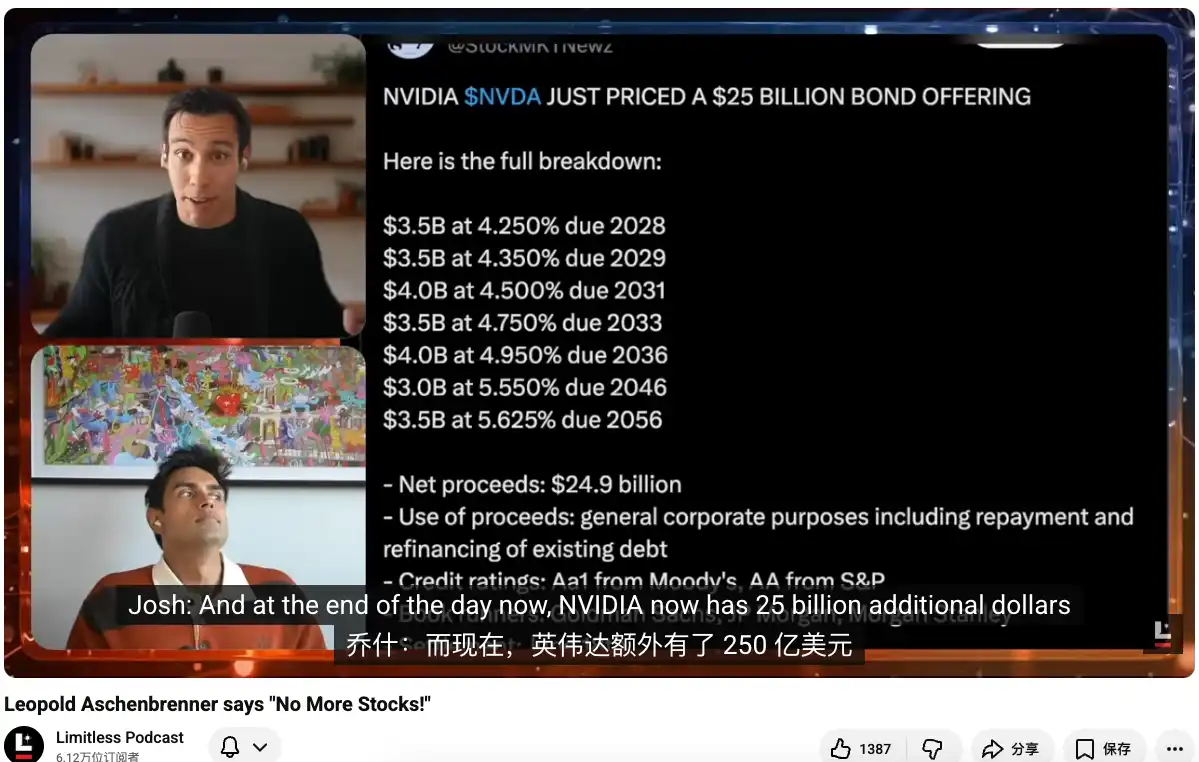
Josh Kale: Furthermore, they initially intended to raise only $20 billion but ended up expanding to $25 billion, with subscriptions exceeding three times the amount. Last episode, when discussing this portfolio, we said not to worry about a bubble just yet because although these companies have massive capital expenditures, their revenues are high enough to theoretically support expansion with their own balance sheets.

But this is NVIDIA's first significant move to finance off its balance sheet since 2021, rather than directly using its cash. I recall it currently has around $12 billion in cash on hand. Putting all this together creates a strange tension: on one side, Leopold is shorting; on the other, NVIDIA, seemingly with infinite cash and profits, is issuing debt. So what's happening?

Breaking Down NVIDIA's Bond Financing

Josh Kale: Ejaaz, can you break down this transaction itself for us? Because this isn't ordinary financing; it's a bond issuance. Ultimately, NVIDIA's balance sheet now has an additional $25 billion, and the interest rates likely appear very low.

Ejaaz Ahamadeen: I'll present both explanations. NVIDIA originally had about $13.7 billion in cash, meaning it could have just spent its own money. So why raise external capital? The simplest analogy is buying a house. Many people choose a mortgage even if they have the full amount because their own capital can be used elsewhere, and if the borrowing cost is low enough, it's actually more economical.

The interest rate environment hasn't been friendly in recent years, but if you're NVIDIA, one of the world's most valuable and sought-after companies, you can borrow on very favorable terms. This $25 billion bond issuance has maturities ranging from 2 to 30 years and can almost be considered very cheap money, with interest rates approaching US Treasury yields.

Moreover, the offering was roughly oversubscribed by 4 times. In other words, there was $85 billion in market demand chasing the $25 billion offering; NVIDIA could practically pick its investors. If you only look at the official statement, NVIDIA's explanation is that this is primarily for financial arrangements, to repay and refinance some existing debt. Google did something very similar a few weeks ago and also in February this year. So you can certainly accept this explanation, viewing it as financial optimization.

But the other side is hard to ignore: Over the past month and a half, NVIDIA, Amazon, Google, and several other hyperscale cloud providers have almost all been increasing external financing. Some via debt, some via equity sales. Leopold's view might not be entirely without merit—could this be a sign of the bubble starting to loosen, the house of cards beginning to wobble? However, if you look solely at the financial structure, it doesn't yet clearly point to danger.

Josh Kale: I see it similarly. $9 billion short on NVIDIA is a truly massive position. But during our research, we saw something else: on May 18th, NVIDIA's board authorized an additional $80 billion for share buybacks and increased the dividend from $0.01 per share to $0.25, a 25-fold increase.

If a company simultaneously engages in massive stock buybacks, significantly increases dividends, and also borrows money in the same month, it's clearly not borrowing due to a cash shortage. A more reasonable explanation is that this is cheap capital, and the financing methods within this AI cycle are undergoing a slight shift. Everyone wants to participate in these capital moves, and NVIDIA realizes borrowing via debt is even cheaper than other financing methods, so it just goes ahead. For now, at least, NVIDIA itself is still doing very well.

Why He Adjusted the Portfolio

Josh Kale: This brings us to another question. What exactly is Leopold thinking? Why has his judgment changed? The stock chart you just showed also indicates NVIDIA's recent performance hasn't been particularly strong, but it's not terrible either. It's still the world's largest company by market cap, nearing $5 trillion, down only about 7% in a month—nothing significant amidst the surge of other AI stocks.
Ejaaz Ahamadeen: I don't think NVIDIA will disappear. Its GPUs, including the CPU product line launched a few weeks ago, I believe will perform very well. AI product demand is currently in exponential surplus, and NVIDIA remains the primary core machine supplier capable of meeting this demand.

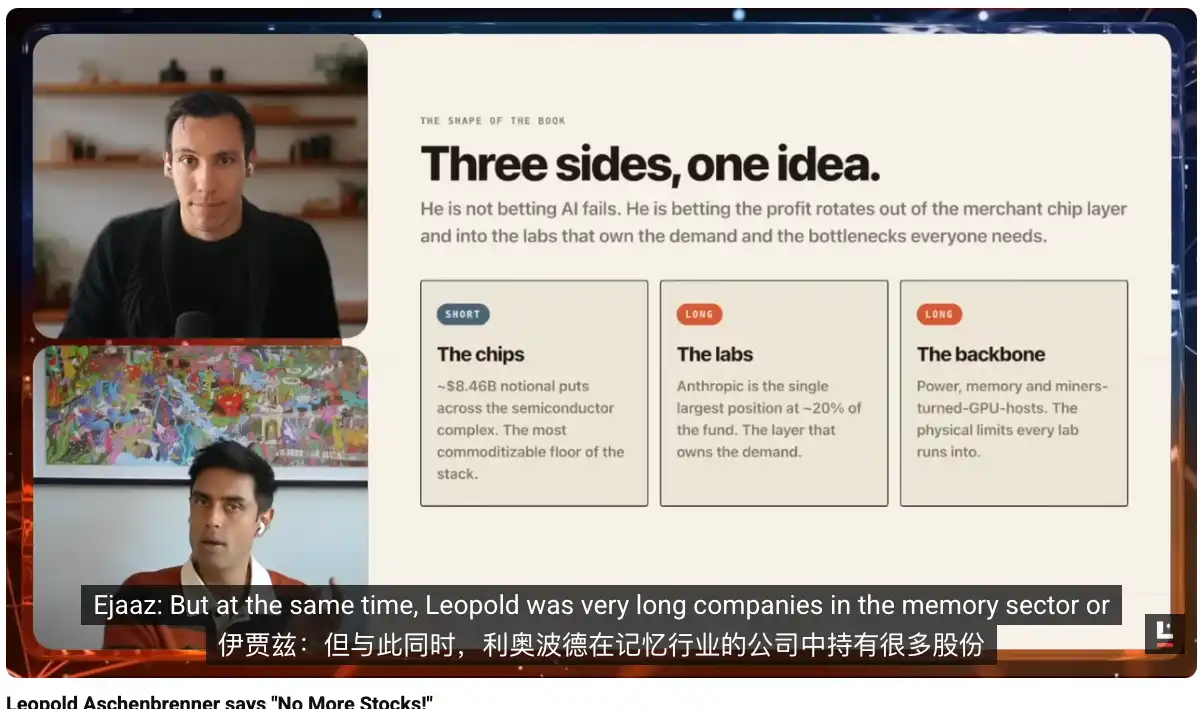
But I do think the classic 'selling picks and shovels' trade in AI has become too crowded, and Leopold's recent portfolio changes convey precisely this signal. Looking at his recent 13F, his bearish exposure is clearly skewed against the semiconductor line, such as NVIDIA, ASML, Oracle, and other infrastructure-level companies.

Yet simultaneously, he is heavily invested in directions like memory, power, and new types of cloud. This indicates his judgment is not that AI infrastructure has peaked, but that certain tiers within the infrastructure stack, particularly semiconductors and traditional popular stocks, have become excessively crowded.

If the question becomes where the money will flow next, there are two answers. The first is the most direct: flow into the next genuine infrastructure bottlenecks, namely power, memory, and data center network segments. The second answer is that mysterious investment exposed just a few weeks ago.

The Unexpectedly Exposed Anthropic Position

Josh Kale: This was the most surprising to me. I only learned about it yesterday from you, and my first reaction was disbelief. Could it be that Leopold's fund, 'Situational Awareness,' has approximately 20% allocated to Anthropic equity? Current external rumors suggest this company constitutes about one-fifth of Leopold's fund. The Wall Street Journal and several other media outlets have reported this, and sources very close to the transaction have confirmed it.

This becomes a completely unexpected card in his portfolio.

Because 13F filings only disclose public market holdings, not private equity, and Anthropic happens to be a large piece of non-public equity. This is also why people have begun to understand why external estimates value his portfolio at $20 billion.
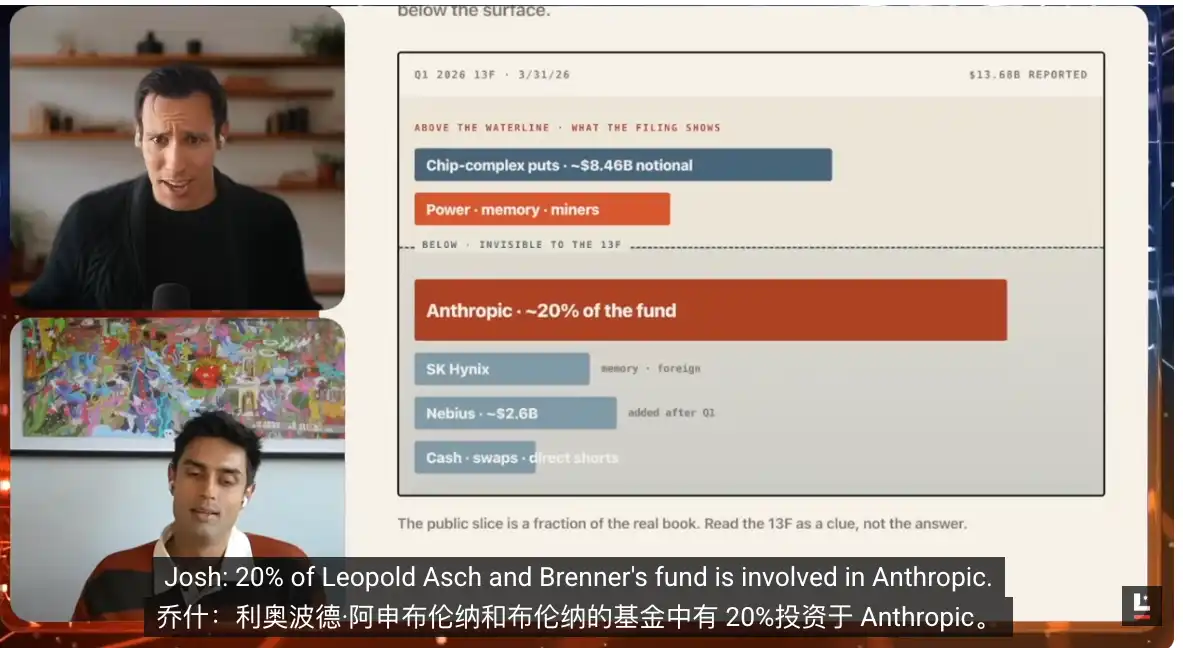
If 20% of the fund is Anthropic, and he invested around early 2025, then the returns on Anthropic over that year have been akin to seven years' worth. This change forces a significant revision in our understanding of his entire investment portfolio.

Ejaaz Ahamadeen: Yes. His first investment in Anthropic via private channels or the fund was around March 2025, when Anthropic's valuation was approximately $60 billion. Now, based on the latest funding round, it's valued at $96.5 billion.

This represents nearly a 15x increase. According to the algorithm presented in our show today, his latest 13F disclosed liquid portfolio value is $13.7 billion. If we add the Anthropic portion reported by The Wall Street Journal, roughly an additional $7 billion, the total fund management size reaches $20 billion.

How exaggerated is this? Bill Ackman, a top investor with three to four decades in the market, runs Pershing Capital at a similar size of around $20 billion. Leopold has been in this game for only a year and a half, he's 24, and has virtually no real investment experience.

Yet he has made some incredibly prescient calls. What's crazy is that he practically wrote all of this out in advance. When he launched the fund a year and a half ago, he published a 65-page AI essay titled 'Situational Awareness,' almost completely laying out the entire logic, including how capital would rotate from semiconductors and certain infrastructure segments to other bottleneck constraints. The market is now developing along these lines, which is truly astonishing.

The Next Wave of Infrastructure Trends

Ejaaz Ahamadeen: So this also tells me where the next money will flow. If he is cautious on NVIDIA, then capital will move to areas like power and memory; at the same time, he also wants to invest directly in the 'mine' itself, rather than continuing to only buy the 'shovels.' Anthropic is his favorite 'mine.'

Josh Kale: This indeed looks like a new trend, and again, he is earlier than most. For the past 12 months, everyone has been searching for AI's bottlenecks—rare metals, memory, RAM, etc.—and the market chased each wave. Those judgments weren't wrong because that wave of gains did happen.

But now, the valuations of directions seen as bottlenecks are gradually becoming rationalized. People already understand these companies' business models, market potential, and future revenues better, so much of the value is already priced in. In the next round, we care more about where the subsequent money will continue to flow.

The direction you mentioned—land, power, enclosures, physical infrastructure—seems correct. Because if we think about what's truly most important for AI, the answer increasingly seems to be physical construction capability. Look at xAI, or more accurately, look at SpaceX, which is now public. Its revenue core isn't rockets themselves but AI infrastructure construction.
Consider its recent deals with Anthropic and Google, which have created value exceeding the combined sum of Starlink, Starship, and the entire satellite business. There is clearly immense demand and value here. So the question becomes, who can actually build these things?

SpaceX is clearly one answer. Last night after hours, its stock was around $230, implying a valuation of about $3.1 trillion. We'll dedicate an episode to SpaceX this week because its recent run is simply too extreme. It just completed the acquisition of Cursor, its valuation has reached $3 trillion, and Elon Musk made more money in one day than Warren Buffett earned in his entire career.

Who Will Capture the Next Round of Profits

Josh Kale: We care about which companies are best at this hardware infrastructure, at developing those 'machines that build machines.' Combining Leopold's direction and the broader trend, we think the next wave of capital will move here. So Ejaaz, in reality, which companies will this rotation land on?

Ejaaz Ahamadeen: Many will be those unsexy-sounding infrastructure companies. A name frequently mentioned recently is Marvell. A few weeks ago at Computex in Taiwan, Jensen Huang directly stated on stage that this would be the next trillion-dollar company.

And just three months before he made that statement, NVIDIA had invested $1.5 billion in Marvell. I'm starting to wonder if this counts as insider trading or market manipulation, because after he said that, the stock rose another 70%.

I think it's easy now to directly claim AI infrastructure has peaked. But if you compare it to historical financial crises, like 2008, that flavor of high leverage, financial engineering, and systemic manipulation hasn't fully emerged this time.

There are two key differences. First, the products these companies are making today are genuinely being purchased. There wasn't such solid real demand during the dot-com bubble or the financial crisis. Second, constrained by physical laws, we can't infinitely add leverage now because the entire system is constrained by manpower and construction capability.

Even if you raise endless amounts of money, you cannot build data centers fast enough, expand memory chip capacity sufficiently, or immediately expand the power grid, transmission lines, and related infrastructure. There aren't enough people on the ground, and permitting, regulation, and various procedures are also hindering progress.

So I actually think this gives investors an advantage. Since you already know the hottest chip and 'pick and shovel' trades are too crowded, then the next money will flow into power, data networks (companies like Astera Labs), and other related segments.

What you really need to think about is when these contracts start to materialize, when these fabs are actually built, when SpaceX rockets can launch AI satellites, and even when they can start using solar energy to train AI models.

The timeline determines the betting rhythm. At least that's the framework I'm investing by, though this is not investment advice. I see it this way because over the past year and a half, we've witnessed firsthand how capital flowed from general AI stocks to semiconductors and infrastructure trades.

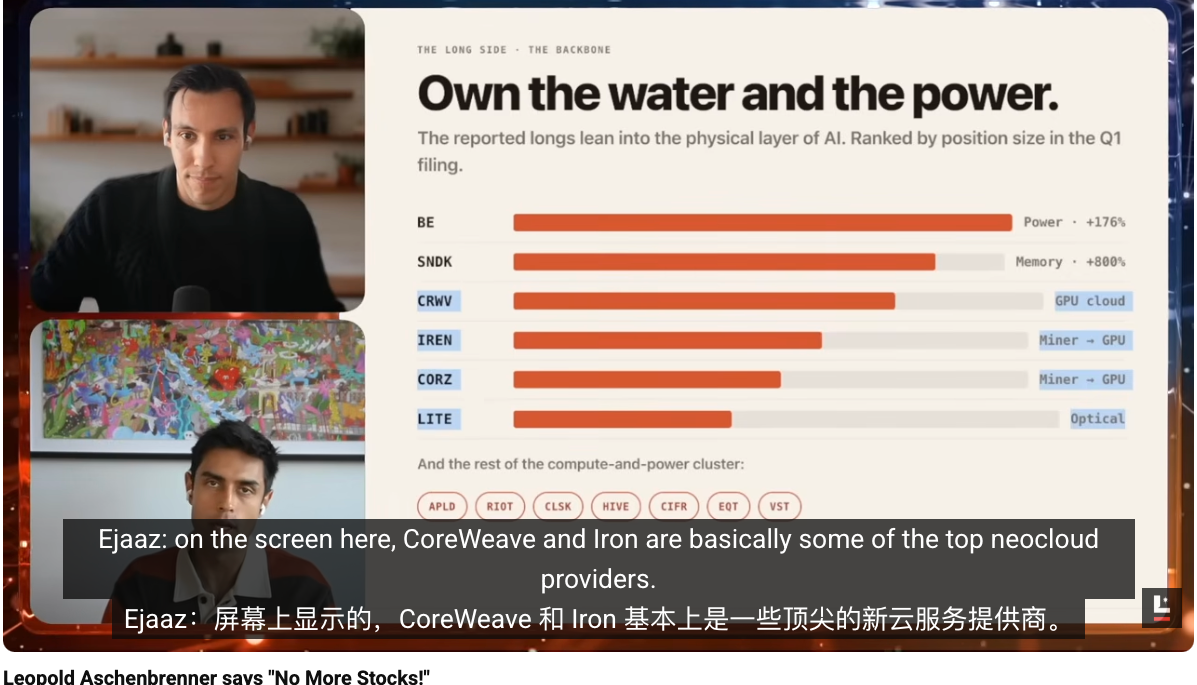
Josh Kale: If you continue looking at this portfolio chart, you'll see this story is clearly written into his holdings structure. By category, what is his largest allocation? Power and energy. Next is memory, followed by cloud and GPU miners—the most tangible infrastructure.

He wants to hold new cloud providers like CoreWeave and also miners who have pivoted to cloud compute. What he wants to own is this physical infrastructure because he believes this is where the real bottlenecks are. As you mentioned, there are many finer details, like the immense difficulty of actual construction, hardware manufacturing, and data center building itself.

If we ask where the biggest bottlenecks are, even permitting might be one. Who is solving these problems? SpaceX wants to move data centers to space, Tesla wants humanoid robots to address labor shortages. But both are far off. In the short to medium term, there exist vast blank opportunities, and this is precisely where Leopold is betting.

The Advantages of Optical Modules and Fiber Optics

Josh Kale: I want to add one detail we didn't expand on earlier. For those wanting to dig deeper and find more alpha, many of his clues lie in optics and deeper layers of the tech stack. Ejaaz, you've been researching this lately. Can you explain his thinking?

Ejaaz Ahamadeen: If you look at the positions on his screen, CoreWeave and Iron are essentially top-tier new cloud service providers. Simply put, they are somewhat like Amazon Web Services, except AWS provides cloud services to internet companies, while these companies provide ready-made GPU infrastructure to AI companies.

They handle setting up GPUs, networks, deployment—all so AI companies don't have to worry about underlying infrastructure and can directly train models and access compute. CoreWeave and Iron have been among his largest concentrated positions since inception and have delivered the highest returns.

Notably, he still holds these two companies among his largest positions today. This also indicates one thing: in his view, this trade is far from over. Furthermore, he has privately invested in Core Scientific, a company that can help unlock CoreWeave's infrastructure supply capacity. In a sense, he's adding another layer of leverage to CoreWeave.

Beyond these, look at companies like Coherent and Lumentum; they are essentially suppliers related to fiber optic and optical connectivity. To explain in the simplest terms, for semiconductors and GPUs to communicate with each other, traditional methods often rely heavily on copper wires.

The issue is, as GPU clusters grow larger, copper wires will get hotter, energy losses will increase, and efficiency will suffer. In this scenario, fiber optics become the next upgrade direction. It enables faster data transfer, is more cost-efficient, and allows companies providing inference and training compute to earn more. So you'll notice his bets have always been very infrastructure-oriented, investing in both these optical companies and power-related companies. It may not sound sexy, but in my view, this is where the money is truly flowing now.

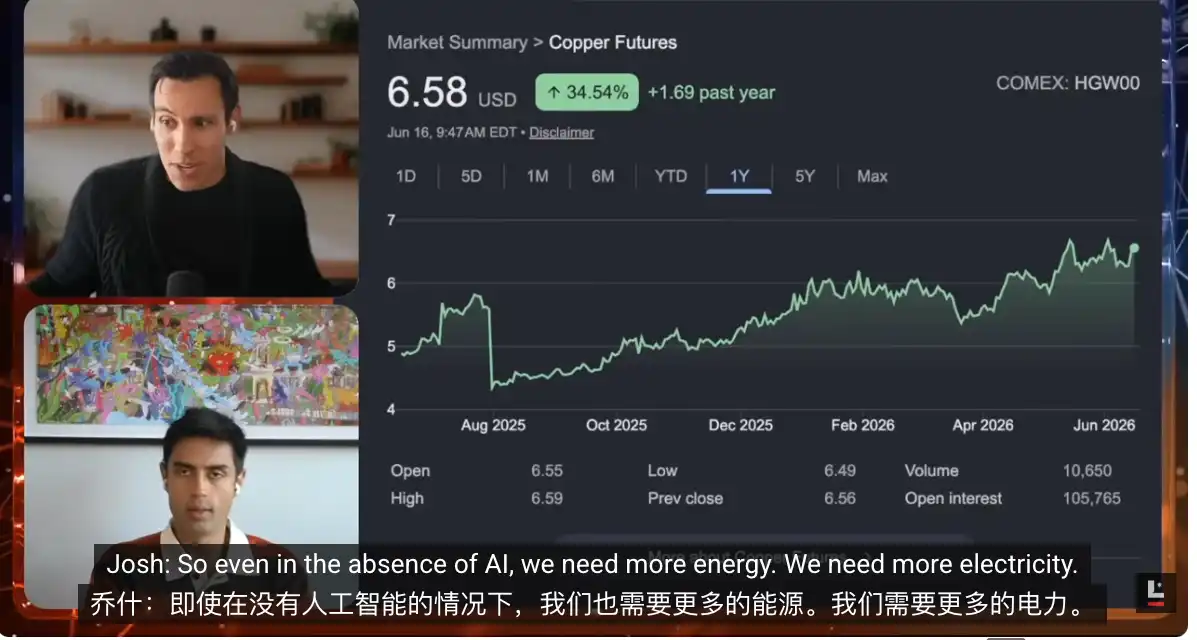
Josh Kale: The copper aspect is also interesting to me because I only recently realized how critical it is for short-distance data transmission. For many high-bandwidth, short-distance transmission scenarios, copper is almost the only material everyone truly wants to use. Only when it becomes unsuitable, such as over long distances or with excessive heat, do they switch to fiber optics. So the combined market demand for copper and fiber optics is currently very strong, which is why observing the copper trade is interesting.

The recent strength in copper futures is essentially because everyone needs it; it's the most critical foundational material for short-distance, high-bandwidth transmission, and fiber optics is the next step.

Thinking at an even more fundamental level, the materials angle has always been interesting. The absolute bottom layer beneath all layers is essentially the raw materials most core to achieving intelligence. Copper is one, lithium is another, and many others. We really should do a dedicated episode on materials. Perhaps Leopold hasn't reached that layer yet, and we might see the next rotation before he does.

Josh Kale: If you keep going down the stack, you could even look directly at copper mines to see how these materials are produced. But returning to the core judgment, I think the next rotation indeed shifts from seemingly smaller bottlenecks to the truly difficult things: hardware and large-scale data center construction.

Whoever can build the data centers will take the profits. We've already seen how much SpaceX is earning due to immense data center demand. Whoever can bring more data centers online faster, provide sufficient power and GPUs, will earn the most. This is essentially what Leopold is betting on now.

Is a Bubble Forming?

Josh Kale: To summarize, we don't believe we are in a bubble-bursting phase yet. Leopold's portfolio seems more like a rotation than a full-scale retreat. So, should we still follow his lead?

Ejaaz Ahamadeen: I admit, when I first saw his 13F, my initial reaction was: this guy is shorting the world's most valuable company with demand booked until 2029? That's outrageous. But now, seeing this financing, I'm starting to think if NVIDIA continues to add external debt in the future, or even potentially sells equity, if this trend persists, then Leopold might be right once again.

If that happens, his fund could ultimately surpass the world's top traders and best investment funds. He has been consistently winning; it's hard not to respect that.

Josh Kale: However, another important point: his life so far has almost always been long-only; he hasn't truly been tested by large-scale selling. We mentioned Bill Ackman earlier—achieving 30x returns and surviving in the market for 30 years are two different things.

If he can maintain this growth trajectory and also learn when to press the sell button, how to manage risk, how to use hedges for protection, that would be even more formidable. We are starting to see the embryonic form of this capability. That $9 billion short isn't achieved by directly shorting $9 billion in cash but through options and leverage, not a one-to-one naked short. Regardless, this is all worth continued observation.

Energy is the Core Bet

Josh Kale: If you had to pick one stock from his entire portfolio that you most want to buy yourself, which would it be?

My own answer is energy stocks. I've always been bullish on energy because, even if AI demand slows, energy itself remains a global necessity, and this demand will only increase.

Even completely ignoring AI, we need more energy, more electricity. Companies like Bloom Energy that can enhance power supply and transmission capacity excite me most because they resemble a hedge-like bet. The single trend that continues to rise regardless of the scenario is our demand for energy, electricity, and power. These companies are the ones I am most willing to be long-term long on.

Ejaaz Ahamadeen: My answer is a bit of a cheat. The companies I most want to follow are those Jensen is investing in that also intersect with Leopold's logic. So the company I'm currently closest to tailing is Marvell. While not a public holding of Leopold's, it aligns very well with his bets on fiber optics and power, and Jensen has already invested $1.5 billion of real money.
I've observed a phenomenon: whenever Jensen invests in a company through NVIDIA, whether it's Intel, CoreWeave, or others, it mostly keeps rising afterward. So my current positioning is roughly here. I also hold some CoreWeave myself because both Jensen and Leopold are extremely bullish on it.

Josh Kale: Marvell is up 270% over the past 6 months. This might genuinely be a good rule of thumb: when influential figures like Jensen, or even someone with enormous sway like Trump, publicly say to buy a certain stock, you probably should take a serious look.

Past instances have repeatedly shown such signals often have substantial realization potential. Whether Intel or Marvell, these cases show that, on one hand, they truly understand what they're talking about, and on the other, they have the ability to influence these companies' outcomes. So this market run is truly insane.

I hope it continues. Based on current evidence, it likely will. At least for now, we remain bullish and optimistic, and will continue making judgments daily based on changes.

Josh Kale: Any final thoughts you want to add regarding Leopold's portfolio update?

Ejaaz Ahamadeen: I'd really like to hear what skeptics think. If after listening to our analysis, you think we're completely wrong or have misinterpreted something, feel free to point it out directly.

Yesterday, I stared at NVIDIA's $25 billion financing news for a long time, intending to find flaws. But if you look purely at financial logic, it does make sense.

Why not borrow this almost risk-free cheap money? Using borrowed money for expansion is clearly more rational than selling your own equity because you retain more future earnings.


Tiền kỹ thuật số thịnh hành

Câu hỏi Liên quan

QAccording to the article, what is Leopold Aschenbrenner's core trading logic behind his recent portfolio adjustments?

AHis core logic is a rotation within the AI infrastructure stack. He believes the classic 'pick-and-shovel' trades (like investing in NVIDIA) have become too crowded. Therefore, he is shifting capital towards what he sees as the next true infrastructure bottlenecks: power, memory, and data center networking. He is also moving to invest directly in the 'mines' (AI models like Anthropic) rather than just the 'shovels' (hardware suppliers).

QWhy does the article highlight NVIDIA's recent $25 billion bond offering as a significant signal?

AThe bond offering is significant because NVIDIA, a highly profitable company with substantial cash reserves, is choosing to raise external debt. The hosts interpret this not as a sign of financial need, but as a signal of a subtle shift in financing for the AI boom—accessing cheap capital. This action, coupled with Leopold's massive short position, prompts questions about potential market saturation or a strategic rotation of capital away from the most crowded 'pick-and-shovel' plays.

QWhat are identified as the next major bottlenecks for AI infrastructure, beyond GPUs?

AThe next major bottlenecks identified are power/electricity, memory, data center networking, and the physical ability to build out data center capacity (including land, construction, and regulatory approvals). The article argues that these physical and logistical constraints are becoming more critical than just GPU supply.

QHow does Leopold Aschenbrenner's portfolio reflect his view on the durability of the energy/utilities sector?

AHis portfolio shows a major allocation to energy and power companies. The hosts view this as a highly durable bet because energy demand is a global necessity that will continue to rise regardless of AI market fluctuations. Investing in companies that enhance power generation and transmission is seen as a 'hedged' long-term position that benefits from a secular trend of increasing power consumption.

QWhat is the strategic significance of the materials copper and fiber optics in the context of advancing AI data centers?

ACopper remains the critical material for short-distance, high-bandwidth connections within data center racks due to its cost-effectiveness. However, as GPU clusters grow larger, heat and energy loss from copper wires increase, making them less efficient for longer distances. Fiber optics are positioned as the next upgrade step, offering higher speeds and better efficiency for these scaling demands. Therefore, strong demand is expected for both materials, representing another infrastructure layer for investment.

Nội dung Liên quan

TechFlow Tình Báo Cục: Tỷ Lệ IPO Của Anthropic Trên 80%, Iran Đóng Eo Biển Hormuz Lần Nữa Gây Chấn Động Giá Dầu

Thị trường dự kiến Anthropic sẽ công bố IPO trước tháng 11/2026, đặt câu hỏi về việc liệu định giá nghìn tỷ USD có tương thích với cam kết an toàn AI của họ hay không. Cùng lúc, các thương hiệu đang sử dụng người có ảnh hưởng ảo AI để tiếp thị sản phẩm. Về tiền mã hóa/Web3, quân đội Iran thông báo đóng cửa lại eo biển Hormuz, gây ra biến động giá dầu, mặc dù dữ liệu theo dõi tàu cho thấy một số tuyến đường vẫn hoạt động. Iran cũng đã nối lại hoạt động bốc dầu tại đảo Kharg, có thể đưa tới 20 triệu thùng dầu ra thị trường. Trong lĩnh vực chip/phần cứng, Goldman Sachs cảnh báo đầu tư vốn 5,3 nghìn tỷ USD vào AI có thể đang chạm đến giới hạn bão hòa tín dụng. Các tin tức công nghệ đáng chú ý: Cloudflare ra mắt tính năng tài khoản tạm thời cho AI agent; lưu lượng IPv6 của Google vượt 50%; Tập đoàn Hyundai Motor có kế hoạch mua lại cổ phần của Boston Dynamics. Trên thị trường chứng khoán Mỹ, các nhà đầu tư nhỏ lẻ đã đổ 370 triệu USD vào SpaceX trong ba ngày, tạo ra làn sóng mua vào mạnh mẽ. Về tài chính vĩ mô, thị trường tín dụng châu Âu báo động khi xảy ra vỡ nợ trái phiếu CLO đầu tiên kể từ sau khủng hoảng, trong khi Nomura cảnh báo về khả năng chuyển hướng chính sách thắt chặt từ Fed. Đường dây ngầm của ngày hôm nay chỉ ra rằng các sự kiện như đóng cửa eo biển Hormuz, vỡ nợ CLO ở châu Âu và cảnh báo về chi tiêu vốn AI đều phản ánh một logic chung: thanh khoản toàn cầu đang thắt chặt và chi phí biên đang tăng lên trên nhiều lĩnh vực. Trong bối cảnh đó, vốn vẫn không ngừng tìm kiếm các câu chuyện tăng trưởng mới, như những tầm nhìn lớn về du hành phản vật chất của Musk hay cơn sốt IPO từ Anthropic và SpaceX.

marsbit38 phút trước

TechFlow Tình Báo Cục: Tỷ Lệ IPO Của Anthropic Trên 80%, Iran Đóng Eo Biển Hormuz Lần Nữa Gây Chấn Động Giá Dầu

marsbit38 phút trước

Tỷ Lệ ETH/BTC Quay Lại Mức Đầu Năm 2023 Khi Nhà Giao Dịch Tranh Luận Về Giá Trị Của Ethereum

Tỷ lệ ETH/BTC đã giảm xuống mức 0.027, tương đương với các mức đầu năm 2023, trong khi ở đỉnh năm 2021, tỷ lệ này là 0.088. Điều này cho thấy Ethereum hiện đang rẻ một cách lịch sử so với Bitcoin, dấy lên cuộc tranh luận giữa việc đây là cơ hội đầu tư ngược chiều hay dấu hiệu của một sự suy giảm cấu trúc. Trên biểu đồ ETH/USDT, một phân tích riêng biệt chỉ ra rằng Ethereum có nguy cơ điều chỉnh giảm sau khi mở cửa tuần mạnh, với cấu trúc thị trường bị phá vỡ và giá đảo chiều dưới mức cao 1.774 USD. Kế hoạch giao dịch được đề cập tập trung vào việc bán ra khi giá kiểm tra lại vùng nhập lệnh khoảng 1.723 USD. Sự kết hợp giữa tỷ giá ETH/BTC thấp và áp lực điều chỉnh trên biểu đồ ETH/USDT tạo ra một thiết lập cơ hội nhưng cũng đầy rủi ro. Ethereum có thể trông rẻ hơn so với Bitcoin, nhưng sức mạnh kỹ thuật vẫn đang cho thấy dấu hiệu yếu đi. Đối với những nhà đầu tư lạc quan về ETH, nhiệm vụ trước mắt là chứng minh được sức mạnh kỹ thuật và bắt đầu thể hiện hiệu suất vượt trội so với Bitcoin một lần nữa.

bitcoinist43 phút trước

Tỷ Lệ ETH/BTC Quay Lại Mức Đầu Năm 2023 Khi Nhà Giao Dịch Tranh Luận Về Giá Trị Của Ethereum

bitcoinist43 phút trước

Thợ săn trở thành con mồi, MEV Bot kiếm nhiều tiền nhất bị hack

Tài khoản MEV Bot nổi tiếng Jaredfromsubway.eth vừa bị tấn công có chủ đích trên chuỗi, thiệt hại ước tính hơn 7,5 triệu USD. Đây không phải là lỗ hổng hợp đồng thông thường mà là một cuộc tấn công "bẫy mật ngược MEV" được thiết kế đặc biệt để khai thác logic hoạt động của bot MEV. Kẻ tấn công đã dành vài tuần để triển khai 66 hợp đồng token và nhóm thanh khoản giả mạo, ngụy trang chúng thành các tài sản chính như WETH, USDC. Chúng tạo ra tín hiệu chênh lệch giá ảo để thu hút bot. Khi bot Jaredfromsubway.eth phát hiện và thực hiện giao dịch "kiếm lời", nó đã vô tình cấp quyền cho một hợp đồng phụ do kẻ tấn công kiểm soát. Do quyền này không bị thu hồi kịp thời, kẻ tấn công đã có thể lợi dụng để chuyển đi toàn bộ ETH, USDC, USDT của bot chỉ trong một giao dịch. Jaredfromsubway.eth được biết đến là một trong những bot MEV hoạt động tích cực và kiếm lời nhiều nhất trên mạng Ethereum, chuyên thực hiện các chiến lược như "tấn công kẹp sandwich" để khai thác lợi nhuận từ việc sắp xếp giao dịch. Ước tính, bot này đã thu về hàng chục triệu USD lợi nhuận MEV. Sự kiện này báo động về việc các mối đe dọa bảo mật trong crypto ngày càng tinh vi, khi ngay cả những "kẻ săn mồi" hàng đầu trên chuỗi cũng có thể trở thành mục tiêu bị khai thác bởi những kế hoạch phức tạp được thiết kế dài hạn. Sau vụ việc, một tài khoản X giả mạo Jaredfromsubway.eth đã xuất hiện với tuyên bố thưởng 1 triệu USD để thu hồi tiền, các nhà phát triển cảnh báo đây có thể là chiêu trò lừa đảo mới.

marsbit2 giờ trước

Thợ săn trở thành con mồi, MEV Bot kiếm nhiều tiền nhất bị hack

marsbit2 giờ trước

Thợ săn bị vây bắt, MEV Bot kiếm tiền giỏi nhất bị hack

Bài viết gốc từ Odaily Planet Daily, tác giả Azuma, báo cáo về vụ tấn công lớn nhắm vào MEV Bot nổi tiếng Jaredfromsubway.eth trên mạng Ethereum. Địa chỉ này đã bị thiệt hại hơn 7,5 triệu USD do một cuộc tấn công "bẫy ngược MEV" được thiết kế đặc biệt. Thay vì khai thác lỗ hổng thông thường, kẻ tấn công đã triển khai một chiến dịch kéo dài hàng tuần, tạo ra 66 hợp đồng token và nhóm thanh khoản giả mạo để bắt chước các tài sản chính như WETH, USDC, USDT. Chúng tạo ra tín hiệu chênh lệch giá có vẻ có lợi nhuận để dụ bot MEV tự động nhận diện và thực hiện giao dịch. Trong quá trình này, bot đã cấp quyền cho một hợp đồng phụ trợ do kẻ tấn công kiểm soát. Việc ủy quyền không bị thu hồi kịp thời đã tạo ra lỗ hổng, cho phép kẻ tấn công trong một giao dịch duy nhất đã chuyển đi toàn bộ ETH, USDC, USDT của bot. Jaredfromsubway.eth là một trong những MEV Bot hoạt động mạnh nhất và gây tranh cãi nhất trên Ethereum, chuyên thực hiện các chiến lược như "tấn công kẹp" (sandwich attack) để kiếm lợi nhuận từ việc sắp xếp giao dịch. Ước tính nó đã kiếm được hàng chục triệu USD. Ngay cả một người sáng lập Ethereum là Vitalik Buterin cũng từng bị bot này "chèn" giao dịch. Sự kiện này gióng lên hồi chuông cảnh báo về sự gia tăng của các mối đe dọa bảo mật trong crypto. Ngay cả những "kẻ săn mồi" hàng đầu như MEV Bot cũng có thể trở thành mục tiêu của các cuộc tấn công tinh vi được thiết kế dựa trên chính logic hoạt động của chúng. Sau vụ việc, một tài khoản X giả mạo đã đổi tên thành Jaredfromsubway.eth và tuyên bố treo thưởng 1 triệu USD để lấy lại tiền, nhưng các nhà phát triển cảnh báo đây là tài khoản lừa đảo, không phải chính chủ, và người dùng cần hết sức cảnh giác.

Odaily星球日报2 giờ trước

Thợ săn bị vây bắt, MEV Bot kiếm tiền giỏi nhất bị hack

Odaily星球日报2 giờ trước

Thực trạng thanh toán ở Mỹ Latinh khác xa những gì bạn nghĩ

Tình hình thanh toán tại Mỹ Latinh đang thay đổi nhanh chóng, khác biệt với nhiều nhận định phổ biến. Dựa trên hành trình thực địa hơn 500 giờ, bài viết đúc kết 10 điểm chính: 1. **Thẻ crypto:** Khối lượng giao dịch thực tế đến từ các chuyên gia dùng USD/USDT nhận lương và rút tiền qua Pix, không phải từ giao dịch nhỏ lẻ. 2. **Mã QR thống trị:** Thanh toán bằng mã QR (Pix ở Brazil, UPI ở Ấn Độ...) đang chiếm lĩnh các thị trường mới nổi, trong khi thẻ vẫn phổ biến ở các nước giàu. Xu hướng này đang định hình lại cơ sở hạ tầng. 3. **Cơ hội lớn:** Thiếu sự tương tác quốc tế giữa các hệ thống thanh toán tức thời nội địa (như Pix, UPI). Đây là cơ hội chưa được khai thác để kết nối các quốc gia. 4. **Cạnh tranh bằng giải ngân:** Các công ty thanh toán hàng đầu đang tìm cách sở hữu ngân hàng để kiểm soát việc giải ngân và AML, thay vì chỉ dùng bên thứ ba. 5. **Mỹ Latinh không đồng nhất:** Mỗi quốc gia (Brazil, Argentina, Mexico...) có thị trường, quy định và nhu cầu ngoại hối riêng biệt, cần chiến lược riêng. 6. **Chuyển đổi ngoại tệ thành hàng hóa:** Tỷ giá chuyển đổi stablecoin đang giảm mạnh, hướng tới 0%. Lợi nhuận sẽ đến từ các dịch vụ giá trị gia tăng trên nền tảng này. 7. **Mở rộng xuyên biên giới:** Mô hình công ty thanh toán thành công mới cần có thương hiệu và công nghệ có thể mở rộng quốc tế ngay từ đầu. 8. **Tìm kiếm thị trường mới:** Brazil và Mexico đã bão hòa. Các hành lang nhỏ hơn như "5 quốc gia bị lãng quên" (Dominican, Guatemala...) hoặc Colombia - Châu Âu có ít cạnh tranh hơn và tiềm năng lớn. 9. **Tiếp thị đúng phân khúc:** Cần phân chia người dùng (khách du lịch, cư dân nước ngoài, công dân số...) và có chiến lược tiếp cận riêng cho từng luồng tiền và nhu cầu cụ thể của họ. 10. **Môi trường pháp lý tiến bộ:** Quy định về tiền mã hóa và fintech ở nhiều nước Mỹ Latinh (Brazil, Mexico, Colombia...) rõ ràng và thực tế hơn so với Mỹ, nhiều nơi đã có khung pháp lý đầy đủ. Bài học lớn nhất: Cơ hội không nằm ở việc cạnh tranh trên các đường ray thanh toán cũ, mà ở việc xây dựng dịch vụ giá trị gia tăng trên các xu hướng mới nổi và giải quyết khoảng trống kết nối quốc tế.

marsbit2 giờ trước

Thực trạng thanh toán ở Mỹ Latinh khác xa những gì bạn nghĩ

marsbit2 giờ trước

Giao dịch

Giao ngay
Hợp đồng Tương lai

Bài viết Nổi bật

GROK AI là gì

Grok AI: Cách mạng hóa Công nghệ Đối thoại trong Kỷ nguyên Web3 Giới thiệu Trong bối cảnh trí tuệ nhân tạo đang phát triển nhanh chóng, Grok AI nổi bật như một dự án đáng chú ý kết nối các lĩnh vực công nghệ tiên tiến và tương tác người dùng. Được phát triển bởi xAI, một công ty do doanh nhân nổi tiếng Elon Musk dẫn dắt, Grok AI nhằm định nghĩa lại cách chúng ta tương tác với trí tuệ nhân tạo. Khi phong trào Web3 tiếp tục phát triển mạnh mẽ, Grok AI hướng tới việc tận dụng sức mạnh của AI đối thoại để trả lời các câu hỏi phức tạp, mang đến cho người dùng một trải nghiệm không chỉ thông tin mà còn giải trí. Grok AI là gì? Grok AI là một chatbot AI đối thoại tinh vi được thiết kế để tương tác với người dùng một cách linh hoạt. Khác với nhiều hệ thống AI truyền thống, Grok AI chấp nhận một loạt các câu hỏi rộng hơn, bao gồm những câu hỏi thường được coi là không phù hợp hoặc ngoài các phản hồi tiêu chuẩn. Các mục tiêu cốt lõi của dự án bao gồm: Lập luận đáng tin cậy: Grok AI nhấn mạnh lập luận theo lẽ thường để cung cấp các câu trả lời hợp lý dựa trên sự hiểu biết về ngữ cảnh. Giám sát có thể mở rộng: Việc tích hợp công cụ hỗ trợ đảm bảo rằng các tương tác của người dùng được theo dõi và tối ưu hóa về chất lượng. Xác minh chính thức: An toàn là điều tối quan trọng; Grok AI tích hợp các phương pháp xác minh chính thức để nâng cao độ tin cậy của các đầu ra của nó. Hiểu biết về ngữ cảnh dài: Mô hình AI xuất sắc trong việc giữ lại và nhớ lại lịch sử cuộc trò chuyện dài, tạo điều kiện cho các cuộc thảo luận có ý nghĩa và nhận thức về ngữ cảnh. Khả năng chống lại các cuộc tấn công: Bằng cách tập trung vào việc cải thiện khả năng phòng thủ chống lại các đầu vào bị thao túng hoặc độc hại, Grok AI nhằm duy trì tính toàn vẹn của các tương tác của người dùng. Nói tóm lại, Grok AI không chỉ là một thiết bị truy xuất thông tin; nó là một đối tác đối thoại hấp dẫn khuyến khích cuộc trò chuyện năng động. Người sáng tạo Grok AI Bộ óc đứng sau Grok AI không ai khác chính là Elon Musk, một cá nhân gắn liền với sự đổi mới trong nhiều lĩnh vực, bao gồm ô tô, du hành vũ trụ và công nghệ. Dưới sự bảo trợ của xAI, một công ty tập trung vào việc phát triển công nghệ AI theo những cách có lợi, tầm nhìn của Musk nhằm định hình lại cách hiểu về các tương tác AI. Sự lãnh đạo và tinh thần nền tảng bị ảnh hưởng sâu sắc bởi cam kết của Musk trong việc thúc đẩy các ranh giới công nghệ. Các nhà đầu tư của Grok AI Mặc dù các chi tiết cụ thể về các nhà đầu tư hỗ trợ Grok AI vẫn còn hạn chế, nhưng đã được công nhận công khai rằng xAI, vườn ươm của dự án, được thành lập và hỗ trợ chủ yếu bởi chính Elon Musk. Các dự án và tài sản trước đây của Musk cung cấp một nền tảng vững chắc, tăng cường thêm độ tin cậy và tiềm năng phát triển của Grok AI. Tuy nhiên, tính đến thời điểm hiện tại, thông tin về các quỹ đầu tư hoặc tổ chức bổ sung hỗ trợ Grok AI vẫn chưa dễ dàng tiếp cận, đánh dấu một lĩnh vực có thể khám phá trong tương lai. Grok AI hoạt động như thế nào? Cơ chế hoạt động của Grok AI sáng tạo không kém gì khung khái niệm của nó. Dự án tích hợp một số công nghệ tiên tiến giúp tạo ra các chức năng độc đáo của nó: Hạ tầng mạnh mẽ: Grok AI được xây dựng bằng Kubernetes cho việc điều phối container, Rust cho hiệu suất và an toàn, và JAX cho tính toán số hiệu suất cao. Bộ ba này đảm bảo rằng chatbot hoạt động hiệu quả, mở rộng hiệu quả và phục vụ người dùng kịp thời. Truy cập kiến thức theo thời gian thực: Một trong những tính năng nổi bật của Grok AI là khả năng truy cập dữ liệu theo thời gian thực thông qua nền tảng X—trước đây được biết đến với tên gọi Twitter. Khả năng này cho phép AI truy cập thông tin mới nhất, giúp nó cung cấp các câu trả lời và khuyến nghị kịp thời mà các mô hình AI khác có thể bỏ lỡ. Hai chế độ tương tác: Grok AI cung cấp cho người dùng sự lựa chọn giữa “Chế độ Vui” và “Chế độ Thông thường.” Chế độ Vui cho phép một phong cách tương tác vui tươi và hài hước hơn, trong khi Chế độ Thông thường tập trung vào việc cung cấp các câu trả lời chính xác và đúng đắn. Sự linh hoạt này đảm bảo một trải nghiệm được cá nhân hóa phù hợp với sở thích của từng người dùng. Nói tóm lại, Grok AI kết hợp hiệu suất với sự tương tác, tạo ra một trải nghiệm vừa phong phú vừa giải trí. Thời gian phát triển của Grok AI Hành trình của Grok AI được đánh dấu bởi các cột mốc quan trọng phản ánh các giai đoạn phát triển và triển khai của nó: Phát triển ban đầu: Giai đoạn nền tảng của Grok AI diễn ra trong khoảng hai tháng, trong đó việc đào tạo và tinh chỉnh ban đầu của mô hình được thực hiện. Phát hành Beta Grok-2: Trong một bước tiến quan trọng, beta Grok-2 đã được công bố. Phiên bản này giới thiệu hai phiên bản của chatbot—Grok-2 và Grok-2 mini—mỗi phiên bản đều có khả năng trò chuyện, lập trình và lập luận. Truy cập công khai: Sau khi phát triển beta, Grok AI đã trở thành có sẵn cho người dùng nền tảng X. Những người có tài khoản được xác minh bằng số điện thoại và hoạt động ít nhất bảy ngày có thể truy cập phiên bản giới hạn, giúp công nghệ có sẵn cho một đối tượng rộng lớn hơn. Thời gian này tóm tắt sự phát triển có hệ thống của Grok AI từ lúc khởi đầu đến khi công khai, nhấn mạnh cam kết của nó đối với việc cải tiến liên tục và tương tác người dùng. Các tính năng chính của Grok AI Grok AI bao gồm một số tính năng chính góp phần vào bản sắc đổi mới của nó: Tích hợp kiến thức theo thời gian thực: Truy cập thông tin hiện tại và liên quan phân biệt Grok AI với nhiều mô hình tĩnh, cho phép một trải nghiệm người dùng hấp dẫn và chính xác. Phong cách tương tác đa dạng: Bằng cách cung cấp các chế độ tương tác khác nhau, Grok AI phục vụ cho sở thích đa dạng của người dùng, khuyến khích sự sáng tạo và cá nhân hóa trong việc trò chuyện với AI. Cơ sở công nghệ tiên tiến: Việc sử dụng Kubernetes, Rust và JAX cung cấp cho dự án một khung vững chắc để đảm bảo độ tin cậy và hiệu suất tối ưu. Xem xét về đạo đức trong đối thoại: Việc bao gồm chức năng tạo hình ảnh thể hiện tinh thần đổi mới của dự án. Tuy nhiên, nó cũng đặt ra các vấn đề đạo đức liên quan đến bản quyền và việc thể hiện tôn trọng các nhân vật dễ nhận biết—một cuộc thảo luận đang diễn ra trong cộng đồng AI. Kết luận Như một thực thể tiên phong trong lĩnh vực AI đối thoại, Grok AI khái quát tiềm năng cho những trải nghiệm người dùng chuyển đổi trong kỷ nguyên số. Được phát triển bởi xAI và được thúc đẩy bởi cách tiếp cận tầm nhìn của Elon Musk, Grok AI tích hợp kiến thức theo thời gian thực với khả năng tương tác tiên tiến. Nó cố gắng mở rộng ranh giới của những gì trí tuệ nhân tạo có thể đạt được trong khi vẫn giữ trọng tâm vào các vấn đề đạo đức và an toàn cho người dùng. Grok AI không chỉ thể hiện sự tiến bộ công nghệ mà còn thể hiện một mô hình đối thoại mới trong bối cảnh Web3, hứa hẹn sẽ thu hút người dùng bằng cả kiến thức sâu sắc và sự tương tác vui tươi. Khi dự án tiếp tục phát triển, nó đứng như một minh chứng cho những gì giao thoa giữa công nghệ, sáng tạo và tương tác giống như con người có thể đạt được.

Tổng lượt xem 657Xuất bản vào 2024.12.26Cập nhật vào 2024.12.26

GROK AI là gì

ERC AI là gì

Euruka Tech: Tổng Quan về $erc ai và Những Tham Vọng trong Web3 Giới thiệu Trong bối cảnh công nghệ blockchain và ứng dụng phi tập trung đang phát triển nhanh chóng, các dự án mới thường xuyên xuất hiện, mỗi dự án đều có những mục tiêu và phương pháp độc đáo. Một trong những dự án đó là Euruka Tech, hoạt động trong lĩnh vực tiền điện tử và Web3 rộng lớn. Mục tiêu chính của Euruka Tech, đặc biệt là token $erc ai của nó, là cung cấp các giải pháp sáng tạo nhằm khai thác những khả năng đang phát triển của công nghệ phi tập trung. Bài viết này nhằm cung cấp một cái nhìn tổng quan về Euruka Tech, khám phá các mục tiêu, chức năng, danh tính của người sáng lập, các nhà đầu tư tiềm năng và tầm quan trọng của nó trong bối cảnh rộng lớn hơn của Web3. Euruka Tech, $erc ai là gì? Euruka Tech được mô tả như một dự án tận dụng các công cụ và chức năng mà môi trường Web3 cung cấp, tập trung vào việc tích hợp trí tuệ nhân tạo trong các hoạt động của nó. Mặc dù các chi tiết cụ thể về khung của dự án vẫn còn mơ hồ, nhưng nó được thiết kế để nâng cao sự tham gia của người dùng và tự động hóa các quy trình trong không gian tiền điện tử. Dự án nhằm tạo ra một hệ sinh thái phi tập trung không chỉ tạo điều kiện cho các giao dịch mà còn tích hợp các chức năng dự đoán thông qua trí tuệ nhân tạo, do đó tên gọi của token, $erc ai. Mục tiêu là cung cấp một nền tảng trực quan giúp tạo ra các tương tác thông minh hơn và xử lý giao dịch hiệu quả hơn trong lĩnh vực Web3 đang phát triển. Ai là Người Sáng Lập Euruka Tech, $erc ai? Hiện tại, thông tin về người sáng lập hoặc đội ngũ sáng lập đứng sau Euruka Tech vẫn chưa được xác định và có phần mờ mịt. Sự thiếu hụt dữ liệu này gây ra lo ngại, vì kiến thức về nền tảng của đội ngũ thường rất quan trọng để thiết lập độ tin cậy trong lĩnh vực blockchain. Do đó, chúng tôi đã phân loại thông tin này là không rõ cho đến khi có các chi tiết cụ thể được công bố trong lĩnh vực công cộng. Ai là Các Nhà Đầu Tư của Euruka Tech, $erc ai? Tương tự, việc xác định các nhà đầu tư hoặc tổ chức hỗ trợ cho dự án Euruka Tech không được cung cấp dễ dàng qua các nghiên cứu hiện có. Một khía cạnh quan trọng đối với các bên liên quan tiềm năng hoặc người dùng đang xem xét tham gia vào Euruka Tech là sự đảm bảo đến từ các quan hệ đối tác tài chính đã được thiết lập hoặc sự hỗ trợ từ các công ty đầu tư uy tín. Thiếu thông tin về các mối quan hệ đầu tư, rất khó để rút ra những kết luận toàn diện về sự an toàn tài chính hoặc độ bền vững của dự án. Theo thông tin đã tìm thấy, phần này cũng đang ở trạng thái không rõ. Euruka Tech, $erc ai hoạt động như thế nào? Mặc dù thiếu các thông số kỹ thuật chi tiết cho Euruka Tech, nhưng điều quan trọng là phải xem xét những tham vọng đổi mới của nó. Dự án tìm cách tận dụng sức mạnh tính toán của trí tuệ nhân tạo để tự động hóa và nâng cao trải nghiệm người dùng trong môi trường tiền điện tử. Bằng cách tích hợp AI với công nghệ blockchain, Euruka Tech nhằm cung cấp các tính năng như giao dịch tự động, đánh giá rủi ro và giao diện người dùng cá nhân hóa. Bản chất đổi mới của Euruka Tech nằm ở mục tiêu tạo ra một kết nối liền mạch giữa người dùng và những khả năng rộng lớn mà các mạng phi tập trung mang lại. Thông qua việc sử dụng các thuật toán học máy và AI, nó nhằm giảm thiểu những thách thức mà người dùng lần đầu gặp phải và tinh giản trải nghiệm giao dịch trong khuôn khổ Web3. Sự cộng sinh giữa AI và blockchain nhấn mạnh tầm quan trọng của token $erc ai, đứng như một cầu nối giữa các giao diện người dùng truyền thống và các khả năng tiên tiến của công nghệ phi tập trung. Thời Gian của Euruka Tech, $erc ai Thật không may, do thông tin hạn chế hiện có về Euruka Tech, chúng tôi không thể trình bày một thời gian biểu chi tiết về các phát triển chính hoặc cột mốc trong hành trình của dự án. Thời gian biểu này, thường rất quý giá trong việc vạch ra sự tiến triển của một dự án và hiểu được quỹ đạo phát triển của nó, hiện không có sẵn. Khi thông tin về các sự kiện đáng chú ý, quan hệ đối tác hoặc các bổ sung chức năng trở nên rõ ràng, các cập nhật chắc chắn sẽ nâng cao sự hiện diện của Euruka Tech trong lĩnh vực tiền điện tử. Làm rõ về Các Dự Án “Eureka” Khác Điều đáng lưu ý là nhiều dự án và công ty chia sẻ một tên gọi tương tự với “Eureka.” Nghiên cứu đã xác định các sáng kiến như một đại lý AI từ NVIDIA Research, tập trung vào việc dạy robot thực hiện các nhiệm vụ phức tạp bằng các phương pháp sinh tạo, cũng như Eureka Labs và Eureka AI, cải thiện trải nghiệm người dùng trong giáo dục và phân tích dịch vụ khách hàng, tương ứng. Tuy nhiên, những dự án này là khác biệt với Euruka Tech và không nên bị nhầm lẫn với các mục tiêu hoặc chức năng của nó. Kết luận Euruka Tech, cùng với token $erc ai của nó, đại diện cho một người chơi hứa hẹn nhưng hiện tại còn mờ mịt trong bối cảnh Web3. Trong khi chi tiết về người sáng lập và các nhà đầu tư vẫn chưa được công bố, tham vọng cốt lõi của việc kết hợp trí tuệ nhân tạo với công nghệ blockchain vẫn là một điểm thu hút sự chú ý. Các phương pháp độc đáo của dự án trong việc thúc đẩy sự tham gia của người dùng thông qua tự động hóa tiên tiến có thể giúp nó nổi bật khi hệ sinh thái Web3 tiến triển. Khi thị trường tiền điện tử tiếp tục phát triển, các bên liên quan nên theo dõi chặt chẽ những tiến bộ xung quanh Euruka Tech, vì sự phát triển của các đổi mới đã được ghi chép, các quan hệ đối tác hoặc một lộ trình rõ ràng có thể mang lại những cơ hội đáng kể trong tương lai gần. Hiện tại, chúng tôi đang chờ đợi những hiểu biết sâu sắc hơn có thể tiết lộ tiềm năng của Euruka Tech và vị trí của nó trong bối cảnh cạnh tranh của tiền điện tử.

Tổng lượt xem 668Xuất bản vào 2025.01.02Cập nhật vào 2025.01.02

ERC AI là gì

DUOLINGO AI là gì

DUOLINGO AI: Tích hợp Học ngôn ngữ với Web3 và Đổi mới AI Trong một kỷ nguyên mà công nghệ định hình lại giáo dục, việc tích hợp trí tuệ nhân tạo (AI) và các mạng blockchain báo hiệu một biên giới mới cho việc học ngôn ngữ. Giới thiệu DUOLINGO AI và đồng tiền điện tử liên quan của nó, $DUOLINGO AI. Dự án này mong muốn kết hợp sức mạnh giáo dục của các nền tảng học ngôn ngữ hàng đầu với những lợi ích của công nghệ Web3 phi tập trung. Bài viết này đi sâu vào các khía cạnh chính của DUOLINGO AI, khám phá các mục tiêu, khung công nghệ, sự phát triển lịch sử và tiềm năng tương lai trong khi duy trì sự rõ ràng giữa tài nguyên giáo dục gốc và sáng kiến tiền điện tử độc lập này. Tổng quan về DUOLINGO AI Cốt lõi của DUOLINGO AI là thiết lập một môi trường phi tập trung nơi người học có thể kiếm được phần thưởng mã hóa cho việc đạt được các cột mốc giáo dục trong khả năng ngôn ngữ. Bằng cách áp dụng hợp đồng thông minh, dự án nhằm tự động hóa các quy trình xác minh kỹ năng và phân bổ token, tuân thủ các nguyên tắc Web3 nhấn mạnh tính minh bạch và quyền sở hữu của người dùng. Mô hình này khác biệt so với các phương pháp truyền thống trong việc tiếp cận ngôn ngữ bằng cách dựa nhiều vào cấu trúc quản trị do cộng đồng điều hành, cho phép những người nắm giữ token đề xuất cải tiến nội dung khóa học và phân phối phần thưởng. Một số mục tiêu đáng chú ý của DUOLINGO AI bao gồm: Học tập gamified: Dự án tích hợp các thành tựu blockchain và token không thể thay thế (NFT) để đại diện cho các cấp độ thành thạo ngôn ngữ, thúc đẩy động lực thông qua các phần thưởng kỹ thuật số hấp dẫn. Tạo nội dung phi tập trung: Nó mở ra cơ hội cho các nhà giáo dục và những người yêu thích ngôn ngữ đóng góp khóa học của họ, tạo điều kiện cho một mô hình chia sẻ doanh thu có lợi cho tất cả các bên đóng góp. Cá nhân hóa dựa trên AI: Bằng cách sử dụng các mô hình học máy tiên tiến, DUOLINGO AI cá nhân hóa các bài học để thích ứng với tiến trình học tập của từng cá nhân, tương tự như các tính năng thích ứng có trong các nền tảng đã được thiết lập. Người sáng lập dự án và Quản trị Tính đến tháng 4 năm 2025, đội ngũ đứng sau $DUOLINGO AI vẫn giữ bí danh, một thực tiễn phổ biến trong lĩnh vực tiền điện tử phi tập trung. Sự ẩn danh này nhằm thúc đẩy sự phát triển tập thể và sự tham gia của các bên liên quan thay vì tập trung vào các nhà phát triển cá nhân. Hợp đồng thông minh được triển khai trên blockchain Solana ghi chú địa chỉ ví của nhà phát triển, điều này thể hiện cam kết về tính minh bạch liên quan đến các giao dịch mặc dù danh tính của các nhà sáng lập vẫn chưa được biết đến. Theo lộ trình của nó, DUOLINGO AI dự định phát triển thành một Tổ chức Tự trị Phi tập trung (DAO). Cấu trúc quản trị này cho phép những người nắm giữ token bỏ phiếu về các vấn đề quan trọng như triển khai tính năng và phân bổ ngân quỹ. Mô hình này phù hợp với tinh thần trao quyền cho cộng đồng có trong nhiều ứng dụng phi tập trung, nhấn mạnh tầm quan trọng của việc ra quyết định tập thể. Nhà đầu tư và Đối tác chiến lược Hiện tại, không có nhà đầu tư tổ chức hoặc nhà đầu tư mạo hiểm nào được xác định công khai liên quan đến $DUOLINGO AI. Thay vào đó, tính thanh khoản của dự án chủ yếu đến từ các sàn giao dịch phi tập trung (DEX), đánh dấu một sự tương phản rõ rệt với các chiến lược tài trợ của các công ty công nghệ giáo dục truyền thống. Mô hình cơ sở này cho thấy một cách tiếp cận do cộng đồng điều hành, phản ánh cam kết của dự án đối với sự phi tập trung. Trong tài liệu trắng của mình, DUOLINGO AI đề cập đến việc hình thành các hợp tác với các “nền tảng giáo dục blockchain” không xác định nhằm làm phong phú thêm các khóa học của mình. Mặc dù các đối tác cụ thể vẫn chưa được công bố, những nỗ lực hợp tác này gợi ý về một chiến lược kết hợp đổi mới blockchain với các sáng kiến giáo dục, mở rộng quyền truy cập và sự tham gia của người dùng qua nhiều con đường học tập khác nhau. Kiến trúc công nghệ Tích hợp AI DUOLINGO AI tích hợp hai thành phần chính dựa trên AI để nâng cao các đề xuất giáo dục của mình: Công cụ học tập thích ứng: Công cụ tinh vi này học từ các tương tác của người dùng, tương tự như các mô hình độc quyền từ các nền tảng giáo dục lớn. Nó điều chỉnh độ khó của bài học một cách linh hoạt để giải quyết các thách thức cụ thể của người học, củng cố các lĩnh vực yếu thông qua các bài tập có mục tiêu. Đại lý hội thoại: Bằng cách sử dụng chatbot được hỗ trợ bởi GPT-4, DUOLINGO AI cung cấp một nền tảng cho người dùng tham gia vào các cuộc hội thoại mô phỏng, thúc đẩy một trải nghiệm học ngôn ngữ tương tác và thực tiễn hơn. Hạ tầng Blockchain Được xây dựng trên blockchain Solana, $DUOLINGO AI sử dụng một khung công nghệ toàn diện bao gồm: Hợp đồng thông minh xác minh kỹ năng: Tính năng này tự động trao token cho người dùng đã vượt qua các bài kiểm tra thành thạo, củng cố cấu trúc khuyến khích cho các kết quả học tập thực sự. Huy hiệu NFT: Những token kỹ thuật số này biểu thị các cột mốc khác nhau mà người học đạt được, chẳng hạn như hoàn thành một phần của khóa học hoặc thành thạo các kỹ năng cụ thể, cho phép họ giao dịch hoặc trưng bày thành tích của mình một cách kỹ thuật số. Quản trị DAO: Các thành viên cộng đồng nắm giữ token có thể tham gia vào quản trị bằng cách bỏ phiếu về các đề xuất chính, tạo điều kiện cho một văn hóa tham gia khuyến khích đổi mới trong các đề xuất khóa học và tính năng của nền tảng. Dòng thời gian lịch sử 2022–2023: Khái niệm Công việc chuẩn bị cho DUOLINGO AI bắt đầu với việc tạo ra một tài liệu trắng, nêu bật sự phối hợp giữa những tiến bộ AI trong học ngôn ngữ và tiềm năng phi tập trung của công nghệ blockchain. 2024: Ra mắt Beta Một phiên bản beta giới hạn giới thiệu các đề xuất trong các ngôn ngữ phổ biến, thưởng cho người dùng sớm bằng các phần thưởng token như một phần của chiến lược tham gia cộng đồng của dự án. 2025: Chuyển đổi DAO Vào tháng 4, một lần ra mắt mainnet đầy đủ diễn ra với sự lưu thông của các token, thúc đẩy các cuộc thảo luận trong cộng đồng về khả năng mở rộng sang các ngôn ngữ châu Á và các phát triển khóa học khác. Thách thức và Hướng đi tương lai Khó khăn kỹ thuật Mặc dù có những mục tiêu tham vọng, DUOLINGO AI phải đối mặt với những thách thức đáng kể. Khả năng mở rộng vẫn là một mối quan tâm liên tục, đặc biệt là trong việc cân bằng chi phí liên quan đến xử lý AI và duy trì một mạng lưới phi tập trung phản hồi. Ngoài ra, việc đảm bảo chất lượng tạo nội dung và quản lý trong bối cảnh cung cấp phi tập trung đặt ra những phức tạp trong việc duy trì tiêu chuẩn giáo dục. Cơ hội chiến lược Nhìn về phía trước, DUOLINGO AI có tiềm năng tận dụng các quan hệ đối tác cấp chứng chỉ vi mô với các tổ chức học thuật, cung cấp các xác nhận kỹ năng ngôn ngữ được xác minh bằng blockchain. Hơn nữa, việc mở rộng chuỗi chéo có thể cho phép dự án tiếp cận các cơ sở người dùng rộng hơn và các hệ sinh thái blockchain bổ sung, nâng cao khả năng tương tác và phạm vi tiếp cận của nó. Kết luận DUOLINGO AI đại diện cho một sự kết hợp đổi mới giữa trí tuệ nhân tạo và công nghệ blockchain, cung cấp một lựa chọn tập trung vào cộng đồng thay thế cho các hệ thống học ngôn ngữ truyền thống. Mặc dù sự phát triển bí danh và mô hình kinh tế mới nổi của nó mang lại một số rủi ro, cam kết của dự án đối với học tập gamified, giáo dục cá nhân hóa và quản trị phi tập trung mở ra một con đường phía trước cho công nghệ giáo dục trong lĩnh vực Web3. Khi AI tiếp tục phát triển và hệ sinh thái blockchain tiến hóa, các sáng kiến như DUOLINGO AI có thể định hình lại cách người dùng tương tác với giáo dục ngôn ngữ, trao quyền cho cộng đồng và thưởng cho sự tham gia thông qua các cơ chế học tập đổi mới.

Tổng lượt xem 695Xuất bản vào 2025.04.11Cập nhật vào 2025.04.11

DUOLINGO AI là gì

Thảo luận

Chào mừng đến với Cộng đồng HTX. Tại đây, bạn có thể được thông báo về những phát triển nền tảng mới nhất và có quyền truy cập vào thông tin chuyên sâu về thị trường. Ý kiến ​​của người dùng về giá của AI (AI) được trình bày dưới đây.

活动图片