Claude always makes mistakes in writing code? These 12 rules reduce the error rate to 3%

marsbitXuất bản vào 2026-05-14Cập nhật gần nhất vào 2026-05-14

Tóm tắt

Claude's Coding Errors Drop to 3% with 12 Key Rules In early 2026, Andrej Karpathy's critique of Claude's coding failures led to the creation of a CLAUDE.md file with 4 foundational rules: "Think before coding," "Prefer simplicity," "Make surgical edits," and "Execute goal-first." These effectively reduced common errors from 40% to 3% in applicable tasks. However, as Claude Code evolved into multi-step agent workflows by May 2026, new failure modes emerged. Eight additional rules were developed to address these gaps: 5. Don't make non-linguistic decisions (e.g., API retry logic). 6. Set hard token budgets to prevent runaway iterations. 7. Expose conflicts; don't average contradictory code patterns. 8. Read existing code before writing to avoid duplication. 9. Ensure tests validate real logic, not just pass. 10. Use checkpoints for long-running, multi-step tasks. 11. Follow existing conventions over introducing new patterns. 12. Fail explicitly; avoid silent failures that appear successful. Testing across 30 codebases showed the 12-rule version maintained a 76% adherence rate while reducing the overall error rate to 3%, covering new agent-specific issues. The key is to treat CLAUDE.md as a behavioral contract targeting observed failures, keeping it under 200 lines for effectiveness. Users should adapt the rules to their specific workflows.

Editor's Note: In January 2026, Andrej Karpathy's complaints about Claude writing code led to the emergence of a seemingly small but extremely crucial file in the AI programming workflow: CLAUDE.md. Forrest Chang later organized these issues into 4 behavioral rules, attempting to constrain Claude's common mistakes when coding: silent assumptions, over-engineering, unintended damage to unrelated code, and lack of clear success criteria.

But a few months later, the use cases for Claude Code are no longer just "make the model write a piece of code." With multi-step Agents, hook chain triggering, skill loading conflicts, and multi-repository collaboration becoming the norm, new failure modes have begun to emerge: the model losing control during long tasks, tests passing without verifying real logic, migrations completing but silently skipping errors, and different coding styles being incorrectly mixed.

The author of this article tested 30 codebases over 6 weeks and added 8 new rules on top of Karpathy's original 4 rules, aiming to cover the new problems arising as AI programming moves from single-shot completions to Agent-driven collaboration.

The following is the original text:

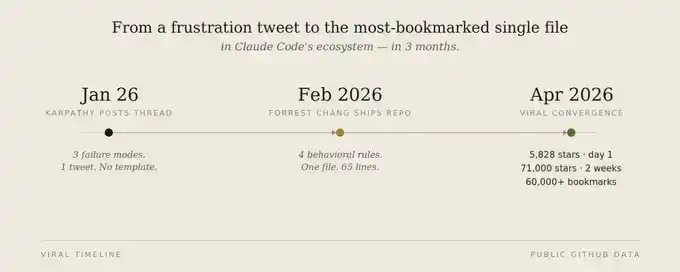
In late January 2026, Andrej Karpathy posted a tweet thread complaining about Claude's approach to writing code. He pointed out three typical problems: making incorrect assumptions without explanation, over-complicating things, and causing unintended damage to code that shouldn't have been touched.

Forrest Chang saw this tweet thread, distilled the complaints into 4 behavioral rules, wrote them into a separate CLAUDE.md file, and published it on GitHub. The project gained 5,828 stars on its first day, was bookmarked 60,000 times within two weeks, and now has 120,000 stars, becoming the fastest-growing single-file code repository of 2026.
Subsequently, I tested it with 30 codebases over 6 weeks.

These 4 rules are indeed effective. Errors that previously appeared with roughly a 40% probability dropped to below 3% for tasks where these rules were applicable. The problem is, this template was initially created to address errors Claude made when writing code in January.

By May 2026, the problems facing the Claude Code ecosystem had changed: Agents conflicting with each other, hook chain triggering, skill loading conflicts, and multi-step workflow disruptions across sessions.

So, I added 8 more rules. Below is the complete 12-rule version of CLAUDE.md: why each one is worth adding, and where the original Karpathy template will quietly fail in 4 specific areas.

If you want to skip the explanation and start using it directly, the complete file is at the end of the article.

Why This Matters

The CLAUDE.md file for Claude Code is the most underestimated file in the entire AI programming tech stack. Most developers typically make three kinds of mistakes:

First, treating it as a preference trash can, stuffing all their habits into it until it bloats to over 4000 tokens, with rule compliance dropping to 30%.

Second, not using it at all, re-prompting every time. This leads to 5x token waste and a lack of consistency between sessions.

Third, copying a template once and never updating it. It might work for two weeks, but as the codebase changes, it will fail without you even realizing it.

The Anthropic official documentation is clear: CLAUDE.md is essentially just advisory. Claude will follow it about 80% of the time. Once it exceeds 200 lines, compliance drops noticeably because important rules get drowned in noise.

Karpathy's template solves this: one file, 65 lines, 4 rules. This is the minimum baseline.

But the ceiling can be higher. Adding the following 8 rules means it covers not just the code-writing problems Karpathy complained about in January 2026, but also the Agent orchestration problems that emerged by May 2026—problems that didn't exist when the original template was written.

The Original 4 Rules

If you haven't seen Forrest Chang's repository, here's the basic version:

Rule 1: Think before you code.
Don't make silent assumptions. State your assumptions, expose trade-offs. Ask before guessing. Propose counterarguments when simpler alternatives exist.

Rule 2: Simple first.
Use the minimal code that solves the problem. Don't add imagined features. Don't design abstraction layers for one-off code. If a senior engineer would find it overcomplicated, simplify it.

Rule 3: Surgical changes.
Only modify what must be changed. Don't "optimize" adjacent code, comments, or formatting as a side effect. Don't refactor what isn't broken. Maintain consistency with the existing style.

Rule 4: Execute toward the goal.
Define success criteria first, then iterate in cycles until verification is complete. Don't tell Claude each step; tell it what the successful outcome should look like and let it iterate.

These 4 rules solve roughly 40% of the failure modes I've seen in unsupervised Claude Code sessions. The remaining 60% of problems lie in the gaps outlined below.
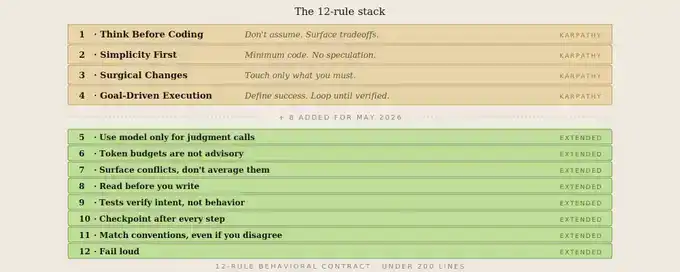
My 8 New Rules, and Why

Each rule comes from a real moment when Karpathy's original 4 rules were no longer sufficient. Below, I'll describe the scenario first, then give the corresponding rule.

Rule 5: Don't let the model do non-language work

Karpathy's rules didn't cover this. So the model started deciding issues that should have been handled by deterministic code: whether to retry an API call, how to route a message, when to escalate. The result was inconsistent decisions every week. You got an unstable, $0.003-per-token if-else statement.

The moment was this: There was code calling Claude to "decide whether to retry on a 503 error." It worked fine initially for two weeks, then suddenly became unstable because the model started treating the request body as part of the decision context. The retry strategy became random because the prompt itself was random.

Rule 6: Set a hard token budget, no exceptions

A CLAUDE.md without budget constraints is a blank check. Every loop can spiral out of control into a 50,000-token context dump. The model won't stop itself.

The moment was this: A debugging session lasted 90 minutes. The model kept iterating over the same 8KB error message, gradually forgetting which fixes it had already tried. In the end, it started proposing solutions I had rejected 40 messages earlier. With a token budget, this process should have been terminated at the 12-minute mark.

Rule 7: Expose conflicts, don't average them out

When two parts of a codebase contradict each other, Claude tries to please both sides, resulting in incoherent code.

The moment was this: A codebase had two error-handling patterns: one using async/await with explicit try/catch, another using a global error boundary. Claude wrote new code that used both. Errors got handled twice. It took me 30 minutes to figure out why errors were being swallowed two times over.

Rule 8: Read first, then write

Karpathy's "Surgical changes" tells Claude not to modify adjacent code. But it doesn't tell Claude to understand adjacent code first. Without this, Claude writes new code that conflicts with existing code 30 lines away.

The moment was this: Claude added a function right next to an existing function that did exactly the same thing, because it didn't read the original function first. Both functions performed the same task. But due to import order, the new function overrode the old one, which had been the de facto standard for 6 months.

Rule 9: Testing is not optional, but tests are not the goal

Karpathy's "Execute toward the goal" implies testing can be a success criterion. But in practice, Claude treats "tests pass" as the sole goal, writing code that passes shallow tests but breaks other things.

The moment was this: Claude wrote 12 tests for an authentication function; all passed. But the authentication logic broke in production. The tests were just verifying the function "returned something," not that it returned the correct thing. The function passed because it returned a constant.

Rule 10: Long-running operations need checkpoints

Karpathy's template assumes interaction is one-off. But real Claude Code work is often multi-step: refactoring across 20 files, building a feature in one session, debugging across multiple commits. Without checkpoints, one wrong step can lose all previous progress.

The moment was this: A 6-step refactoring task failed on step 4. By the time I noticed, Claude had already completed steps 5 and 6 on top of the erroneous state. Unraveling the fix took longer than redoing the entire task. With checkpoints, step 4 would have revealed the problem.

Rule 11: Conventions over novelty

In a codebase with established patterns, Claude loves to introduce its own style. Even if its way is "better," introducing a second pattern is worse than any single pattern.

The moment was this: Claude introduced hooks into a React codebase based on class components. It ran. But it also broke the codebase's existing testing patterns, which relied on componentDidMount. It took half a day to delete and rewrite it.

Rule 12: Fail loudly, not silently

Claude's most expensive failures are often the ones that look like successes. A function "runs" but returns wrong data; a migration "completes" but skips 30 records; a test "passes" but only because the assertion itself is wrong.

The moment was this: Claude said a database migration "completed successfully." In reality, it silently skipped 14% of records triggering constraint conflicts. The skipping was logged but not explicitly surfaced. Eleven days later, when report data started showing anomalies, we discovered the problem.

Data Results

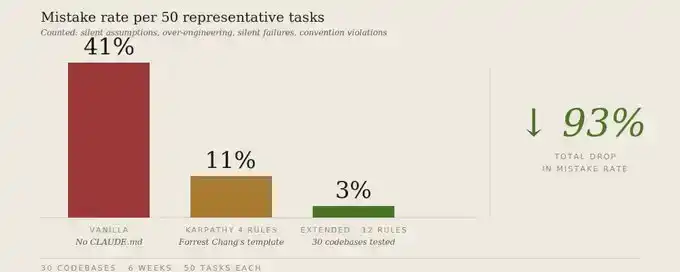
Over 6 weeks, I tracked the same set of 50 representative tasks across 30 codebases, testing three configurations.
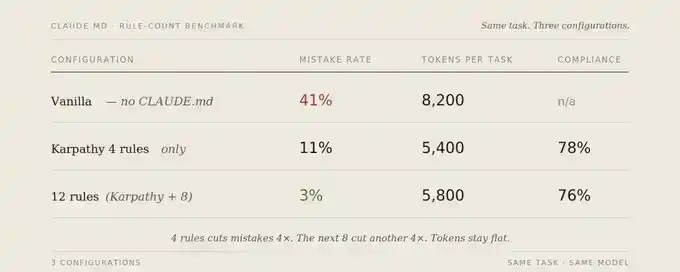
Error rate refers to: tasks needing correction or rewriting to match original intent. Counted errors include: silent erroneous assumptions, over-engineering, unintended damage, silent failures, convention violations, conflict averaging, missed checkpoints.

Compliance rate refers to: when a rule applies, how likely Claude is to explicitly apply it.

The truly interesting result isn't just the error rate dropping from 41% to 3%. More importantly, expanding from 4 to 12 rules barely increased compliance burden—compliance only dropped from 78% to 76%, but the error rate fell another 8 percentage points. The new rules cover failure modes the original 4 didn't handle; they aren't competing for the same attention budget.
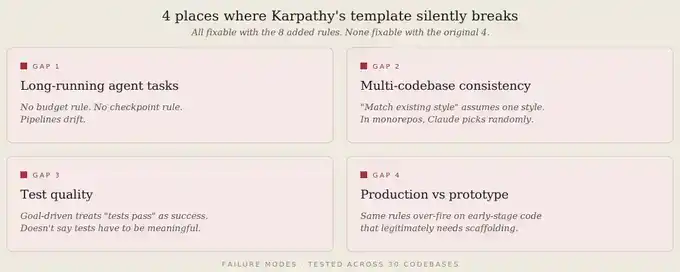
Where the Karpathy Template Quietly Fails

Even without new rules, the original 4-rule template is insufficient in at least 4 areas.

First, long-running Agent tasks.
Karpathy's rules mainly target the moment Claude is writing code. But what happens when Claude runs a multi-step pipeline? The original template has no budget rule, no checkpoint rule, no "fail loudly" rule. So the pipeline slowly drifts.

Second, multi-repository consistency.
"Match existing style" assumes only one style. But in a monorepo with 12 services, Claude must choose which style to match. The original rules don't tell it how. So it either picks randomly or averages several styles together.

Third, test quality.
"Execute toward the goal" treats "tests pass" as success, without stating tests must be meaningful. Result: Claude writes tests that verify almost nothing, but that make it overconfident.

Fourth, production vs. prototyping differences.
The same 4 rules that prevent production code from being over-engineered can also slow down prototyping. Because prototyping sometimes needs 100 lines of exploratory scaffolding to find direction first. Karpathy's "Simple first" triggers too easily for early-stage code.

These 8 new rules aren't meant to replace Karpathy's original 4, but to patch their gaps: the original template corresponds to the auto-completion-like coding scenario of January 2026; by May 2026, Claude Code has entered an Agent-driven, multi-step, multi-repository collaborative environment, and the problems faced are different.
What Didn't Work

Before finalizing these 12 rules, I tried other approaches.

Adding rules I saw on Reddit / X.
Most were either rephrasing Karpathy's original 4 rules or domain-specific rules that couldn't generalize, like "Always use Tailwind classes." I eventually removed them all.

More than 12 rules.
I tested up to 18. After 14, compliance dropped from 76% to 52%. The 200-line limit is real. Beyond that, Claude starts pattern-matching to "there are rules here" instead of reading each rule.

Rules dependent on specific tools.
For example, "Always use eslint." If eslint isn't installed in the project, the rule fails, silently. I later rephrased them to be tool-agnostic, e.g., changing "use eslint" to "follow styles already enforced in the codebase."

Putting examples in CLAUDE.md instead of rules.
Examples consume more context than rules. Three examples use roughly the same context as 10 rules, and Claude easily overfits to examples. Rules are abstract, examples are concrete. So, use rules.

"Be careful," "Think deeply," "Stay focused."
These are noise. Compliance for such instructions dropped to about 30% because they aren't verifiable. I replaced them with more specific imperative rules like "State assumptions explicitly."

Telling Claude to act like a "senior engineer."
This didn't work. Claude already thinks it's like a senior engineer. The real issue isn't whether it thinks so, but whether it executes like one. Imperative rules narrow this gap; identity prompts don't.

The Complete 12-Rule CLAUDE.md

Below is the complete version ready for copy-paste.

Temporarily unable to display this content outside of Lark Docs.

Save it as CLAUDE.md in your repository root. Below these 12 rules, add project-specific rules like tech stack, test commands, error patterns, etc. Keep the total under 200 lines; beyond that, rule compliance drops noticeably.

How to Install

Just two steps:

1. Append Karpathy's 4 basic rules to your existing CLAUDE.md
curl https://raw.githubusercontent.com/forrestchang/andrej-karpathy-skills/main/CLAUDE.md >> CLAUDE.md


2. Paste Rules 5–12 from this article below them

Save the file in the repository root. The >> is crucial—it appends to any existing CLAUDE.md instead of overwriting your project-specific rules.

Mental Model

CLAUDE.md isn't a wishlist; it's a behavioral contract to block specific failure patterns you've observed.

Each rule should answer one question: What error does it prevent?

Karpathy's 4 rules prevent the failure modes he saw in January 2026: silent assumptions, over-engineering, unintended damage, weak success criteria. They are the foundation; don't skip them.

My 8 new rules prevent the new failure modes emerging after May 2026: Agent loops without budget constraints, multi-step tasks without checkpoints, tests that seem to test but miss critical logic, and problems where silent failures are packaged as silent successes. They are incremental patches.

Of course, results vary. If you don't run multi-step pipelines, Rule 10 is less important. If your codebase has only one unified style enforced by linters, Rule 11 is redundant. After reading these 12, keep the rules that truly correspond to errors you've actually made; delete the rest.

A 6-rule CLAUDE.md tailored to your real failure patterns is better than a 12-rule version where 6 rules are never applicable.

Conclusion

Karpathy's tweet in January 2026 was essentially a complaint. Forrest Chang turned it into 4 rules. Ultimately, 120,000 developers starred the result. And most of them are still using only those 4 rules today.

The models have advanced, and the ecosystem has changed. Multi-step Agents, hook chains, skill loading, multi-repo collaboration—these didn't exist when Karpathy wrote that tweet. The original 4 rules don't solve these problems. They aren't wrong; they're incomplete.

Add 8 more rules. 6 weeks of testing across 30 codebases. Error rate drops from 41% to 3%.

Bookmark this article tonight and paste these 12 rules into your CLAUDE.md. If it saves you a week of Claude-related detours, feel free to share it.


Câu hỏi Liên quan

QWhat was the original 4-rule CLAUDE.md template created to solve, and how effective was it?

AThe original 4-rule CLAUDE.md template was created to solve the typical errors Andrej Karpathy complained about in January 2026 regarding Claude's coding behavior: silent assumptions, over-engineering, unintended collateral damage to unrelated code, and lack of clear success criteria. In tests, it reduced the error rate from around 40% to below 3% for tasks where these rules applied.

QWhat are two of the new problems that emerged in the Claude Code ecosystem by May 2026 that the original 4 rules didn't cover?

ABy May 2026, new failure modes included agents conflicting with each other, chain reactions from hooks, skill loading conflicts, and interruptions in multi-step, cross-session workflows. The original rules were insufficient for these issues related to agent orchestration and long-running tasks.

QAccording to the article, what are two common mistakes developers make when using a CLAUDE.md file?

ATwo common mistakes are: 1) Treating it as a preference dump, stuffing all personal habits into it until it bloats to over 4000 tokens, causing rule compliance to drop to 30%. 2) Not using it at all and re-prompting every time, which wastes 5x more tokens and lacks consistency across sessions.

QWhat does Rule 6 ('Set a hard token budget, no exceptions') aim to prevent, and what was the 'moment' that revealed its necessity?

ARule 6 aims to prevent uncontrolled, runaway iterative processes where a debugging session could spiral into a 50,000-token context dump without the model stopping itself. The revealing moment was a 90-minute debugging session where the model kept iterating over the same 8KB error message, forgetting previous fixes and eventually proposing solutions that had been rejected 40 messages earlier.

QWhy does the author advise against having more than 12-14 rules in a CLAUDE.md file, and what was the observed effect of exceeding this limit?

AThe author advises against having more than 12-14 rules because Anthropic's documentation states that compliance noticeably drops once the file exceeds 200 lines, as important rules get drowned out by noise. In tests, when the rule count exceeded 14, compliance rates dropped from 76% to 52%, as Claude started pattern-matching for 'rules are here' instead of reading each rule carefully.

Nội dung Liên quan

USDC bắt đầu nhân bản, Coinbase ra mắt dịch vụ tùy chỉnh nhãn hiệu phát hành stablecoin

Coinbase đã ra mắt nền tảng Custom Stablecoins, cho phép các doanh nghiệp tạo stablecoin mang thương hiệu riêng, với ví dụ điển hình là USDF cho ứng dụng Flipcash. USDF được phát hành trên Solana, được hỗ trợ 1:1 bởi USDC và đóng vai trò là đơn vị định giá & thanh toán ổn định cho các loại tiền tệ cộng đồng do người dùng tạo ra trong ứng dụng. Động thái này đánh dấu sự chuyển dịch trong ngành: stablecoin không chỉ là tài sản để thu hút người dùng, mà đang trở thành một "công cụ thanh toán" có thể tích hợp vào các sản phẩm cụ thể như mạng xã hội, trò chơi hoặc nền kinh tế sáng tạo. Coinbase đóng vai trò là nhà cung cấp hạ tầng, xử lý các vấn đề phức tạp như phát hành, dự trữ, hợp đồng trên chuỗi, cổng fiat và tuân thủ, cho phép các công ty như Flipcash tập trung vào nghiệp vụ cốt lõi. Mô hình này mở ra hướng đi mới cho các startup trong lĩnh vực thanh toán crypto: thay vì tự phát hành stablecoin, họ có thể tận dụng các giải pháp hạ tầng có sẵn để tích hợp khả năng stablecoin vào sản phẩm một cách liền mạch, đáp ứng các nhu cầu thực tế về thanh toán, quyết toán và quản lý dòng tiền. Tuy nhiên, việc này đòi hỏi năng lực hạ tầng và tuân thủ mạnh mẽ, như trường hợp của Coinbase với lợi thế về USDC, cổng fiat và kinh nghiệm quy định.

链捕手18 phút trước

USDC bắt đầu nhân bản, Coinbase ra mắt dịch vụ tùy chỉnh nhãn hiệu phát hành stablecoin

链捕手18 phút trước

37 ngày tạm giam, những người đầu tiên kiếm tiền từ 'trạm trung chuyển AI' bắt đầu vào tù

Theo tin từ giới làm AI, tháng 5/2026, một quản trị viên trạm trung chuyển AI đã công khai tuyên bố bị tạm giữ hình sự 37 ngày vì hành vi đảo ngược, thu thập trái phép và bán lại tài nguyên API AI giá rẻ, hiện đang được bảo lãnh tại ngoại. Sự bùng nổ nhu cầu sử dụng AI trong nước gặp phải các rào cản như hạn chế khu vực của mô hình lớn nước ngoài, dẫn đến sự phát triển của các dịch vụ trung chuyển AI. Các dịch vụ này đóng vai trò như "người môi giới", giúp người dùng tiếp cận các mô hình và thu phí. Các mô hình kinh doanh chính của trạm trung chuyển AI bao gồm: - Bán lại hạn mức miễn phí từ việc đăng ký hàng loạt tài khoản. - Lợi dụng chính sách hoàn tiền để kiếm lời. - Khai man số lượng Token tính phí cho người dùng. - Đánh tráo mô hình (dùng mô hình nhỏ thay thế mô hình lớn như đã quảng cáo). - Thu thập và bán dữ liệu hội thoại của người dùng. Tuy nhiên, hoạt động này tiềm ẩn nhiều rủi ro pháp lý: 1. Mô hình kinh doanh có thể vi phạm pháp luật: Việc thu thập tài nguyên không qua kênh chính thức và cung cấp dịch vụ viễn thông/gia công dữ liệu mà không có giấy phép có thể cấu thành tội kinh doanh trái phép. 2. Thiếu nghĩa vụ bảo mật dữ liệu: Các trạm trung chuyển thường không có biện pháp bảo vệ dữ liệu người dùng, rủi ro rò rỉ cao, có thể dẫn đến trách nhiệm hình sự vì không tuân thủ nghĩa vụ quản lý an ninh mạng. 3. Thu thập và bán dữ liệu người dùng trái phép: Hành vi này dễ dàng đạt ngưỡng cấu thành tội xâm phạm thông tin cá nhân. Sự kiện này phản ánh những vấn đề của ngành AI trong giai đoạn phát triển nóng. Đối với người dùng, dịch vụ trung chuyển giúp giảm rào cản nhưng đặt dữ liệu nhạy cảm vào rủi ro. Đối với nhà cung cấp, nó gây tổn hại đến mô hình kinh doanh, méo mó nhận thức về giá trị và làm xói mòn nền tảng phát triển bền vững của toàn ngành.

marsbit46 phút trước

37 ngày tạm giam, những người đầu tiên kiếm tiền từ 'trạm trung chuyển AI' bắt đầu vào tù

marsbit46 phút trước

Cho Thị Trường Lên Chuỗi: Canton Network Đang Dần Trở Thành Nền Tảng Mới Cho Tài Chính Tổ Chức

Visa vừa trở thành Siêu Xác thực viên với trọng số cao nhất trong Canton Network chỉ sau 3 ngày đề xuất, đánh dấu sự công nhận của tài chính truyền thống đối với cơ sở hạ tầng blockchain này. Khác với các blockchain công khai như Ethereum, Canton được thiết kế riêng cho các tổ chức tài chính, với khả năng kiểm soát hiển thị dữ liệu gốc, cho phép các giao dịch riêng tư giữa các đối tác trực tiếp trong khi vẫn được xác minh bởi mạng lưới. Điều này giải quyết trở ngại lớn về tính minh bạch toàn cục đối với các ngân hàng và tổ chức. Được tạo bởi Digital Asset Holdings, Canton có sự tham gia của hàng loạt gã khổng lồ tài chính như Goldman Sachs, JP Morgan, BNP Paribas, DTCC, Nasdaq và giờ là Visa. Mạng lưới hiện xử lý hơn 9 nghìn tỷ USD giá trị giao dịch mỗi tháng, tập trung vào các nghiệp vụ thực tế như repo được token hóa, thanh toán trái phiếu kho bạc và điều động tài sản thế chấp. Các trường hợp sử dụng chính bao gồm JPM Coin của JP Morgan cho thanh toán, kế hoạch token hóa trái phiếu kho bạc của DTCC và giao dịch repo xuyên biên giới có thể hoạt động 24/7. Mục tiêu cốt lõi là đạt được thanh toán nguyên tử, nơi việc thanh toán và giao tài sản xảy ra đồng thời. Token CC của mạng lưới được thiết kế như một "tài sản tiện ích mạng", được thúc đẩy bởi khối lượng hoạt động tài chính thực tế, với phân phối không có premine. Về lâu dài, Canton hướng tới trở thành một cơ sở hạ tầng tài chính "vô hình" toàn cầu, tương tự như SWIFT, hỗ trợ dòng vốn xuyên biên giới theo thời gian thực và hoạt động liên tục cho nhiều loại tài sản. Thách thức lớn nhất hiện nay không phải là công nghệ mà là việc triển khai và phối hợp toàn cầu giữa các khu vực pháp lý và tổ chức khác nhau.

marsbit1 giờ trước

Cho Thị Trường Lên Chuỗi: Canton Network Đang Dần Trở Thành Nền Tảng Mới Cho Tài Chính Tổ Chức

marsbit1 giờ trước

Giao dịch

Giao ngay
Hợp đồng Tương lai

Bài viết Nổi bật

AGENT S là gì

Agent S: Tương Lai của Tương Tác Tự Động trong Web3 Giới thiệu Trong bối cảnh không ngừng phát triển của Web3 và tiền điện tử, các đổi mới đang liên tục định nghĩa lại cách mà cá nhân tương tác với các nền tảng kỹ thuật số. Một dự án tiên phong như vậy, Agent S, hứa hẹn sẽ cách mạng hóa tương tác giữa con người và máy tính thông qua khung tác nhân mở của nó. Bằng cách mở đường cho các tương tác tự động, Agent S nhằm đơn giản hóa các nhiệm vụ phức tạp, cung cấp các ứng dụng chuyển đổi trong trí tuệ nhân tạo (AI). Cuộc khám phá chi tiết này sẽ đi sâu vào những phức tạp của dự án, các tính năng độc đáo của nó và những tác động đối với lĩnh vực tiền điện tử. Agent S là gì? Agent S đứng vững như một khung tác nhân mở đột phá, được thiết kế đặc biệt để giải quyết ba thách thức cơ bản trong việc tự động hóa các nhiệm vụ máy tính: Thu thập Kiến thức Cụ thể theo Miền: Khung này học một cách thông minh từ nhiều nguồn kiến thức bên ngoài và kinh nghiệm nội bộ. Cách tiếp cận kép này giúp nó xây dựng một kho lưu trữ phong phú về kiến thức cụ thể theo miền, nâng cao hiệu suất của nó trong việc thực hiện nhiệm vụ. Lập Kế Hoạch Qua Các Tầm Nhìn Nhiệm Vụ Dài Hạn: Agent S sử dụng lập kế hoạch phân cấp tăng cường kinh nghiệm, một cách tiếp cận chiến lược giúp phân chia và thực hiện các nhiệm vụ phức tạp một cách hiệu quả. Tính năng này nâng cao đáng kể khả năng quản lý nhiều nhiệm vụ con một cách hiệu quả và hiệu suất. Xử Lý Các Giao Diện Động, Không Đều: Dự án giới thiệu Giao Diện Tác Nhân-Máy Tính (ACI), một giải pháp đổi mới giúp nâng cao tương tác giữa các tác nhân và người dùng. Sử dụng các Mô Hình Ngôn Ngữ Lớn Đa Phương Thức (MLLMs), Agent S có thể điều hướng và thao tác các giao diện người dùng đồ họa đa dạng một cách liền mạch. Thông qua những tính năng tiên phong này, Agent S cung cấp một khung vững chắc giải quyết các phức tạp liên quan đến việc tự động hóa tương tác giữa con người với máy móc, mở ra nhiều ứng dụng trong AI và hơn thế nữa. Ai là Người Tạo ra Agent S? Mặc dù khái niệm về Agent S là hoàn toàn đổi mới, thông tin cụ thể về người sáng lập vẫn còn mơ hồ. Người sáng lập hiện vẫn chưa được biết đến, điều này làm nổi bật giai đoạn sơ khai của dự án hoặc sự lựa chọn chiến lược để giữ kín các thành viên sáng lập. Bất chấp sự ẩn danh, sự chú ý vẫn tập trung vào khả năng và tiềm năng của khung này. Ai là Các Nhà Đầu Tư của Agent S? Vì Agent S còn tương đối mới trong hệ sinh thái mã hóa, thông tin chi tiết về các nhà đầu tư và những người tài trợ tài chính của nó không được ghi chép rõ ràng. Sự thiếu vắng thông tin công khai về các nền tảng đầu tư hoặc tổ chức hỗ trợ dự án dấy lên câu hỏi về cấu trúc tài trợ và lộ trình phát triển của nó. Hiểu biết về sự hỗ trợ là rất quan trọng để đánh giá tính bền vững và tác động tiềm năng của dự án. Agent S Hoạt Động Như Thế Nào? Tại cốt lõi của Agent S là công nghệ tiên tiến cho phép nó hoạt động hiệu quả trong nhiều bối cảnh khác nhau. Mô hình hoạt động của nó được xây dựng xung quanh một số tính năng chính: Tương Tác Giống Như Con Người: Khung này cung cấp lập kế hoạch AI tiên tiến, cố gắng làm cho các tương tác với máy tính trở nên trực quan hơn. Bằng cách bắt chước hành vi của con người trong việc thực hiện nhiệm vụ, nó hứa hẹn nâng cao trải nghiệm người dùng. Ký Ức Tường Thuật: Được sử dụng để tận dụng các trải nghiệm cấp cao, Agent S sử dụng ký ức tường thuật để theo dõi lịch sử nhiệm vụ, từ đó nâng cao quy trình ra quyết định của nó. Ký Ức Tình Huống: Tính năng này cung cấp cho người dùng hướng dẫn từng bước, cho phép khung này cung cấp hỗ trợ theo ngữ cảnh khi các nhiệm vụ diễn ra. Hỗ Trợ OpenACI: Với khả năng chạy cục bộ, Agent S cho phép người dùng duy trì quyền kiểm soát đối với các tương tác và quy trình làm việc của họ, phù hợp với tinh thần phi tập trung của Web3. Tích Hợp Dễ Dàng với Các API Bên Ngoài: Tính linh hoạt và khả năng tương thích với nhiều nền tảng AI khác nhau đảm bảo rằng Agent S có thể hòa nhập liền mạch vào các hệ sinh thái công nghệ hiện có, làm cho nó trở thành lựa chọn hấp dẫn cho các nhà phát triển và tổ chức. Những chức năng này cùng nhau góp phần vào vị trí độc đáo của Agent S trong không gian tiền điện tử, khi nó tự động hóa các nhiệm vụ phức tạp, nhiều bước với sự can thiệp tối thiểu của con người. Khi dự án phát triển, các ứng dụng tiềm năng của nó trong Web3 có thể định nghĩa lại cách mà các tương tác kỹ thuật số diễn ra. Thời Gian Phát Triển của Agent S Sự phát triển và các cột mốc của Agent S có thể được tóm tắt trong một dòng thời gian nêu bật các sự kiện quan trọng của nó: 27 tháng 9, 2024: Khái niệm về Agent S được ra mắt trong một bài nghiên cứu toàn diện mang tên “Một Khung Tác Nhân Mở Sử Dụng Máy Tính Như Một Con Người,” trình bày nền tảng cho dự án. 10 tháng 10, 2024: Bài nghiên cứu được công bố công khai trên arXiv, cung cấp một cái nhìn sâu sắc về khung và đánh giá hiệu suất của nó dựa trên tiêu chuẩn OSWorld. 12 tháng 10, 2024: Một video trình bày được phát hành, cung cấp cái nhìn trực quan về khả năng và tính năng của Agent S, thu hút thêm sự quan tâm từ người dùng và nhà đầu tư tiềm năng. Những dấu mốc trong dòng thời gian không chỉ minh họa sự tiến bộ của Agent S mà còn chỉ ra cam kết của nó đối với sự minh bạch và sự tham gia của cộng đồng. Những Điểm Chính Về Agent S Khi khung Agent S tiếp tục phát triển, một số thuộc tính chính nổi bật, nhấn mạnh tính đổi mới và tiềm năng của nó: Khung Đổi Mới: Được thiết kế để cung cấp cách sử dụng máy tính trực quan giống như tương tác của con người, Agent S mang đến một cách tiếp cận mới cho việc tự động hóa nhiệm vụ. Tương Tác Tự Động: Khả năng tương tác tự động với máy tính thông qua GUI đánh dấu một bước tiến tới các giải pháp tính toán thông minh và hiệu quả hơn. Tự Động Hóa Nhiệm Vụ Phức Tạp: Với phương pháp mạnh mẽ của nó, nó có thể tự động hóa các nhiệm vụ phức tạp, nhiều bước, làm cho các quy trình nhanh hơn và ít sai sót hơn. Cải Tiến Liên Tục: Các cơ chế học tập cho phép Agent S cải thiện từ các trải nghiệm trước đó, liên tục nâng cao hiệu suất và hiệu quả của nó. Tính Linh Hoạt: Khả năng thích ứng của nó trên các môi trường hoạt động khác nhau như OSWorld và WindowsAgentArena đảm bảo rằng nó có thể phục vụ một loạt các ứng dụng rộng rãi. Khi Agent S định vị mình trong bối cảnh Web3 và tiền điện tử, tiềm năng của nó để nâng cao khả năng tương tác và tự động hóa quy trình đánh dấu một bước tiến quan trọng trong công nghệ AI. Thông qua khung đổi mới của mình, Agent S minh họa cho tương lai của các tương tác kỹ thuật số, hứa hẹn một trải nghiệm liền mạch và hiệu quả hơn cho người dùng trên nhiều ngành công nghiệp khác nhau. Kết luận Agent S đại diện cho một bước nhảy vọt táo bạo trong sự kết hợp giữa AI và Web3, với khả năng định nghĩa lại cách chúng ta tương tác với công nghệ. Mặc dù vẫn còn ở giai đoạn đầu, những khả năng cho ứng dụng của nó là rộng lớn và hấp dẫn. Thông qua khung toàn diện của mình giải quyết các thách thức quan trọng, Agent S nhằm đưa các tương tác tự động lên hàng đầu trong trải nghiệm kỹ thuật số. Khi chúng ta tiến sâu hơn vào các lĩnh vực tiền điện tử và phi tập trung, các dự án như Agent S chắc chắn sẽ đóng một vai trò quan trọng trong việc định hình tương lai của công nghệ và sự hợp tác giữa con người với máy tính.

Tổng lượt xem 797Xuất bản vào 2025.01.14Cập nhật vào 2025.01.14

AGENT S là gì

Làm thế nào để Mua S

Chào mừng bạn đến với HTX.com! Chúng tôi đã làm cho mua Sonic (S) trở nên đơn giản và thuận tiện. Làm theo hướng dẫn từng bước của chúng tôi để bắt đầu hành trình tiền kỹ thuật số của bạn.Bước 1: Tạo Tài khoản HTX của BạnSử dụng email hoặc số điện thoại của bạn để đăng ký tài khoản miễn phí trên HTX. Trải nghiệm hành trình đăng ký không rắc rối và mở khóa tất cả tính năng. Nhận Tài khoản của tôiBước 2: Truy cập Mua Crypto và Chọn Phương thức Thanh toán của BạnThẻ Tín dụng/Ghi nợ: Sử dụng Visa hoặc Mastercard của bạn để mua Sonic (S) ngay lập tức.Số dư: Sử dụng tiền từ số dư tài khoản HTX của bạn để giao dịch liền mạch.Bên thứ ba: Chúng tôi đã thêm những phương thức thanh toán phổ biến như Google Pay và Apple Pay để nâng cao sự tiện lợi.P2P: Giao dịch trực tiếp với người dùng khác trên HTX.Thị trường mua bán phi tập trung (OTC): Chúng tôi cung cấp những dịch vụ được thiết kế riêng và tỷ giá hối đoái cạnh tranh cho nhà giao dịch.Bước 3: Lưu trữ Sonic (S) của BạnSau khi mua Sonic (S), lưu trữ trong tài khoản HTX của bạn. Ngoài ra, bạn có thể gửi đi nơi khác qua chuyển khoản blockchain hoặc sử dụng để giao dịch những tiền kỹ thuật số khác.Bước 4: Giao dịch Sonic (S)Giao dịch Sonic (S) dễ dàng trên thị trường giao ngay của HTX. Chỉ cần truy cập vào tài khoản của bạn, chọn cặp giao dịch, thực hiện giao dịch và theo dõi trong thời gian thực. Chúng tôi cung cấp trải nghiệm thân thiện với người dùng cho cả người mới bắt đầu và người giao dịch dày dạn kinh nghiệm.

Tổng lượt xem 1.4kXuất bản vào 2025.01.15Cập nhật vào 2025.03.21

Làm thế nào để Mua S

Thảo luận

Chào mừng đến với Cộng đồng HTX. Tại đây, bạn có thể được thông báo về những phát triển nền tảng mới nhất và có quyền truy cập vào thông tin chuyên sâu về thị trường. Ý kiến ​​của người dùng về giá của S (S) được trình bày dưới đây.

活动图片