Dissecting Circle's Q1 Earnings Report: After the Interest Rate Dividend Ebbs, USDC Prepares for a Big Chess Game

marsbitXuất bản vào 2026-05-11Cập nhật gần nhất vào 2026-05-11

Tóm tắt

Title: Circle Q1 2026 Earnings: Shifting Strategy as Interest Rate Windfall Subsides Circle reported its Q1 2026 financial results. While total revenue and reserve income of $694M slightly missed expectations, adjusted EBITDA grew 24% to $151M. A key trend is the decline in reserve income due to lower Federal Reserve interest rates, which Circle is countering by diversifying its revenue streams. Notably, non-interest "Other Revenue" hit a record $42M. USDC's circulation reached 77 billion, up 28% year-over-year, but its on-chain transaction volume surged 263% to $21.5 trillion, indicating significantly higher utilization in payments and DeFi. Financially, the core RLDC Margin improved to 41%, showing better cost control. However, operating expenses nearly doubled, partly due to post-IPO stock compensation costs. Looking ahead, Circle is expanding beyond being a simple stablecoin issuer. It highlighted the $222M presale for its Arc Network (valued at $3B) and launched new services like Managed Payments and the "Agent Stack" for AI-driven commerce. The company's strategy is evolving to position USDC as the foundational dollar network for the internet, targeting broader payment, enterprise, and AI agent economies.

Original | Odaily Planet Daily(@OdailyChina)

Author | Azuma(@azuma_eth)
Before the US stock market opened on May 11th, stablecoin issuer Circle officially announced its Q1 2026 earnings report.

The financial report data shows, Circle's total revenue and reserve income for Q1 was $694 million, slightly below market expectations of $715 million; EPS was $0.21, higher than market expectations of $0.18; adjusted EBITDA was $151 million, a year-on-year increase of 24%; net profit was $55 million, a year-on-year decrease of 15%.

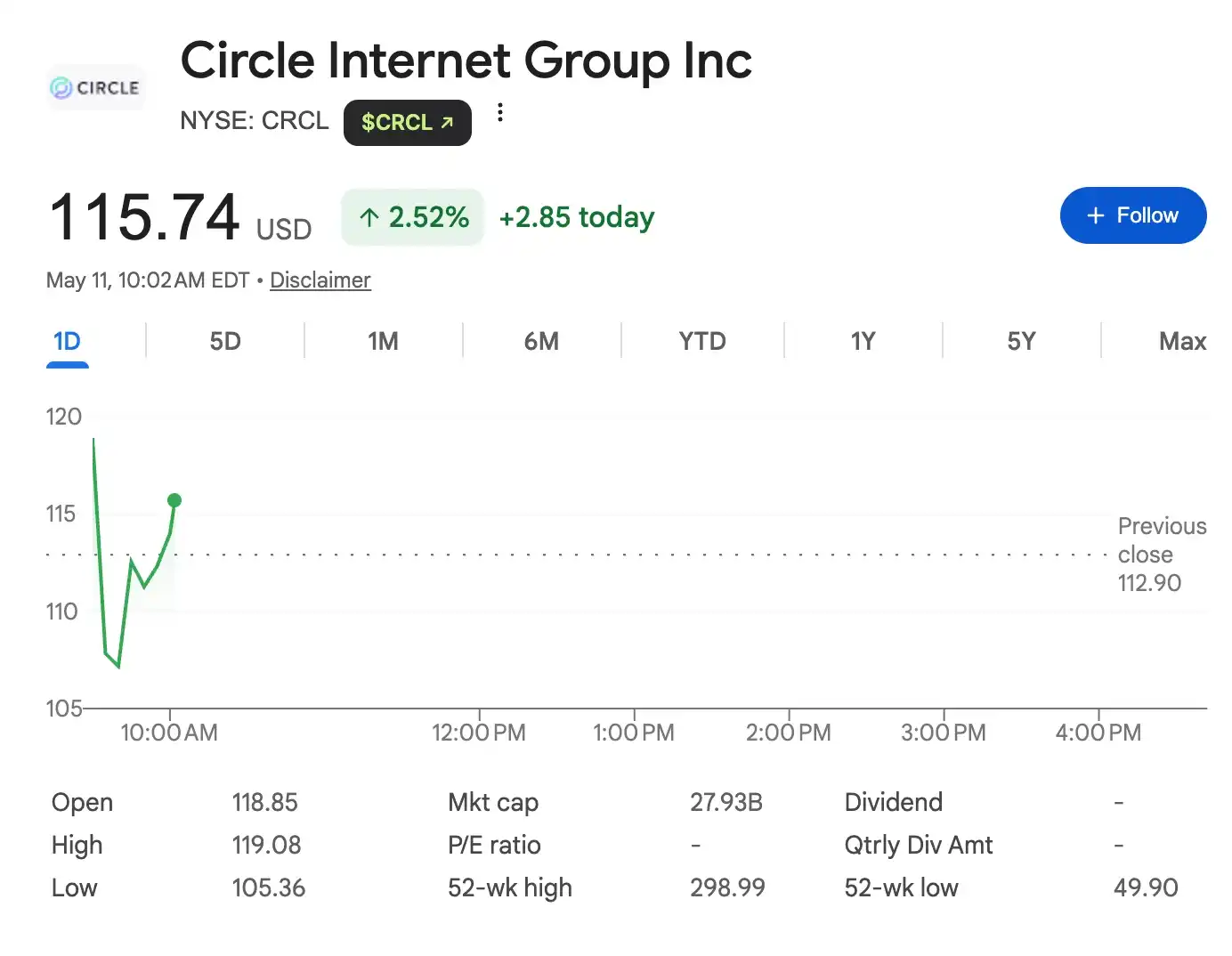
Affected by the earnings release, CRCL experienced significant pre-market volatility, with nearly a 6% pre-market gain gradually being erased amid fluctuations. As of 22:00, after the opening of US stocks, CRCL once continued to plummet but then quickly turned from loss to gain, temporarily quoted at $115.74, with an intraday increase of 2.52%.
Interpretation of Core Data

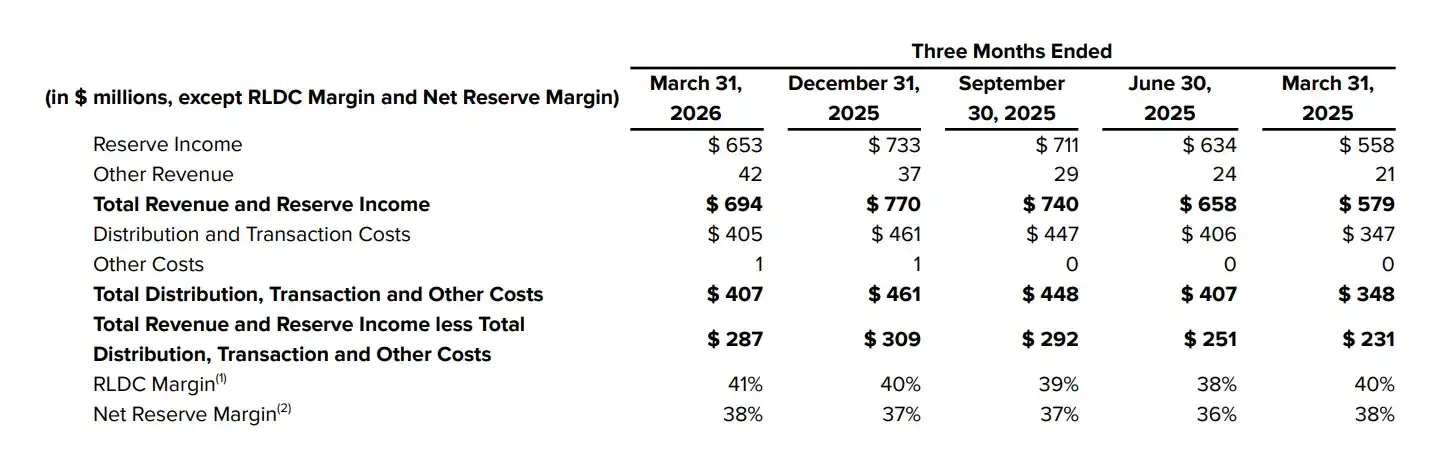
As shown in the report, Circle's total revenue and reserve income for this quarter was $694 million. Although it increased by 20% year-on-year, it broke the growth trend of previous consecutive quarters ($579M → $658M → $740M → $770M → $694M) and also fell short of market expectations.

Circle attributed the slowdown in revenue growth to a decline in the Reserve Return Rate. On December 10, 2025, the Federal Reserve lowered the federal funds rate target range by 25 basis points to 3.5%-3.75%, thereby compressing the yield of Circle's primarily US Treasury-backed reserve assets.
However, despite the relatively weak revenue, this earnings report from Circle still reveals some locally optimistic data.

First, Circle's Other Revenue, excluding Reserve Income, reached a new high of $42 million, showing a growth trend over multiple consecutive quarters ($21M → $24M → $29M → $37M → $42M).

As we mentioned in this afternoon's article "Earnings Report, Bill, Federal Reserve... Circle Faces Three Major Tests This Week", this means Circle's revenue sources are becoming more diversified. Its platform services, API tools, and payment products are generating tangible commercial returns, and reliance on interest income is decreasing.

Another noteworthy data point is RLDC Margin, the profit margin after revenue minus distribution costs. This reflects the core business profitability after deducting distribution expenses and is widely regarded as Circle's most crucial profit metric. This quarter, Circle's RLDC Margin reached 41%, achieving growth for four consecutive quarters (36% → 39% → 40% → 41%). This means Circle's control over distribution costs is becoming more efficient.
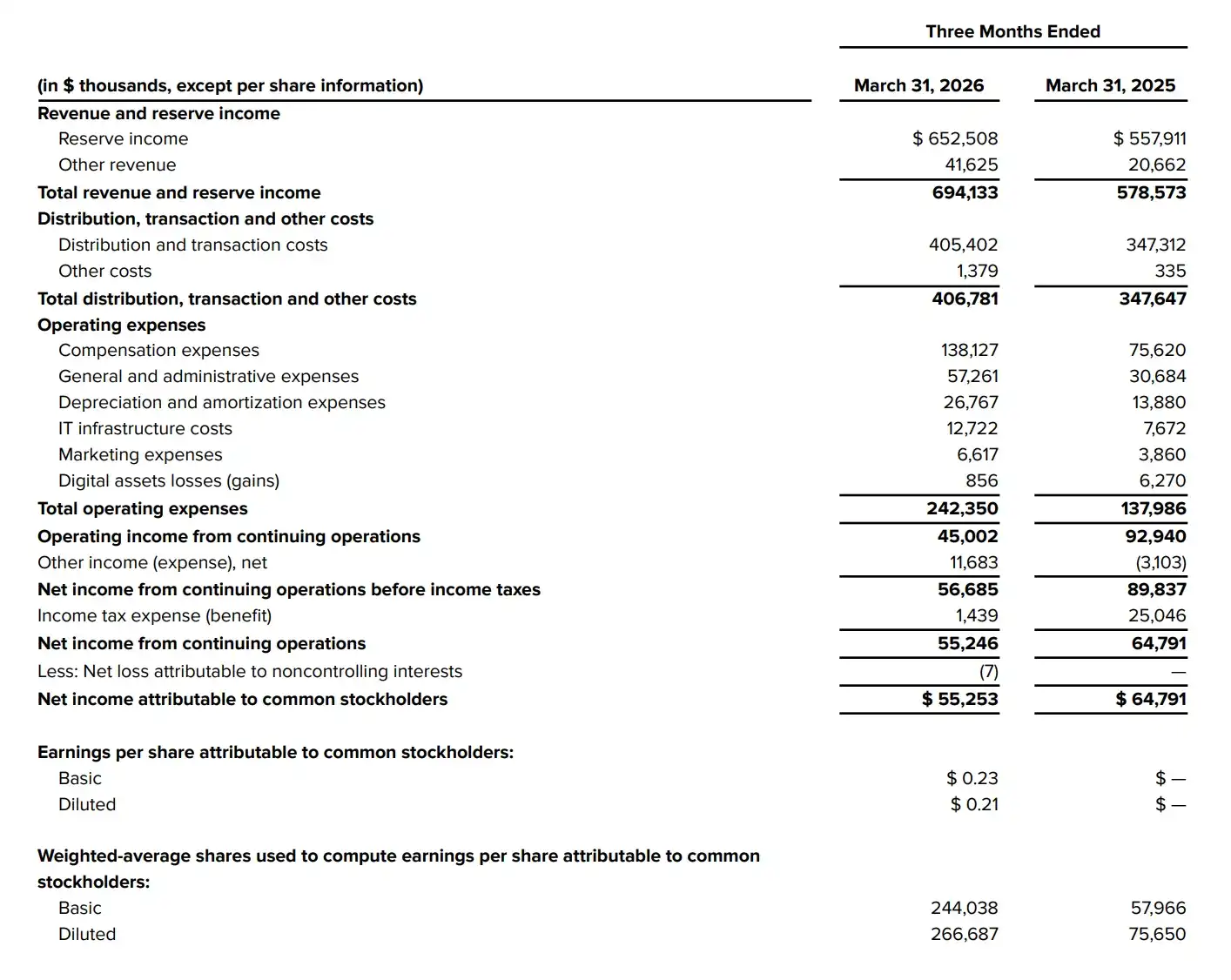
Now let's look at the expense situation. Distribution and Transaction Costs remain Circle's largest expense item, reaching a high of $405 million this quarter, a 17% year-on-year increase. This expense is mainly tied to the USDC distribution contract with Coinbase. This contract is set to expire in August this year. How it is renewed (primarily looking at whether the revenue-sharing ratio will be adjusted) will greatly impact Circle's subsequent expenses and profit status.

Apart from distribution costs, Total Operating Expenses also surged from $138 million last year to $242 million, a year-on-year increase of 76%. The primary increase came from Compensation expenses, which nearly doubled from $75.62 million to $138 million—Circle explained this was mainly due to IPO-related stock-based compensation expenses and related taxes.

Affected by the surge in expenses, Circle's operating profit for this quarter dropped to $45 million from $92.94 million in the same period last year; net profit attributable to common shareholders decreased from $64.79 million to $55.25 million; earnings per share (EPS) were $0.23, diluted to $0.21.

Other Operational Highlights

In addition to core financial data, Circle disclosed several operational highlights in its Q1 earnings report.

The most crucial data point is that USDC's circulation at the end of Q1 reached 77 billion tokens, a year-on-year increase of 28%. However, at the same time, USDC's on-chain transaction volume in Q1 reached a staggering $21.5 trillion, a year-on-year increase of 263%. Visa Onchain Analytics data also shows that USDC accounted for 63% of the total stablecoin transaction volume in Q1.
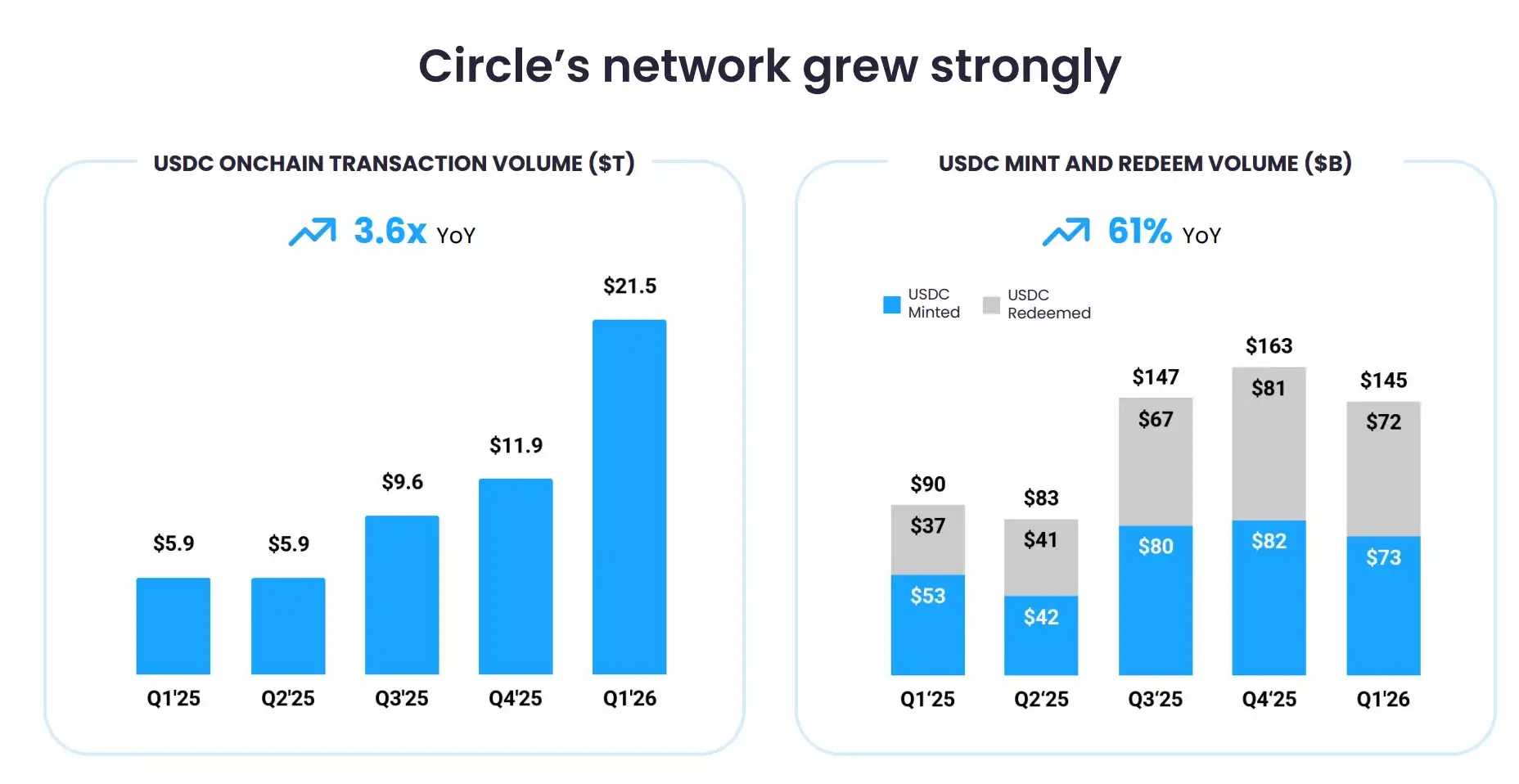
The transaction volume growth rate far exceeding the circulation growth rate means that the turnover and application frequency of each USDC token on-chain has significantly increased — USDC is not lying statically in wallets but is being genuinely and frequently used in scenarios like payments, DeFi, and cross-border settlements.

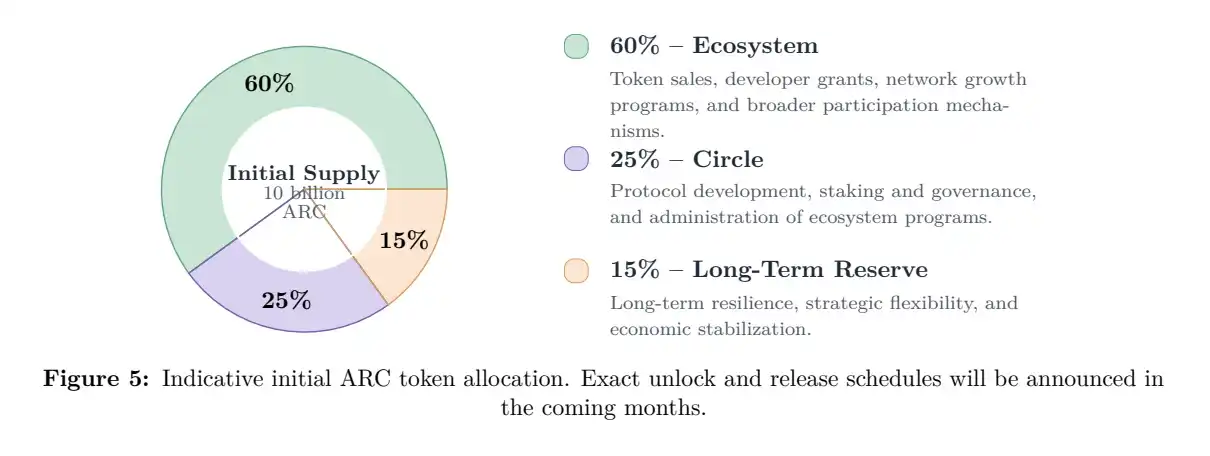
Another important point is that Circle also disclosed that its payment network, Arc Network, has completed a $222 million ARC token pre-sale with a valuation as high as $3 billion. Investors include renowned institutions such as a16z, BlackRock, Intercontinental Exchange, Standard Chartered, and SBI. The ARC token whitepaper disclosed today shows that 60% of the tokens will be allocated to the ecosystem (token sales, developer grants, network growth); 25% will be allocated to Circle (protocol development, staking & governance); 15% will be allocated to a long-term reserve (strategic flexibility & economic stability).
In the subsequent earnings call, when asked how the ARC tokens belonging to Circle would be accounted for, Circle Co-founder and CEO Jeremy Allaire stated: "When ARC tokens are created, they will be recorded on Circle's balance sheet at cost, and their cost is zero. Subsequently, after Circle fulfills its obligations under the token pre-sale agreement, we will recognize the value of these tokens as 'Other Revenue', and this value will then be directly reflected in RLDC and Adjusted EBITDA."

This also means that in a future quarter, Circle's reported revenue data will look "exceptionally good" due to the inclusion of ARC token value.

Furthermore, the estimated annual transaction volume for Circle's institutional payment service, Circle Payments Network (CPN) (extrapolated based on 30-day data as of March 31st), has also reached $8.3 billion; In April, Circle launched the "Managed Payments" product to expand its payment offerings. This product allows financial institutions to launch stablecoin payment services without having to manage digital assets themselves.

To prepare for the AI Agent-driven commercial future, Circle also announced the launch of Agent Stack, a set of infrastructure services and toolkits for the AI Agent economy, designed to provide high-speed, low-cost financial service capabilities for autonomously operating AI Agents. Jeremy Allaire's vision for this is: "With the ARC token pre-sale, the momentum building for Arc Network, and the launch of Agent Stack, we are building trusted infrastructure for AI-native economic activity and a more programmable internet financial system."

Circle's New Chess Game

Against the macroeconomic backdrop of receding high-interest dividends (Warsh is expected to promote a "rate cut + balance sheet reduction" strategy upon succeeding as Fed Chair), Circle clearly does not want to be entirely at the mercy of the Federal Reserve's interest rate policy. Its strategic focus has quietly shifted towards diversified expansion of non-interest revenue.

Judging from the details disclosed in this quarterly report, after successively launching services like CPN, Managed Payments, Agent Stack, and Arc Network, Circle's goal is no longer just to be a "stablecoin issuer." It is attempting to build USDC into the underlying dollar network for the internet era. Under this new vision, Circle's service targets are no longer limited to exchanges or crypto-native users but are extending comprehensively into cross-border payments, corporate settlements, and even the AI Agent economy.

Circle's ambition is now abundantly clear: to transform USDC from a "static reserve asset" into "flowing economic blood." This is perhaps the big chess game Circle truly wants to play.

Câu hỏi Liên quan

QWhat were Circle's total revenue and reserve income for Q1 2026, and how did it compare to market expectations?

ACircle's total revenue and reserve income for Q1 2026 was $6.94 billion, which was slightly below the market expectation of $7.15 billion.

QAccording to the article, what are the two key positive data points from Circle's Q1 report despite slowing revenue growth?

ATwo key positive data points are: 1) Other Revenue (excluding Reserve Income) reached a new high of $42 million, showing a consecutive growth trend. 2) The RLDC Margin, a core profitability indicator, reached 41%, marking four consecutive quarters of growth.

QWhat major operational highlight regarding USDC usage is mentioned in the Q1 report?

AA major operational highlight is that the on-chain transaction volume of USDC reached $21.5 trillion in Q1, a 263% year-over-year increase, significantly outpacing its circulation growth of 28%. This indicates much higher frequency of real-world use.

QWhat is the significance of the Arc Network and its ARC token for Circle's future financials, as explained by CEO Jeremy Allaire?

AThe ARC tokens allocated to Circle will be recorded on its balance sheet at cost (which is zero). Once Circle fulfills its obligations under the token presale agreement, the value of these tokens will be recognized as 'other revenue,' which will directly boost the RLDC and Adjusted EBITDA figures in a future quarter.

QHow does the article describe Circle's strategic shift and ultimate ambition in the context of declining interest rate benefits?

ACircle's strategy is shifting from relying on interest income to diversifying into non-interest revenue streams. Its ultimate ambition is to transform USDC from a 'static reserve asset' into 'circulating economic blood,' aiming to build it as the foundational dollar network for the internet era, extending into cross-border payments, corporate settlement, and the AI Agent economy.

Nội dung Liên quan

Báo cáo tài chính Nvidia thứ Tư: Cuộc chiến định đoạn vận mệnh thị trường tăng giá AI đã tới

Tập đoàn Nvidia dự kiến công bố báo cáo tài chính vào ngày 20/5 (giờ Mỹ), được coi là một bài kiểm tra áp lực quan trọng đối với chu kỳ tăng giá AI hiện tại. Thị trường bán dẫn đang trong tình trạng mua quá mức nghiêm trọng, vị thế quyền chọn nghiêng mạnh về lạc quan, cùng tín hiệu hiếm gặp về việc giá cổ phiếu và biến động ngầm cùng tăng, làm gia tăng rủi ro hai chiều xung quanh sự kiện này. Chuyên gia Peter Callahan của Goldman Sachs chỉ ra mâu thuẫn cốt lõi: nền tảng cơ bản vẫn mạnh mẽ, nhưng áp lực kỹ thuật đang tích lũy. Chỉ số SOX hiện cao hơn khoảng 60% so với đường trung bình 200 ngày, mức chênh lệch chưa từng thấy kể từ thời kỳ bong bóng dot-com. Báo cáo của Nvidia, đặc biệt là hướng dẫn triển vọng cho quý tới, sẽ là yếu tố then chốt kiểm chứng kỳ vọng của thị trường vào chu kỳ siêu tăng tốc điện toán AI. Thị trường quyền chọn cho thấy các tín hiệu mâu thuẫn: vị thế mua quyền chọn mua vẫn cực kỳ mạnh, nhưng hoạt động phòng ngừa rủi ro suy giảm cũng đang tăng lên. Đồng thời, sự tham gia của thị trường chứng khoán Mỹ đang thiếu hụt, với mức tăng chủ yếu được hỗ trợ bởi một số ít cổ phiếu công nghệ lớn và bán dẫn, trong khi nhiều lĩnh vực khác tụt lại phía sau, làm dấy lên lo ngại về tính bền vững của đợt tăng giá hiện tại.

marsbit9 phút trước

Báo cáo tài chính Nvidia thứ Tư: Cuộc chiến định đoạn vận mệnh thị trường tăng giá AI đã tới

marsbit9 phút trước

Lock.com Bước Vào Giai Đoạn Truy Cập Sớm Với Kiến Trúc Chống Lại Máy Tính Lượng Tử và Chữ Ký Biệt Lập

Quantography Labs đã công bố bản phát hành truy cập sớm của Lock.com, một ví tiền mã hóa không cần phần cứng chuyên dụng, được xây dựng dựa trên phương pháp bảo mật cách ly và ngắt kết nối mạng (air-gapped). Nền tảng này hiện đã có sẵn cho người dùng truy cập sớm. Lock.com tách biệt môi trường lưu trữ khóa riêng tư khỏi các hệ thống có kết nối mạng, loại bỏ sự phụ thuộc vào các nhà sản xuất phần cứng hoặc chuỗi cung ứng thiết bị chuyên dụng. Khóa riêng tư luôn được giữ trên một thiết bị ký giao dịch hoàn toàn ngoại tuyến, trong khi các giao dịch được tạo và phát trên một thiết bị đã kết nối. Khóa riêng tư không bao giờ chạm tới internet. Kiến trúc của Lock.com tích hợp các tiêu chuẩn mật mã hậu lượng tử, cụ thể là chữ ký ML-DSA và bao bọc khóa ML-KEM, cùng với mô hình ký giao dịch cách ly. Giai đoạn truy cập sớm tập trung vào việc thu thập phản hồi từ người dùng trước khi ra mắt chính thức. Quantography Labs là một công ty đầu tư và công nghệ tập trung vào tài chính bảo mật, tài sản kỹ thuật số và nghiên cứu ứng dụng. Lock.com là sản phẩm đầu tiên của họ được phát hành công khai.

TheNewsCrypto20 phút trước

Lock.com Bước Vào Giai Đoạn Truy Cập Sớm Với Kiến Trúc Chống Lại Máy Tính Lượng Tử và Chữ Ký Biệt Lập

TheNewsCrypto20 phút trước

Đại học Harvard có thể lỗ 150 triệu USD vì đầu tư tiền mã hóa! Đã thanh lý Ethereum, cắt giảm mạnh vị thế ETF Bitcoin

Harvard Management Company (HMC), cơ quan quản lý quỹ hiến tặng của Đại học Harvard, đã báo cáo việc thanh lý toàn bộ danh mục ETF Ethereum (ETHA) và giảm mạnh 43% vị thế ETF Bitcoin (IBIT) trong quý đầu năm 2026. Các động thái này diễn ra khi giá tiền mã hóa sụt giảm, đưa tổng giá trị danh mục công khai về khoảng 117 triệu USD, giảm mạnh so với mức đỉnh 443 triệu USD vào quý 3/2025. Theo ước tính, HMC có thể đã chịu khoản lỗ hơn 150 triệu USD từ hoạt động này, với tỷ lệ lỗ ước tính 28% cho Bitcoin và 35% cho Ethereum. Hành động được cho là phản ánh việc tái cân bằng rủi ro, nhu cầu thanh khoản và áp lực tài chính. Harvard đang đối mặt với thâm hụt ngân sách và gánh nặng thuế mới, khiến các tài sản có tính thanh khoản cao như ETF tiền mã hóa trở thành mục tiêu điều chỉnh đầu tiên. Trong khi Harvard rút lui, một số tổ chức khác như quỹ đầu tư Mubadala (Abu Dhabi) vẫn tiếp tục tăng mua ETF Bitcoin. Động thái của Harvard nhấn mạnh cách các tổ chức truyền thống tiếp cận thị trường tiền mã hóa: coi chúng như một phần của danh mục đầu tư rủi ro và có thể nhanh chóng điều chỉnh khi cần thu hẹp rủi ro hoặc tăng tính thanh khoản.

marsbit21 phút trước

Đại học Harvard có thể lỗ 150 triệu USD vì đầu tư tiền mã hóa! Đã thanh lý Ethereum, cắt giảm mạnh vị thế ETF Bitcoin

marsbit21 phút trước

Đại học Harvard Có Thể Lỗ 150 Triệu USD Khi Giao Dịch Tiền Ảo! Đã Thanh Lý Ethereum, Cắt Giảm Mạnh Vị Thế ETF Bitcoin

Havard Management Company (HMC), cơ quan quản lý quỹ tài trợ lớn nhất thế giới, đã báo cáo giảm mạnh vị thế ETF Bitcoin (IBIT) 43% và thanh lý toàn bộ ETF Ethereum (ETHA) trong quý I/2026, theo hồ sơ 13F mới đây. Tổng tài sản crypto công khai của Harvard đã giảm từ mức đỉnh 443 triệu USD xuống còn khoảng 117 triệu USD chỉ sau hai quý. Các chuyên gia ước tính HMC có thể lỗ hơn 150 triệu USD từ các vị thế này, với Bitcoin mua vào quanh 110.000 USD và bán ra quanh 80.000 USD, còn Ethereum mua quanh 4.000 USD và thanh lý quanh 2.600 USD. Động thái này diễn ra trong bối cảnh Harvard đối mặt thâm hụt ngân sách 113 triệu USD năm 2025 và gánh nặng thuế mới lên đến 300 triệu USD/năm từ luật thuế của đảng Cộng hòa. Việc cắt giảm các ETF crypto có tính thanh khoản cao được cho là để đáp ứng nhu cầu thanh khoản và quản lý rủi ro, thay vì bán các tài sản kém thanh khoản như đầu tư tư nhân (chiếm 41% quỹ). Trong khi Harvard rút lui, một số tổ chức khác như quỹ đầu tư Mubadala của Abu Dhabi vẫn tiếp tục tăng mua ETF Bitcoin, và Đại học Dartmouth mở rộng danh mục sang ETF Solana.

链捕手26 phút trước

Đại học Harvard Có Thể Lỗ 150 Triệu USD Khi Giao Dịch Tiền Ảo! Đã Thanh Lý Ethereum, Cắt Giảm Mạnh Vị Thế ETF Bitcoin

链捕手26 phút trước

Giao dịch

Giao ngay
Hợp đồng Tương lai
活动图片