More and More 'Model Supermarkets' Are Opening: ByteDance, Alibaba, and Tencent Compete to Integrate

marsbitXuất bản vào 2026-04-24Cập nhật gần nhất vào 2026-04-24

Tóm tắt

Chinese tech giants like ByteDance, Alibaba, and Tencent are accelerating the rollout of integrated AI model subscription services—dubbed “model supermarkets”—to provide developers with bundled access to multiple leading domestic large language models (LLMs). ByteDance’s Volcengine recently upgraded its "Coding Plan" by adding newer models like GLM-5.1, Minimax M2.7, and Kimi k2.6, allowing subscribers to use various top models under a single monthly fee starting at ¥40. However, user feedback reveals significant issues, including rapid consumption of usage limits (e.g., hitting caps within hours), frequent server errors (like HTTP 429), and slow response times during peak hours. Complaints about misleading deduction rates—where calls to advanced models consume more quota—are also common. The trend is industry-wide: Alibaba, Tencent, and Baidu have all launched similar multi-model coding plans. While these platforms reduce trial costs for developers, they also expose challenges in balancing affordability with service quality and computational stability. Amid this shift, independent AI companies like Zhipu, MiniMax, and Moonlight Face (Kimi) are developing strategies to avoid becoming mere “pipes” in this ecosystem—focusing on vertical applications, autonomous agents, and long-context models to retain competitiveness. Analysts suggest that, while platform aggregation may pressure model firms in the short term, specialized and vertical AI capabilities will remain differentia...

ByteDance's Volcano Engine recently officially launched GLM-5.1 in its Coding Plan, with the official statement claiming "aligned with the original full capabilities, no purchase limits." Prior to this, Volcano's Coding Plan had long only offered older models like GLM-4.7. This update not only introduced GLM-5.1 but also integrated multiple latest domestic large models such as Minimax M2.7, Kimi k2.6, and DeepSeek-V3.2.
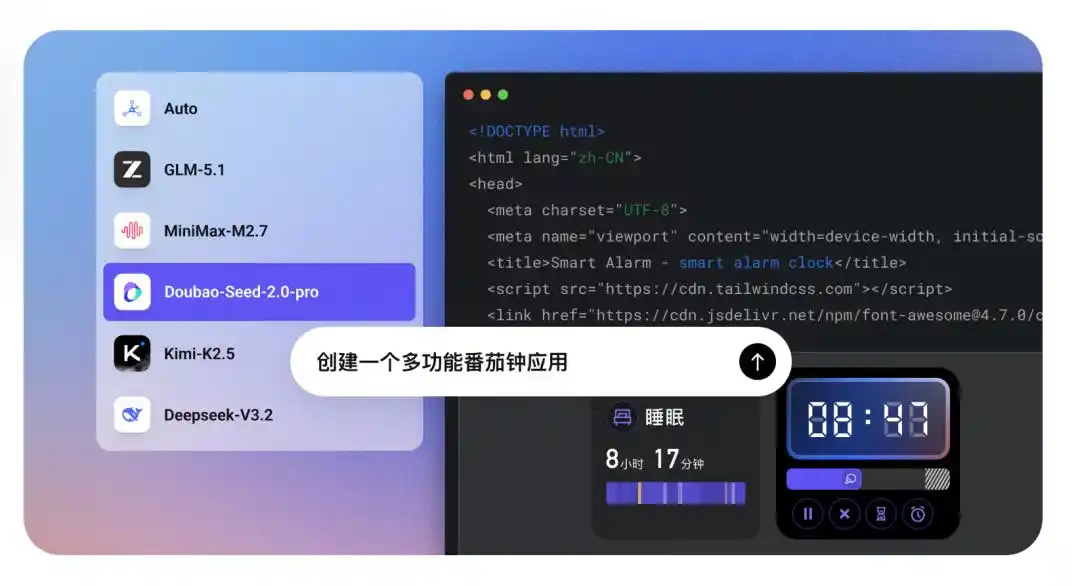
This means developers can call upon multiple leading models simultaneously with just one subscription fee. Market feedback indicates that this "bundled model" significantly reduces developers' trial-and-error costs. Currently, the Lite plan is priced at 40 yuan per month, and the Pro plan at 200 yuan per month, making many developers willing to "buy a spot first."

Zhipu's GLM-5.1 itself demonstrated impressive engineering capabilities in an update in early April 2026. In two official videos released by Zhipu, "Building a Linux Desktop from Scratch in 8 Hours" and "655 Iterations, Increasing Query Throughput of the Vector Database to 6.9 Times the Initial Official Version," it redefined public imagination regarding large models' "8-hour effective execution."

Journalist's On-the-Ground Visit to Developer Community: Majority of Users Report "Not Durable"

Upon entering a Volcano Coding developer exchange group, the journalist found that alongside posts sharing experience feedback, a large number of users reported a gap between expectations and actual experience. Scrolling through a few pages of the exchange community revealed numerous posts complaining and requesting refunds, with many netizens exclaiming "feel cheated."
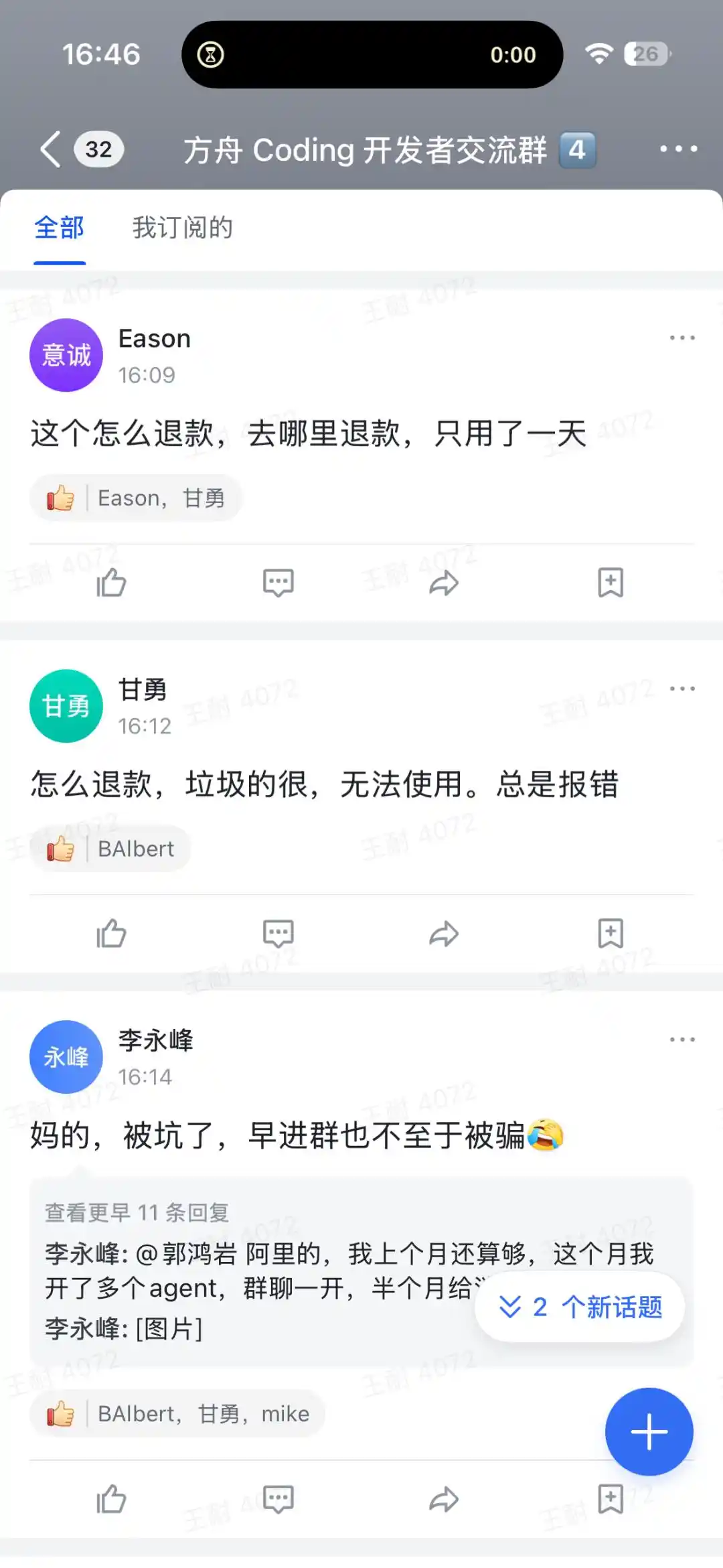
The controversies mainly focus on two points:

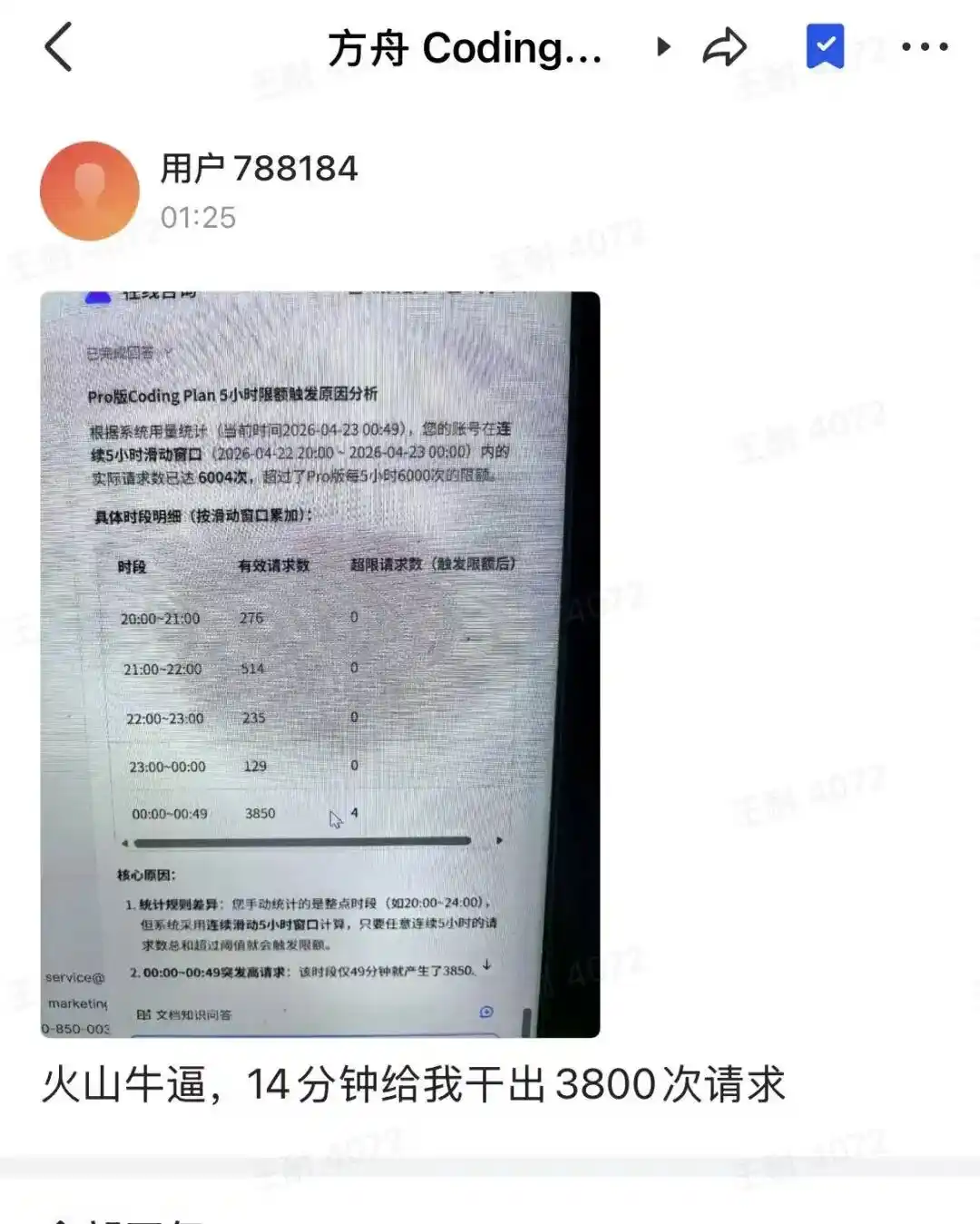
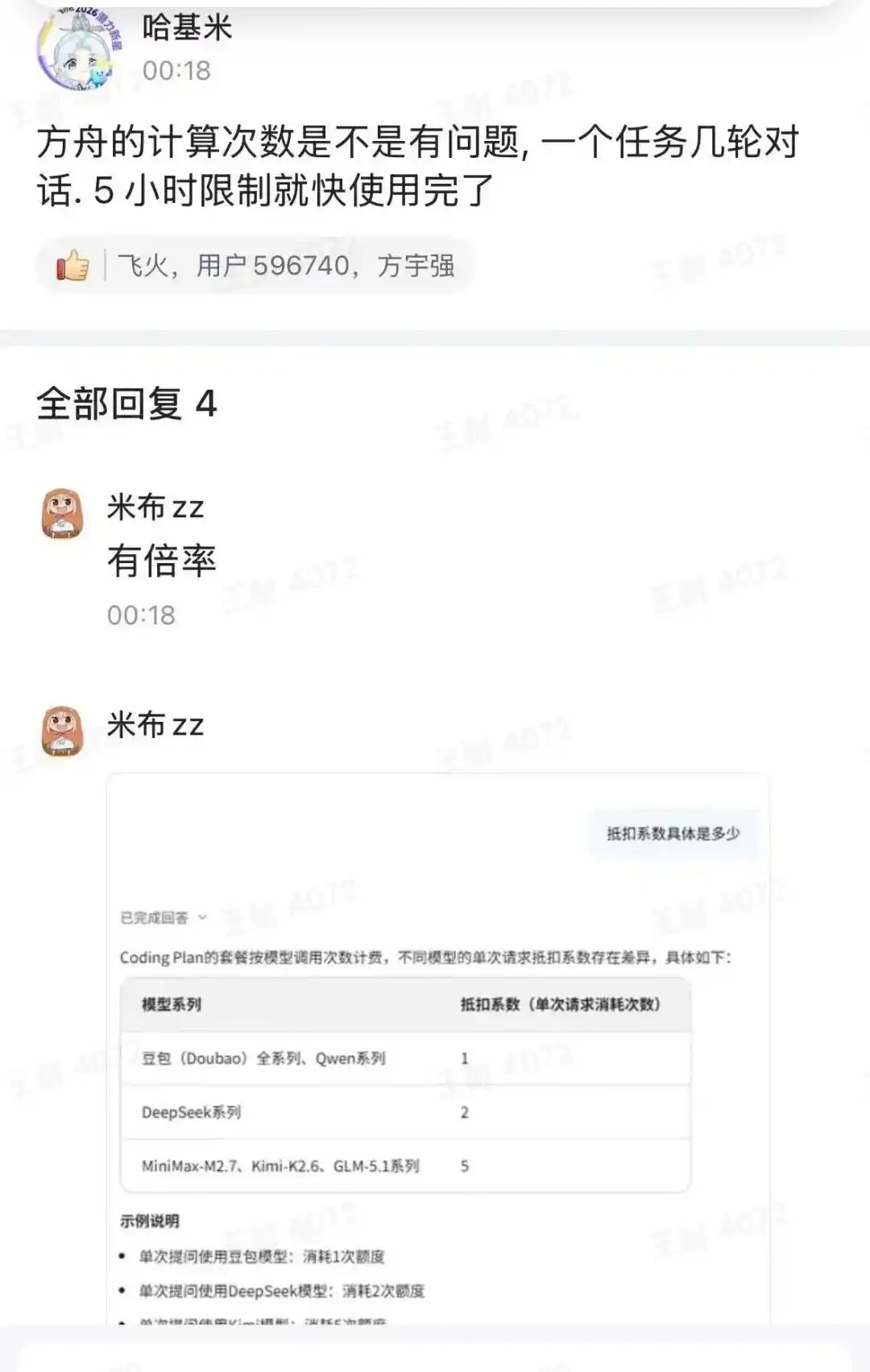
One is the issue of usage limits being consumed too quickly. A user named "Hakimi" posted saying "a few rounds of dialogue in one task and the 5-hour limit is almost used up." Another netizen shared that the reason their "5-hour limit was triggered" was because the account had a continuous sliding window over 5 hours, with the actual number of requests exceeding 6004, surpassing the system limit.
The second is the decline in experience due to computational resource scheduling pressure. Many users reported encountering 429 errors (too many requests) and "first-character delays of over one minute during peak hours being the norm." One user bluntly stated: "The 5-hour limit triggers too frequently, making it unusable for serious development."

Simultaneously, behind the low price of 40 yuan per month for the Coding Plan, there is also a hidden "undercurrent" regarding different deduction coefficients for "a single call request" within the plan. For example, a user posted an image in the developer exchange group showing the "differences in deduction coefficients for calling different models." For instance, the Doubao series and Qwen series have a deduction coefficient of 1, the DeepSeek series is 2, and the MiniMax-M2.7, Kimi-K2.6, and GLM-5.1 series are 5.
This also reflects that building a "model supermarket" is not as easy as imagined. Developers are attracted by the "cost-effectiveness," but the shortcomings exposed initially in areas like computational resource scheduling have caused many developers to hesitate after trying it out. This also reveals the growing pains of the "bundled model" in its early stages. As users flock in, the carrying capacity of the computing platform faces challenges. Finding a sustainable balance between attracting users with low prices and maintaining service quality will be a long-term challenge for Volcano Engine and its followers.

Cloud Vendors Collectively Shift to "Model Supermarkets": Initial Signs of Stratification and Solidification

This "integrative" update by Volcano Engine's Coding Plan is not an isolated incident.

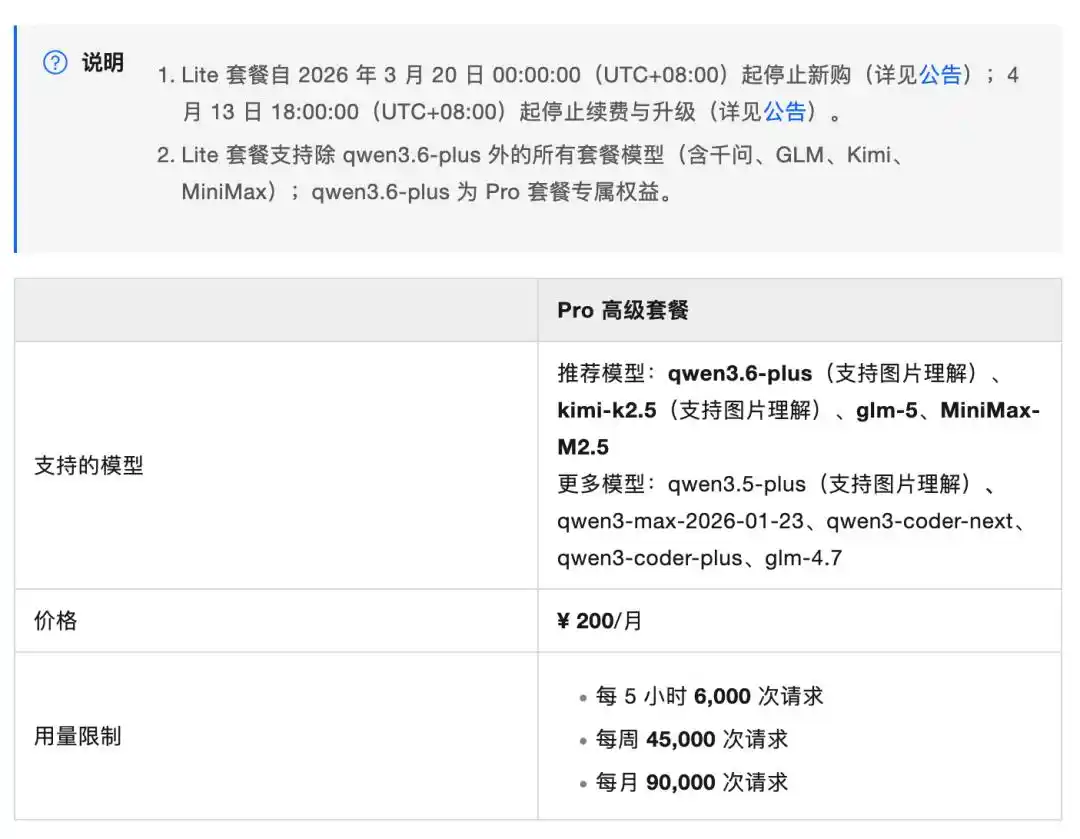
Since early 2026, mainstream cloud vendors like Alibaba Cloud, Baidu Intelligent Cloud, and Tencent Cloud have all been advancing multi-model integration layouts. For example, Alibaba Cloud, as an industry pioneer, earlier launched the multi-model subscription package "Bailian Coding Plan," currently supporting the Qwen series, kimi-k2.5, glm-5, MiniMax-M2.5, and other models. Currently, the Pro price is 200 yuan per month, and the Lite package stopped new purchases from March 20th and stopped renewals and upgrades from April 13th.
Tencent Cloud's large model Coding Plan subscription service was fully updated in March 2026, supporting multiple latest models including Tencent HY 2.0 Instruct, GLM-5, Kimi-K2.5, and MiniMax-M2.5. Baidu Qianfan officially launched its AI coding subscription service, Coding Plan, in February 2026, also one of the较早 (relatively early) domestic cloud vendors to offer such services.

The "model supermarket" model is not a choice of just one company but is becoming a track where cloud vendors are racing to layout. However, tearing open the aggregation strategy of cloud vendors, whoever can provide more stable services, more transparent quota rules, more flexible disaster recovery mechanisms, and whoever can extend beyond programming to more enterprise-level service capabilities, and whether the renewal rate can keep up, all become new core competitive factors.

Internationally, Amazon Bedrock and Microsoft Azure's model aggregation service platforms, though different in scenarios from the domestic Coding subscription model, belong to the same integration trend.
Overall, industry competition is shifting from "single model capability competition" to "platform integration capability + ecosystem service capability" competition, and industry concentration will rapidly increase.

Wang Kai, Chief Asset Allocation Analyst at Guosen Securities, told reporters that although industry differentiation is accelerating, judging the integration period might be slightly premature. "More accurately, this is the refinement and iteration of industry chain分工 (division of labor). Model vendors focus on algorithms, cloud vendors focus on engineering delivery, each leveraging their main business advantages." He believes that regardless of whether other cloud vendors follow suit, the competitive landscape will evolve from individual efforts to ecological niche differentiation.

Increased Pressure for Large Model Companies to Become "Pipelined"?

So-called "pipelining" does not mean model companies disappear, but rather that they lose product premium, user connection rights, and discourse power, with profits shifting towards the computing platform side, becoming a "dominated" role.

Under the aggregation wave of cloud vendors, "pipelining" is also becoming a Sword of Damocles hanging over the heads of independent large model companies. In this silent game, leading players like Zhipu AI, Moonlight Shadow (Kimi), and MiniMax have not chosen passive compromise but have grown from their genes, offering different breakout paths.

Zhipu AI CEO Zhang Peng, in a public dialogue on April 8th, clearly stated that Zhipu's ultimate goal is never to become a "replaceable calling tool" but to build a fully autonomous agent. This positioning attempts to upgrade Zhipu from a "model supplier" to a "task executor," thereby bypassing the low-price trap of pure API pipelines.

Moonlight Shadow (Kimi) adopts a strategy of "decentralized layout + deep cultivation of long text." It synchronously accesses multiple mainstream cloud platforms like Volcano Engine and Alibaba Cloud, achieving multi-source computational power supply, avoiding being bound to a single channel, and ensuring service stability and cost control. Kimi K2.6, launched in April 2026, adopts a Mixture of Experts (MoE) architecture with a standard context window of 256K tokens.

MiniMax focuses its core investments on vertical fields such as content creation, intelligent customer service, education, enterprise services, and entertainment socializing, with key layouts in scenarios like game AI, digital humans, and multimodal interaction, creating "customized capabilities difficult for cloud platforms to replace."
Will platform integration by major vendors accelerate the "pipelining" of model companies? Wang Kai, Chief Asset Allocation Analyst at Guosen Securities, believes it is necessary to distinguish between short-term and long-term perspectives.

"In the short term, distribution channels being controlled by the platform, partial ceding of pricing power, and profits of model vendors shifting to the entry point side are business norms. But in the long run, general models are prone to homogenization; deep learning models in vertical scenarios like finance, healthcare, and law have professional barriers that cannot be erased simply by centralized aggregation." he said.

In terms of responding to the risk of being platformized, strategies from OpenAI and Anthropic can be referenced. On one hand, strengthen channels that directly face end-users, such as the independent operation of ChatGPT and Claude, which essentially establishes user connections bypassing platforms. On the other hand, the speed of technological iteration and user brand recognition are two effective moats, so model companies need to balance R&D investment with productization layout.

The final outcome of this game of "pipelining vs. platformization" might not be about who eats whom, but a further clarification of division of labor. Cloud vendors act as pipes, model companies focus on technology, and both sides gradually find their respective survival boundaries in the game.

As for who eats whom, at this stage, it is far from the end of the story.

This article is from the WeChat public account "Sci-Tech Innovation Board Daily," author: Wang Nai

Tiền kỹ thuật số thịnh hành

Câu hỏi Liên quan

QWhat is the main advantage of ByteDance's Volcano Engine Coding Plan 'model supermarket' for developers?

AThe main advantage is that developers can access multiple leading domestic large models (like GLM-5.1, Minimax M2.7, Kimi k2.6, DeepSeek-V3.2) with a single subscription fee, significantly reducing trial-and-error costs.

QWhat are the two main complaints from developers about the Volcano Engine Coding Plan service?

AThe two main complaints are: 1) Usage limits being exhausted too quickly (e.g., a few rounds of dialogue using up the 5-hour limit), and 2) Performance issues like frequent 429 errors (too many requests) and long response delays during peak hours.

QWhich major cloud providers in China are also adopting the 'model supermarket' strategy mentioned in the article?

AMajor cloud providers adopting this strategy include Alibaba Cloud (with its 'Bailian Coding Plan'), Tencent Cloud, and Baidu Qianfan, all of which offer multi-model subscription services.

QWhat is the concept of 'pipelining' (管道化) as a risk for independent large model companies?

A'Pipelining' refers to the risk where independent model companies lose product pricing power, user connection rights, and discourse power. Their profits shift to the computing power platform providers, reducing them to a 'dominated' role as easily replaceable API tools.

QWhat strategies are companies like Zhipu AI, Moonshot (Kimi), and MiniMax adopting to avoid being 'pipelined'?

AZhipu AI aims to build fully autonomous agents to become 'task executors' rather than mere suppliers. Moonshot (Kimi) uses a multi-platform strategy and focuses on long-text capabilities. MiniMax invests heavily in vertical fields like content creation and gaming AI to build customized capabilities that are hard for platforms to replace.

Nội dung Liên quan

Ethlabs Ra Đời, Các Công Ty Kho Bạc Chi Tiền Cho Ethereum Sau EF

Vào ngày 22 tháng 6, năm cựu nhà nghiên cứu cốt lõi của Ethereum Foundation (EF) đã thành lập Ethlabs, một phòng thí nghiệm R&D phi lợi nhuận độc lập tập trung vào nghiên cứu giao thức lõi và cơ sở hạ tầng cấp tổ chức cho Ethereum. Sứ mệnh của Ethlabs là biến Ethereum thành "lớp thanh toán cho nền kinh tế toàn cầu". Tổ chức nhận được sự hỗ trợ từ các công ty kho bạc ETH như BitMine và Sharplink, cùng hơn 50 cá nhân trong cộng đồng. Sự ra đời của Ethlabs diễn ra trong bối cảnh EF đang đối mặt với áp lực kép về nhân sự và tài chính, với làn sóng nhân sự chủ chốt rời đi và khoản tài trợ 30 triệu USD hàng năm cho các nhóm phát triển client lõi sắp hết hạn mà chưa có kế hoạch gia hạn. Song song đó, giá trị của ETH đang chuyển dịch. Thành công của chiến lược mở rộng L2, đặc biệt sau bản nâng cấp Dencun (EIP-4844), đã làm giảm phí L1 và phá vỡ tạm thời câu chuyện "siêu âm tiền tệ", làm dấy lên tranh luận về việc nắm bắt giá trị. Ethlabs đặt "khuôn khổ kinh tế tiền tệ ETH" là ưu tiên nghiên cứu ban đầu. Các công ty kho bạc như BitMine và Sharplink, nắm giữ lượng ETH lớn, coi việc hỗ trợ Ethlabs là sự đầu tư chiến lược gắn liền với giá trị tài sản của họ, với niềm tin rằng Ethereum sẽ trở thành lớp cơ sở trung lập cho tài chính toàn cầu. Cấu trúc quản trị của Ethereum đang chuyển từ một tổ chức tập trung (EF) sang mạng lưới phân tán gồm nhiều "nút quản lý" chuyên biệt như Ethlabs. Mặc dù điều này có thể nâng cao hiệu quả và giảm thiểu rủi ro hệ thống, nhưng nó cũng đặt ra thách thức mới về chi phí phối hợp và cơ chế đạt được sự đồng thuận giữa các thực thể độc lập.

Foresight News33 phút trước

Ethlabs Ra Đời, Các Công Ty Kho Bạc Chi Tiền Cho Ethereum Sau EF

Foresight News33 phút trước

Giao dịch

Giao ngay
Hợp đồng Tương lai

Bài viết Nổi bật

AGENT S là gì

Agent S: Tương Lai của Tương Tác Tự Động trong Web3 Giới thiệu Trong bối cảnh không ngừng phát triển của Web3 và tiền điện tử, các đổi mới đang liên tục định nghĩa lại cách mà cá nhân tương tác với các nền tảng kỹ thuật số. Một dự án tiên phong như vậy, Agent S, hứa hẹn sẽ cách mạng hóa tương tác giữa con người và máy tính thông qua khung tác nhân mở của nó. Bằng cách mở đường cho các tương tác tự động, Agent S nhằm đơn giản hóa các nhiệm vụ phức tạp, cung cấp các ứng dụng chuyển đổi trong trí tuệ nhân tạo (AI). Cuộc khám phá chi tiết này sẽ đi sâu vào những phức tạp của dự án, các tính năng độc đáo của nó và những tác động đối với lĩnh vực tiền điện tử. Agent S là gì? Agent S đứng vững như một khung tác nhân mở đột phá, được thiết kế đặc biệt để giải quyết ba thách thức cơ bản trong việc tự động hóa các nhiệm vụ máy tính: Thu thập Kiến thức Cụ thể theo Miền: Khung này học một cách thông minh từ nhiều nguồn kiến thức bên ngoài và kinh nghiệm nội bộ. Cách tiếp cận kép này giúp nó xây dựng một kho lưu trữ phong phú về kiến thức cụ thể theo miền, nâng cao hiệu suất của nó trong việc thực hiện nhiệm vụ. Lập Kế Hoạch Qua Các Tầm Nhìn Nhiệm Vụ Dài Hạn: Agent S sử dụng lập kế hoạch phân cấp tăng cường kinh nghiệm, một cách tiếp cận chiến lược giúp phân chia và thực hiện các nhiệm vụ phức tạp một cách hiệu quả. Tính năng này nâng cao đáng kể khả năng quản lý nhiều nhiệm vụ con một cách hiệu quả và hiệu suất. Xử Lý Các Giao Diện Động, Không Đều: Dự án giới thiệu Giao Diện Tác Nhân-Máy Tính (ACI), một giải pháp đổi mới giúp nâng cao tương tác giữa các tác nhân và người dùng. Sử dụng các Mô Hình Ngôn Ngữ Lớn Đa Phương Thức (MLLMs), Agent S có thể điều hướng và thao tác các giao diện người dùng đồ họa đa dạng một cách liền mạch. Thông qua những tính năng tiên phong này, Agent S cung cấp một khung vững chắc giải quyết các phức tạp liên quan đến việc tự động hóa tương tác giữa con người với máy móc, mở ra nhiều ứng dụng trong AI và hơn thế nữa. Ai là Người Tạo ra Agent S? Mặc dù khái niệm về Agent S là hoàn toàn đổi mới, thông tin cụ thể về người sáng lập vẫn còn mơ hồ. Người sáng lập hiện vẫn chưa được biết đến, điều này làm nổi bật giai đoạn sơ khai của dự án hoặc sự lựa chọn chiến lược để giữ kín các thành viên sáng lập. Bất chấp sự ẩn danh, sự chú ý vẫn tập trung vào khả năng và tiềm năng của khung này. Ai là Các Nhà Đầu Tư của Agent S? Vì Agent S còn tương đối mới trong hệ sinh thái mã hóa, thông tin chi tiết về các nhà đầu tư và những người tài trợ tài chính của nó không được ghi chép rõ ràng. Sự thiếu vắng thông tin công khai về các nền tảng đầu tư hoặc tổ chức hỗ trợ dự án dấy lên câu hỏi về cấu trúc tài trợ và lộ trình phát triển của nó. Hiểu biết về sự hỗ trợ là rất quan trọng để đánh giá tính bền vững và tác động tiềm năng của dự án. Agent S Hoạt Động Như Thế Nào? Tại cốt lõi của Agent S là công nghệ tiên tiến cho phép nó hoạt động hiệu quả trong nhiều bối cảnh khác nhau. Mô hình hoạt động của nó được xây dựng xung quanh một số tính năng chính: Tương Tác Giống Như Con Người: Khung này cung cấp lập kế hoạch AI tiên tiến, cố gắng làm cho các tương tác với máy tính trở nên trực quan hơn. Bằng cách bắt chước hành vi của con người trong việc thực hiện nhiệm vụ, nó hứa hẹn nâng cao trải nghiệm người dùng. Ký Ức Tường Thuật: Được sử dụng để tận dụng các trải nghiệm cấp cao, Agent S sử dụng ký ức tường thuật để theo dõi lịch sử nhiệm vụ, từ đó nâng cao quy trình ra quyết định của nó. Ký Ức Tình Huống: Tính năng này cung cấp cho người dùng hướng dẫn từng bước, cho phép khung này cung cấp hỗ trợ theo ngữ cảnh khi các nhiệm vụ diễn ra. Hỗ Trợ OpenACI: Với khả năng chạy cục bộ, Agent S cho phép người dùng duy trì quyền kiểm soát đối với các tương tác và quy trình làm việc của họ, phù hợp với tinh thần phi tập trung của Web3. Tích Hợp Dễ Dàng với Các API Bên Ngoài: Tính linh hoạt và khả năng tương thích với nhiều nền tảng AI khác nhau đảm bảo rằng Agent S có thể hòa nhập liền mạch vào các hệ sinh thái công nghệ hiện có, làm cho nó trở thành lựa chọn hấp dẫn cho các nhà phát triển và tổ chức. Những chức năng này cùng nhau góp phần vào vị trí độc đáo của Agent S trong không gian tiền điện tử, khi nó tự động hóa các nhiệm vụ phức tạp, nhiều bước với sự can thiệp tối thiểu của con người. Khi dự án phát triển, các ứng dụng tiềm năng của nó trong Web3 có thể định nghĩa lại cách mà các tương tác kỹ thuật số diễn ra. Thời Gian Phát Triển của Agent S Sự phát triển và các cột mốc của Agent S có thể được tóm tắt trong một dòng thời gian nêu bật các sự kiện quan trọng của nó: 27 tháng 9, 2024: Khái niệm về Agent S được ra mắt trong một bài nghiên cứu toàn diện mang tên “Một Khung Tác Nhân Mở Sử Dụng Máy Tính Như Một Con Người,” trình bày nền tảng cho dự án. 10 tháng 10, 2024: Bài nghiên cứu được công bố công khai trên arXiv, cung cấp một cái nhìn sâu sắc về khung và đánh giá hiệu suất của nó dựa trên tiêu chuẩn OSWorld. 12 tháng 10, 2024: Một video trình bày được phát hành, cung cấp cái nhìn trực quan về khả năng và tính năng của Agent S, thu hút thêm sự quan tâm từ người dùng và nhà đầu tư tiềm năng. Những dấu mốc trong dòng thời gian không chỉ minh họa sự tiến bộ của Agent S mà còn chỉ ra cam kết của nó đối với sự minh bạch và sự tham gia của cộng đồng. Những Điểm Chính Về Agent S Khi khung Agent S tiếp tục phát triển, một số thuộc tính chính nổi bật, nhấn mạnh tính đổi mới và tiềm năng của nó: Khung Đổi Mới: Được thiết kế để cung cấp cách sử dụng máy tính trực quan giống như tương tác của con người, Agent S mang đến một cách tiếp cận mới cho việc tự động hóa nhiệm vụ. Tương Tác Tự Động: Khả năng tương tác tự động với máy tính thông qua GUI đánh dấu một bước tiến tới các giải pháp tính toán thông minh và hiệu quả hơn. Tự Động Hóa Nhiệm Vụ Phức Tạp: Với phương pháp mạnh mẽ của nó, nó có thể tự động hóa các nhiệm vụ phức tạp, nhiều bước, làm cho các quy trình nhanh hơn và ít sai sót hơn. Cải Tiến Liên Tục: Các cơ chế học tập cho phép Agent S cải thiện từ các trải nghiệm trước đó, liên tục nâng cao hiệu suất và hiệu quả của nó. Tính Linh Hoạt: Khả năng thích ứng của nó trên các môi trường hoạt động khác nhau như OSWorld và WindowsAgentArena đảm bảo rằng nó có thể phục vụ một loạt các ứng dụng rộng rãi. Khi Agent S định vị mình trong bối cảnh Web3 và tiền điện tử, tiềm năng của nó để nâng cao khả năng tương tác và tự động hóa quy trình đánh dấu một bước tiến quan trọng trong công nghệ AI. Thông qua khung đổi mới của mình, Agent S minh họa cho tương lai của các tương tác kỹ thuật số, hứa hẹn một trải nghiệm liền mạch và hiệu quả hơn cho người dùng trên nhiều ngành công nghiệp khác nhau. Kết luận Agent S đại diện cho một bước nhảy vọt táo bạo trong sự kết hợp giữa AI và Web3, với khả năng định nghĩa lại cách chúng ta tương tác với công nghệ. Mặc dù vẫn còn ở giai đoạn đầu, những khả năng cho ứng dụng của nó là rộng lớn và hấp dẫn. Thông qua khung toàn diện của mình giải quyết các thách thức quan trọng, Agent S nhằm đưa các tương tác tự động lên hàng đầu trong trải nghiệm kỹ thuật số. Khi chúng ta tiến sâu hơn vào các lĩnh vực tiền điện tử và phi tập trung, các dự án như Agent S chắc chắn sẽ đóng một vai trò quan trọng trong việc định hình tương lai của công nghệ và sự hợp tác giữa con người với máy tính.

Tổng lượt xem 884Xuất bản vào 2025.01.14Cập nhật vào 2025.01.14

AGENT S là gì

Làm thế nào để Mua S

Chào mừng bạn đến với HTX.com! Chúng tôi đã làm cho mua Sonic (S) trở nên đơn giản và thuận tiện. Làm theo hướng dẫn từng bước của chúng tôi để bắt đầu hành trình tiền kỹ thuật số của bạn.Bước 1: Tạo Tài khoản HTX của BạnSử dụng email hoặc số điện thoại của bạn để đăng ký tài khoản miễn phí trên HTX. Trải nghiệm hành trình đăng ký không rắc rối và mở khóa tất cả tính năng. Nhận Tài khoản của tôiBước 2: Truy cập Mua Crypto và Chọn Phương thức Thanh toán của BạnThẻ Tín dụng/Ghi nợ: Sử dụng Visa hoặc Mastercard của bạn để mua Sonic (S) ngay lập tức.Số dư: Sử dụng tiền từ số dư tài khoản HTX của bạn để giao dịch liền mạch.Bên thứ ba: Chúng tôi đã thêm những phương thức thanh toán phổ biến như Google Pay và Apple Pay để nâng cao sự tiện lợi.P2P: Giao dịch trực tiếp với người dùng khác trên HTX.Thị trường mua bán phi tập trung (OTC): Chúng tôi cung cấp những dịch vụ được thiết kế riêng và tỷ giá hối đoái cạnh tranh cho nhà giao dịch.Bước 3: Lưu trữ Sonic (S) của BạnSau khi mua Sonic (S), lưu trữ trong tài khoản HTX của bạn. Ngoài ra, bạn có thể gửi đi nơi khác qua chuyển khoản blockchain hoặc sử dụng để giao dịch những tiền kỹ thuật số khác.Bước 4: Giao dịch Sonic (S)Giao dịch Sonic (S) dễ dàng trên thị trường giao ngay của HTX. Chỉ cần truy cập vào tài khoản của bạn, chọn cặp giao dịch, thực hiện giao dịch và theo dõi trong thời gian thực. Chúng tôi cung cấp trải nghiệm thân thiện với người dùng cho cả người mới bắt đầu và người giao dịch dày dạn kinh nghiệm.

Tổng lượt xem 1.6kXuất bản vào 2025.01.15Cập nhật vào 2026.06.02

Làm thế nào để Mua S

Thảo luận

Chào mừng đến với Cộng đồng HTX. Tại đây, bạn có thể được thông báo về những phát triển nền tảng mới nhất và có quyền truy cập vào thông tin chuyên sâu về thị trường. Ý kiến ​​của người dùng về giá của S (S) được trình bày dưới đây.

活动图片