Authors| Turbo @IOSG & James @Surf
TL; DR
-
Fixed-income products based on stablecoins are more favored in bear markets
-
TVL of all products rises during bull markets, but performance diverges significantly in bear markets. In bear markets, investors tend to prefer more stable yields and lower underlying risks, which drives the growth of yield-bearing stablecoins
-
Protocols are developing towards the front-end and the back-end
-
Major DeFi protocols are starting to build their own wallets and mobile applications to control traffic entry points. The crypto industry is entering the application era, where retail users can access financial services through mobile apps
-
The demand from new L1/L2 and DeFi projects for their own stablecoins will drive yield-bearing protocols towards a "back-end" model, bringing huge demand to yield-bearing protocols
-
Interest rate cuts, declining treasury yields, and the rise of alternative RWA yield sources
-
Expected interest rate cuts will lead to lower treasury yields. This will prompt stablecoins to incorporate a wider range of RWA assets into their underlying assets
-
Real-world businesses and financial products can become solid sources of yield, which can be a special advantage for a yield-bearing protocol even if its front-end is relatively weak.
Current On-Chain Yield Panorama
We studied 18 on-chain yield products, covering a variety of yield sources. These include tokenized treasuries and their derivatives, native staking (ETH/SOL), liquid staking tokens (LST) like Lido and Jito, yield-bearing stablecoins (sUSDe, SyrupUSD), protocol revenue-sharing models (JLP, SKY), DeFi strategies and ecosystem incentives (Lido GGV, SIUSD/LIUSD, asBNB), DEX LP (Uniswap), market making (HLP), and RWA products (PRIME, USDai, USP). For each product, this article evaluates dimensions such as APY, liquidity, withdrawal time, and main risks.
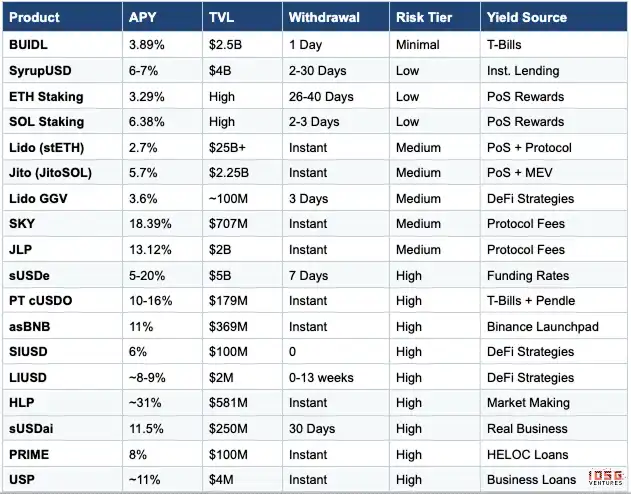
▲ Source: IOSG; Data as of November 2025, USP, SIUSD, LIUSD data as of January 2026
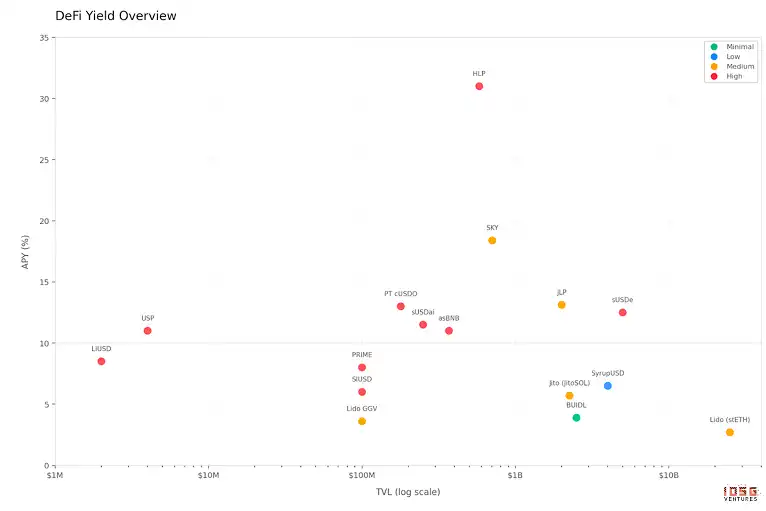
▲ Source: Surf
Yield Models
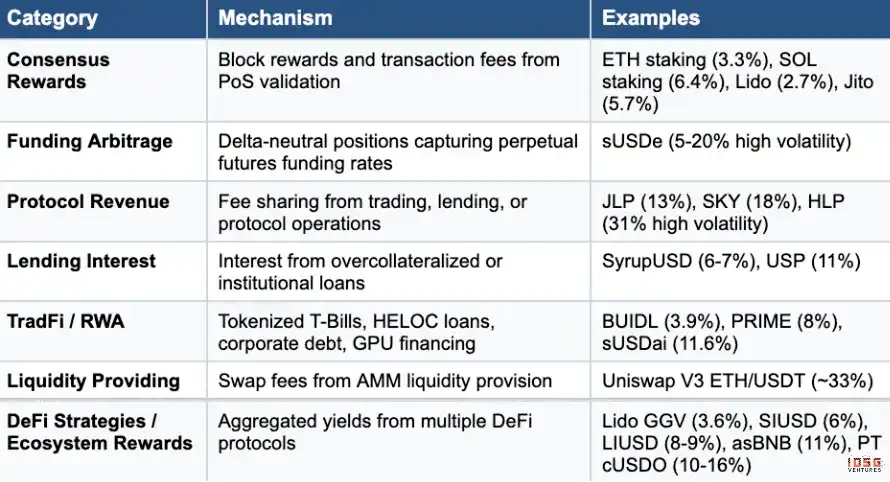
On-chain yields have eight different mechanisms, each with different returns, risks, and sensitivity to market influences:
Consensus rewards (ETH/SOL staking, LST) provide stable, protocol-level guaranteed yields. Funding rate arbitrage and protocol revenue are affected by market cycles, strong in bull markets and compressed in bear markets. Lending and RWA yields introduce counterparty risk but are relatively stable. LP can capture transaction fees. DeFi strategies and ecosystem incentives aggregate yields from multiple protocols, but also carry smart contract risks.
Risk Stratification
Products mainly have risks in the following four dimensions:
-
Protocol risk: Technical risks, including smart contract risk
-
Counterparty risk: Dependence on centralized entities or off-chain participants Market
-
Strategy risk: Exposure to asset price volatility or strategy issues
-
Liquidity risk: TVL depth and withdrawal mechanisms
The extremely low-risk layer includes tokenized treasuries and mature lending. Low-risk products like native staking and liquid staking derivatives introduce smart contract risk, but their code is very mature, so this risk is low. Medium-risk products increase protocol complexity through DeFi strategy aggregation or protocol revenue sharing, while also facing token price volatility and yield fluctuation risks. High-risk products present multiple overlapping risks: funding rate strategies face reduced yields in bear markets, market making Vaults face market manipulation risks, and emerging RWA protocols introduce third-party participants, leading to issues of opacity and limited liquidity.
Key Conclusions and the Future of On-Chain Yields
Stablecoin-based/Relatively Fixed-Rate Products are the Preferred Choice in Bear Markets
We conducted an in-depth analysis of the TVL and APY performance of different yield products in bull and bear markets. Selected stETH (staking), JitoSOL (staking), sUSDS (lending), WETH/USDT (Uniswap DEX LP), SyrupUSDC (Maple lending), and sUSDE (Ethena funding rate strategy) as representatives of different yield products. The bull market was approximately from June to October, after which the market turned bearish.
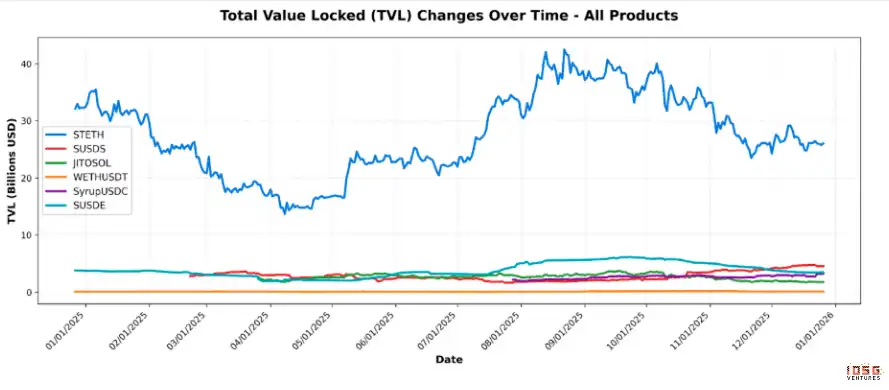
▲ Source: DeFiLlama
Looking at TVL data, the TVL of all products increased during the bull market. But in the bear market, the TVL of stETH, sUSDE, and JitoSOL decreased, while the TVL of sUSDS and SyrupUSDC increased.
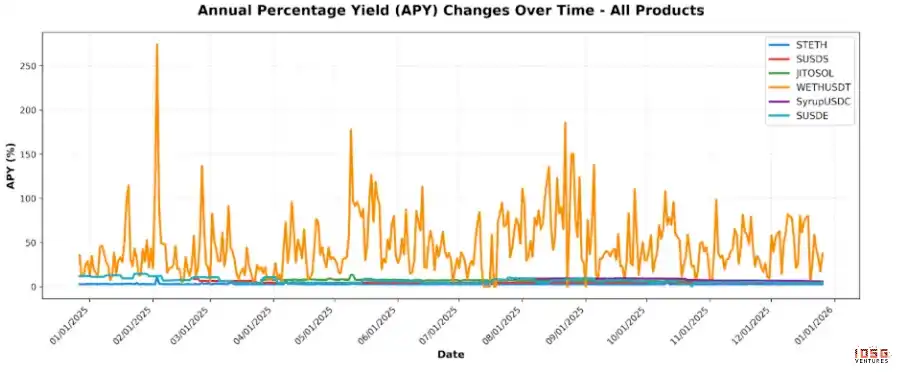
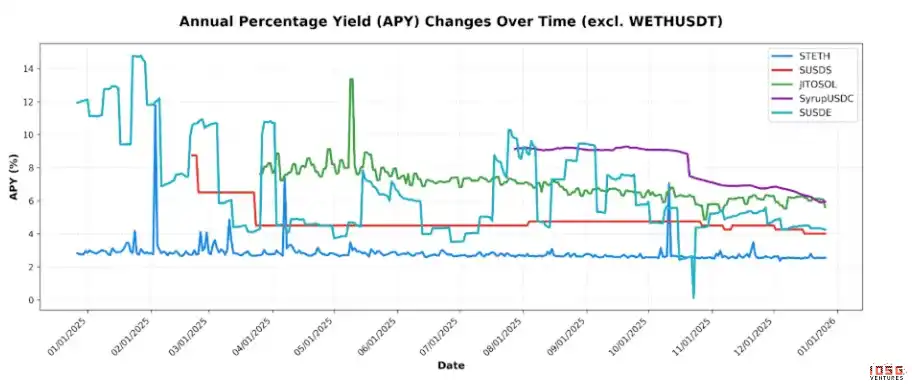
▲ Source: DeFiLlama
The APY of the WETH/USDT pool and stETH was relatively stable across different market environments. The APY of JitoSOL, SyrupUSDC, sUSDE, and sUSDS all decreased, with sUSDE and SyrupUSDC seeing significant drops. The chart also shows that products with higher APY also have higher volatility. The APY of sUSDS is more governance-driven than market-driven, so it remained stable most of the time.
Overall, stablecoin-based yield products will attract more attention and have higher liquidity in bear markets. Yield products not backed by stablecoins will experience TVL declines in bear markets due to falling prices of underlying assets. Investors also tend to prefer more stable yields and lower underlying risks, which also drives the growth of yield-bearing stablecoin TVL.
In bear markets, relatively fixed-rate products are a more reasonable choice. Although sUSDS is not market-driven, its APY is stable and predictable in the medium term. The APY of sUSDE is too volatile and affected by market conditions, potentially dropping significantly in bear markets, making it not an ideal choice.
This also illustrates that when evaluating on-chain yield opportunities, looking only at APY does not fully reflect potential returns. The underlying asset plays a key role in determining actual performance, especially for products like JLP (an index fund composed of SOL, BTC, ETH), asBNB, and SKY. In these cases, token price volatility often outweighs the APY itself, making asset selection as important as yield. However, some investors can mitigate this risk through hedging strategies, such as shorting an equivalent amount of the underlying asset on CEX or DEX, thereby isolating the underlying asset price volatility and capturing only the yield-bearing income.
Protocols Developing Towards the Front-End and Back-End
In the past, with treasury yields at 4%, stablecoins were an excellent cash flow business. However, yield-bearing stablecoins are products that share almost 100% of the treasury yield with users, which poses some challenges to traditional stablecoins. Since 2024, the market share of yield-bearing stablecoins has been steadily rising. If we look at the supply of the top three native yield stablecoins and the top three non-native yield stablecoins (USDT, USDC, PYUSD, USDe, USDS, USDY), the market share of native yield stablecoins has risen from 0.1% to 7.6%, peaking at 11.5%.
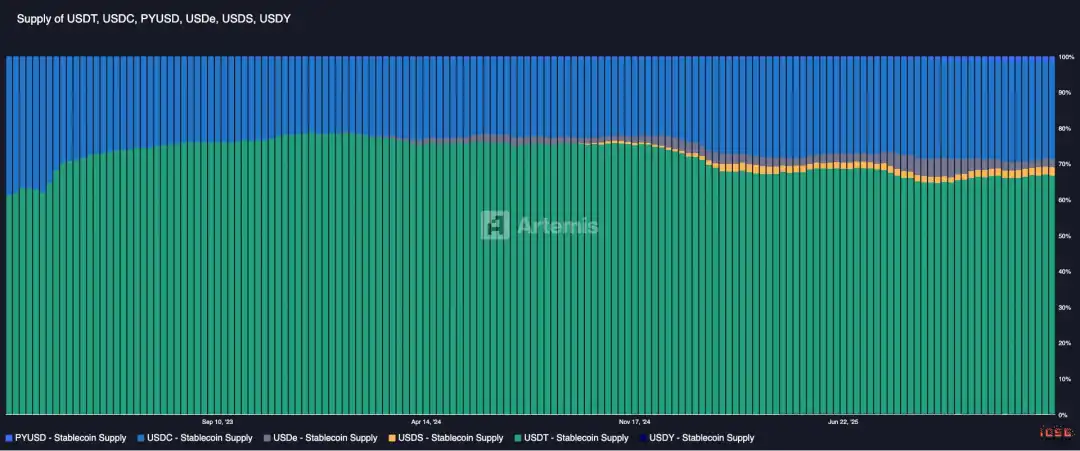
▲ Source: Artemis
This is why many DeFi protocols are starting to control traffic entry points and try to build their own distribution channels. Many large DeFi protocols are building their own wallets or mobile applications to control the entry point.
This also shows a trend: the crypto industry is entering the application era. Retail users can access financial services through mobile applications, which is a more convenient way for Web2 users to enter Web3. These applications can also provide seedless services to lower the learning threshold.
The demand from L1 and DeFi projects for their own stablecoins will be an important catalyst for the future growth of yield-bearing protocols. Yield-bearing protocols may also be pushed towards a "back-end" model.
Given the current stablecoin supply situation, if all L1 blockchains deploy their own stablecoins instead of relying on USDT or USDC, their revenue could double or triple. This is a great incentive for project parties. This trend is already clear, MegaETH, Jupiter, Hyperliquid, BNB are all creating their own stablecoins, which will bring huge demand to yield-bearing protocols.
Ethena has already seen this trend. They offer Stablecoin-as-a-Service, bringing treasury yields to these projects. Protocols and chains can generate substantial stable revenue streams by deploying their own stablecoins.

▲ Source: DeFiLlama
Interest Rate Cuts, Declining Treasury Yields, and the Rise of Alternative RWA Yield Sources
Influenced by US monetary policy, the on-chain yield landscape will also change.
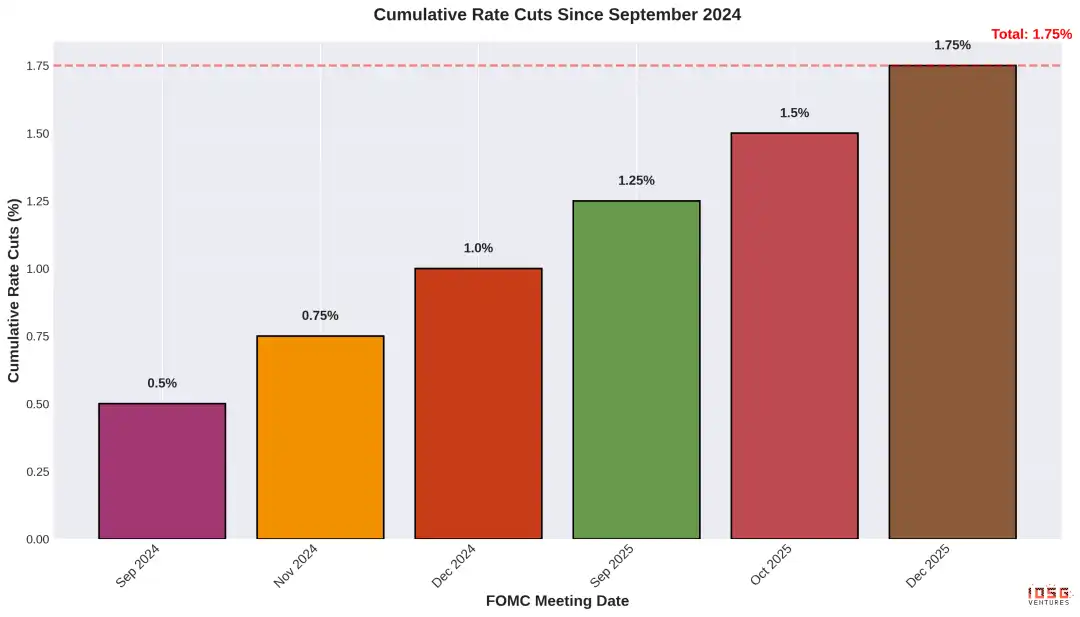
▲ Source: FOMC
President Trump nominated Kevin Warsh to succeed Powell as Fed Chair. If approved, the handover is expected to be completed in May 2026.
The nomination of the new Fed Chair is expected to accelerate the pace of interest rate cuts, leading to a decline in US Treasury (T-Bill) yields.

▲ Source: FOMC participants’ assessments of appropriate monetary policy: Midpoint of target range or target level for the federal funds rate; Dec 10th 2025
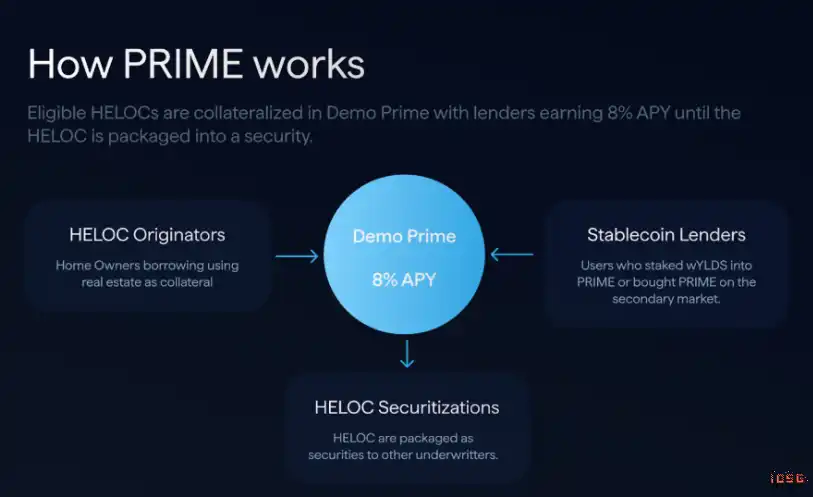
This will prompt stablecoins to incorporate a wider range of RWA assets into their underlying assets, thereby making their underlying assets more diversified. Figure's PRIME is a typical case of on-chaining HELOC yields. HELOC (Home Equity Line of Credit) is a loan that allows homeowners to borrow, spend, and repay on demand using their home as collateral. PRIME token holders provide funding for HELOC loans, with a fixed yield of 8%.
▲ Source: Kamino
Another category is on-chaining real-world businesses as yield sources. USDai is a way to on-chain GPU financing. The yield source for USDai is loan repayments from borrowers, specifically, monthly repayments from GPU infrastructure operators who obtain financing by collateralizing GPU hardware.
Private credit is also gaining attention, which is another attractive APY solid yield source. Projects like Craftt and Pareto allow on-chain users to earn yields by lending assets to institutions and companies. This type of yield also has solid real-world business support.
These examples show that real-world businesses and financial products can be solid sources of yield. Even if the front-end is relatively weak, this can be a special advantage for a yield-bearing protocol.
Crypto-native yield sources are also becoming increasingly important in a competitive market. Products offering exclusive yield streams have special value. For example, asBNB provides exposure to Binance Launchpad yields, a yield source only available within the BSC ecosystem.
Similarly, when revenue-sharing models are supported by transparent revenue fundamentals, such models are very attractive. The success of JLP and HLP shows that users are willing to put funds into products that directly share real protocol revenue.
Institutional Adoption of On-Chain Yields: End-to-End Services & Crypto Credit Products (Preferred Shares)
With the wave of institutional adoption, many institutions may try to capture on-chain yields or crypto收入. The key is to provide end-to-end services.
End-to-End Services from DeFi Protocols
For example, Ether.fi provides institutional staking services, with the core being end-to-end asset management. They offer both non-custodial and custodial staking options, and also provide a "white-glove" service, which is an end-to-end staking service offering a controlled environment including annual audits, KYC compliance, and monthly statements. This ETH fund is also a CIMA registered fund. On top of staking, institutions can also participate in DeFi lending and fixed income from other protocols.
Preferred shares are a kind of "Treasury" based on Crypto, an important way to distribute crypto yields to institutions
DAT's preferred shares are actually underestimated as a way for institutions to obtain on-chain yields. Essentially, this is a credit debt asset based on Crypto, similar to treasury bonds. Treasury bonds are a debt created based on national credit and capability, while DAT companies have created a credit market based on Crypto assets, and preferred shares are a credit debt product created based on this credit market. Preferred shares provide crypto yields to traditional institutions through dividends. There are two main types of yields: long-term CAGR and DeFi yields including staking.
Strategy's STRC offers an 11.5% annualized dividend, payable monthly in cash, tradable on most major brokerage platforms. Strategy's foundation lies in Bitcoin's CAGR. Its assumption is that BTC is an anti-inflation asset and believes the real inflation rate is about 8%. STRF and other similar preferred share products like STRD and STRK bring the anti-inflation portion of the yield to investors. Investors can also choose STRK with an 8% yield, with the opportunity to convert to MSTR to capture more Bitcoin upside.
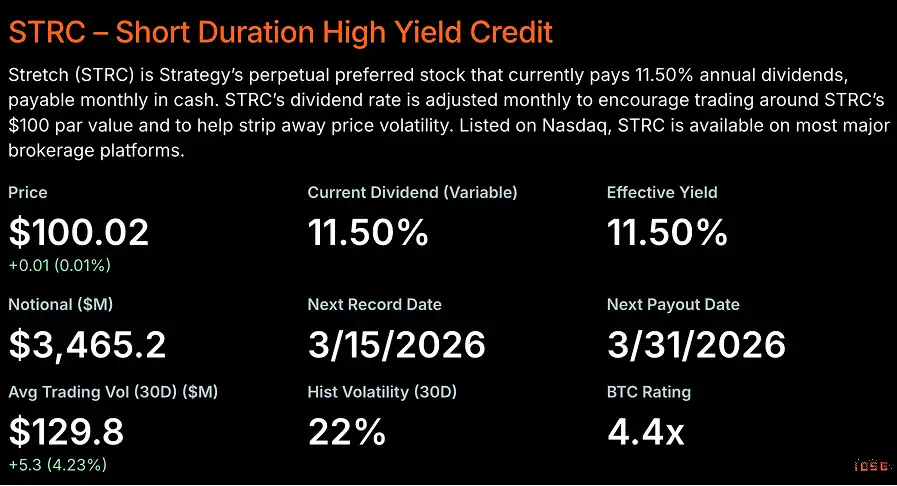
▲ Base information about STRC; Source: Strategy
Traditional finance has similar anti-inflation products, such as TIPS (Treasury Inflation-Protected Securities) issued by the government. TIPS rise with inflation and fall with deflation. They use the CPI (Consumer Price Index)统计 by the U.S. Bureau of Labor Statistics to adjust TIPS. Although the TIPS interest rate is lower than the inflation rate (2.7%), this is the real yield after deducting inflation because the principal is adjusted according to the inflation rate, and the real yield is about 4%.
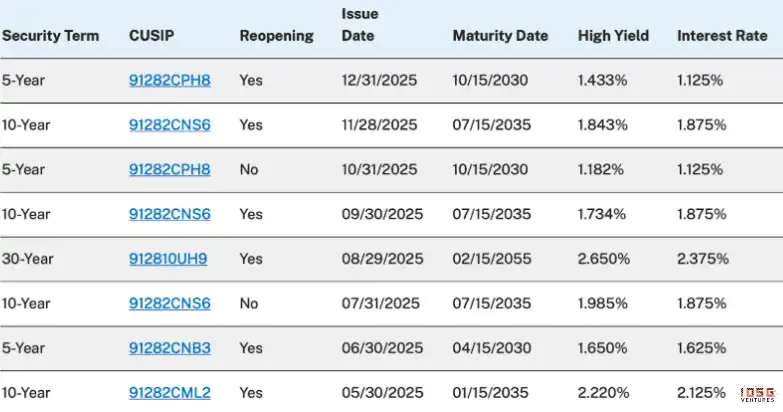
▲ Interest rate of TIPS; Source: Treasurydirect.gov
Interestingly, stablecoin projects like Saturn Labs are on-chaining DAT's stable yield as a yield source for stablecoins. In the digital asset era and the Fed's rate-cutting cycle, this could be an on-chain treasury alternative.
Preferred share dividends can also be a way to distribute aggregated on-chain yields to stock investors. Solana DAT Forward Industries stakes almost its entire SOL holdings (over 6.87 million SOL), obtaining about 7% staking yield. They also convert about 25% of SOL to fwdSOL (LST) for greater DeFi liquidity and yield opportunities. Although they have not yet announced that these yields will be distributed to investors via preferred shares, they have the ability to provide about 7% yield and utilize on-chain protocols to generate higher yields. DeFi Development Company offers Series C Perpetual Preferred Shares with an annual dividend rate of 10%. Based on current on-chain yield rates and SOL staking rates, they can afford these dividends.